Ekanika
Ekanika (एकनिका) is a Sanskrit-origin Hindu girl-name meaning “Singular, unique”. Find pronunciation, origin, deity association, popularity and similar Hindu baby names.
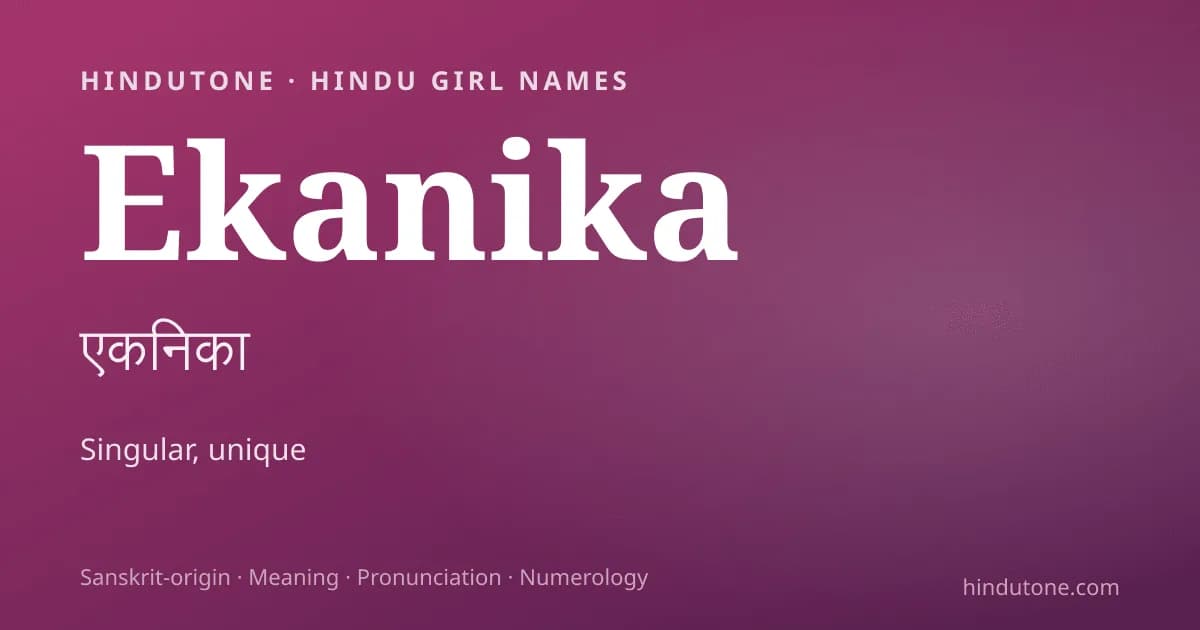
Ekanika (एकनिका) is a Sanskrit-origin Hindu girl-name meaning “Singular, unique”. Find pronunciation, origin, deity association, popularity and similar Hindu baby names.
Ekanika (एकनिका) is a Sanskrit-origin Hindu girl-name meaning “Singular, unique”. This guide covers Ekanika’s meaning, origin, pronunciation, deity association, popularity and similar names — useful for Hindu families in India, USA, UK, Canada and Australia choosing a meaningful baby name.
What does Ekanika mean?
Ekanika (एकनिका) is a Hindu girl-name meaning Singular, unique. The Sanskrit root carries depth and sacred resonance, making this name a meaningful choice rooted in dharmic tradition.
Origin & Sanskrit form
The Sanskrit form of Ekanika is एकनिका, drawn from the rich Sanskrit lexicon. Its phonetics translate naturally across South Asian languages — Hindi, Tamil, Telugu, Bengali, Marathi, Kannada and Malayalam — preserving its devotional weight in every script.
Pronunciation & spelling variants
Ekanika is pronounced phonetically in Sanskrit. Common Roman-script spellings include Ekanika and minor regional variants. NRI families often retain the Sanskrit spelling for cultural authenticity while choosing a phonetic Roman version that English speakers can pronounce easily.
Popularity in 2026
Ekanika has steady appeal among Hindu families in India and across the diaspora. It balances tradition with modern phonetic ease, and its Sanskrit roots resonate with parents seeking a name that carries cultural depth without sounding archaic.
Similar Hindu girl names
Explore the full A–Z directory of Hindu girl names on HinduTone — organised by letter, by deity, by nakshatra, and by rashi — to find the perfect name with the right meaning, sound, and astrological fit for your child.
The meaning and Sanskrit roots of Ekanika
Ekanika (एकनिका) is a Sanskrit-origin Hindu girl-name meaning “singular, unique.” Its heart is the root eka, one of the most profound words in Sanskrit — the number one, but also oneness, singularity and the indivisible. From eka come ideas of that which stands alone, complete and unmatched.
The graceful ending -ika turns this idea into a soft, feminine name, giving “the one and only” a warm and personal touch. Ekanika thus means far more than a numeral; it speaks of a person who is distinct, whole in herself and quietly incomparable — one of a kind.
Ekanika in Hindu culture and tradition
The concept of eka lies at the very centre of Hindu thought. The Vedas famously declare “ekam sat” — truth is one — and the philosophy of Advaita rests on the oneness of all existence. Oneness is not loneliness here but unity, the single reality behind the countless forms of the world.
To name a daughter Ekanika is therefore to touch this sacred idea of the singular. It suggests a child who is complete in herself, whose worth does not depend on comparison, and who mirrors, however gently, the philosophical beauty of the One from which all arises. It is a name of quiet spiritual dignity.
The spirit of the name Ekanika
Ekanika carries the spirit of individuality and inner completeness. It suits a girl imagined as distinctive and self-possessed — someone who charts her own path, secure in who she is. Melodic and rare, the name itself feels as unique as its meaning.
- Distinctive and one of a kind
- Self-assured and complete in herself
- Independent yet centred
- Rooted in the noble idea of oneness
Names similar to Ekanika
Those charmed by Ekanika may also like other eka-rooted names such as Eka, Ekta (unity), Ekanshi and Ekaja, or names of uniqueness and rarity like Advika (one of a kind), Anokhi and Nishtha. Each shares Ekanika’s theme of singular identity and quiet, complete selfhood.
Frequently Asked Questions
What does the name Ekanika mean?
Ekanika ( एकनिका ) is a Sanskrit-origin Hindu girl-name meaning “Singular, unique” . This guide covers Ekanika’s meaning, origin, pronunciation, deity association, popularity and similar names — useful for Hindu families in India, USA, UK, Canada and Australia choosing a meaningful baby name.
Is Ekanika a good Hindu baby name?
Yes — it is a traditional Hindu name with an auspicious meaning, suitable for a baby and rooted in Sanatana Dharma values.
What is the origin of the name Ekanika?
It has Sanskrit/Hindu origins; its roots, deity association and significance are detailed above.
Are there variations or similar names to Ekanika?
Related and similarly-themed Hindu names, along with their meanings, are listed in the guide above to help you choose.
Ekanika — Name Facts
- Meaning
- Singular, unique
- Gender
- Hindu girl name
- Nakshatra
- Krittika
- Rashi
- Vrishabha (Taurus)
- Numerology
- 8
Frequently asked questions
What does the name Ekanika mean?
Ekanika is a Sanskrit-origin Hindu girl name meaning “Singular, unique”.
Is Ekanika a boy or girl name?
Ekanika is traditionally a Hindu girl name.
Which nakshatra and rashi suit the name Ekanika?
By the first-syllable rule of Vedic naming, Ekanika aligns with the Krittika nakshatra, under the Vrishabha (Taurus) rashi.
What is the numerology number of Ekanika?
The Chaldean name number of Ekanika is 8.
Explore more: Krittika nakshatra names · Vrishabha rashi names · Hindu girl names with E · All Hindu names A–Z
Deepen the naming journey
Choosing a name is one step. Continue with:
- Find your child’s nakshatra from today’s panchangam — verify the Krittika assignment against your birth chart.
- Hindu gods & goddesses — the pantheon behind Hindu names — Vishnu, Shiva, Devi, and the deities most Hindu names honour.
- Slokas & mantras for the family altar — chant ashtottaras and daily prayers as your child grows.
- The Namakaranam ceremony — 11th-day naming ritual — samskara vidhi, prasadam, and family customs.
- Auspicious Hindu festivals & naming muhurats — best tithis in 2026 for a namakarana ceremony.
- Temple for the first darshan — take the newborn to the family deity temple within 40 days.
- Hinduism guide for young parents — samskaras, dharma, and raising children in the tradition.