Kanthadhaahkatiparyantamadhyakuutasvarupini
Kanthadhaahkatiparyantamadhyakuutasvarupini (कण्ठाधःकटिपर्यन्तमध्यकूटस्वरूपिणी) is a Sanskrit-origin Hindu girl-name meaning “Whose middle body from throat to waist is the Madhya Kuta”. Find pronunciation, origin, deity association, popularity and similar Hindu baby names.
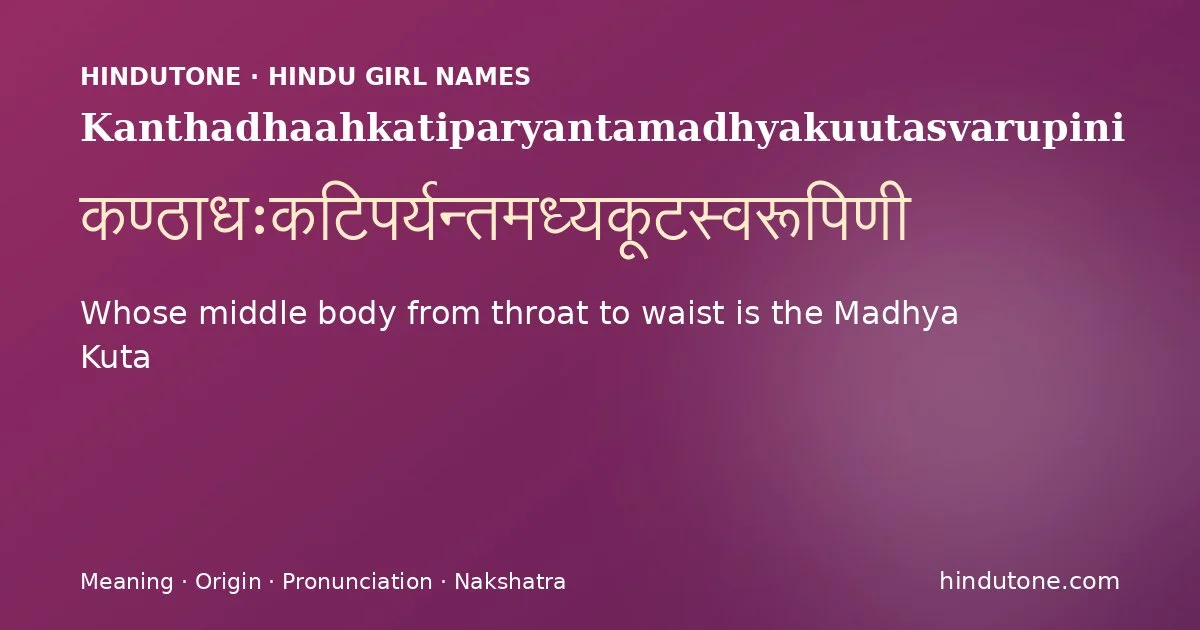
Kanthadhaahkatiparyantamadhyakuutasvarupini (कण्ठाधःकटिपर्यन्तमध्यकूटस्वरूपिणी) is a Sanskrit-origin Hindu girl-name meaning “Whose middle body from throat to waist is the Madhya Kuta”. Find pronunciation, origin, deity association, popularity and similar Hindu baby names.
Kanthadhaahkatiparyantamadhyakuutasvarupini (कण्ठाधःकटिपर्यन्तमध्यकूटस्वरूपिणी, IAST: Kaṇṭhādhaḥkaṭiparyantamadhyakūṭasvarūpiṇī) is a Sanskrit-origin Hindu girl-name meaning “Whose middle body from throat to waist is the Madhya Kuta”. The Goddess embodies the Madhya Kūṭa — the central syllabic group of the Śrī Vidyā mantra — in the region of Her divine form spanning from below the throat down to the waist, a sacred correspondence that transforms Her body into a living, breathing yantra of cosmic sound.
Meaning, etymology & significance
Kaṇṭha means throat, adhaḥ means below, kaṭi means waist, paryanta means up to or until, madhya means middle, kūṭa is a peak or cluster of mantra-syllables, and svarūpiṇī means one who is of that very form. In the Śrī Vidyā system, the Pañcadaśākṣarī mantra's three kūṭas map onto the Devī's body: Vāgbhava on the face, Kāmarāja (Madhya Kūṭa) from throat to waist, and Śakti Kūṭa below the waist. Each repetition of the mantra is thus a meditation on Her complete divine body as the living scripture.
This name is chanted in Śrī Cakra navāvaraṇa pūjā as part of the sequential meditation on the Devī's form and its correspondence with the Mahā Mantra. As a purely descriptive anatomical-mantra compound, it is not usable as a given name; Madhyakūṭā or simply Kūṭā are noted as possible poetic distillations.
Scriptural source
Kanthadhaahkatiparyantamadhyakuutasvarupini appears in the Lalitha Sahasranama, among the sacred names of Lalitha.
Astrology — nakshatra, rashi & numerology
By the standard Vedic correspondence between a name’s first syllable and the lunar mansion, Kanthadhaahkatiparyantamadhyakuutasvarupini aligns with the Mrigashira nakshatra, under the Mithuna rashi (Moon sign). Its Chaldean name-number is 7.
Kanthadhaahkatiparyantamadhyakuutasvarupini — Name Facts
- Meaning
- Whose middle body from throat to waist is the Madhya Kuta
- Gender
- Hindu girl name
- Nakshatra
- Mrigashira
- Rashi
- Mithuna (Gemini)
- Numerology
- 7
Frequently asked questions
What does the name Kanthadhaahkatiparyantamadhyakuutasvarupini mean?
Kanthadhaahkatiparyantamadhyakuutasvarupini is a Sanskrit-origin Hindu girl name meaning “Whose middle body from throat to waist is the Madhya Kuta”.
Is Kanthadhaahkatiparyantamadhyakuutasvarupini a boy or girl name?
Kanthadhaahkatiparyantamadhyakuutasvarupini is traditionally a Hindu girl name.
Which nakshatra and rashi suit the name Kanthadhaahkatiparyantamadhyakuutasvarupini?
By the first-syllable rule of Vedic naming, Kanthadhaahkatiparyantamadhyakuutasvarupini aligns with the Mrigashira nakshatra, under the Mithuna (Gemini) rashi.
What is the numerology number of Kanthadhaahkatiparyantamadhyakuutasvarupini?
The Chaldean name number of Kanthadhaahkatiparyantamadhyakuutasvarupini is 7.
Explore more: Mrigashira nakshatra names · Mithuna rashi names · Hindu girl names with K · All Hindu names A–Z