Līlāvigrahadhāriṇī
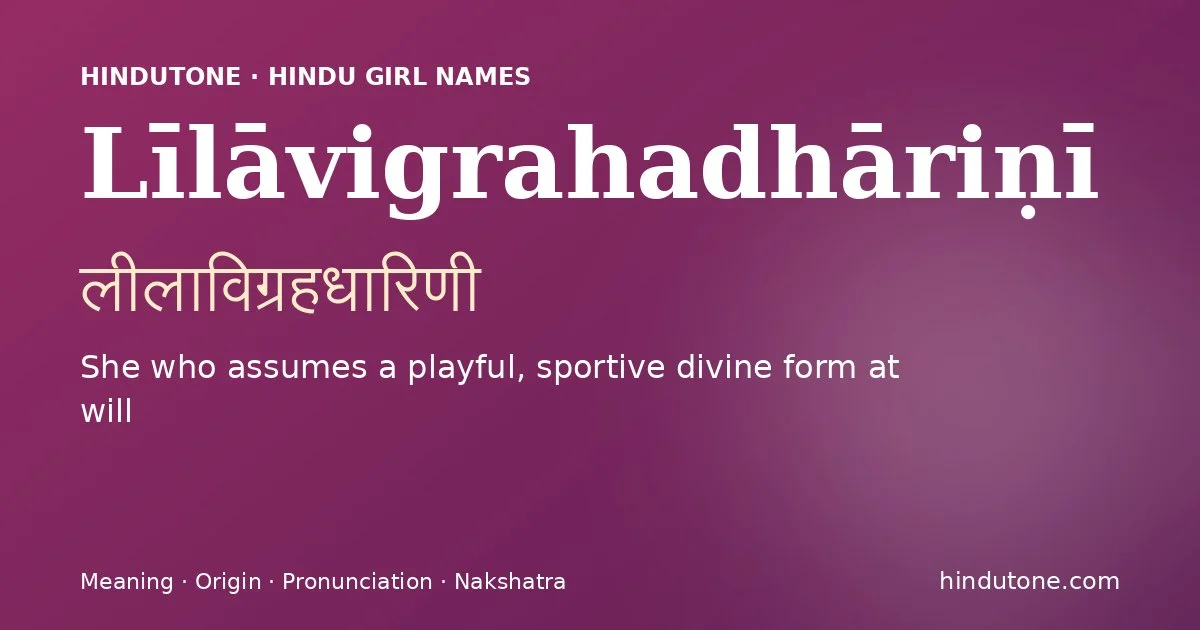
Līlāvigrahadhāriṇī (लीलाविग्रहधारिणी) is a Sanskrit-origin Hindu girl-name meaning “She who assumes a playful, sportive divine form at will”. Find pronunciation, origin, deity association, popularity and similar Hindu baby names.
Līlāvigrahadhāriṇī (लीलाविग्रहधारिणी) is a Sanskrit-origin Hindu girl-name meaning “She who assumes a playful, sportive divine form at will”. Find pronunciation, origin, deity association, popularity and similar Hindu baby names.
Līlāvigrahadhāriṇī (लीलाविग्रहधारिणी, IAST: Līlāvigrahadhāriṇī) is a Sanskrit-origin Hindu girl-name meaning “She who assumes a playful, sportive divine form at will”. From līlā (divine play), vigraha (embodied form), and dhāriṇī (bearer, wearer of), this name reveals that Lalitā's very manifestation is not compelled but freely chosen — a spontaneous, joyful act of cosmic play.
Meaning, etymology & significance
Līlā is the Sanskrit concept of the divine's effortless, purposeless sport — creation undertaken not from necessity but from sheer creative bliss. Vigraha is the manifest, embodied form in which the formless chooses to be perceived, and dhāriṇī means one who bears or assumes. Lalitā thus takes on her luminous body as a dancer dons a costume — freely, joyfully, and with matchless grace.
This epithet is beloved in Vaiṣṇava and Śākta traditions alike, affirming that divinity is never burdened by embodiment but delights in it. Pronounced lee-laa-vig-rah-hah-dhaa-ri-nee, the name is a worthy choice for a girl, though 'Līlā' or 'Vigrahadhāriṇī' are simpler extractions.
Scriptural source
Līlāvigrahadhāriṇī appears in the Lalitha Sahasranama, among the sacred names of Lalitha.
Līlāvigrahadhāriṇī — Name Facts
- Meaning
- She who assumes a playful, sportive divine form at will
- Gender
- Hindu girl name
- Nakshatra
- Bharani
- Rashi
- Mesha (Aries)
- Numerology
- 1
Frequently asked questions
What does the name Līlāvigrahadhāriṇī mean?
Līlāvigrahadhāriṇī is a Sanskrit-origin Hindu girl name meaning “She who assumes a playful, sportive divine form at will”.
Is Līlāvigrahadhāriṇī a boy or girl name?
Līlāvigrahadhāriṇī is traditionally a Hindu girl name.
Which nakshatra and rashi suit the name Līlāvigrahadhāriṇī?
By the first-syllable rule of Vedic naming, Līlāvigrahadhāriṇī aligns with the Bharani nakshatra, under the Mesha (Aries) rashi.
What is the numerology number of Līlāvigrahadhāriṇī?
The Chaldean name number of Līlāvigrahadhāriṇī is 1.
Explore more: Bharani nakshatra names · Mesha rashi names · Hindu girl names with L · All Hindu names A–Z