Manipurantarudita
Manipurantarudita (मणिपूरान्तरुदिता) is a Sanskrit-origin Hindu girl-name meaning “She who has risen within the Maṇipūra cakra”. Find pronunciation, origin, deity association, popularity and similar Hindu baby names.
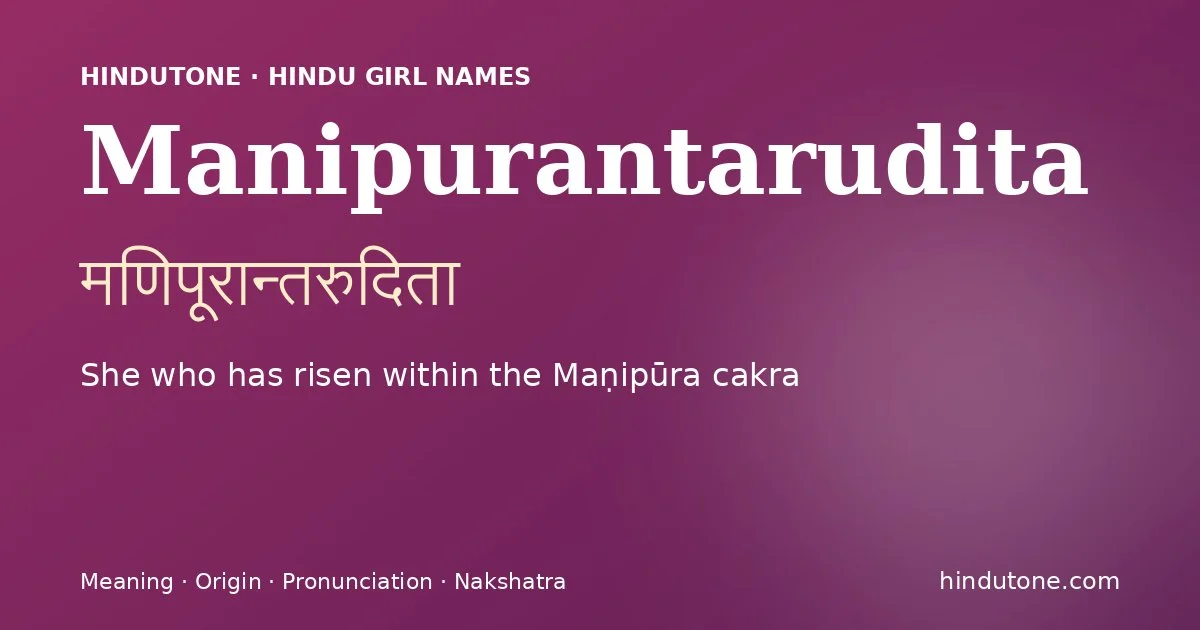
Manipurantarudita (मणिपूरान्तरुदिता) is a Sanskrit-origin Hindu girl-name meaning “She who has risen within the Maṇipūra cakra”. Find pronunciation, origin, deity association, popularity and similar Hindu baby names.
Manipurantarudita (मणिपूरान्तरुदिता, IAST: maṇipūrāntaruditā) is a Sanskrit-origin Hindu girl-name meaning “She who has risen within the Maṇipūra cakra”. Maṇipūra (the jewel-city cakra at the solar plexus), antara (within, in the inner space of), and uditā (she who has risen, awakened, from the root ud + i) paint Lalitā as the Kuṇḍalinī consciousness blazing forth within the third cakra after piercing the Brahmagranthi.
Meaning, etymology & significance
The Maṇipūra cakra, associated with fire, willpower, and luminous self-assertion, is described in Tāntric texts as the city of wish-fulfilling jewels — a realm where dormant vitality is transformed into radiant agency. Uditā, from the verb ud + i (to rise, to be born again, to dawn), beautifully captures the solar quality of this awakening: the Goddess does not merely arrive at Maṇipūra but rises within it like a sun, flooding it with consciousness-light. This name thus carries the exhilarating imagery of inner dawn at the center of the subtle body.
In Kuṇḍalinī sādhanā, the experience of the Goddess's presence in the Maṇipūra is associated with a surge of warmth, confidence, and psychic vitality, and Maṇipūrāntaruditā names her precisely as that dawning presence. As a personal name, Udita (she who has risen) is used independently as a popular and beautiful girl's name in modern India.
Scriptural source
Manipurantarudita appears in the Lalitha Sahasranama, among the sacred names of Lalitha.
Astrology — nakshatra, rashi & numerology
By the standard Vedic correspondence between a name’s first syllable and the lunar mansion, Manipurantarudita aligns with the Magha nakshatra, under the Simha rashi (Moon sign). Its Chaldean name-number is 2.
Manipurantarudita — Name Facts
- Meaning
- She who has risen within the Maṇipūra cakra
- Gender
- Hindu girl name
- Nakshatra
- Magha
- Rashi
- Simha (Leo)
- Numerology
- 2
Frequently asked questions
What does the name Manipurantarudita mean?
Manipurantarudita is a Sanskrit-origin Hindu girl name meaning “She who has risen within the Maṇipūra cakra”.
Is Manipurantarudita a boy or girl name?
Manipurantarudita is traditionally a Hindu girl name.
Which nakshatra and rashi suit the name Manipurantarudita?
By the first-syllable rule of Vedic naming, Manipurantarudita aligns with the Magha nakshatra, under the Simha (Leo) rashi.
What is the numerology number of Manipurantarudita?
The Chaldean name number of Manipurantarudita is 2.
Explore more: Magha nakshatra names · Simha rashi names · Hindu girl names with M · All Hindu names A–Z