Padadvayaprabha-jala-parakrita-saroruha
Padadvayaprabha-jala-parakrita-saroruha (पदद्वयप्रभाजालपराकृतसरोरुहा) is a Sanskrit-origin Hindu girl-name meaning “She whose feet's radiant web surpasses the glory of lotuses”. Find pronunciation, origin, deity association, popularity and similar Hindu baby names.
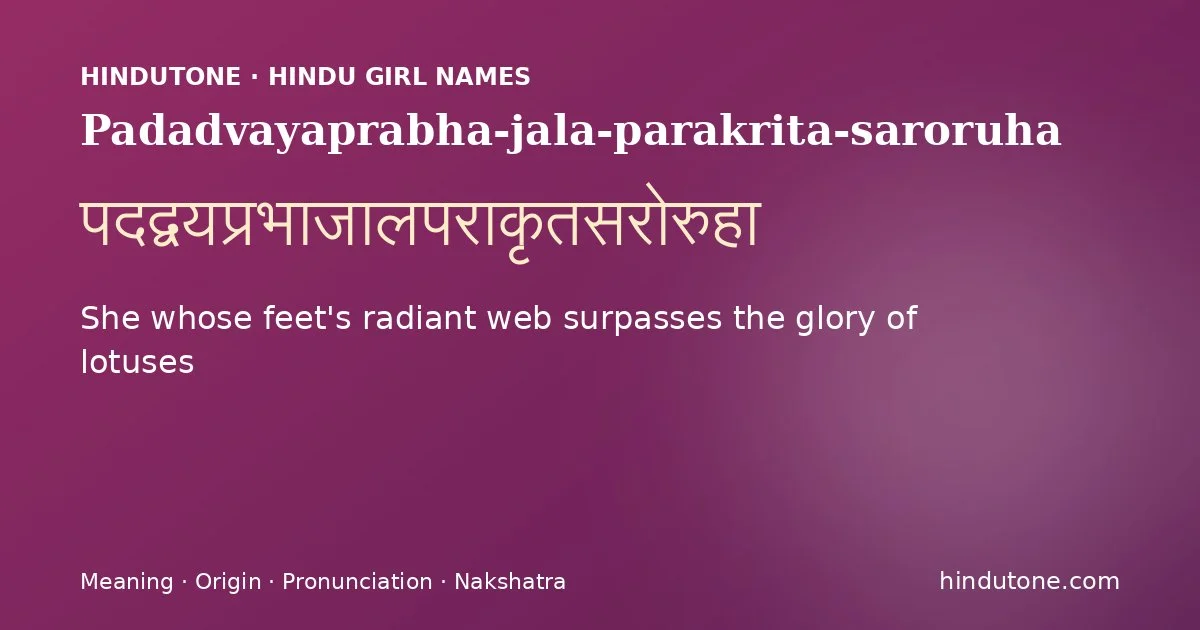
Padadvayaprabha-jala-parakrita-saroruha (पदद्वयप्रभाजालपराकृतसरोरुहा) is a Sanskrit-origin Hindu girl-name meaning “She whose feet's radiant web surpasses the glory of lotuses”. Find pronunciation, origin, deity association, popularity and similar Hindu baby names.
Padadvayaprabha-jala-parakrita-saroruha (पदद्वयप्रभाजालपराकृतसरोरुहा, IAST: Padadvaяprabhājāla-parākṛta-saroruhā) is a Sanskrit-origin Hindu girl-name meaning “She whose feet's radiant web surpasses the glory of lotuses”. Pada-dvaya (the pair of feet), prabhā (radiance), jāla (net, web), parākṛta (surpassing, defeating), and saroruha (lotus, born in a lake) declare that the luminous web of light streaming from the Goddess's two feet outshines the beauty of the lotus itself.
Meaning, etymology & significance
The lotus, saroruha, is the supreme symbol of beauty, purity, and spiritual perfection in the Hindu tradition — it is born in water yet untouched by mud, the seat of Lakṣmī and of Brahmā. To say that the radiance of the Goddess's feet defeats even the lotus is to place Lalitā's grace above the highest symbol of creation. Prabhājāla, the web or network of light, suggests that her feet do not merely shine but cast an interconnected net of luminosity that covers and transcends all natural beauty.
This nāma is a fitting culmination to the section of the Sahasranāma describing the Goddess from head to foot, closing with her feet — the very locus of divine grace and devotee refuge — as superior even to the sacred lotus. Saroruhā (lotus-born) or Prabhā (radiance) are lovely and usable girl's names that carry the light of this epithet.
Scriptural source
Padadvayaprabha-jala-parakrita-saroruha appears in the Lalitha Sahasranama, among the sacred names of Lalitha.
Astrology — nakshatra, rashi & numerology
By the standard Vedic correspondence between a name’s first syllable and the lunar mansion, Padadvayaprabha-jala-parakrita-saroruha aligns with the Uttara phalguni nakshatra, under the Kanya rashi (Moon sign). Its Chaldean name-number is 2.
Padadvayaprabha-jala-parakrita-saroruha — Name Facts
- Meaning
- She whose feet's radiant web surpasses the glory of lotuses
- Gender
- Hindu girl name
- Nakshatra
- Uttara Phalguni
- Rashi
- Kanya (Virgo)
- Numerology
- 2
Frequently asked questions
What does the name Padadvayaprabha-jala-parakrita-saroruha mean?
Padadvayaprabha-jala-parakrita-saroruha is a Sanskrit-origin Hindu girl name meaning “She whose feet's radiant web surpasses the glory of lotuses”.
Is Padadvayaprabha-jala-parakrita-saroruha a boy or girl name?
Padadvayaprabha-jala-parakrita-saroruha is traditionally a Hindu girl name.
Which nakshatra and rashi suit the name Padadvayaprabha-jala-parakrita-saroruha?
By the first-syllable rule of Vedic naming, Padadvayaprabha-jala-parakrita-saroruha aligns with the Uttara Phalguni nakshatra, under the Kanya (Virgo) rashi.
What is the numerology number of Padadvayaprabha-jala-parakrita-saroruha?
The Chaldean name number of Padadvayaprabha-jala-parakrita-saroruha is 2.
Explore more: Uttara Phalguni nakshatra names · Kanya rashi names · Hindu girl names with P · All Hindu names A–Z