Para
Para (परा) is a Sanskrit-origin Hindu girl-name meaning “The supreme, the transcendent, the highest reality”. Find pronunciation, origin, deity association, popularity and similar Hindu baby names.
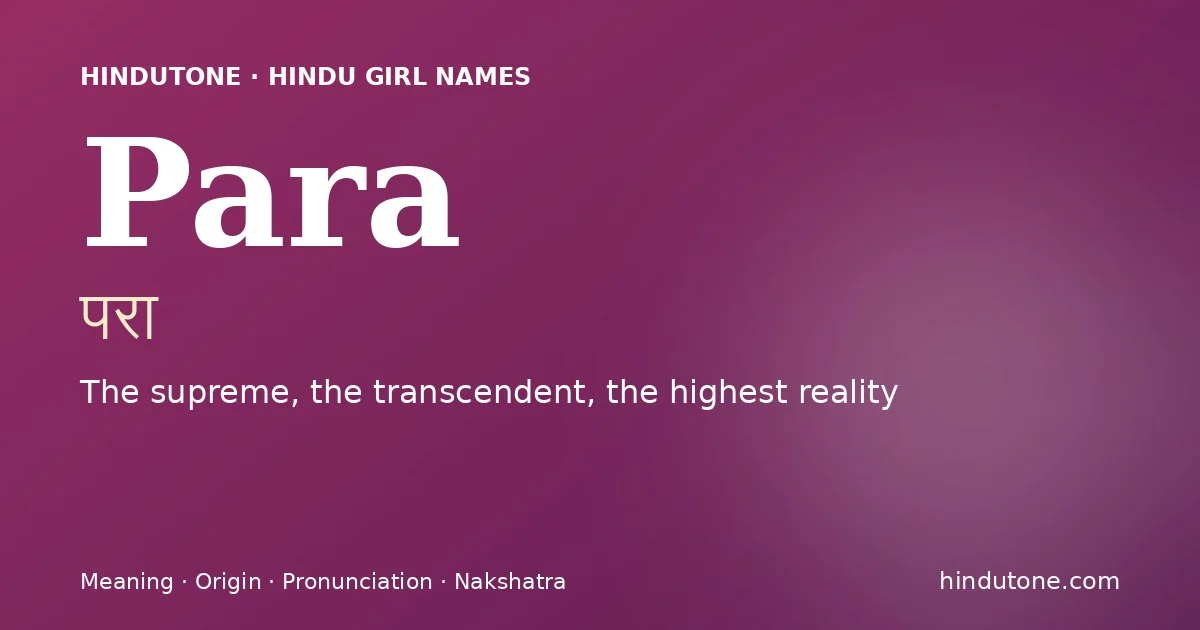
Para (परा) is a Sanskrit-origin Hindu girl-name meaning “The supreme, the transcendent, the highest reality”. Find pronunciation, origin, deity association, popularity and similar Hindu baby names.
Para (परा, IAST: Parā) is a Sanskrit-origin Hindu girl-name meaning “The supreme, the transcendent, the highest reality”. From the Sanskrit para (beyond, supreme, other shore), this single syllable of a name encapsulates the Goddess's absolute transcendence over all manifest and unmanifest creation — she is Parā, the furthest shore of existence that nothing surpasses.
Meaning, etymology & significance
In Śākta tantra, especially in the Trika system of Kashmir, Parā is the first and highest of the four levels of vāk (divine speech): Parā, Paśyantī, Madhyamā, and Vaikharī — a sequence that the Lalitā Sahasranāma traverses across several consecutive names. As Parā, Lalitā is the undifferentiated, transcendent vibration of consciousness-speech that precedes all thought and sound, residing in the mūlādhāra as pure potential. This name is therefore not merely an adjective meaning 'supreme' but a technical designation of the Goddess as the absolute ground of all sonic and cognitive existence.
Parā is an epithet shared by several forms of the Goddess — including Parā Devī and Parā Śakti — and is invoked at the opening of many Śākta stotras; as a given name it is used across India, particularly in Tamil Nadu and Andhra Pradesh, often in the form Parā or Paradevī. Short and euphonious, it is pronounced PA-raa with a long final vowel.
Scriptural source
Para appears in the Lalitha Sahasranama, among the sacred names of Lalitha.
Astrology — nakshatra, rashi & numerology
By the standard Vedic correspondence between a name’s first syllable and the lunar mansion, Para aligns with the Uttara phalguni nakshatra, under the Kanya rashi (Moon sign). Its Chaldean name-number is 3.
Para — Name Facts
- Meaning
- The supreme, the transcendent, the highest reality
- Gender
- Hindu girl name
- Nakshatra
- Uttara Phalguni
- Rashi
- Kanya (Virgo)
- Numerology
- 3
Frequently asked questions
What does the name Para mean?
Para is a Sanskrit-origin Hindu girl name meaning “The supreme, the transcendent, the highest reality”.
Is Para a boy or girl name?
Para is traditionally a Hindu girl name.
Which nakshatra and rashi suit the name Para?
By the first-syllable rule of Vedic naming, Para aligns with the Uttara Phalguni nakshatra, under the Kanya (Virgo) rashi.
What is the numerology number of Para?
The Chaldean name number of Para is 3.
Explore more: Uttara Phalguni nakshatra names · Kanya rashi names · Hindu girl names with P · All Hindu names A–Z