Sakalāgamasandohaśuktisampuṭamauktikā
Sakalāgamasandohaśuktisampuṭamauktikā (सकलागमसन्दोहशुक्तिसम्पुटमौक्तिकā) is a Sanskrit-origin Hindu girl-name meaning “She who is the pearl within the oyster-shell of all Āgamas”. Find pronunciation, origin, deity association, popularity and similar Hindu baby names.
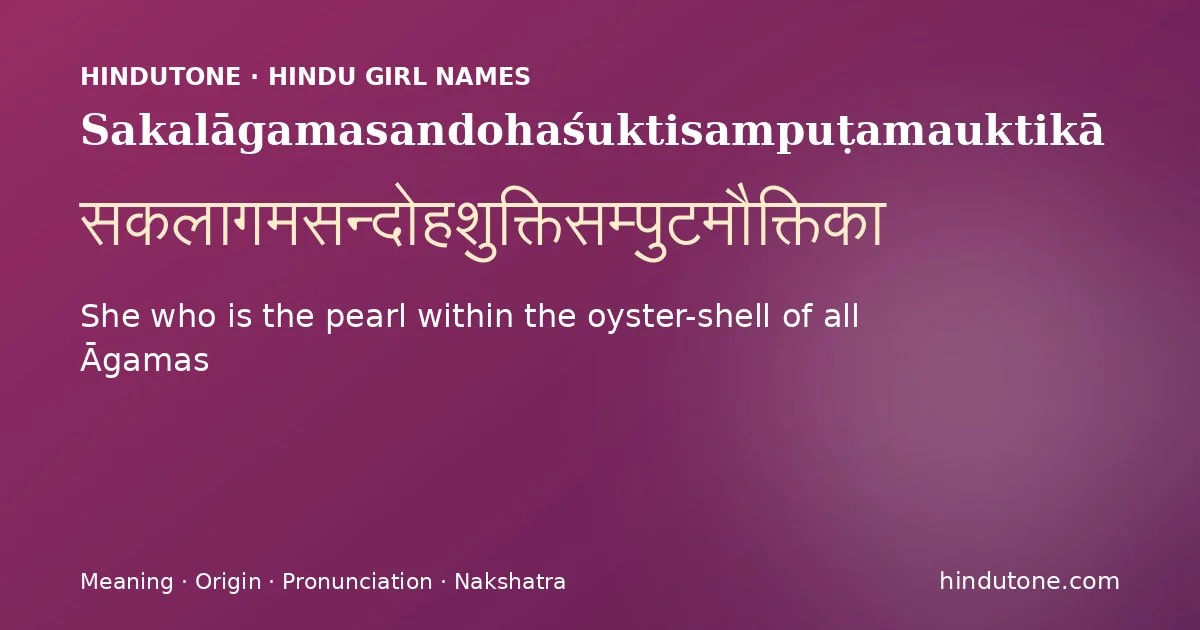
Sakalāgamasandohaśuktisampuṭamauktikā (सकलागमसन्दोहशुक्तिसम्पुटमौक्तिकā) is a Sanskrit-origin Hindu girl-name meaning “She who is the pearl within the oyster-shell of all Āgamas”. Find pronunciation, origin, deity association, popularity and similar Hindu baby names.
Sakalāgamasandohaśuktisampuṭamauktikā (सकलागमसन्दोहशुक्तिसम्पुटमौक्तिकā, IAST: Sakalāgamasandohaśuktisampuṭamauktikā) is a Sanskrit-origin Hindu girl-name meaning “She who is the pearl within the oyster-shell of all Āgamas”. From sakala (all), āgama (sacred tantric/Vedic scriptures), sandoha (collection, abundance), śukti (oyster shell), sampuṭa (a closed casket or paired shells), and mauktikā (pearl), Lalitā is the precious pearl of wisdom enshrined within the vast treasury of all sacred scriptures.
Meaning, etymology & significance
The metaphor is exquisitely crafted: the entire corpus of āgamic scriptures—all tantras, vedas, and sacred traditions—are likened to oyster shells (śukti-sampuṭa), and Lalitā herself is the luminous pearl (mauktikā) hidden within. Sandoha means 'an abundance' or 'collection,' emphasizing the totality of all scriptural revelation. She is thus not merely described by scripture but is the very essence and jewel that scripture exists to reveal.
This epithet from the Lalitā Sahasranāma is too expansive for use as a given name but inspires the shorter devotional name Mauktikā, meaning 'pearl,' which is used as a girl's name in traditional Hindu families. Pronounce mauktikā with the diphthong au and a clear retroflex ṭ.
Scriptural source
Sakalāgamasandohaśuktisampuṭamauktikā appears in the Lalitha Sahasranama, among the sacred names of Lalitha.
Astrology — nakshatra, rashi & numerology
By the standard Vedic correspondence between a name’s first syllable and the lunar mansion, Sakalāgamasandohaśuktisampuṭamauktikā aligns with the Shatabhisha nakshatra, under the Kumbha rashi (Moon sign). Its Chaldean name-number is 2.
Sakalāgamasandohaśuktisampuṭamauktikā — Name Facts
- Meaning
- She who is the pearl within the oyster-shell of all Āgamas
- Gender
- Hindu girl name
- Nakshatra
- Shatabhisha
- Rashi
- Kumbha (Aquarius)
- Numerology
- 2
Frequently asked questions
What does the name Sakalāgamasandohaśuktisampuṭamauktikā mean?
Sakalāgamasandohaśuktisampuṭamauktikā is a Sanskrit-origin Hindu girl name meaning “She who is the pearl within the oyster-shell of all Āgamas”.
Is Sakalāgamasandohaśuktisampuṭamauktikā a boy or girl name?
Sakalāgamasandohaśuktisampuṭamauktikā is traditionally a Hindu girl name.
Which nakshatra and rashi suit the name Sakalāgamasandohaśuktisampuṭamauktikā?
By the first-syllable rule of Vedic naming, Sakalāgamasandohaśuktisampuṭamauktikā aligns with the Shatabhisha nakshatra, under the Kumbha (Aquarius) rashi.
What is the numerology number of Sakalāgamasandohaśuktisampuṭamauktikā?
The Chaldean name number of Sakalāgamasandohaśuktisampuṭamauktikā is 2.
Explore more: Shatabhisha nakshatra names · Kumbha rashi names · Hindu girl names with S · All Hindu names A–Z