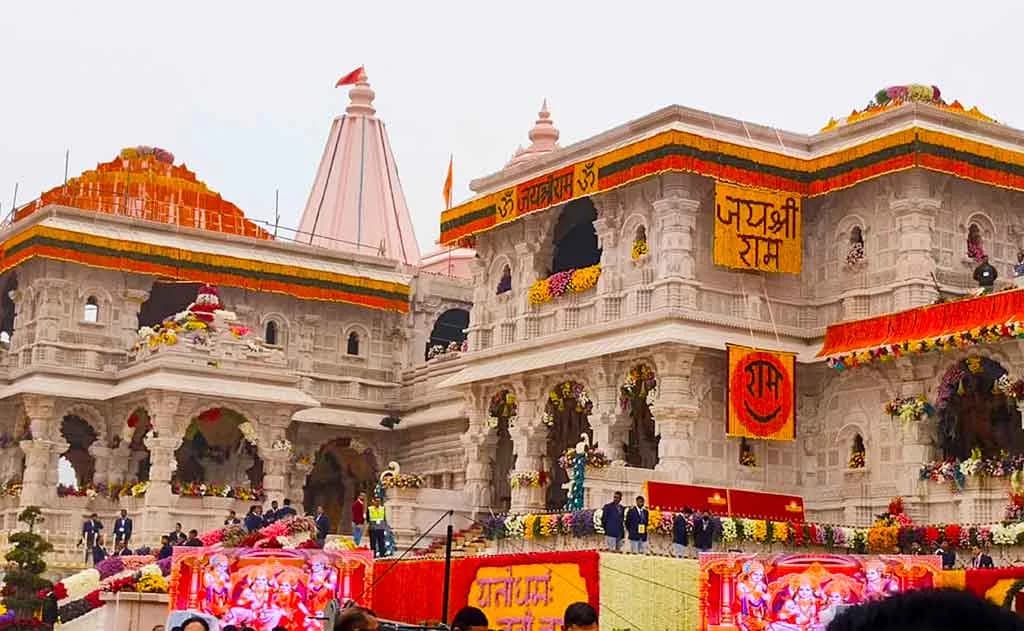
Modi & Mohan Bhagwat Hoist Dharma Dhwaja at Ayodhya Ram Mandir: A Landmark of Civilizational Resurgence
Ayodhya, November 26, 2025 — In a moment etched forever in the spiritual consciousness of Bharat, Prime Minister Narendra Modi and RSS Sarsanghchalak Mohan…
Ayodhya, November 26, 2025 — In a moment etched forever in the spiritual consciousness of Bharat, Prime Minister Narendra Modi and RSS Sarsanghchalak Mohan…
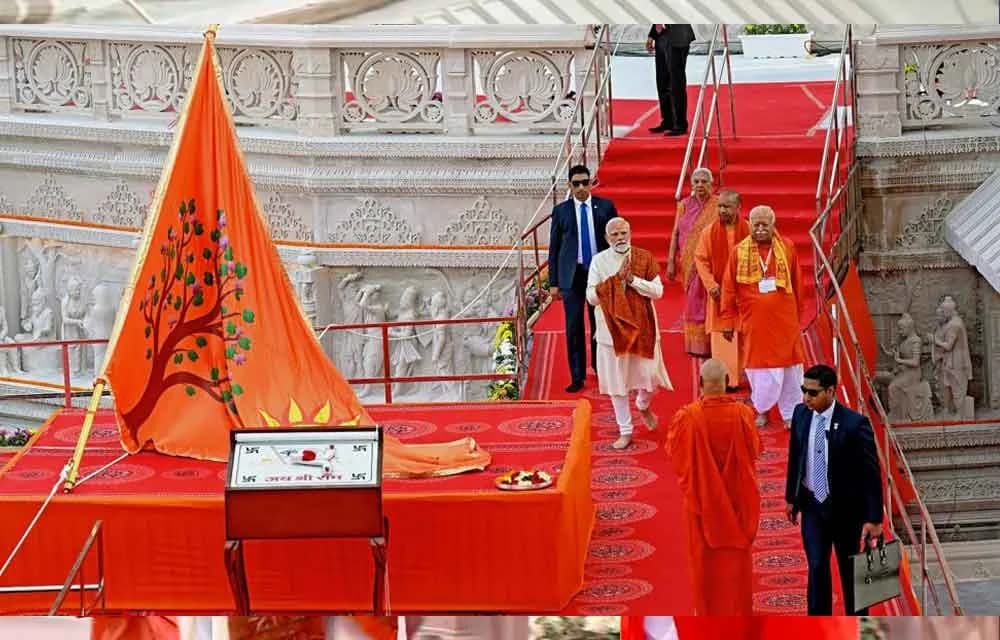
Ayodhya, November 26, 2025 — In a moment etched forever in the spiritual consciousness of Bharat, Prime Minister Narendra Modi and RSS Sarsanghchalak Mohan Bhagwat jointly hoisted the sacred Dharma Dhwaja at the revered Shri Ram Janmabhoomi Mandir during the grand Dharma Dhwajarohan Utsav.
The majestic 10×20-foot saffron Dhwaja, embellished with Lord Ram’s divine Surya emblem, the eternal Om, and the holy Kovidara tree, ascended a towering 42-foot pole amid thunderous chants of “Jai Shri Ram!” and resonant Vedic mantras. This spiritually charged moment comes nearly two years after the historic Pran Pratishtha of Ram Lalla in January 2024.
Key Highlights of the Ceremony
🔱 A Rare and Historic Joint Hoisting
For the first time, PM Modi and Mohan Bhagwat together unfurled the Dharma Dhwaja — a powerful gesture symbolising the harmonious alignment of Bharat’s political leadership and cultural foundation.
🔱 Deep Symbolism of the Dhwaja
The saffron flag embodies the ideals of Ram Rajya — satya (truth), nyaya (justice), daya (compassion), and samriddhi (prosperity).
It represents India’s unbroken civilizational journey from the age of the Ramayana to the modern era.
🔱 PM Modi’s Message to the Nation
In an emotional address, the Prime Minister called the event
“a resounding proclamation of India’s spiritual revival and the dawn of a new era guided by the ideals of Maryada Purushottam Shri Ram.”
🔱 Dignitaries in Attendance
UP Chief Minister Yogi Adityanath, eminent saints from across Bharat, and thousands of devotees witnessed the historic moment in Ayodhya’s divine ambience.
Why This Moment Matters for Bharat
The hoisting of the Dharma Dhwaja is far more than a ceremonial tradition — it is a reaffirmation of Sanatana Dharma, a declaration of Bharat’s cultural self-confidence, and a celebration of identity rooted in timeless values.
As PM Modi expressed:
“This flag is not just cloth on a pole. It is the rising spirit of 140 crore Indians aspiring for a Viksit Bharat inspired by Ram Rajya.”
Across the nation and the world, devotees rejoiced as #DharmaDhwaja, #RamRajya, and #Ayodhya dominated social media trends.
Watch: Modi & Mohan Bhagwat Hoist Dharma Dhwaja at Ram Mandir
(Embed video link when available)
Stay tuned to Hindutone.com for live updates, exclusive images, and detailed coverage of every spiritual milestone from Ayodhya.
Related Keywords
Modi Bhagwat Ayodhya, Dharma Dhwaja Hoisting, Ram Mandir Ayodhya 2025, Dharma Dhwajarohan Utsav, Ram Rajya Revival, Mohan Bhagwat Ram Temple, PM Modi Ayodhya Visit November 2025, Sanatana Dharma Flag
Jai Shri Ram!
🔱 May the Dharma Dhwaja always soar high, guiding Bharat towards eternal glory.
What is the Dharma Dhwaja and What Does Its Symbolism Signify?
The Dharma Dhwaja — literally the 'Flag of Righteousness' — has been an integral symbol in Sanatana Dharma since Vedic antiquity. Temple flags, known as Dhvajas or Pataakas, are mentioned in the Agama Shastras as essential components of temple consecration and daily worship. A raised Dhwaja above a temple signifies the presence of the divine and signals to the devotee from a distance that the Lord resides within, drawing the seeker toward the sacred precinct.
The specific iconography on the Ram Mandir's Dhwaja carries layered meaning. The Surya emblem references Lord Ram's solar lineage — he belongs to the Suryavamsha, or Solar Dynasty, as celebrated in the Valmiki Ramayana's Bala Kanda. The sacred syllable Om (ॐ) is described in the Mandukya Upanishad as the imperishable Brahman encompassing all of existence. The Kovidara tree, a flowering kachnar, holds botanical and ritual significance in ancient Indian texts and is associated with the sacred groves described in Valmiki's depiction of Ayodhya.
Together, these three symbols — solar lineage, primordial sound, and sacred flora — encode an entire civilizational worldview on a single 10×20-foot saffron canvas. Saffron (bhagwa) itself is the colour of the sacrificial flame (Agni), representing renunciation, tapas, and the pursuit of Dharma over personal ambition — qualities that define Ram Rajya as an ideal of governance.
The Dhwajarohan Ritual: Scriptural Roots and Ceremonial Significance
The rite of Dhwajarohan — the formal hoisting of the temple flag — is codified in the Pancharatra and Shaiva Agama traditions as a post-consecration samskara for a newly established or renovated temple. The ceremony typically follows Pran Pratishtha and marks the transition of the temple from a constructed structure to a living, breathing sacred cosmos (brahmanda). The Dhwaja, once raised, is considered an extension of the deity's own presence into the sky.
According to the Vishnu Dharmottara Purana, a temple without a Dhwaja is considered incomplete in its ritual standing. The pole (Dhwajastambha) represents Mount Meru, the cosmic axis, and the flag at its pinnacle symbolises the sovereignty of Dharma over the three worlds. The height of 42 feet for the Dhwajastambha at Ayodhya's Ram Mandir is thus not arbitrary — tall poles are prescribed in the Manasara Shilpashastra and similar texts as befitting the presiding deity's cosmic stature.
The chanting of Vedic mantras during the actual hoisting — particularly from the Rig Vedic hymns addressing Indra's victory banner and from the Purusha Sukta — transforms the physical act into a yagna-like ritual. Each mantra invocation is timed to the raising of the flag so that the cloth ascends simultaneously with the crescendo of sacred sound, creating an integrated sensory and spiritual experience for the assembled devotees.
Ayodhya in Scripture: Why This City Is the Eternal Seat of Ram Rajya
Ayodhya — whose very name derives from the Sanskrit root meaning 'that which cannot be conquered' (a + yodhya) — is described in the Valmiki Ramayana's Bala Kanda as a city of unparalleled grandeur founded by Manu, the progenitor of humanity. It stretched twelve yojanas in length and three yojanas in breadth, adorned with broad streets, fragrant flower gardens, and a treasury overflowing with virtue. The Atharva Veda also contains a reference to Ayodhya as a city of divine construction: 'ashtachakra navadwara devanam puri ayodhya' — the eight-wheeled, nine-gated city of the gods.
The Skanda Purana and the Brahma Purana both list Ayodhya among the Sapta Moksha Puris — the seven cities where liberation (moksha) can be attained by a devotee who dies within their sacred precincts. The others are Mathura, Haridwar, Kashi (Varanasi), Kanchipuram, Ujjain, and Dwarka. This classification places Ayodhya not merely as a historical site but as a cosmic tīrtha — a ford between the mortal and divine planes.
With the Pran Pratishtha of Ram Lalla in January 2024 and now the Dharma Dhwajarohan Utsav of November 2025, Ayodhya is being restored to its scriptural dignity after centuries of disruption. For millions of devotees, these ceremonies are not political events but the fulfilment of a sankalpa — a sacred vow — spanning generations of Hindus who kept the memory of Ram Janmabhoomi alive through prayer, pilgrimage, and sacrifice.
The Political and Cultural Alignment: Rashtra, Dharma, and the Role of Leadership
The joint participation of Prime Minister Modi and RSS Sarsanghchalak Mohan Bhagwat in the Dhwajarohan ceremony carries a deliberate symbolic weight that echoes ancient Indian concepts of Rajadharma. The Shanti Parva of the Mahabharata elaborates extensively on the duty of a ruler to uphold Dharma — a king's legitimacy, according to Bhishma's counsel to Yudhishthira, is derived not from military conquest but from his alignment with cosmic and moral order. A political leader participating in Dharmic ritual is thus not conflating state and religion but expressing the classical Indian understanding that governance must be rooted in eternal values.
The RSS, as Bharat's largest cultural organisation, has long articulated the concept of 'Hindu Rashtra' not as a theocratic state but as a civilizational identity — a distinction Mohan Bhagwat has elaborated on in multiple public addresses. His co-presence with the Prime Minister at the Ram Janmabhoomi signals the convergence of what RSS ideology terms 'Shakti' (state power) and 'Sangathan' (organised society), united under the banner of Dharma. Together, they represent what ancient texts would classify as the Raja and the Dharmacharya working in complementary roles — much as Ram himself embodied both sovereign and sage.
Uttar Pradesh Chief Minister Yogi Adityanath's attendance further underscores a three-tier alignment — national, organisational, and state — all present at the spiritual heart of Bharat. This convergence, rare in modern Indian political life, is being read by many observers as a conscious reinstatement of the idea that temporal authority derives its deeper legitimacy from its service to Sanatana Dharma.
What Comes Next: The Living Temple and the Vision of Ram Rajya
The Shri Ram Janmabhoomi Mandir complex is not yet fully complete. The larger temple precinct, designed in the Nagara architectural style under the guidance of the Shri Ram Janmabhoomi Teerth Kshetra Trust, includes multiple subsidiary shrines, a museum, an archive of the Ram Janmabhoomi movement, pilgrim facilities, and a vast open-air courtyard. The Dharma Dhwajarohan Utsav of November 2025 marks another milestone in this ongoing work of civilizational reconstruction.
Beyond the physical temple, the Ayodhya of 2025 is being transformed into a world-class pilgrimage city — with upgrades to the Ayodhya Dham railway station, new ghats along the Sarayu River, and road connectivity projects linking the city to the broader pilgrim circuit of Varanasi, Prayagraj, and Chitrakoot. This infrastructural renewal mirrors the classical concept of a 'tīrthakshetra' — a sacred geography designed to support the spiritual journey of millions of yatrikas (pilgrims).
The deeper vision being articulated — of Ram Rajya as a governing ideal — draws from Mahatma Gandhi's own invocation of the term as a society founded on truth, fearlessness, and equal dignity for all. Whether one approaches this ideal from a devotional, philosophical, or civic perspective, the hoisting of the Dharma Dhwaja at Ram Janmabhoomi stands as a declaration that Bharat intends to draw from the deepest wells of its own civilizational inheritance as it shapes its future.
Frequently Asked Questions
Where is Modi & Mohan Bhagwat Hoist Dharma Dhwaja at Ayodhya located?
Ayodhya , November 26, 2025 — In a moment etched forever in the spiritual consciousness of Bharat, Prime Minister Narendra Modi and RSS Sarsanghchalak Mohan Bhagwat jointly hoisted the sacred Dharma Dhwaja at the revered Shri Ram Janmabhoomi Mandir during the grand Dharma Dhwajarohan Utsav . The majestic 10×20-foot saffron Dhwaja , embellished with Lord Ram’
Who is the presiding deity of Modi & Mohan Bhagwat Hoist Dharma Dhwaja at Ayodhya?
The presiding deity is Lord Rama.
What are the timings and how do I reach Modi & Mohan Bhagwat Hoist Dharma Dhwaja at Ayodhya?
Temples typically open early morning and evening; confirm current darshan timings before visiting. The nearest airport, railway station and road routes are covered in the guide above.
What is the best time to visit Modi & Mohan Bhagwat Hoist Dharma Dhwaja at Ayodhya?
Major festival days and the cooler months are popular, though weekday mornings offer a calmer darshan. Plan around the temple's key festivals for the most vibrant experience.
You might also like
Shani Deva Temples Worldwide & Must-Performed Rituals — Complete Devotee's Guide
Janmashtami 2026 in India: Date, Rituals & Top Temples to Visit

ISKCON to Serve Pure Sattvik Mid-Day Meals to School Children in Bengal | Suvendu Adhikari Initiative