Varanasi Ropeway Project: Swaying Cabins in Trials Spark Online Debate Over Safety and Costs
Varanasi Ropeway Project: Swaying Cabins in Trials Spark Online Debate Over Safety and Costs India's first public urban ropeway system, known as the Kashi…

Varanasi Ropeway Project: Swaying Cabins in Trials Spark Online Debate Over Safety and Costs India's first public urban ropeway system, known as the Kashi…
Varanasi Ropeway Project: Swaying Cabins in Trials Spark Online Debate Over Safety and Costs
India's first public urban ropeway system, known as the Kashi Ropeway in Varanasi, has become a topic of intense online discussion following viral videos from late 2025 trial runs showing cabins swaying significantly in the wind. The project, costing approximately ₹807–815 crore, aims to connect Varanasi Cantonment Railway Station to Godowlia Chowk (near the Kashi Vishwanath Temple) over a 3.75–3.85 km route with five stations: Cantt, Kashi Vidyapith, Rath Yatra, Girja Ghar, and Godowlia.
The ropeway is designed to reduce travel time from around 45 minutes in heavy traffic to about 16–20 minutes, with a capacity to handle up to 100,000 passengers daily using 148–153 gondola cabins (each holding 8–10 people). Trial runs began in October 2025, and full public operations are expected by May 2026.
Viral Videos and Public Reaction
In early January 2026, videos emerged showing empty cabins swinging like a pendulum during testing, particularly in windy conditions. Social media users reacted with a mix of alarm and humor:
- Some called it a "death trap" or "suicide pendulum," expressing fears for passenger comfort and safety, especially for elderly pilgrims or those prone to motion sickness.
- Jokes included references to a "Khatron Ke Khiladi" (fear factor) experience or dying "every minute out of fear."
- Others raised doubts about the project's high cost, questioning if it was a "waste of money" amid allegations of over-expenditure or corruption.
Netizens were divided: critics highlighted the swaying as a potential hazard in a flat urban area like Varanasi, while supporters noted it's common in ropeway systems worldwide.
Engineering Explanation: Intentional Design for Safety
Experts and informed users explained that the swaying is a deliberate feature in modern monocable detachable gondola (MDG) systems, like those used in Switzerland and the European Alps:
- Cabins are designed to hang freely and absorb wind forces, reducing stress on cables, towers, and the overall structure.
- Rigid cabins could transfer more force to the system, increasing risks in strong winds.
- The ropeway includes advanced safety measures: wind sensors that automatically halt operations if speeds exceed safe limits, multiple redundant brakes, AI-based monitoring, emergency power backups, and compliance with international European standards.
- Technology providers (including Swiss involvement) ensure resilience, though ropeways generally pause in extreme weather.
No official statement directly addressed the January 2026 videos, but authorities have consistently affirmed the system's safety during trials.
Project Background and Benefits
- Foundation laid by Prime Minister Narendra Modi in March 2022.
- Developed by National Highways Logistics Management Limited (NHLML) under the Ministry of Road Transport and Highways.
- Eco-friendly alternative to road expansion in Varanasi's narrow, congested streets, easing access for pilgrims and tourists to the Kashi Vishwanath Corridor and ghats.
- Expected to operate 16 hours daily with low waiting times.
While the swaying videos fueled mockery and skepticism, they highlight a normal testing phase for a pioneering urban transport solution in India. As operations near, the ropeway promises to transform mobility in one of the world's oldest living cities.
🌸 For More Devotional Journey, Follow
- Temples
/temples/ - Tirumala Updates
/tirumala/ - Sabarimala Yatra
/category/sabarimala-yatra/ - Pooja, Slokas & Mantras
/pooja-slokas-and-mantras/ - Hindu Gods
/hindu-gods/
Why Varanasi Was Chosen: The Pilgrimage Traffic Problem
Varanasi, known in sacred texts as Kashi — the City of Light — receives an estimated 60,000 to 70,000 pilgrims on ordinary days, swelling to several lakh during festivals such as Kartik Purnima, Dev Deepawali, and Mahashivratri. The narrow lanes of the old city, some barely wide enough for two people to pass, converge on ghats and temple entrances that were never designed for motorised traffic. The 3.75 km stretch from Varanasi Cantonment Railway Station to Godowlia Chowk passes through some of the most congested urban fabric in India, where road-widening is architecturally impossible without demolishing centuries-old structures.
The Kashi Vishwanath Temple corridor redevelopment, completed in 2021, has already increased pedestrian footfall significantly by clearing encroachments and creating a direct walkway to the Manikarnika and Lalita Ghats. The ropeway is conceived as the next phase of this pilgrim-mobility upgrade, meant to complement, not replace, the existing e-rickshaw and boat-based transit options that locals and visitors currently rely upon.
How Monocable Detachable Gondola Technology Actually Works
The Kashi Ropeway uses a Monocable Detachable Gondola (MDG) system, a well-established technology used in mountain resorts across Switzerland, Austria, and France, and increasingly in urban settings in Bolivia, Mexico City (Mexicable), and Medellín (Metrocable). In this design, each cabin is clamped to and detached from a continuously moving haul rope at each station, allowing it to slow down safely for boarding and alighting while the main rope continues at operational speed — typically 6 to 7 metres per second.
The free-hanging suspension of the cabin on the grip assembly is not a flaw; it is what allows the gondola to self-align with the angle of the rope and absorb wind-induced oscillation without transmitting stress to the structural towers. Engineering standards such as European Norm EN 12929 govern cabin sway limits, typically capping lateral displacement at angles that still keep passengers within a safe centre-of-gravity envelope. The cabins seen swinging in the trial videos were empty, which means they had no ballast weight — a loaded cabin behaves noticeably more stably due to the lower centre of gravity created by passenger weight.
Kashi's Sacred Geography and the Ropeway Route's Spiritual Significance
The five stations on the Kashi Ropeway corridor — Cantt, Kashi Vidyapith, Rath Yatra, Girja Ghar, and Godowlia — traverse a zone dense with religious and historical landmarks. Kashi Vidyapith was established in 1921 as part of the swadeshi movement. The Rath Yatra station references the annual chariot procession associated with Kashi's own local Rath Yatra tradition. Godowlia Chowk itself sits at the threshold of the main pilgrimage artery leading down to Dashashwamedh Ghat, where the nightly Ganga Aarti — a choreographed ritual invoking Agni and the Devi Ganga — draws thousands of worshippers daily.
From an elevated cabin at roughly 30–35 metres above street level, passengers will have an unprecedented aerial view of the Ganga, the tiered ghats, and temple shikhara spires that define Varanasi's skyline. For many pilgrims, this perspective — the Kashi panorama described in the Kashi Khanda section of the Skanda Purana as a tirtha whose darshan itself confers merit — adds an unintended dimension of devotional experience to what is primarily a transit project.
Comparable Urban Ropeways Globally: Lessons for the Kashi Project
The Metrocable system in Medellín, Colombia, launched in 2004, is the most cited precedent for urban aerial transit serving dense, low-income communities. It reduced commute times for hillside neighbourhoods from over an hour to under ten minutes and became a catalyst for social infrastructure investment along its corridor. Bolivia's Mi Teleférico in La Paz, operating since 2014, is the world's largest urban cable car network and carries over 250,000 passengers daily across multiple lines — demonstrating the scalability of the technology in a developing-country context.
However, both Medellín and La Paz systems were built to serve communities with severely limited road access, where the ropeway was essentially the only viable rapid transit option. Critics of the Kashi project argue that Varanasi, while congested, has existing road and rail infrastructure that a Bus Rapid Transit or metro extension could serve at lower per-passenger cost. Proponents counter that the ropeway's minimal surface footprint — requiring only tower bases rather than full right-of-way acquisition — makes it uniquely suited to the heritage-sensitive urban core of Varanasi, where land acquisition for surface transit would be legally and culturally prohibitive.
Cost Scrutiny and Accountability: What the ₹807 Crore Figure Covers
The project is being developed under the National Ropeway Development Programme, branded Parvatmala Pariyojana, which was announced in Union Budget 2022–23 to build ropeway connectivity in hilly and pilgrim-heavy regions. The Kashi Ropeway is being executed by the National Highways Logistics Management Limited (NHLML), a subsidiary of the National Highways Authority of India (NHAI). The ₹807–815 crore cost covers civil infrastructure for five stations, 148–153 gondola cabins, the haul rope and drive machinery, tower construction, ticketing and operations systems, and land acquisition or lease charges in one of India's most densely built urban areas.
Public concern about cost is legitimate as a matter of civic oversight. Independent infrastructure economists have noted that urban ropeways in general carry a higher per-kilometre capital cost than BRT but a lower cost than underground metro systems. The relevant comparison for Varanasi is not the cost in isolation but the cost per passenger moved per year against available alternatives, a figure that will only be verifiable after the system reaches steady-state ridership post-2026. The National Audit process through the Comptroller and Auditor General (CAG) of India remains the appropriate institutional mechanism for evaluating procurement and expenditure propriety.
Safety Protocols and Who Governs Ropeway Operations in India
Ropeways in India are governed under the Ropeways and Aerial Tramways Rules, 1978 (framed under the Electricity Act and later aligned with Ministry of Road Transport and Highways guidelines), though a more comprehensive dedicated Ropeway Policy was proposed in 2022 alongside the Parvatmala announcement. The Directorate General of Mines Safety (DGMS) has historically overseen ropeway installations in mining contexts, but urban passenger ropeways like Kashi fall under a framework that regulators are still consolidating at the national level.
For the Kashi project, NHLML has indicated that the gondola systems are sourced from internationally certified manufacturers whose equipment complies with European ropeway safety norms. Wind speed anemometers at towers automatically trigger operational slowdowns or shutdowns when wind exceeds defined thresholds — typically 50 to 70 km/h depending on system specifications. Passengers including elderly pilgrims and those with mobility impairments are the target demographic, and the stations are designed for level boarding with minimal step height, an accessibility consideration often absent from Varanasi's existing transit infrastructure.
Frequently Asked Questions
What is Varanasi Ropeway Project?
Varanasi Ropeway Project: Swaying Cabins in Trials Spark Online Debate Over Safety and Costs India's first public urban ropeway system, known as the Kashi Ropeway in Varanasi, has become a topic of intense online discussion following viral videos from late 2025 trial runs showing cabins swaying significantly in the wind. The project, costing approximately ₹8
What are the key points about Varanasi Ropeway Project?
The ropeway is designed to reduce travel time from around 45 minutes in heavy traffic to about 16–20 minutes, with a capacity to handle up to 100,000 passengers daily using 148–153 gondola cabins (each holding 8–10 people). Trial runs began in October 2025, and full public operations are expected by May 2026.
Why does Varanasi Ropeway Project matter in Hinduism?
It reflects core values of Sanatana Dharma and offers practical and spiritual guidance that remains relevant across generations.
How can devotees apply Varanasi Ropeway Project in daily life?
By reflecting on its teaching, incorporating the related practices or observances into daily routine, and approaching it with sincere devotion and understanding.
You might also like
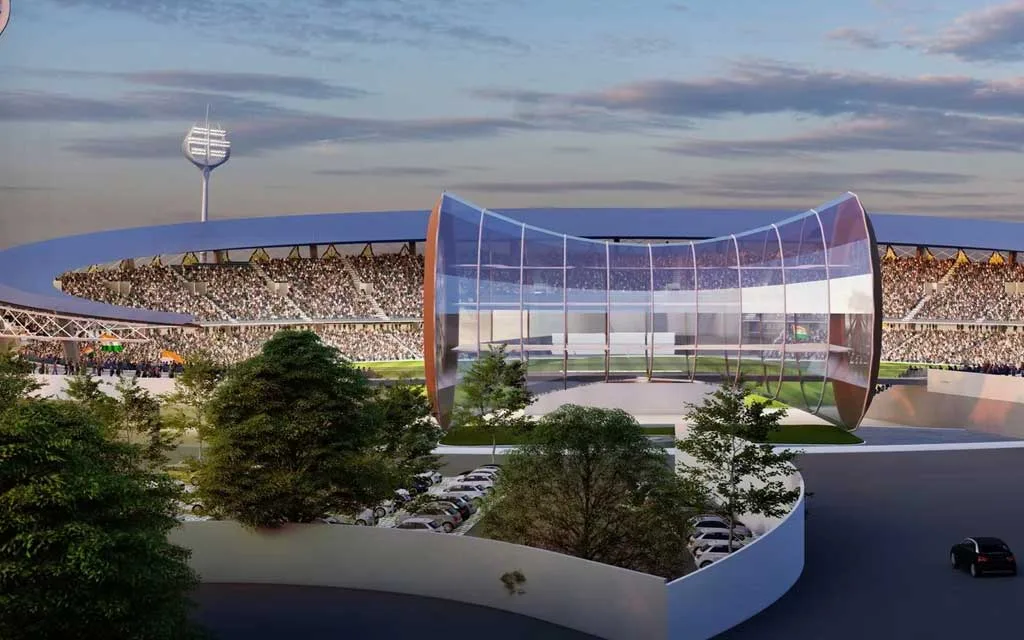
The Varanasi International Cricket Stadium, a groundbreaking project in the sacred city of Kashi

Divine Hindu Temple News, Festivals & Global Devotion in Jyeshtha Adhik Maas 2026

Shani Deva Temples Worldwide & Must-Performed Rituals — Complete Devotee's Guide