Top 10 Most Visited Spiritual and Pilgrimage Sites in the World 2025: Varanasi Leads with Record Numbers
Most Visited Holy Places World 2025 | Top Pilgrimage Destinations | Har Har Mahadev In 2025, spiritual tourism continues to inspire millions worldwide, with…
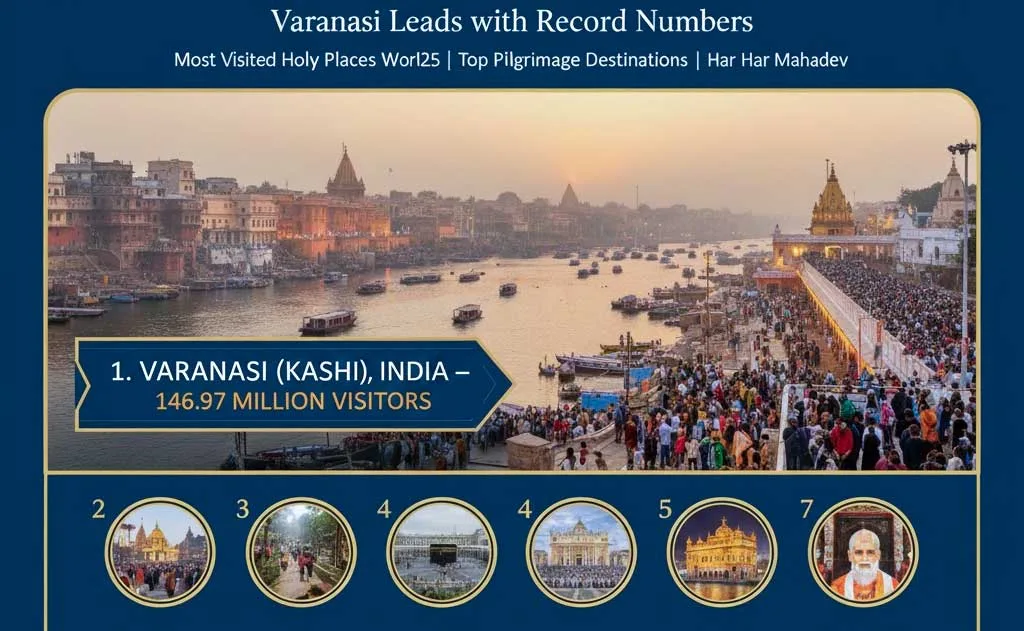
Most Visited Holy Places World 2025 | Top Pilgrimage Destinations | Har Har Mahadev In 2025, spiritual tourism continues to inspire millions worldwide, with…
Most Visited Holy Places World 2025 | Top Pilgrimage Destinations | Har Har Mahadev
In 2025, spiritual tourism continues to inspire millions worldwide, with sacred sites drawing devotees seeking divine blessings, peace, and cultural immersion. Leading the list is Varanasi (Kashi), India's eternal spiritual capital, which welcomed a staggering 146.97 million visitors—the highest ever for any pilgrimage destination. This marks Varanasi as the world's most visited spiritual place in 2025, far surpassing global icons.
This SEO-optimized guide explores the top 10 most visited religious and pilgrimage sites based on 2025 visitor data, highlighting their significance for Hindu devotees and global travelers.
1. Varanasi (Kashi Vishwanath Temple & Ganges Ghats), India – 146.97 Million Visitors
Varanasi, home to the sacred Kashi Vishwanath Jyotirlinga and holy Ganges, achieved a historic milestone in 2025. The Kashi Vishwanath Corridor and improved infrastructure drove this 25-fold surge since 2014. Devotees flock for darshan, Ganga Aarti, and moksha-believing rituals. Har Har Mahadev!
2. Tirumala Venkateswara Temple (Tirupati Balaji), India – 30-40 Million Visitors Annually
One of the richest and most revered Vaishnava temples, dedicated to Lord Venkateswara. Pilgrims endure long queues for the divine laddu prasadam and blessings of Balaji.
3. Sabarimala Ayyappa Temple, India – 25-30 Million Visitors Annually
Nestled in Kerala's forests, this shrine attracts millions during the Mandala season, with strict vratham observances for Lord Ayyappa's darshan.
4. Vaishno Devi Temple, Jammu & Kashmir, India – 8-10 Million Visitors Annually
The holy cave shrine of Mata Vaishno Devi draws trekkers seeking fulfillment of wishes through the challenging yatra.
5. Golden Temple (Harmandir Sahib), Amritsar, India – 6-10 Million Visitors Annually
The holiest Sikh gurdwara, symbolizing equality and service, offers serene langar and spiritual solace to all faiths.
6. Mecca (Masjid al-Haram & Kaaba), Saudi Arabia – Estimated 18-20 Million Pilgrims (Hajj + Umrah)
Islam's holiest site, where millions perform Hajj and Umrah, circling the Kaaba in unity.
7. Vatican City (St. Peter's Basilica), Italy – 7-11 Million Visitors Annually
The heart of Catholicism, with Michelangelo's masterpieces and papal blessings drawing Christian pilgrims worldwide.
8. Jagannath Puri Temple, Odisha, India – 7-10 Million Visitors Annually
Famous for the Rath Yatra, this Char Dham site honors Lord Jagannath, Balabhadra, and Subhadra.
9. Amarnath Cave Shrine, Jammu & Kashmir, India – Millions During Yatra Season
The ice lingam of Lord Shiva in the Himalayas attracts hardy pilgrims for divine grace.
10. Shirdi Sai Baba Temple, Maharashtra, India – Millions Annually
The abode of Sai Baba, where devotees experience miracles and universal teachings of faith.
These sacred destinations reflect humanity's enduring quest for spirituality. With Varanasi's unprecedented 2025 record, India solidifies its position as the global hub for Hindu pilgrimages.
Plan your 2026 yatra to these divine sites and experience eternal bliss. For detailed guides on Hindu temples, rituals, aartis, and pilgrimage tips, visit www.hindutone.com.
Om Namah Shivaya | Har Har Mahadev | Jai Mata D
🌸 For More Devotional Journey, Follow
- Temples
/temples/ - Tirumala Updates
/tirumala/ - Sabarimala Yatra
/category/sabarimala-yatra/ - Pooja, Slokas & Mantras
/pooja-slokas-and-mantras/ - Hindu Gods
/hindu-gods/
Why Does Varanasi Hold an Unbreakable Position as the World's Supreme Pilgrimage City?
Varanasi, known in sacred literature as Kashi — meaning 'the city that illumines' — occupies a singular position in Hindu cosmology that no infrastructure project alone can explain. The Skanda Purana devotes an entire section, the Kashi Khanda, to describing how Lord Shiva himself declared this city his permanent abode (avimukta kshetra), promising that any soul who dies within its boundaries receives Taraka Mantra — the liberating wisdom whispered in the ear at the moment of death. This theological promise of moksha without regard to caste, conduct, or birth converts every visit into a potentially final pilgrimage.
The Kashi Vishwanath Jyotirlinga is one of twelve Jyotirlingas listed in the Shiva Purana, each considered a spontaneous eruption of Shiva's infinite light rather than a human-made image. The 2019–2021 Kashi Vishwanath Corridor project widened the temple approach, connected it directly to the Ganga ghats, and created a pilgrimage experience that reduced hours-long crowding into a more fluid, reverential circuit — a practical change that directly contributed to the 2025 visitor surge. The eighty-four ghats along the Ganga, from Assi Ghat in the south to Adi Keshava Ghat in the north, each carry their own ritual identity, making the entire riverfront a living scripture that pilgrims read with their feet.
What Makes Tirumala Venkateswara the Wealthiest and Most Continuously Thronged Temple on Earth?
The Tirumala Venkateswara Temple, managed by the Tirumala Tirupati Devasthanams (TTD) on the seven hills of Tirumala in Andhra Pradesh, is consecrated to Lord Venkateswara — an avatar of Vishnu whose name literally means 'Lord who destroys the sins of Kali Yuga.' The Brahmotsavam festival, held annually for nine days, regularly draws over five lakh pilgrims in a single day alone. The Venkateswara Suprabhatam, composed by Prativadi Bhayankaram Annangaracharya in the 15th century and recited daily before dawn, is among the most widely heard Sanskrit devotional pieces in the world.
The temple's laddu prasadam — a sweet made from chickpea flour, sugar, cashews, and ghee — holds a Geographical Indication (GI) tag specific to Tirumala, protecting its recipe and preparation method. Pilgrims often wait twelve to eighteen hours in the famous virtual queue system (VQ tokens) before receiving the thirty-second darshan of the deity, yet no reduction in visitor numbers has ever been recorded across decades. Economically, TTD's annual revenue places it among the wealthiest religious trusts globally, funding hospitals, schools, Vedic universities, and annadanam programs that feed tens of thousands of pilgrims daily at no cost.
How Does the Sabarimala Pilgrimage Differ from All Other Major Hindu Yatras in Practice and Philosophy?
The Sabarimala Ayyappa Temple, located in the Periyar Tiger Reserve of Kerala's Pathanamthitta district, is unique in its requirement of a mandatory forty-one-day vratham (vow of austerity) before undertaking the climb. During this period, devotees — called Ayyappa swamis — wear black or dark blue garments, abstain from non-vegetarian food and alcohol, maintain celibacy, sleep on the floor, and greet every fellow devotee with 'Swamiye Saranam Ayyappa,' treating one another as embodiments of Lord Ayyappa himself. This radical egalitarianism dissolves social hierarchies entirely during the pilgrimage.
The theology of Ayyappa blends Shaiva and Vaishnava traditions: he is said to be born of the union of Shiva and Mohini (Vishnu's female form), making him Hariharaputra — son of both Hari and Hara. The eighteen sacred steps (pathinettampadi) leading to the sanctum are considered allegorical, each step representing a human quality — desire, anger, greed, delusion, pride, jealousy, and so on — that the devotee symbolically ascends beyond. The Mandala-Makaravilakku season, running roughly from December through mid-January, culminates in the appearance of the celestial Makarajyothi star, an event witnessed by millions on the Ponnambalamedu hilltop opposite the shrine.
What Ancient Scriptural and Geological Significance Underpins the Vaishno Devi Cave Shrine?
The Vaishno Devi shrine, set within the Trikuta mountains of Reasi district in Jammu and Kashmir at an altitude of approximately 5,200 feet, enshrines the goddess in her primordial form as three natural rock formations called pindis — representing Maha Kali, Maha Lakshmi, and Maha Saraswati. Unlike most Hindu temples where a crafted murti is the focal point of worship, here the earth itself is the deity, making the cave a swayambhu (self-manifested) sacred space of the highest theological category. The Devi Bhagavata Purana and various Shakta Upanishads describe Trikuta as one of the Shakti Pithas, though classical lists vary.
The yatra route stretches from the base camp at Katra through either the traditional 12-kilometre Banganga-Adhkuwari-Bhawan trail or the newer Tarakote Marg, and helicopter services connect Sanjichhat to the bhawan for differently-abled pilgrims. The Shri Mata Vaishno Devi Shrine Board has developed RFID-based yatra slips to manage crowd flow, preventing the kind of stampedes that have historically threatened dense pilgrimage routes. The belief that Mata Vaishno Devi 'calls' only those devotees she wishes to receive — expressed in the Kashmiri phrase 'Bulawa aaya hai' (the divine summons has come) — gives the yatra an intensely personal spiritual character that keeps return pilgrimage rates unusually high.
How Do These Indian Pilgrimage Sites Compare with Global Sacred Destinations in Visitor Scale and Spiritual Architecture?
When placed alongside global pilgrimage destinations such as the Vatican City in Rome (approximately five to seven million annual visitors), Lourdes in France (around three to four million), and the Camino de Santiago routes in Spain (which saw roughly half a million completions in recent years), the scale of Indian pilgrimage is simply without parallel. Varanasi's 146.97 million visitors in 2025 alone exceeds the combined annual footfall of the Vatican, Lourdes, and Jerusalem several times over, underscoring that the Hindu tradition of tirtha yatra — pilgrimage to sacred water crossings — mobilises human movement at a civilizational scale rarely appreciated in global discourse on spiritual tourism.
The architectural grammar of Indian pilgrimage sites also differs fundamentally from the Western cathedral model. Rather than a single enclosed sacred interior, major Hindu tirthas are conceived as sacred geographies — entire cities, river stretches, forest ranges, and mountain systems consecrated as divine bodies. Kashi is described in the Kashi Khanda as the trident tip of Shiva resting above the flood plains; Tirumala is the coils of Adisesha, the cosmic serpent; Sabarimala is embedded within a functioning tiger reserve that is itself protected in part because of its religious status. This integration of ecology, geography, and theology gives Indian pilgrimage sites a living, boundless character that no single building can replicate.
What Practical Guidance Should a First-Time Pilgrim Know Before Undertaking Any of These Sacred Yatras?
For Varanasi, the Ganga Aarti at Dashashwamedh Ghat takes place every evening at sunset and is the single most attended public ritual in the city — arriving forty-five minutes early secures a seated view from the stone steps. The Kashi Vishwanath Temple now operates a digital darshan queue system; booking a Mangala Aarti slot (pre-dawn) provides both a shorter line and the most spiritually potent moment of the temple's daily cycle, when the deity is believed to be freshly awakened.
For Tirupati, TTD's official website (tirupatibalaji.ap.gov.in) offers Sudarshana tokens for same-day darshan and advance VQ slips for planned visits — walk-in queues without tokens can mean waiting beyond eighteen hours. For Sabarimala, the Kerala government's VIPLAVAM online system issues pilgrimage dates and slots during Mandala season; the vratham must formally begin before arriving at Katta (the base), and mala (the sacred necklace) must be received from a gurusivaswami at an Ayyappa temple near one's home. For Vaishno Devi, yatra slips are mandatory and can be obtained at Katra or online via the Shrine Board portal; the Adhkuwari cave along the route — where the goddess is said to have meditated for nine months — requires a separate queuing system and is worth planning time for independently.
Frequently Asked Questions
What is Top 10 Most Visited Spiritual and Pilgrimage Sites?
Most Visited Holy Places World 2025 | Top Pilgrimage Destinations | Har Har Mahadev In 2025, spiritual tourism continues to inspire millions worldwide, with sacred sites drawing devotees seeking divine blessings, peace, and cultural immersion. Leading the list is Varanasi (Kashi) , India's eternal spiritual capital, which welcomed a staggering 146.97 million
What are the key points about Top 10 Most Visited Spiritual and Pilgrimage Sites?
This marks Varanasi as the world's most visited spiritual place in 2025 , far surpassing global icons. This SEO-optimized guide explores the top 10 most visited religious and pilgrimage sites based on 2025 visitor data, highlighting their significance for Hindu devotees and global travelers.
Why does Top 10 Most Visited Spiritual and Pilgrimage Sites matter in Hinduism?
It reflects core values of Sanatana Dharma and offers practical and spiritual guidance that remains relevant across generations.
How can devotees apply Top 10 Most Visited Spiritual and Pilgrimage Sites in daily life?
By reflecting on its teaching, incorporating the related practices or observances into daily routine, and approaching it with sincere devotion and understanding.
You might also like
Shani Deva Temples Worldwide & Must-Performed Rituals — Complete Devotee's Guide
Top 20 Sivalayam in USA: A Devotee's Guide to America's Most Sacred Shiva Temples (2026)
Purushottam Maas 2026: Lord Vishnu's Sacred Gift of Spiritual Multiplication & Divine Grace