Meditation, Mantras, and Mindfulness: Hindu Practices Transforming the West
How ancient Hindu wisdom is reshaping modern wellness culture Introduction: From Temple to Boardroom In the heart of Silicon Valley, tech executives begin…
How ancient Hindu wisdom is reshaping modern wellness culture Introduction: From Temple to Boardroom In the heart of Silicon Valley, tech executives begin…
How ancient Hindu wisdom is reshaping modern wellness culture
Introduction: From Temple to Boardroom
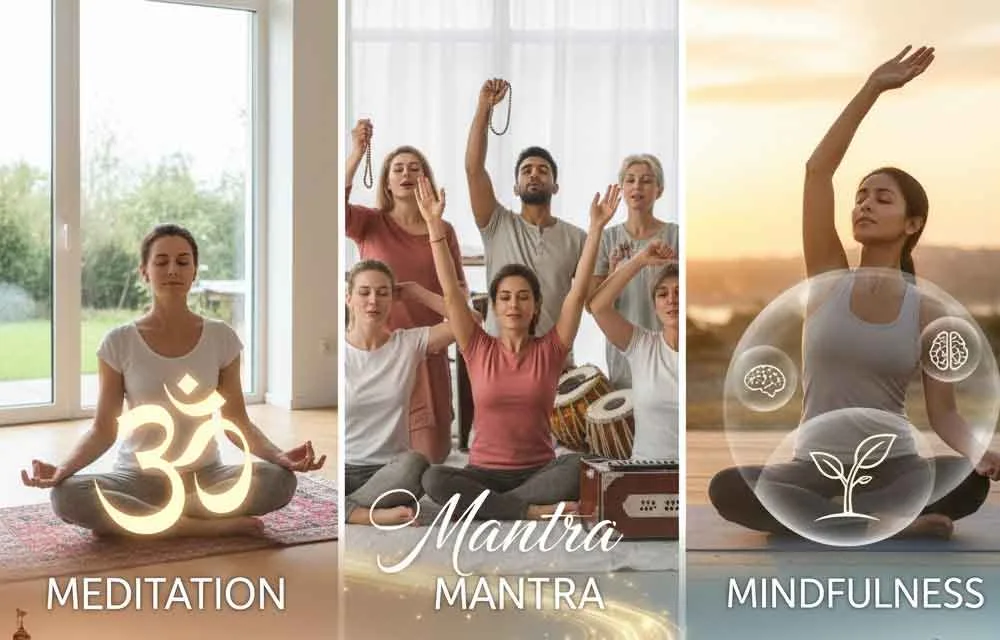
In the heart of Silicon Valley, tech executives begin their day with sunrise meditation. In New York's bustling studios, yoga practitioners chant "Om" before flowing through asanas. Across Europe, wellness retreats incorporate kirtan and bhakti practices into their programs. What was once confined to ashrams and temples in India has become a global phenomenon, with Hindu spiritual practices now forming the bedrock of Western wellness culture.
This transformation represents one of the most significant cross-cultural exchanges of our time. Ancient Hindu philosophies—developed over thousands of years—are now being embraced by millions who may never have set foot in a temple or read the Bhagavad Gita. Yet the essence of these practices continues to offer what it always has: a path to inner peace, self-realization, and connection with something greater than ourselves.
The Meditation Revolution: From Vedic Tradition to Modern Practice
Ancient Roots, Contemporary Applications
Meditation, or dhyana, has been a cornerstone of Hindu practice for over 5,000 years. The Vedas and Upanishads describe meditation as the pathway to moksha—liberation from the cycle of rebirth and union with the divine. What began as a spiritual discipline for monks and seekers has evolved into a secular wellness practice embraced by Fortune 500 companies, healthcare systems, and educational institutions worldwide.
The journey of meditation to the West began in earnest in the 1960s and 70s, when teachers like Maharishi Mahesh Yogi introduced Transcendental Meditation (TM) to Western audiences. His technique, rooted in Vedic traditions, attracted celebrities like The Beatles and sparked widespread interest in Eastern spirituality. Today, meditation apps like Headspace and Calm have over 100 million users combined, offering guided practices that trace their lineage directly back to Hindu contemplative traditions.
The Science Meets Spirituality
What distinguishes the current meditation boom from earlier waves is the robust scientific validation of practices that Hindu sages intuited millennia ago. Modern neuroscience has confirmed what the Upanishads taught: regular meditation physically alters the brain, increasing gray matter density in regions associated with learning, memory, and emotional regulation while decreasing activity in the amygdala, the brain's fear center.
Studies from Harvard, Stanford, and other leading institutions have documented meditation's ability to reduce stress, lower blood pressure, improve immune function, and even slow cellular aging. This scientific endorsement has made meditation acceptable—even desirable—in contexts where "Hindu practice" might face resistance, from corporate wellness programs to military training facilities.
Om: The Primordial Sound Resonating Globally
More Than a Syllable
Perhaps no element of Hindu practice has achieved greater global recognition than the sacred syllable "Om" (also spelled Aum). This single sound, described in the Mandukya Upanishad as the sonic representation of ultimate reality, has transcended its religious origins to become a universal symbol of meditation and spiritual practice.
The three sounds within Om—A-U-M—are said to represent the triad of waking, dreaming, and deep sleep states, as well as the trimurti of Brahma, Vishnu, and Shiva. The silence that follows represents turiya, the fourth state of consciousness—pure awareness beyond the three ordinary states. This profound philosophical concept, encoded in a single syllable, has captivated Western practitioners seeking both simplicity and depth in their spiritual practice.
The Vibration of Healing
Western yoga studios routinely begin and end classes with collective Om chanting, creating a sense of unity and sacred space. But the practice has expanded far beyond yoga mats. Sound healing practitioners incorporate Om into therapeutic sessions, citing both its spiritual significance and its physiological effects. Research has shown that chanting Om can stimulate the vagus nerve, promoting relaxation and activating the parasympathetic nervous system.
Kirtan—the devotional practice of call-and-response chanting—has evolved from temple worship to become a popular form of participatory music in Western cities. Artists like Krishna Das, Deva Premal, and Snatam Kaur fill concert halls with audiences who may identify as spiritual but not religious, drawn to the emotional release and communal connection that chanting provides.
Bhakti Yoga: The Path of Devotion Goes Mainstream
Love as Liberation
While Westerners are most familiar with hatha yoga (physical postures), bhakti yoga—the yoga of devotion—is experiencing its own renaissance. This ancient practice, detailed in texts like the Bhagavad Gita and Bhagavata Purana, teaches that loving devotion to the divine is a direct path to spiritual realization, accessible to all regardless of intellectual capacity or physical ability.
Bhakti's emphasis on emotional engagement and personal relationship with the divine resonates with contemporary seekers disillusioned with purely intellectual or physical approaches to spirituality. The practice doesn't require mastering complex philosophies or difficult postures—it asks only for an open heart.
From Krishna to Christ Consciousness
Interestingly, bhakti yoga's influence extends beyond explicitly Hindu contexts. The practice's core teaching—that love is the highest spiritual path—has found expression in interfaith settings, where practitioners draw parallels between bhakti devotion and Christian mysticism, Sufi poetry, or Buddhist loving-kindness meditation.
ISKCON (International Society for Krishna Consciousness), founded by Srila Prabhupada in 1966, introduced bhakti practices to Western audiences through temple services, prasadam (blessed food), and public kirtan. While initially viewed as countercultural, many bhakti practices have been absorbed into mainstream wellness culture, stripped of specific deity worship but retaining the essential practice of devotional singing and heart-centered meditation.
Mindfulness: Buddhist-Hindu Synthesis
Shared Roots, Distinct Flavors
While mindfulness is often associated with Buddhism, its practices share deep roots with Hindu meditation techniques. The Sanskrit word sati (Pali: smrti), meaning "memory" or "awareness," appears in both Hindu and Buddhist texts. The Yoga Sutras of Patanjali, a foundational Hindu text, describe dharana (concentration) and dhyana (meditation) practices remarkably similar to Buddhist vipassana techniques.
Contemporary mindfulness teachers often draw on both traditions, even when they don't explicitly acknowledge the Hindu contributions. The emphasis on breath awareness (pranayama), body scanning (yoga nidra), and present-moment awareness all have parallels in Hindu contemplative practices dating back thousands of years.
The Mindfulness Industrial Complex
The integration of mindfulness into Western culture has been so complete that a multi-billion dollar "mindfulness industry" has emerged. From mindful eating to mindful parenting, from corporate mindfulness training to mindfulness-based stress reduction (MBSR) in hospitals, the concept has permeated nearly every sector of society.
This commercialization has sparked debate within Hindu and Buddhist communities about authenticity, cultural appropriation, and the secularization of sacred practices. Critics argue that extracting meditation from its ethical and philosophical context—the yamas and niyamas of Patanjali's eight-limbed path—creates a spiritually shallow "McMindfulness" that serves capitalism rather than liberation.
Supporters counter that making these practices accessible to diverse populations—regardless of religious belief—represents a democratization of wisdom once available only to renunciates and religious elites. The tension between preservation and adaptation continues to shape how Hindu practices evolve in Western contexts.
Yoga: The Gateway Practice
Beyond the Poses
For many Westerners, yoga asanas (physical postures) serve as the gateway to deeper Hindu philosophical concepts. What begins as a fitness class often evolves into curiosity about Sanskrit terminology, meditation practices, and the philosophical framework underlying the physical practice.
The eight limbs of yoga described in Patanjali's Yoga Sutras provide a comprehensive spiritual path: ethical guidelines (yamas and niyamas), physical postures (asanas), breath control (pranayama), sense withdrawal (pratyahara), concentration (dharana), meditation (dhyana), and ultimate union (samadhi). While Western yoga studios may focus primarily on asanas, many practitioners gradually discover the other limbs, finding themselves drawn to meditation retreats, pranayama workshops, or studies of Hindu philosophy.
The Commodification Controversy
The global yoga industry, valued at over $80 billion, represents both the successful transmission of Hindu wisdom and its potential distortion. Instagram influencers performing advanced poses in exotic locations, expensive yoga retreats, and designer yoga wear raise questions about whether the practice has strayed too far from its roots as a spiritual discipline accessible to all.
Yet this popularization has also created unprecedented interest in authentic Hindu teachings. Many serious practitioners, dissatisfied with superficial approaches, seek out traditional teachers, study Sanskrit, and engage deeply with source texts like the Bhagavad Gita and Upanishads.
Ayurveda: Hindu Wisdom for Holistic Health
The Science of Life
Ayurveda, the ancient Hindu system of medicine, has found new life in Western wellness culture. Based on the principle that health results from balance among the three doshas (vata, pitta, kapha), Ayurveda offers a holistic approach to wellbeing that considers physical, mental, emotional, and spiritual dimensions.
Western integrative medicine increasingly incorporates Ayurvedic concepts like individualized nutrition based on constitutional type, seasonal eating, and the use of adaptogenic herbs like ashwagandha and tulsi. Ayurvedic practices like oil pulling, tongue scraping, and self-massage with warm oil (abhyanga) have become trendy wellness rituals.
Traditional Knowledge Meets Modern Research
Universities and research institutions now study Ayurvedic herbs and treatments using modern scientific methods. While some practices have been validated by research, others remain controversial. This intersection of ancient wisdom and contemporary science exemplifies the ongoing dialogue between Hindu traditional knowledge and Western empiricism.
The Guru-Student Relationship in Modern Context
From Ashram to Online Course
The traditional Hindu guru-shishya (teacher-student) relationship—characterized by years of devoted study, service, and transmission of knowledge—faces adaptation in the digital age. While some Western practitioners seek out traditional gurus and spend extended periods in Indian ashrams, many more encounter Hindu teachings through YouTube videos, online courses, and bestselling books.
This democratization of knowledge challenges traditional gatekeeping while raising questions about depth of understanding and authentic transmission. Can the subtle insights of meditation be adequately conveyed through an app? Does removing practices from their cultural and religious context fundamentally alter their meaning and efficacy?
Contemporary Teachers Bridging Cultures
A new generation of teachers—both Indian and Western, traditional and contemporary—works to make Hindu wisdom accessible while maintaining philosophical integrity. Figures like Sadhguru, whose Isha Foundation reaches millions globally, and Ram Dass (Richard Alpert), who translated Hindu concepts for Western audiences, exemplify different approaches to this cultural bridge-building.
The Philosophical Foundation: Vedanta Goes Mainstream
Non-Dualism for the Modern Mind
Advaita Vedanta, the non-dualistic school of Hindu philosophy teaching that individual consciousness (Atman) and universal consciousness (Brahman) are one, has profoundly influenced contemporary spirituality. The concept that separation is illusion and that true nature is infinite awareness resonates with quantum physics' insights and appeals to scientifically-minded seekers.
Teachers like Eckhart Tolle, while not explicitly Hindu, present teachings remarkably aligned with Advaita philosophy. His emphasis on present-moment awareness and transcending the egoic mind echoes insights from the Upanishads and the teachings of 20th-century Advaita sages like Ramana Maharshi and Nisargadatta Maharaj.
The Self-Help Movement's Hindu Roots
Many ideas now commonplace in Western self-help and personal development literature derive from Hindu philosophy: the law of attraction (karma), the power of visualization (dhyana), the importance of intention (sankalpa), and the concept of life purpose (dharma). While these concepts are often stripped of their religious context and repackaged, their Hindu origins remain traceable.
Cultural Exchange or Appropriation?
Navigating Complex Territory
The Western adoption of Hindu practices raises important questions about cultural exchange versus appropriation. When do respect, adaptation, and sharing become exploitation and erasure? This conversation involves multiple perspectives: traditional Hindu communities concerned about misrepresentation, Western practitioners seeking authentic engagement, and diverse voices within Hinduism itself debating what constitutes appropriate transmission.
Some Hindu organizations and scholars celebrate the global spread of their traditions as validation of universal truths. Others object to commercialization, secularization, and the removal of practices from their religious and cultural context. The fact that yoga studios may feature Buddha statues (Buddhist) alongside Om symbols (Hindu) and quote the Dalai Lama while teaching practices from the Yoga Sutras reflects both the syncretism of modern spirituality and a sometimes superficial engagement with source traditions.
Toward Respectful Integration
Increasingly, Western practitioners and teachers recognize the importance of acknowledging Hindu origins, studying traditional texts, and maintaining relationships with source communities. Some yoga teacher training programs now include modules on Hindu philosophy and cultural sensitivity. Kirtan performers credit traditional ragas and explain the meanings of Sanskrit chants. These gestures, while imperfect, represent growing awareness of the need for respectful transmission.
The Future: Synthesis and Evolution
A Two-Way Exchange
While this article focuses on Hindu influence on the West, the exchange is not unidirectional. Western engagement has sparked renewed interest in Hindu practices within India, particularly among urban, educated populations who sometimes discover yoga and meditation through Western teachers before exploring their own traditions. Scientific validation of practices once dismissed as superstition has rehabilitated traditional knowledge in some Indian contexts.
Contemporary Hinduism itself continues to evolve, influenced by global engagement, scientific discourse, and the need to remain relevant to new generations. The dialogue between tradition and modernity, East and West, shapes the ongoing development of these ancient practices.
The Wellness Revolution's Spiritual Core
As mental health crises, burnout, and disconnection plague modern societies, Hindu practices offer time-tested tools for cultivating inner peace, resilience, and meaning. The meditation cushion, the yoga mat, and the kirtan hall provide spaces for people of all backgrounds to access states of consciousness described in the Upanishads thousands of years ago.
Whether practiced in their traditional religious context or adapted for secular settings, whether taught by Indian gurus or Western teachers, whether called by their Sanskrit names or translated into contemporary language—these practices continue to serve their essential function: helping humans navigate the challenges of existence and discover their true nature.
Conclusion: Ancient Wisdom for Modern Times
The transformation of Hindu practices in Western contexts represents one of the great spiritual migrations of our era. Meditation, mantras, and mindfulness—once the province of renouncers seeking moksha—now help corporate executives manage stress, help trauma survivors heal, and help ordinary people find meaning in their daily lives.
This widespread adoption has both benefits and costs. The democratization of practices once available only to religious elites allows millions to access profound tools for wellbeing. Yet commercialization and decontextualization risk reducing depth to trend, wisdom to commodity.
Perhaps the most remarkable aspect of this cultural exchange is not how much has changed, but how much remains. When a practitioner in Los Angeles chants Om, experiencing the same vibration that ancient rishis described in the Vedas; when someone in London experiences the dissolution of self in deep meditation, touching what the Upanishads call Brahman; when participants at a kirtan in Berlin feel their hearts open in devotion—they connect with an unbroken lineage of human spiritual experience stretching back millennia.
The Bhagavad Gita teaches that there are many paths to truth—the path of knowledge, the path of action, the path of devotion. Modern Western engagement with Hindu practices reflects this multiplicity, with each individual finding their own entry point, their own authentic practice, their own path to self-realization.
As Hindu wisdom continues to influence global wellness culture, the invitation remains the same as it has always been: to look within, to cultivate awareness, to transcend the limited ego, and to discover the infinite consciousness that is our true nature. Whether in an ancient temple or a modern studio, whether chanting in Sanskrit or silence, the journey continues.
Join the conversation about the global spiritual renaissance. Share your experiences with meditation, mantras, and mindfulness.
#Mindfulness #MantraHealing #GlobalSpirituality #HinduWisdom #MeditationPractice #YogaPhilosophy #BhaktiYoga #AncientWisdom #ModernWellness #SpiritualAwakening
About HinduTone.com HinduTone explores the rich philosophical, cultural, and spiritual heritage of Hinduism and its global influence. We celebrate ancient wisdom while engaging thoughtfully with its contemporary expressions.
Frequently Asked Questions
What is the Meditation, Mantras, and Mindfulness?
How ancient Hindu wisdom is reshaping modern wellness culture Introduction: From Temple to Boardroom In the heart of Silicon Valley, tech executives begin their day with sunrise meditation. In New York's bustling studios, yoga practitioners chant "Om" before flowing through asanas.
How many times should the Meditation, Mantras, and Mindfulness be chanted?
It is traditionally chanted 108 times using a rudraksha or tulsi mala. Even 11 or 21 sincere repetitions daily are considered beneficial — steady, focused practice matters more than the count.
What is the best time to chant the Meditation, Mantras, and Mindfulness?
Dawn (Brahma Muhurta) after a bath is considered ideal, though it may be chanted any time with a calm, focused mind. Many devotees keep a fixed daily time to build consistency.
Who can chant the Meditation, Mantras, and Mindfulness?
Anyone may chant it with faith and a pure mind, regardless of age, gender or background. Beginners benefit from first hearing the correct pronunciation and understanding its meaning.
What are the benefits of chanting the Meditation, Mantras, and Mindfulness?
It is believed to calm the mind, dissolve negativity, and draw divine grace, protection and clarity to the devotee.
You might also like
Powerful Mantras for Students & Parents Before Joining School
Powerful Hindu Mantras for Purushottam Maas 2026: Vishnu Bhakti, Chanting Guide & Global Devotion
Purushottam Maas 2026: Lord Vishnu's Sacred Gift of Spiritual Multiplication & Divine Grace