Valmiki Ramayana: The Complete Story of Lord Rama — Chapter by Chapter | HinduTone
Valmiki Ramayana: The Complete Story of Lord Rama — All 7 Kandas Explained "Ramo vigrahavan dharmah" — Rama is Dharma embodied in human form.— Valmiki…
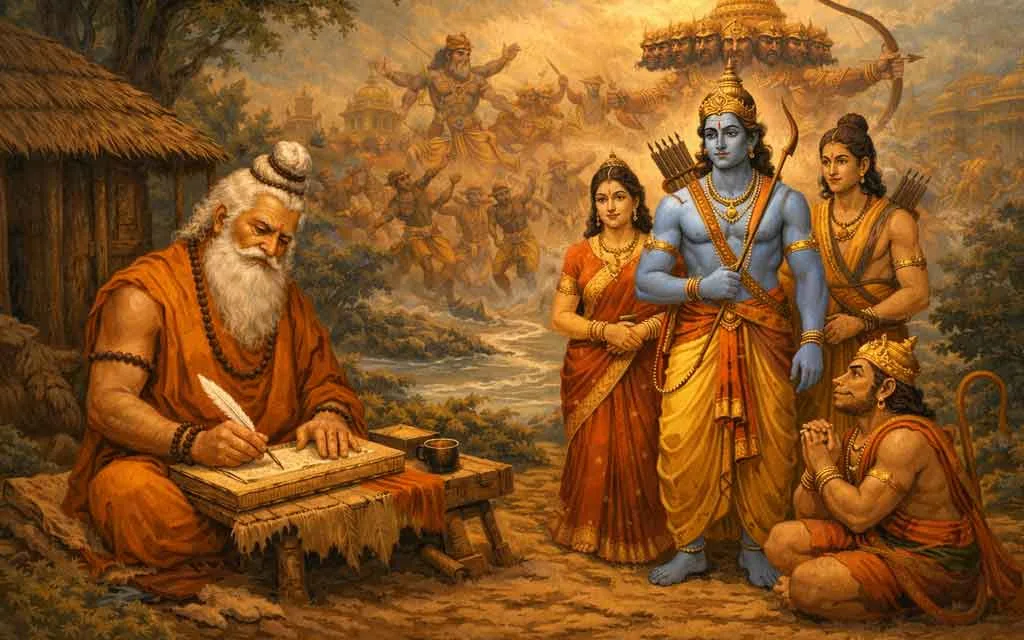
Valmiki Ramayana: The Complete Story of Lord Rama — All 7 Kandas Explained "Ramo vigrahavan dharmah" — Rama is Dharma embodied in human form.
Valmiki Ramayana: The Complete Story of Lord Rama — All 7 Kandas Explained
"Ramo vigrahavan dharmah" — Rama is Dharma embodied in human form.
— Valmiki Ramayana, Aranya Kanda
The Valmiki Ramayana is the original Ramayana — the Adi Kavya (the first great poem) of Sanskrit literature and one of the two supreme epics of Sanatan Dharma. Composed by the sage Maharshi Valmiki over 24,000 verses (shlokas), it tells the story of Lord Rama — the seventh avatar of Lord Vishnu — who descended to earth to restore dharma (righteousness) and to demonstrate for all time what it means to live a complete human life.
Unlike later retellings, the Valmiki Ramayana is not merely a tale of adventure. It is a scripture of dharma — a living guide to duty, love, sacrifice, loyalty, and the nature of the divine. Every character is a philosophical archetype. Every event carries layers of spiritual teaching.
This complete guide by HinduTone takes you through all seven Kandas (books) of the Valmiki Ramayana — chapter by chapter — with their deeper spiritual meanings, key characters, pivotal moments, and the wisdom they carry for readers today.
[image: 📖] Table of Contents
- About Valmiki and the Composition of the Ramayana
- The 24,000 Shlokas and the Gayatri Connection
- Structure: The Seven Kandas
- Kanda 1 — Bal Kanda: The Birth and Childhood of Rama
- Kanda 2 — Ayodhya Kanda: The Exile of Prince Rama
- Kanda 3 — Aranya Kanda: The Forest Years and Sita's Abduction
- Kanda 4 — Kishkindha Kanda: The Alliance with the Vanaras
- Kanda 5 — Sundara Kanda: Hanuman's Leap of Devotion
- Kanda 6 — Yuddha Kanda: The Great War and Rama's Victory
- Kanda 7 — Uttara Kanda: The Final Chapter
- Key Characters of the Ramayana
- The Ramayana's Spiritual Philosophy
- Frequently Asked Questions
- Related Content on HinduTone
[image: 🔱] About Valmiki and the Composition of the Ramayana {#about-valmiki}
The Transformation of a Dacoit into a Sage
One of the most remarkable stories in Hindu tradition is the origin story of the Ramayana's author himself. Valmiki was not always a holy sage. According to the Uttara Kanda and later tradition, he was originally known as Ratnakar — a highway robber who sustained his family through theft and violence.
One day, Ratnakar encountered the Saptarishis (seven great sages) in the forest. They questioned him about his life, and a single conversation shattered his inner world. They asked: "Will those for whom you commit these sins share in your karmic burden?" Ratnakar went to his family and discovered that they would not — each person bears the fruit of their own actions.
Devastated, he surrendered to the sages. They gave him the divine name of Rama to meditate upon, but he was so conditioned by negativity that he could only say "Mara, Mara, Mara" (killer, killer, killer) — yet by divine grace, the reversal Ma-Ra, Ma-Ra becomes Ra-Ma, Ra-Ma. He sat in meditation so long that an anthill (valmika) formed around him — and when he emerged, he was reborn as Valmiki, one of the greatest poets and sages in all of history.
This story is itself a teaching: the Ramayana, the story of the most righteous being who ever lived, was composed by a man who began life in the depths of darkness. No one is beyond transformation.
The Inspiration: A Moment of Divine Grief
Valmiki's poetic gift was awakened by a moment of pure compassion. Walking by the Tamasa River, he witnessed a hunter kill a male bird (krauncha) while it was mating, causing its partner to cry out in anguish. The sage's heart broke open in grief, and from that grief, the very first verse of Sanskrit poetry (shloka) spontaneously arose from his lips — a curse upon the hunter, but simultaneously a perfect verse of metrical poetry.
Lord Brahma then appeared to Valmiki and revealed that this new poetic form — the shloka — was given to him for a divine purpose: to compose the story of Rama. The divine messenger Narada had already told Valmiki the outline of the Rama story. Now, by Brahma's grace, Valmiki entered a state of divine vision (divya drishti) in which he could see and hear every event of Rama's life directly, as if watching it unfold before his eyes.
This is why the Valmiki Ramayana is not merely a historical account — it is a revealed scripture, a shruti of the heart.
[image: 🔢] The 24,000 Shlokas and the Gayatri Connection {#gayatri-connection}
The Valmiki Ramayana contains exactly 24,000 shlokas — a number of profound significance. The Gayatri Mantra contains 24 syllables. According to tradition, Valmiki structured the entire Ramayana so that every 1,000th shloka begins with one of the 24 syllables of the Gayatri. This means the Ramayana is, in a very real sense, a vast elaboration of the Gayatri Mantra — a meditation on the supreme light of consciousness (Savitri) that illumines all understanding.
The seven Kandas correspond to the seven planes of consciousness in Vedic cosmology:
- Bhu (Earth) — Bal Kanda
- Bhuva (Atmosphere) — Ayodhya Kanda
- Svaha (Heaven) — Aranya Kanda
- Maha (Beyond heaven) — Kishkindha Kanda
- Jana (Higher mind) — Sundara Kanda
- Tapa (Tapas consciousness) — Yuddha Kanda
- Satya (Truth absolute) — Uttara Kanda
[image: 📚] Structure: The Seven Kandas {#seven-kandas}
[image: 📖] KANDA 1 — BAL KANDA: The Birth and Childhood of Rama {#bal-kanda}
"When dharma declined and adharma flourished, the Lord of all creation chose to descend."
The Kingdom of Ayodhya
The Ramayana opens with a magnificent description of Ayodhya — a city of divine perfection. Located on the banks of the Sarayu River, Ayodhya was the capital of the Ikshvaku dynasty (Solar dynasty), ruled by the mighty and just king Dasharatha. His name itself means "one whose chariot can move in ten directions" — a warrior of incomparable skill.
Ayodhya was a city where no one was poor, no one was unlearned, no one practiced adharma. Its streets were wide, its citizens happy, its merchants honest, its Brahmanas dedicated to knowledge. It was, in every sense, a civilization at its height.
Yet Dasharatha had one sorrow that no amount of wealth or power could dissolve: he had three queens — Kaushalya, Kaikeyi, and Kaikeyi — and no heir. The Solar dynasty faced extinction.
The Putrakameshti Yajna
On the advice of the great sage Vashishtha, King Dasharatha performed the Putrakameshti Yajna — a rare, elaborate fire sacrifice for the boon of sons. The great sage Rishyashringa was brought from the forests to conduct this most powerful of rituals.
As the sacred fire blazed, a luminous being emerged from the flames — Agnideva (the fire god) himself, bearing a golden vessel of divine payasam (sacred pudding). He instructed Dasharatha to distribute this amongst his queens.
- Kaushalya received half
- Kaikeyi received a quarter
- The remaining quarter was shared between Kaikeyi and Sumitra
In due time, all three queens became pregnant. On the ninth day of the bright fortnight of the month of Chaitra (now celebrated as Ram Navami), the four princes were born:
- From Kaushalya: Rama — shining like the morning sun
- From Kaikeyi: Bharata — embodiment of righteousness
- From Sumitra: Lakshmana and Shatrughna — twins, pillars of loyalty
The entire cosmos celebrated. Flowers rained from the heavens. Celestial musicians played. The earth herself rejoiced.
The Child Rama
From his earliest days, Rama displayed extraordinary qualities. He was calm where others were excited, generous where others were protective, and always aware — even as a small child — of the difference between right and wrong. He was deeply devoted to his father and respectful to all elders. His brothers adored him; Lakshmana in particular was inseparable from Rama — the Ramayana notes that without Rama, Lakshmana would not eat, sleep, or play.
The four princes received their education under the sage Vashishtha, mastering the Vedas, warfare, statecraft, and dharmashastra.
Sage Vishwamitra Arrives — and Changes Everything
The pivotal event of Bal Kanda arrives when the great and fiery sage Vishwamitra comes to Dasharatha's court. He has come with an audacious request: he needs Prince Rama — barely sixteen years old — to protect his yajna (fire sacrifice) from the demon Maricha and the demoness Tataka, who have been disrupting sacred rites in the forest.
Dasharatha is horrified. He offers his entire army, even himself — but not his beloved Rama against demons. The sage grows stern. Vashishtha intervenes and wisely counsels the king: "Send Rama. He is not merely your son. He is more than you know."
With a breaking heart, Dasharatha sends Rama — and Lakshmana insists on going as his brother's shadow and protector.
Rama Kills Tataka
In the forest, Vishwamitra tests Rama's readiness. He teaches him the divine mantras Bala and Atibala — mantras that ensure the recipient never suffers from hunger, thirst, or fatigue. These are Vishwamitra's most prized possessions, given freely to the one he recognizes as divine.
The first test comes immediately: Tataka — a powerful yaksha woman transformed into a demoness — attacks. Rama initially hesitates to kill a woman, expressing to Vishwamitra that the killing of a woman goes against a warrior's code. Vishwamitra reminds him that a demoness who terrorizes innocents has forfeited such protection. Rama kills Tataka — the first demon he slays — with a single arrow. He completes Vishwamitra's yajna by destroying Maricha and Subahu.
The Svayamvara of Sita — Rama Lifts the Bow of Shiva
Vishwamitra then leads the princes to Mithila, the kingdom of the philosopher-king Janaka. Here, a wondrous svayamvara (bride-choosing ceremony) has been arranged for Janaka's daughter — the incomparably beautiful and virtuous Sita.
The condition of the svayamvara: whoever can lift and string the Pinaka — the enormous bow of Lord Shiva, so heavy that no ordinary warrior can even move it — shall win Sita's hand. Kings and warriors from across the earth have come and failed, some even injuring themselves attempting to lift it.
Rama approaches the bow with serene confidence. He lifts it effortlessly with his left hand — and then draws the string back with such force that the bow snaps in two with a sound like thunder, shaking the earth. Sita steps forward and places the jaimala (victory garland) around his neck. The gods shower flowers. This is the moment — Rama and Sita are united.
Parashurama's Challenge
As Rama and Sita return to Ayodhya with the marriage party, the fearsome sage Parashurama — the sixth avatar of Vishnu — blocks their path. He is furious that the Shiva-bow has been broken. He challenges Rama to string the bow of Vishnu (Sharanga) that he carries.
Rama calmly takes the bow, strings it instantly, and aims it at Parashurama — demonstrating that he is no ordinary prince, but the supreme Purushottama. Parashurama recognizes the greater avatar before him, bows in reverence, and withdraws. This moment in Bal Kanda signals to the aware reader: Rama is Vishnu himself.
[image: 📖] KANDA 2 — AYODHYA KANDA: The Exile of Prince Rama {#ayodhya-kanda}
"The greatest test of dharma is not when it is convenient, but when it costs everything."
The Joy Before the Storm
Rama returns to Ayodhya as a married prince, and the city erupts in joy. Years pass. Dasharatha, old and longing for retirement, announces his decision to crown Rama as Yuvaraja (crown prince). The news sends all of Ayodhya into celebration — people decorate their homes, musicians perform in the streets, and even the trees seem to bloom out of season.
The only dark cloud: Queen Manthara, the hunchbacked maid of Queen Kaikeyi, watches the celebrations with bitter jealousy. She begins to whisper into Kaikeyi's ear — "Your son Bharata will be a servant in Rama's court. Your glory ends today."
Kaikeyi's Two Boons
Kaikeyi was once Dasharatha's most beloved queen. Years ago, she had saved his life on the battlefield, and he had offered her two boons — to be fulfilled whenever she wished. Under Manthara's poisonous influence, Kaikeyi enters the kopa bhavan (chamber of grief) and presents her two demands to Dasharatha:
- Bharata must be crowned king of Ayodhya
- Rama must be exiled to the Dandaka Forest for fourteen years
Dasharatha collapses in anguish. He begs, he weeps, he offers kingdoms, he offers his life — but Kaikeyi is immovable. The old king is bound by the code of a Kshatriya: a promise made must be kept. The Ramayana here confronts one of its most devastating truths: even the greatest king is powerless before his own word.
Rama's Perfect Response
When Rama is summoned and told of the situation — his coronation cancelled, his exile ordered — his response becomes one of the most celebrated moments in all of Hindu literature. He shows no anger, no grief, no bitterness. He says simply: "My father has commanded. I will go."
He asks only that Bharata be told that Rama sent his love, and that Dasharatha be cared for in his grief. This is not weakness — this is the perfection of dharma-putra (son of righteousness). Rama understands that a father's word is sacred; to break it would bring dishonor to the entire Ikshvaku lineage.
Sita refuses to stay behind. Her words to Rama — among the most beautiful in the entire epic — form a philosophy of wifehood and devotion: "A wife's dharma is to be with her husband. The forest with you is more beautiful than any palace without you. I will follow you as shadow follows light."
Lakshmana is furious — this is the one moment in the Ramayana where we see Lakshmana's famous anger. He is willing to take up arms against Dasharatha himself. Rama calms him with patient wisdom. Lakshmana ultimately chooses to accompany them — his devotion overrides even his anger.
The Farewell of Ayodhya
The departure of Rama from Ayodhya is one of the most emotionally devastating sequences in world literature. The entire city weeps — nobles, merchants, servants, and animals alike. The streets that were decorated for a coronation now empty in grief. Dasharatha follows the chariot until his legs give out, calling "Rama! Rama!" as the chariot disappears into the distance.
The charioteer Sumantra returns without Rama, and the city of Ayodhya falls into a darkness it has never known.
Dasharatha dies — literally of a broken heart — within days of Rama's departure. Before dying, he remembers a curse from his youth: a blind couple had once cursed him that he too would die separated from a beloved son. The curse has come to pass.
The Sage Bharadwaja and the Parnashala
Rama, Sita, and Lakshmana travel south across the Ganga. The sage Bharadwaja at Prayag directs them to the beautiful mountain Chitrakuta, where they build a simple forest cottage (parnashala) of leaves and branches. Here, amid the forests, rivers, and birdsong, they begin their forest life.
The Ayodhya Kanda captures something philosophically profound: Rama is more magnificent in exile than on any throne. The Ramayana asks its readers — where is a person's true greatness? In the crown they wear or the character they carry?
Bharata Refuses the Crown
Bharata returns from his maternal grandfather's home to find his father dead and his brother in exile. He is devastated. He turns to his mother Kaikeyi with grief and anger — calling her actions adharma of the highest order.
Bharata sets out immediately for the forest to bring Rama back. He finds Rama at Chitrakuta. In a legendary meeting, Bharata begs Rama to return. Rama refuses — his father's word must be honored, and fourteen years must pass. Bharata, in a remarkable act of devotion, accepts Rama's sandals (paduka) and places them on the throne of Ayodhya — ruling as a regent, not as king, in his brother's name for all fourteen years.
This episode — called the Bharata Milap — is considered the highest example of fraternal love and loyalty in all of Hindu tradition.
[image: 📖] KANDA 3 — ARANYA KANDA: The Forest Years and Sita's Abduction {#aranya-kanda}
"The demon king reached for what was not his — and in doing so, sealed his own fate."
Life in the Dandaka Forest
The Aranya Kanda follows Rama, Sita, and Lakshmana as they go deeper south into the Dandaka Forest — a vast wilderness filled with sages, hermitages, and powerful demons. Wherever they stop, sages flock to Rama, sharing their difficulties: demon armies under Ravana's command routinely attack their ashrams, kill their students, and desecrate their sacrifices.
Rama makes a solemn promise: "I will protect every sage in this forest. You have my word as a warrior of the Solar dynasty." This commitment — freely given — sets the entire epic in motion.
The forest chapters of the Ramayana present a profound contrast: the simplicity and beauty of forest life against the ugliness of demoniacal violence. Valmiki's descriptions of the forests — the flowering ashoka trees, the crystal rivers, the calls of birds at dawn — are among the most beautiful passages in Sanskrit literature.
Viradha and Agastya
The trio encounters the demon Viradha, a massive figure who seizes Sita. Rama and Lakshmana attack — Viradha cannot be killed by weapons, so they bury him alive. Viradha, freed from his curse in death, reveals he was once a gandharva (celestial musician) named Tumburu who was cursed by Kubera. Rama's presence liberated him.
The sage Agastya — one of the greatest sages of the south — gifts Rama the magnificent bow of Vishnu, the Brahmadanda (staff of Brahma), and a quiver that never empties. These divine weapons are entrusted to Rama as the protector of dharma.
Surpanakha — The Turning Point
The critical pivot of the entire Ramayana arrives through a seemingly minor encounter. Surpanakha, the sister of Ravana, sees Rama in the forest and is instantly infatuated. She assumes the form of a beautiful woman and proposes herself to Rama.
Rama gently tells her he is married — but directs her to Lakshmana with a touch of playful teasing. Lakshmana, sharp-tongued and direct, refuses her more bluntly. In rage, she lunges at Sita. Lakshmana draws his sword and cuts off her nose and ears.
Surpanakha flees to Lanka — to her brother Ravana. In his golden court, she describes her humiliation and, more cunningly, describes Sita's beauty in such terms that Ravana's desire is inflamed. His minister Maricha warns him repeatedly: "Do not touch Sita. Rama is no ordinary mortal. This will be the end of Lanka." But Ravana is drunk on pride.
The Killing of Khara and Dushana
Before Ravana acts, Surpanakha first sends her brothers Khara and Dushana with an army of 14,000 demons to destroy Rama. In one of the Ramayana's most dramatic battle sequences, Rama faces this entire army alone — instructing Lakshmana to protect Sita — and destroys all 14,000 demons, including Khara and Dushana, with breathtaking skill and speed.
Word reaches Ravana: Rama alone destroyed 14,000 of his finest warriors.
Maricha's Deception — The Golden Deer
Ravana devises a cunning plan. He compels Maricha (his uncle and a master of illusion) to take the form of a magnificent golden deer and lure Rama away. Maricha begs to be spared this mission, knowing it means his death. Ravana says: "You will die either way — by Rama's arrow or by mine. Better to die gloriously."
The golden deer appears before the ashram. Sita, enchanted, asks Rama to capture it for her. Lakshmana immediately suspects a trick — "No animal in nature is made of gold" — but Sita wants it. Rama sets out after the deer, leaving Lakshmana with strict instructions to protect Sita under all circumstances.
As Maricha is struck by Rama's arrow, he cries out in Rama's voice: "Lakshmana! Sita!" The cry carries across the forest to their ashram.
Sita panics and commands Lakshmana to go to Rama's aid. Lakshmana refuses — his brother's instructions were clear, and he senses the deception. Sita, in her desperation and grief, says words she will forever regret — accusing Lakshmana of wanting Rama dead, even of desiring her himself. These unjust words wound Lakshmana deeply. Torn between duty to Rama and inability to bear Sita's distress, he draws a protective line (Lakshman Rekha) around the ashram and leaves.
The moment Lakshmana's back turns, Ravana approaches in the disguise of a wandering sanyasi (ascetic) and begs for alms. Sita, compelled by the code of hospitality, steps outside the line — and in an instant, the ten-headed king of Lanka seizes her.
Jatayu's Sacrifice
The aged vulture king Jatayu — an old friend of Dasharatha — witnesses the abduction from the skies. Though ancient and far outmatched, he attacks Ravana with everything he has, fighting with such ferocity that he damages Ravana's chariot and wounds the demon king. Ravana severs Jatayu's wings, and the great bird falls, mortally wounded.
When Rama and Lakshmana find the dying Jatayu, the bird manages to tell Rama what he has witnessed: "Southward! He took her southward!" Then Jatayu dies in Rama's arms — and Rama performs the funeral rites of a son for him. This moment — a divine avatar performing the last rites for a wounded bird — reveals the depth of Rama's love and gratitude.
[image: 📖] KANDA 4 — KISHKINDHA KANDA: The Alliance with the Vanaras {#kishkindha-kanda}
"Even the mightiest river finds its way to the ocean. Even in the darkest forest, the right ally appears."
Grief and the Search
Rama and Lakshmana move southward through the forest in desperate search. The Kishkindha Kanda opens with Rama in his rawest moment of human grief — weeping for Sita among the forest flowers, asking the trees if they have seen her, addressing the river, the birds, the mountains. Valmiki does not shy away from this: Rama, the avatar of Vishnu, grieves as fully as any human being would for a beloved spouse.
This is one of the Ramayana's most important teachings: to feel deeply is not weakness. Even the divine experiences love, loss, and longing — because these are the fullest expressions of consciousness incarnate.
Shabari's Devotion
On their southward journey, they encounter the ancient devotee Shabari — an old tribal woman who has spent decades in the forest awaiting Rama's arrival, on the word of her departed guru Matanga. She has kept herself alive through this one hope.
When Rama arrives at her humble hermitage, she offers him forest berries — but she has tasted each one first to ensure none are sour, as she wants only the sweetest for her Lord. In Valmiki's telling, this gesture moves Rama profoundly. He accepts her offering with complete grace, honoring her devotion above all social convention.
Shabari then merges into divine light in Rama's presence — one of the most beloved scenes in the entire epic, celebrated across all traditions of bhakti.
Sugriva and the Meeting with Hanuman
Near the Rishyamukha Mountain, Rama and Lakshmana are observed by Sugriva, the exiled king of the vanaras (monkey people), who is hiding with his loyal retinue out of fear of his elder brother Vali. Seeing two formidable warriors, Sugriva sends his most trusted minister to investigate.
Hanuman descends from the mountain in the guise of a Brahmin student and speaks to Rama with such eloquence, clarity, and grace that Rama turns to Lakshmana and says: "No one who has not mastered the Vedas and the arts of expression could speak this way. This is no ordinary being."
Rama and Hanuman recognize each other — not as strangers meeting for the first time, but as two souls reuniting across time. Hanuman falls at Rama's feet. Rama places his hand on Hanuman's head. This is the meeting that changes the course of the epic.
The Pact Between Rama and Sugriva
Rama forms an alliance with Sugriva: Rama will kill Vali and restore Sugriva to his throne; in return, Sugriva's vast army of vanaras will help search for Sita.
Vali had been given a powerful boon: whoever faces him in direct combat loses half his strength to Vali. Rama therefore must kill Vali from behind a tree — an act that has been debated for millennia. When Vali, struck by Rama's arrow, confronts Rama with this question — "Why did you not fight me openly?" — Rama gives a measured answer about dharma, kingship, and the protection of the innocent. Vali, as he dies, acknowledges the justice of Rama's action.
Sugriva is restored to Kishkindha. His queen Ruma is returned. And then — the monsoon rains arrive, halting all action for four months.
Rama Waits — The Fire of Patience
These four months are among the most spiritually significant in the Ramayana. Rama waits on the mountain Pravarshana in the rain, controlling his grief through sheer discipline. He says to Lakshmana: "A man who cannot wait cannot win."
When the rains end, Sugriva has been feasting and has forgotten his promise. A furious Lakshmana goes to Kishkindha to remind him. Sugriva sends out four great search parties in all directions, led by his greatest warriors. The southern party — led by the brilliant Angada and accompanied by Hanuman — is given one month to find Sita.
[image: 📖] KANDA 5 — SUNDARA KANDA: Hanuman's Leap of Devotion {#sundara-kanda}
"The Sundara Kanda is named 'beautiful' — not for the island it describes, but for the devotion it contains."
The Sundara Kanda is the most beloved section of the entire Ramayana. It is recited independently in homes, temples, and prayer gatherings across India as a source of courage, protection, and devotion. It is the Kanda of Hanuman — and through Hanuman, it is the Kanda of pure, unbounded devotion.
The Search Ends at the Ocean's Edge
The southern search party reaches the ocean at the tip of the subcontinent. Lanka is 100 yojanas (an ancient unit of distance) across the sea. The vanaras are demoralized — who among them can make this leap?
In this moment of despair, the wise old bear Jambavan turns to Hanuman: "You have forgotten who you are. Do you not remember? As a child, you leapt to swallow the sun. You are the son of Vayu, the wind god. There is nothing in the three worlds that is beyond your power."
Hanuman has been quiet throughout this journey — but these words awaken something in him. He grows to his full, towering form. He stands at the edge of the cliff, fills his lungs, and leaps across the ocean — the leap heard from one end of the earth to the other.
The Obstacles on the Way to Lanka
Hanuman's ocean crossing is not unobstructed. Mainaka, the mountain who was once forced below the ocean by Indra, rises to offer Hanuman rest — but Hanuman declines, touching the mountain gently with thanks: there is no time for rest when Rama's work calls. The demoness Simhika grabs his shadow to pull him down — he destroys her. The serpent goddess Surasa opens her mouth and demands he enter — Hanuman shrinks to thumb size, enters her mouth, and exits, fulfilling the letter of her challenge through viveka (clever discernment).
Hanuman in Lanka
Arriving in Lanka at night, Hanuman reduces himself to the size of a cat and moves invisibly through the extraordinary city. Valmiki's description of Lanka is breathtaking: golden towers, wide roads, gem-encrusted buildings, magnificent gardens, and an army of powerful demons at every gate.
Hanuman searches everywhere. He finds Ravana in his chambers — reclining amidst wine and women, enormous and dark, his ten heads sleeping. Despite everything, Hanuman notes that Ravana has an aura of undeniable majesty — had he not chosen the path of adharma, he would have been among the greatest beings in all creation.
Finally, in the Ashoka Vana (the garden of ashoka trees), Hanuman finds Sita — thin, pale, dressed in a single garment, surrounded by demonesses who alternate between threatening her and trying to convince her to accept Ravana's proposals. Ravana comes to the garden and once again pleads with and threatens Sita. Sita holds a blade of grass between them and says: "I would rather be burned to ash than dishonor Rama."
Hanuman Reveals Himself to Sita
Hanuman waits for the right moment and speaks to Sita in a soft voice from the branches above — reciting Rama's glories and telling her everything. Sita is startled, then disbelieving, then overwhelmed with joy and grief together.
Hanuman offers to carry her back to Rama. Sita refuses — her rescue must be by Rama's hand, not by being carried like stolen goods. She gives Hanuman her chudamani (the jewel from her hair) as a token for Rama.
The Burning of Lanka
Before leaving, Hanuman decides to announce his presence — to test Lanka's strength and to send a message. He allows himself to be captured by Ravana's son Indrajit (Meghnad) through the Brahmastra. Brought before Ravana's court, Hanuman is declared an ambassador and his tail is set ablaze as punishment.
Hanuman grows his tail endlessly long — more and more cloth is needed to wrap it. Then, ablaze, he leaps from building to building and burns Lanka — an act simultaneously of destruction and of purification. He extinguishes his tail in the ocean, and with a great cry of "Jai Sri Rama!", leaps back across the sea.
The vanaras celebrate. Hanuman places the chudamani in Rama's hands. When Rama receives Sita's jewel, he embraces Hanuman with tears streaming down his face. "You have done what no one else in the three worlds could do."
[image: 📖] KANDA 6 — YUDDHA KANDA: The Great War and Rama's Victory {#yuddha-kanda}
"Ravana's greatest enemy was never Rama. It was his own pride."
Building the Bridge — Ram Setu
The entire vanara army assembles at the ocean's edge — millions of beings: bears, monkeys, diverse forest dwellers. The ocean god Samudra appears before Rama after three days of prayer and grants safe passage: the architect-vanara Nala (son of the divine architect Vishwakarma) possesses the boon that stones will float if he touches them.
The entire army builds Ram Setu — the bridge to Lanka — in five days. Each stone is inscribed with "Ram" before being cast into the water. This bridge (identified by many with the geographic formation called Adam's Bridge) stands as one of the most enduring symbols in Hindu civilization.
Vibhishana's Surrender
One of the great dramatic moments before the war begins: Vibhishana, Ravana's younger brother and the one righteous member of his family, approaches Rama's camp to surrender. He has tried many times to counsel Ravana — to return Sita, to avoid war, to preserve Lanka. Ravana humiliated and banished him.
Several vanara generals distrust Vibhishana — he is a demon, a rakshasa, and he could be a spy. But Rama says immediately: "Anyone who comes to me in surrender receives my protection — whether human, demon, or enemy. I cannot turn away one who comes with open hands."
Vibhishana is made king of Lanka even before the war begins — Rama's promise runs ahead of his conquest.
The War Begins
The Yuddha Kanda describes battles of cosmic scale. Ravana's armies include demons of extraordinary power — Prahasta, Kumbhakarna, Indrajit (Meghnad), and eventually Ravana himself — each battle more intense than the last.
Kumbhakarna — Ravana's giant brother who sleeps for six months at a time — is awakened for battle. He is a mountain of a demon who consumes armies before him. Rama eventually kills him with celestial weapons.
Indrajit (Meghnad) is the most dangerous of Ravana's generals — he had once defeated even Indra (the king of the gods), earning his name. He fights using illusion and invisible assault, at one point enveloping Rama and Lakshmana in a cocoon of serpent-arrows that renders them unconscious. The great bird Garuda — Vishnu's vehicle — descends and dispels the serpent weapons with his divine presence alone.
The Brahmastra and Lakshmana's Fall
Indrajit strikes Lakshmana with the Shakti weapon (given to him by Brahma) — a weapon against which there is no defense. Lakshmana falls, mortally wounded. Rama collapses over his brother's body in grief that shakes the entire vanara army.
The royal physician Sushena diagnoses that Lakshmana can be saved only by the Sanjeevani herb from the Himalayas — but it must be brought before dawn.
Hanuman is dispatched immediately. He flies to the Dronagiri mountain in the Himalayas — but unable to identify the specific herb in the darkness, he lifts the entire mountain and carries it to Lanka. Sushena identifies the herb, Lakshmana is revived, and Rama embraces Hanuman with a gratitude beyond words.
Lakshmana then kills Indrajit — the most celebrated duel of the war — through a final confrontation that spans hours.
The Fall of Ravana
The battle between Rama and Ravana is the culmination of the entire epic. They face each other across the battlefield — Rama standing on the earth, Ravana in his great celestial chariot. Indra sends his divine charioteer Matali with Indra's own chariot and weapons for Rama.
The duel is extraordinary. Rama destroys Ravana's heads repeatedly — but they keep regenerating. Then, by the advice of the sage Agastya who appears on the battlefield, Rama chants the Aditya Hridayam (the hymn to the Sun) to restore his strength. He then invokes the Brahmastra — the weapon of final cosmic dissolution — and drives it through Ravana's chest.
Ravana falls. His ten heads — representing the ten negative qualities (lust, anger, greed, infatuation, pride, envy, selfishness, injustice, cruelty, and ego) — are extinguished. Lanka mourns. The gods shower flowers on Rama.
Sita's Agni Pariksha
When Sita is brought before Rama after the war, Rama's behavior shocks everyone: he is cold and distant. He says, publicly, that he cannot accept her back — a woman who lived in another man's house for a year.
Sita, composed in her dignity, responds: "You speak to me as a common man speaks to a common woman. I am not that, and you know it." She walks into a fire — Agni Pariksha (the trial by fire) — calling upon the fire god to witness her purity.
Agni himself rises from the flames, holding Sita — unharmed, unchanged, radiant — and declares her absolutely pure. Rama's eyes fill with tears. He explains: he knew she was pure — but as king, he had to establish it before all worlds, leaving no whisper of doubt for all of eternity.
The gods appear in their full splendor. Dasharatha's spirit descends to bless his children. The fourteen years of exile are complete.
The Return to Ayodhya — Pushpaka Vimana
Vibhishana offers the magnificent flying palace Pushpaka Vimana — originally belonging to Kubera, seized by Ravana — for Rama's return. With Sita, Lakshmana, Hanuman, Sugriva, Vibhishana, and the entire vanara army, Rama flies north.
As they approach Ayodhya, Rama points out landmarks of their journey to Sita — Chitrakuta, Prayag, the Ganga, Shringaverapura. It is a homecoming of profound tenderness.
Bharata, who has been counting every single day of the fourteen years, is making preparations to die — he had vowed that if Rama did not return on the last day of the fourteenth year, he would enter fire. As Hanuman arrives ahead to announce Rama's return, Bharata falls to the ground in relief and joy.
Ram Rajya begins. The era of perfect governance, perfect justice, and divine kingship — celebrated to this day as the ideal of human civilization.
[image: 📖] KANDA 7 — UTTARA KANDA: The Final Chapter {#uttara-kanda}
"Even the perfect king carries the weight of the world — and sometimes, the weight breaks the heart."
The Uttara Kanda is the most complex and philosophically challenging section of the Ramayana. It is sometimes debated whether it was part of Valmiki's original composition or added later — but it has been part of the canonical text for millennia, and its teachings are essential to understanding the full scope of the epic.
The Happy Kingdom — And the Whisper
For years after his return, Ayodhya prospers under Rama's rule. Sita is queen and is pregnant with their child. The kingdom is at its zenith.
Then comes the whisper. A washerman — a common citizen of Ayodhya — publicly questions his wife's purity after she spent a night away from home, saying: "I am no Rama, to take back a wife who lived in Ravana's house." The comment is reported to Rama.
Rama is placed in the most agonizing position a dharmic ruler can face: the conflict between his duty as a husband and his duty as a king. As a husband, he knows absolutely that Sita is pure. As a king in a culture where the king must be above all suspicion, the queen's reputation affects every family in the kingdom. A king who ignores public opinion undermines the very moral fabric his rule is meant to protect.
With a grief that Valmiki says he cannot fully describe, Rama instructs Lakshmana to take Sita to the forest — near the ashram of Valmiki — and leave her there, without telling her the reason.
Sita in the Forest — The Birth of Lava and Kusha
Sita, abandoned without explanation in the forest, weeps — but does not break. She finds shelter at Valmiki's ashram, where the sage already knows, through his divine vision, who she is and what has happened. He shelters her with honor and protection.
In the ashram, Sita gives birth to twin boys: Lava and Kusha. They grow up in the forest, trained by Valmiki himself — learning the Vedas, warfare, music, and statecraft. And they are trained to sing the Ramayana — the entire epic, composed by Valmiki himself, that tells the story of their father.
The Ashwamedha Yajna — The Greatest Reunion
Rama performs the Ashwamedha Yajna (horse sacrifice), a great ritual of universal kingship. The sacred horse is released to roam, with armies following to challenge anyone who stops it. The horse eventually reaches Valmiki's ashram — and is stopped by two remarkable boys who single-handedly defeat the armies of the vanaras, even capturing Hanuman.
The armies bring word back to Rama: "Two boys, identical to each other, fighting with the skill and grace of gods — each one looking exactly like you."
Rama comes to the ashram. He hears Lava and Kusha singing the Ramayana. He sees in their faces his own reflection. He knows.
Valmiki brings Sita before the assembly. Rama asks her once more to take an oath of purity before all the people.
Sita speaks her final words — among the most powerful in all of the Ramayana: "If I have been devoted to Rama alone in thought, word, and deed — let the earth, who is my mother, receive me."
The earth opens. Bhumi Devi (the Earth Goddess) — Sita's divine mother — rises on a celestial throne and takes Sita into her embrace. Sita descends into the earth. The throne closes.
Rama stands in stunned silence. The gods console him. Brahma appears and reminds him of his divine nature — as Vishnu, he will be reunited with Sita (as Lakshmi, his eternal consort) in his divine realm.
Rama's Ascension
After Sita's departure, Rama rules for many more years — but he is never truly present on earth again. His heart has returned to the divine. When the time comes, he walks into the Sarayu River at Ayodhya — and as his body touches the sacred waters, he is absorbed back into his divine form as Vishnu, greeted by all the gods, surrounded by the sounds of celestial music.
Lava and Kusha are established as kings of their own realms. Hanuman remains on earth — as long as the name of Rama is spoken, Hanuman is present, invisibly, in every recitation of the Ramayana.
[image: 👥] Key Characters of the Ramayana {#key-characters}
[image: 🧘] The Ramayana's Spiritual Philosophy {#spiritual-philosophy}
Rama as the Ideal Human Being
The Ramayana's central teaching is not simply "good defeats evil." It is the sustained portrait of a life lived entirely in alignment with dharma — and the extraordinary beauty and cost of that life.
Rama gives up a throne, loses a father, lives fourteen years in the wilderness, loses his wife to abduction, wages a war across continents, and ultimately loses his wife again to the demands of kingship. He never once violates his code. He never retaliates out of anger, never breaks a promise, never demeans a person below his station, never lies to protect himself.
The Ramayana is asking its readers: what kind of person do you want to become?
The Three Paths of Bhakti in the Ramayana
- Sita represents Madhura Bhakti (love as a spouse) — the most intimate possible relationship with the divine
- Hanuman represents Dasya Bhakti (love as a servant) — total surrender of the self in service
- Bharata represents Sakhya Bhakti (love as a friend and brother) — deep personal intimacy without ownership
Ravana as the Shadow Self
Ravana is not simply a villain. He is a scholar of the highest order, a devotee of Shiva, a composer of the Shiva Tandava Stotram, a master of fourteen branches of knowledge. His fall is the fall of intelligence without wisdom — of power without conscience.
The Ramayana teaches: knowledge without humility becomes arrogance. Power without compassion becomes tyranny. Even the greatest devotion, if it excludes ethical responsibility to others, cannot protect the devotee from their own shadow.
The Ramayana and Ram Rajya
Ram Rajya — the kingdom of Rama — is the Ramayana's vision of an ideal civilization:
- A ruler who places duty above personal comfort or gain
- Citizens whose welfare is the king's highest priority
- A legal and social system founded on truth
- A culture where every being — human, animal, and nature — is treated with dignity
This vision has inspired Indian political and social thought for millennia, from the freedom movement to the present day.
[image: ❓] Frequently Asked Questions {#faq}
Q1: How many verses does the Valmiki Ramayana contain?
The Valmiki Ramayana contains approximately 24,000 shlokas (verses) divided across seven books (Kandas) and around 500 cantos (sargas).
Q2: Which Kanda of the Ramayana is considered the most sacred to recite?
The Sundara Kanda is considered the most auspicious Kanda for recitation. It focuses on Hanuman's devotion and is recited independently in many traditions for protection, courage, and the fulfillment of desires. The Bal Kanda is also widely recited for its account of Rama's birth and divine childhood.
Q3: Did Valmiki meet Rama in person?
Yes. According to the Uttara Kanda, Valmiki sheltered Sita when she was exiled, raised Lava and Kusha in his ashram, and was present at the Ashwamedha Yajna where Lava and Kusha sang the Ramayana before Rama himself.
Q4: What is the difference between Valmiki Ramayana and Tulsidas's Ramcharitmanas?
The Valmiki Ramayana is the original Sanskrit epic (Adi Kavya) written approximately 5,000–7,000 years ago. The Ramcharitmanas by Tulsidas was written in the 16th century CE in Awadhi (a form of Hindi) and is deeply devotional in tone. Both are sacred. The Valmiki Ramayana is more narrative and realistic; the Ramcharitmanas is more oriented toward bhakti (devotion).
Q5: Is the Ramayana a true historical account or mythology?
This is a question that scholars and believers approach differently. Many archaeologists and historians note that places mentioned in the Ramayana — Ayodhya, Chitrakuta, Panchavati, Kishkindha (identified with Hampi), and even Adam's Bridge (Ram Setu) — exist as real geographical locations. Many Hindu traditions regard the Ramayana as a historical event (itihasa), while academic scholarship treats it as a magnificent work of epic literature with deep historical and cultural layers.
Q6: Who is Hanuman's father?
Hanuman is the son of Anjana (a celestial nymph) and Kesari (a vanara chieftain). He is also called the son of Vayu (the wind god), as Vayu's divine energy was instrumental in his birth. He is therefore called Vayuputra and Anjaneya.
Q7: Why did Rama kill Vali from behind a tree?
Vali had a boon that whoever faced him in direct combat would automatically transfer half their strength to him — making him effectively invincible in any direct duel. Rama, representing the established king (Dasharatha's son) upholding the covenant of a dharmic alliance, acted as a king executing justice on behalf of a wronged party (Sugriva). This has been debated in Hindu philosophical tradition for centuries, and multiple interpretations exist.
Q8: What happened to Hanuman after the Ramayana?
Hanuman is considered chiranjeevi — immortal. He is believed to be present wherever the name of Rama is recited and to dwell on earth for as long as the story of Rama is told. He will appear as a devotee before Kalki, the future avatar of Vishnu, in the next era.
Q9: What does "Ramayana" mean?
Ramayana is a Sanskrit compound: Rama + ayana (journey/going). It means "the journey of Rama" — both his literal journey from Ayodhya to Lanka and back, and the spiritual journey of consciousness from ignorance to liberation.
Q10: How long did Rama rule Ayodhya?
According to the Uttara Kanda, Rama ruled Ayodhya for 11,000 years — a number that in Vedic tradition represents a complete and perfect age of righteous governance. During his rule, no one died before their time, no one suffered from disease or poverty, and justice prevailed in every corner of the kingdom.
© HinduTone.com — All Rights Reserved. This content is written exclusively for HinduTone and may not be reproduced without permission.
Last Updated: April 2026 |
You might also like
Purushottam Maas 2026: Lord Vishnu's Sacred Gift of Spiritual Multiplication & Divine Grace
Hindu Priest Jobs New Zealand 2026 — Auckland, Wellington, Christchurch Vacancies & NZ Religious Worker Visa Guide
Hindu Priest Jobs Malaysia 2026 — Batu Caves, KL, Penang Vacancies & Tamil Hindu Career Guide