AI & Quantum Computing in the Vedas: How Ancient Hindu Wisdom Predicted Modern Science
A deep exploration of how the Vedas, Upanishads, and Puranas anticipated modern AI and quantum computing — Indra's Net, Paramanu atomic theory, Akasha quantum field, Advaita entanglement, Brahman superposition, and stories from the Mahabharata that map perfectly to today's technology.
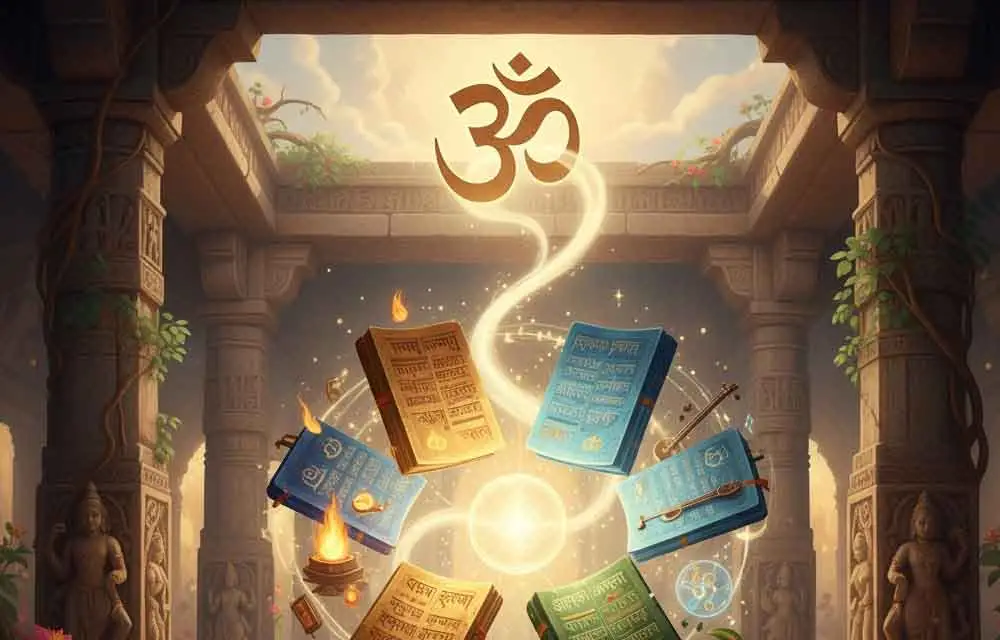
A deep exploration of how the Vedas, Upanishads, and Puranas anticipated modern AI and quantum computing — Indra's Net, Paramanu atomic theory, Akasha quantum field, Advaita entanglement, Brahman superposition, and stories from the Mahabharata that map perfectly to today's technology.
"Ekam sat viprā bahudhā vadanti" — Truth is one; the wise call it by many names.
— Rigveda 1.164.46
Our ancient seers — the Rishis — did not merely compose hymns. They mapped consciousness, reality, and information itself. Today's breakthroughs in Artificial Intelligence and Quantum Computing are, in many ways, a rediscovery of what the Vedas articulated thousands of years ago.
From quantum superposition to neural networks, from Indra's Net to the Akashic field — the parallels are profound, purposeful, and deeply inspiring for every Hindu. This article explores the remarkable resonance between the world's oldest knowledge tradition and the frontiers of 21st-century science.
Part 1 — Indra's Net: The Original Internet
Imagine an infinite cosmic net belonging to Indra, king of the gods. At every node hangs a brilliant jewel, and each jewel reflects every other jewel — infinitely, perfectly. This is the Vedic description of an interconnected universe where every node contains the whole.
Source: Atharva Veda · Avatamsaka Sutra
Modern AI neural networks are exactly this — millions of interconnected nodes, each influencing all others, producing intelligence from pure connection. The internet itself mirrors Indra's Net. Every webpage links to every other. Every AI model is trained on the reflection of reflections that is human knowledge.
The parallel:
- Each jewel in Indra's Net = each neuron in a neural network
- The reflection of all jewels = the distributed representation of knowledge across all parameters
- The infinite net = the global internet and the world wide web
Part 2 — AI & Consciousness
2.1 Chit — Pure Consciousness & Artificial Intelligence
Source: Aitareya Upanishad · Mandukya Upanishad
The Vedas describe three layers of existence: Sat (Being), Chit (Consciousness), and Ananda (Bliss). The concept of Chit — awareness that knows itself — is the oldest and deepest question in philosophy. Today, AI researchers wrestle with the same question: what is consciousness, and can a machine possess it?
"Prajnanam Brahma" — Pure intelligence is Brahman. (Aitareya Upanishad)
Modern Large Language Models (LLMs) process language as patterns — similar to how the Vedas describe Shabda Brahman (the universe as vibrating sound/word). The entire cosmos is a self-organising language model in the Vedic view.
2.2 Yantra, Automata & Artificial Beings
Source: Mahabharata · Ramayana · Arthashastra
The concept of artificial beings — constructed with intention and intelligence — is ancient in Hindu thought:
- Yantras in Sanskrit literally means "machine" or "device." Kautilya's Arthashastra describes mechanical birds, soldiers, and devices used in warfare and statecraft.
- Maya Danava, the divine architect of the asuras, created the city of Dwarka and mechanical contraptions of stunning complexity — ancient robotics.
- Nala's Bridge (Ramayana) — Rama's army of vanaras built a miraculous bridge using stones that floated, described in detail as a feat of applied science and coordination intelligence.
- Vishwakarma's automata — the divine craftsman created self-moving vehicles, celestial cities, and mechanical beings (Yantrapurushas) to serve the devas.
2.3 Akasha — The Quantum Field & Data Storage
Source: Vaisheshika Sutra · Chandogya Upanishad
Akasha is the first and subtlest of the five elements (Panchabhutas) — it pervades all space, carries all sound, and stores all information. The Vaisheshika school, one of the world's first scientific frameworks, described Akasha as the medium through which all forces and information travel.
Today's "cloud computing" and AI data storage mirrors this exactly — an invisible, omnipresent field holding all human knowledge, accessible from anywhere. The "Akashic Records" of mysticism are structurally identical to the modern data cloud.
- Akasha Tattva = Quantum field / Cloud storage
- Akashic Records = Internet Archive / AI training data
- Shabda (sound/vibration in Akasha) = Electromagnetic signal propagation
Part 3 — Quantum Computing & Vedanta
3.1 Brahman & Quantum Superposition
Source: Mandukya Upanishad · Advaita Vedanta
Quantum superposition states that a particle exists in all possible states simultaneously until observed. This precisely mirrors the Vedantic description of Brahman — the infinite, undifferentiated ground of being that contains all possibilities simultaneously.
- Brahman is Nirguna — containing all potentials in undifferentiated wholeness → A quantum particle exists in superposition (all states at once)
- Shristi (creation) is like "observation" — possibilities collapse into manifest reality → Measurement (observation) causes wave function collapse
- Vyavaharika (relative reality) emerges from Paramarthika (absolute reality) → Classical reality emerges from quantum probability
3.2 Quantum Entanglement & Advaita
Source: Brihadaranyaka Upanishad · Vedanta Sutra
Quantum entanglement: two particles, once connected, remain instantaneously correlated regardless of distance. Einstein called it "spooky action at a distance."
"Aham Brahmasmi" — I am Brahman.
"Tat tvam asi" — Thou art That.
The Vedas called it Advaita — non-duality. Both statements assert that separation is maya — illusion. At the deepest level, all beings are one entangled reality.
3.3 Paramanu — The World's First Atomic Theory
Source: Vaisheshika Darshana · Kanada's Sutras (~600 BCE)
Maharishi Kanada — whose very name means "particle eater" — founded the Vaisheshika school and formulated the world's first atomic theory. He proposed that all matter is composed of indivisible units called Paramanu (para = beyond, anu = atom).
Kanada's Paramanu theory predates Democritus by centuries. His description of atoms combining in specific ratios (dvi-paramanu, tri-paramanu) directly prefigures modern chemistry and quantum atomic theory.
3.4 Spanda — Vibration & Quantum Waves
Source: Kashmir Shaivism · Spanda Karikas
Kashmir Shaivism's concept of Spanda — the primordial vibration or "throb" of consciousness — is a remarkable parallel to quantum wave mechanics. Reality, in this view, is not matter but patterned vibration arising from pure awareness.
Quantum mechanics reveals the same: all matter is fundamentally wave-like. Particles are quantised vibrations in fields. The universe is, at its core, a symphony of vibrations — exactly as the Vedic Rishis sang in the Sama Veda.
Part 4 — Stories from the Puranas
Story 1 — Samudra Manthan: The Churning of the Ocean
The devas and asuras, rivals in an eternal contest, decided to cooperate for a single great purpose: to churn the cosmic ocean (Kshira Sagara — the Milky Sea) and extract Amrita, the nectar of immortality. Mount Meru became the churning rod. The great serpent Vasuki became the rope. Vishnu himself, as the Kurma avatar (tortoise), formed the pivot beneath the mountain.
AI Parallel: Training an AI model is precisely this — churning vast oceans of data using enormous computational power. Devas and asuras (competing algorithms, adversarial networks like GANs) cooperate and compete to extract intelligence — the Amrita of insight — from raw information.
The Halahala poison that emerged — so deadly it threatened all creation — represents the existential risks of advanced technology. Shiva consuming and containing it in his throat (becoming Neelakantha) mirrors how wise governance must contain the dangerous byproducts of technological power.
Quantum Parallel: The churning mirrors quantum computation — qubits in superposition "churn" all possible states simultaneously before collapsing to the optimal solution.
Story 2 — Arjuna's Vishwaroopa: The Universal Form
Source: Bhagavad Gita, Chapter 11
On the battlefield of Kurukshetra, Arjuna asks Krishna to reveal his true form. Krishna grants him Divya Drishti — divine sight. What Arjuna sees shatters him: the entire universe — past, present, and future — contained within one infinite, blazing form. Thousands of suns. All beings entering and exiting like rivers into the sea. Time itself consuming all.
AI Parallel: A trained AI model is a kind of Vishwaroopa — it has absorbed the entirety of human knowledge and can perceive patterns across all domains simultaneously. To interact with a modern LLM is to access a compressed reflection of all recorded human thought.
Quantum Parallel: The Vishwaroopa represents a quantum state before collapse — all possibilities, all timelines, all forms existing simultaneously in superposition. Divya Drishti is the quantum observer whose act of seeing collapses infinity into a single moment.
Story 3 — Garuda's Flight: The First Algorithm
Source: Mahabharata · Garuda Purana
Garuda, the divine eagle, is born with the specific mission to retrieve Amrita from the heavens and free his mother Vinata from bondage. He calculates his path with perfect precision, defeats armies of celestial guardians, bypasses a spinning chakra of razor blades, navigates past two giant serpents — all by applying pure intelligence to each obstacle in sequence.
AI Parallel: Garuda's journey is a perfect metaphor for pathfinding algorithms (like A* or Dijkstra) — navigating complex obstacle spaces with optimal, purposeful intelligence. His "one feather lost" to the Vajra is the acceptable loss function in machine learning optimisation.
Quantum Parallel: Quantum algorithms like Grover's algorithm search vast solution spaces exponentially faster — just as Garuda traversed the cosmos in moments through divine speed.
Story 4 — The City of Dwarka: Divine Computation
Source: Mahabharata · Bhagavata Purana
Dwarka, the golden city built by Vishwakarma at Krishna's direction, was designed with perfect geometric precision. It was said to be a city that functioned like a living organism — self-maintaining, self-organising, with roads that adjusted to the seasons, buildings that responded to light, and mechanisms that ensured perfect civic order.
AI Parallel: Dwarka is the Vedic vision of a Smart City — AI-managed urban infrastructure where systems self-optimise. Vishwakarma is the original AI engineer. Krishna directing its construction is the human-AI collaboration model: divine intention + machine execution.
When Krishna departed, Dwarka was submerged — not destroyed, but preserved beneath the ocean, waiting. Archaeological discoveries off the coast of Gujarat suggest a real sunken city matching these descriptions — now being studied as one of the world's great mysteries.
Story 5 — Drona's Brahmastra: Precision Targeting & Quantum Weapons
Source: Mahabharata · Drona Parva
The Brahmastra was the most powerful weapon in the Mahabharata — invoked not by physical force, but by precise mantra (sonic code), mental concentration, and specific intention. Once released, it could not be stopped by any physical means. It could target a single individual within millions, find its target across dimensions, and — crucially — could only be countered by another Brahmastra.
AI Parallel: Precision-guided weapons, AI-targeted drone swarms, and cybersecurity exploits that can identify a single vulnerability across billions of systems — these are the modern Brahmastras. The ethical debates around autonomous weapons mirror exactly the Mahabharata's warnings about using such weapons unwisely.
Quantum Parallel: Quantum cryptography and quantum hacking operate through principles that — like the Brahmastra — cannot be "observed" without being altered. Quantum key distribution is the Kavach (armour) that can only be defeated by quantum means.
Part 5 — Complete Parallels Reference
- Brahman (undifferentiated absolute) — Mandukya Upanishad → Quantum vacuum / Zero-point field
- Paramanu (indivisible particle) — Vaisheshika, Kanada ~600 BCE → Quantum particle / Quark
- Akasha (omnipresent space-information) — Chandogya Upanishad → Quantum field / Cloud computing
- Advaita non-duality — Brihadaranyaka Upanishad → Quantum entanglement
- Superposition of gunas — Samkhya Karika → Quantum superposition
- Shristi (observation causing manifestation) — Vedanta → Wave function collapse
- Indra's Net (interconnected jewels) — Atharva Veda → Neural networks / Internet
- Chit (pure awareness) — Aitareya Upanishad → Machine consciousness / AGI
- Shabda Brahman (universe as word) — Vakya Padiya → Large Language Models
- Yantra-Purusha (mechanical beings) — Mahabharata → Robots / Autonomous AI
- Spanda (primordial vibration) — Kashmir Shaivism → Quantum oscillation / String theory
- Nada Brahman (sound as creation) — Sama Veda → Wave-particle duality
- Karma (cause-effect information) — Nyaya Darshana → Machine learning (data → prediction)
- Brahmastra (precision intent-weapon) — Mahabharata → AI-guided autonomous weapons
- Maya (illusion of separate reality) — Shankara's Vivekachudamani → Simulation hypothesis / VR
Closing Reflection — Dharma in the Digital Age
The Rishis of the Vedic age were not primitive poets guessing at the nature of reality. They were rigorous investigators of consciousness, matter, and information — using the most advanced instrument available: the trained human mind in deep samadhi.
What they discovered — that reality is fundamentally informational, vibrational, and interconnected — is exactly what quantum physics and AI are now confirming through instruments of silicon and light.
For Hindus, this is not surprise. It is smaran — remembrance.
The task of our generation is not merely to adopt these technologies, but to imbue them with the ethical and spiritual wisdom our tradition has always carried. The Vedas did not just describe the universe — they provided the dharmic framework to navigate it wisely.
"Tamaso mā jyotirgamaya" — Lead us from darkness to light. (Brihadaranyaka Upanishad 1.3.28)
May the light of ancient wisdom guide the circuits of modern science.
Frequently Asked Questions
What is AI & Quantum Computing in the Vedas?
"Ekam sat viprā bahudhā vadanti" — Truth is one; the wise call it by many names. — Rigveda 1.164.46 Our ancient seers — the Rishis — did not merely compose hymns.
What are the key points about AI & Quantum Computing in the Vedas?
They mapped consciousness, reality, and information itself. Today's breakthroughs in Artificial Intelligence and Quantum Computing are, in many ways, a rediscovery of what the Vedas articulated thousands of years ago.
Why does AI & Quantum Computing in the Vedas matter in Hinduism?
It reflects core values of Sanatana Dharma and offers practical and spiritual guidance that remains relevant across generations.
How can devotees apply AI & Quantum Computing in the Vedas in daily life?
By reflecting on its teaching, incorporating the related practices or observances into daily routine, and approaching it with sincere devotion and understanding.
You might also like
Why Adhika Masam Comes Once in 3 Years — The Hidden Science Behind the Hindu Extra Month
Complete MBBS Once in Life: The Spiritual Meaning of Mahabharata, Bhagavatam, Bhagavad Gita & Ramayana
Karma, Rebirth, and Remembrance of God – Why Worship God Even During Good Times?