Brahmagupta: The Sage Who Gave the World Zero — A Jewel of Bharat’s Spiritual-Scientific Heritage
Rooted in Dharma and Knowledge: The Early Life of Brahmagupta In the sacred land of Bharat, where the rhythm of life is guided by dharma, spirituality, and the…
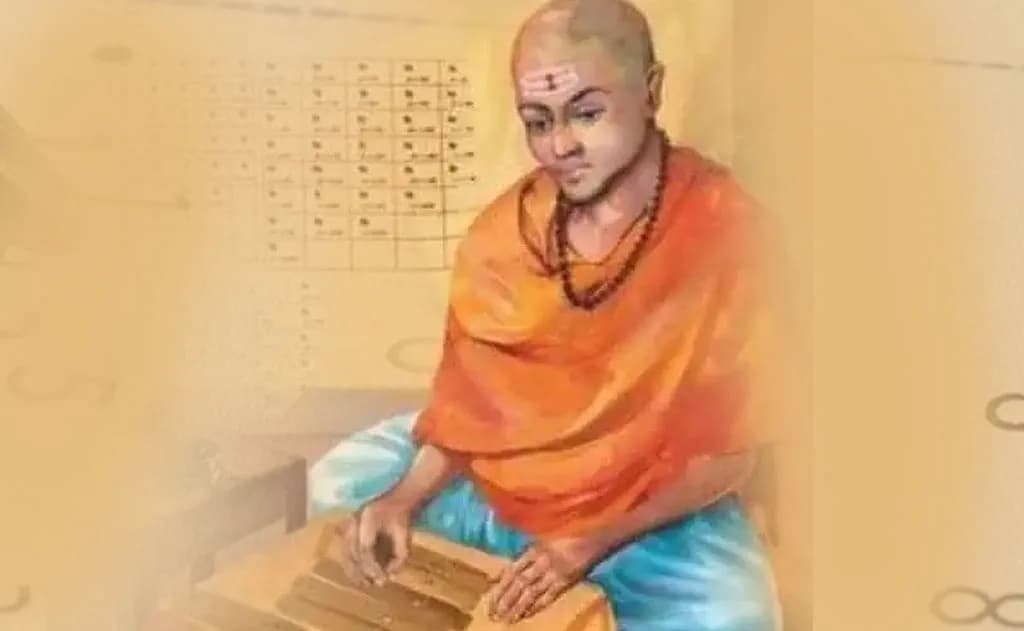
Rooted in Dharma and Knowledge: The Early Life of Brahmagupta In the sacred land of Bharat, where the rhythm of life is guided by dharma, spirituality, and the…
Rooted in Dharma and Knowledge: The Early Life of Brahmagupta
In the sacred land of Bharat, where the rhythm of life is guided by dharma, spirituality, and the eternal quest for truth, the year 598 CE witnessed the birth of a visionary. In Ujjain—one of India’s holiest cities known for its deep spiritual vibrations and astronomical wisdom—Brahmagupta was born. This city, sanctified by the presence of Mahakaleshwar Jyotirlinga, was not only a spiritual center but also a thriving seat of learning in ancient India.
Though details of his early life remain wrapped in mystery, Brahmagupta’s works reflect the timeless Bharatiya parampara (Indian tradition) of blending jnana (knowledge) with adhyatma (spiritual insight). Growing in the cradle of ancient Vedic astronomy and Ganita Shastra (mathematics), Brahmagupta became a shining example of how the ancient sages of India harmonized observation with intuition.
Brāhmasphuṭasiddhānta: A Divine Offering to Mathematics
At just 30 years old, Brahmagupta composed a masterful Sanskrit text, Brāhmasphuṭasiddhānta—“The Correctly Established Doctrine of Brahma.” Written in verses, this sacred treatise was more than a scholarly text—it was a mathematical yajna, a spiritual pursuit to understand the cosmos through numbers.
In this legendary work, Brahmagupta didn’t merely compute planetary positions or solve equations—he gifted the world the very concept of Zero (Shunya) as a complete number, not just a placeholder. This was a revelation born from the spiritual understanding of nothingness (Shunyata)—a concept deeply rooted in Hindu and Buddhist philosophy.
Zero: From Spiritual Emptiness to Mathematical Eternity
While other civilizations used symbols to denote ‘nothing,’ it was Brahmagupta who gave Shunya a soul. He treated it not as emptiness to be feared, but as a sacred force with defined mathematical rules:
- Zero plus zero is zero.
- A number minus itself is zero.
- A number times zero is zero.
- Division by zero is undefined—a mystery even he acknowledged.
In a world still clinging to tangible arithmetic, Brahmagupta saw the divine wisdom in the void, transforming the way humanity would understand numbers forever.
Debts and Wealth: Embracing the Dualities with Negative Numbers
True to the Vedantic philosophy of dualities, Brahmagupta introduced negative numbers, likening them to "debts" versus "wealth." Just as night and day, gain and loss, or life and death coexist in the cycle of samsara, so too did he accept positive and negative values as natural elements of mathematics. He set rules that modern algebra still follows—demonstrating that our rishis did not fear complexity, but embraced it with clarity.
Algebra, Geometry, and the Dance of the Cosmos
Brahmagupta’s brilliance echoed in algebra, where he worked with quadratic equations, series, and geometric principles. His formula for the area of cyclic quadrilaterals—now known as Brahmagupta’s Theorem—still finds its place in textbooks today.
But what’s more remarkable is that his work was always in service of understanding the divine cosmos. His calculations were not just mathematical—they were spiritual mappings of the celestial order, helping sages and priests predict eclipses, tithis, and planetary alignments with accuracy.
Astronomy Rooted in Truth and Bold Inquiry
Brahmagupta did not blindly follow tradition—he dared to question and refine it. He aligned with great thinkers like Aryabhata, supporting the idea of a spherical and rotating Earth—centuries ahead of European discoveries. His astronomical charts, based on observations and calculations, served temple priests, astrologers, and navigators for generations.
From Ujjain to the World: The Global Journey of Indian Wisdom
In the 8th century, his works were translated into Arabic during the Islamic Golden Age. They profoundly influenced Al-Khwarizmi, the father of algebra, whose writings would later spread to Europe. Thus, through Brahmagupta, Bharatiya jnana (Indian knowledge) crossed deserts and seas, laying the foundations for modern science and computing.
Legacy of a Rishi-Mathematician
While the exact date of Brahmagupta’s death remains unknown, his ideas live on—proof that Bharat’s contributions to science are not only ancient but eternal. His spiritual-scientific mindset, grounded in the understanding of Shunya, duality, and cosmic rhythm, continues to resonate in every calculator, computer, and equation we use today.
Brahmagupta’s story is not just about numbers—it is about the sacred pursuit of truth. He is a beacon of what makes Hindu civilization unique: the ability to blend spirit and science, philosophy and logic, the divine and the empirical.
Let us honor such rishis of Ganita through platforms like www.hindutone.com, reminding the world that Bharat was, is, and always will be a guiding light in the journey of human knowledge.
Frequently Asked Questions
What is Brahmagupta?
Rooted in Dharma and Knowledge: The Early Life of Brahmagupta In the sacred land of Bharat , where the rhythm of life is guided by dharma, spirituality, and the eternal quest for truth, the year 598 CE witnessed the birth of a visionary. In Ujjain —one of India’s holiest cities known for its deep spiritual vibrations and astronomical wisdom— Brahmagupta was
What are the key points about Brahmagupta?
This city, sanctified by the presence of Mahakaleshwar Jyotirlinga , was not only a spiritual center but also a thriving seat of learning in ancient India. Though details of his early life remain wrapped in mystery, Brahmagupta’s works reflect the timeless Bharatiya parampara (Indian tradition) of blending jnana (knowledge) with adhyatma
Why does Brahmagupta matter in Hinduism?
It reflects core values of Sanatana Dharma and offers practical and spiritual guidance that remains relevant across generations.
How can devotees apply Brahmagupta in daily life?
By reflecting on its teaching, incorporating the related practices or observances into daily routine, and approaching it with sincere devotion and understanding.
You might also like
Shani Jayanti 2026: Date, Significance, Rituals & Powerful Mantras
Sacred Hindu Festivals & Temple News: Divine Week — May 2026
Shani Deva Temples Worldwide & Must-Performed Rituals — Complete Devotee's Guide