Ganesh Aarti — Sukhkarta Dukhharta: Lyrics, Meaning and How to Perform
The traditional Ganesh aarti Sukhkarta Dukhharta, its opening lines, faithful meaning, and a simple guide to performing aarti with your family.

The traditional Ganesh aarti Sukhkarta Dukhharta, its opening lines, faithful meaning, and a simple guide to performing aarti with your family.
Quick answer: Sukhkarta Dukhharta is the most widely sung Ganesh aarti, traditionally attributed to the 17th-century Marathi saint Samarth Ramdas. Its opening line hails Ganesha as the maker of happiness and remover of sorrow. It is sung at the close of the puja while circling a lit lamp before the deity.
Few devotional songs are as instantly recognisable across Indian homes as Sukhkarta Dukhharta, the beloved Ganesh aarti sung to Lord Ganesha at the end of the daily puja and throughout the Ganesh Chaturthi festival. Its cadence is simple enough for a child to learn, yet its words carry a deep affection for the elephant-faced deity who is worshipped first among all gods.
This aarti is traditionally attributed to the 17th-century Marathi saint Samarth Ramdas (Ramdas Swami), guru of Chhatrapati Shivaji. Because it belongs to the classical devotional tradition and is centuries old, its text is in the public domain and has been passed down through countless households, temples and mandals. Below we share the well-known opening lines with a careful transliteration and a faithful, line-by-line meaning, followed by a practical guide to performing aarti at home.
Who wrote Sukhkarta Dukhharta?
The aarti is composed in Marathi and is one of the best-loved bhajans in the Maharashtrian tradition, though it is now sung far beyond Maharashtra. It is customarily attributed to Samarth Ramdas, the saint-poet who also composed the Manache Shlok and the Dasbodh. As with many devotional works of that era, the aarti was preserved orally and in handwritten pothis long before print, and small regional variations in wording exist between families and regions — all of them equally valid.
Ganesh Chaturthi in 2026 falls on Monday, 14 September 2026 (Bhadrapada Shukla Chaturthi). During the festival, this aarti is sung morning and evening before the installed idol, often ending the community aarti at pandals across cities.
Sukhkarta Dukhharta — opening lines
Below are the widely-attested opening lines of the aarti in Devanagari with a Roman transliteration. This is the portion nearly every devotee knows by heart. Later verses of the full aarti are traditionally recited too; where a family's exact wording of the later stanzas differs, follow your own household or local mandal tradition rather than a single printed version.
सुखकर्ता दुःखहर्ता, वार्ता विघ्नाची।
Sukhakarta dukhaharta, varta vighnachi.
नुरवी पुरवी प्रेम कृपा जयाची॥
Nurvi purvi prem krupa jayachi.
सर्वांगी सुंदर, उटी शेंदुराची।
Sarvangi sundar, uti shendurachi.
कंठी झळके माळ, मुक्ताफळांची॥
Kanthi zhalke mala, muktaphalanchi.
जय देव जय देव, जय मंगलमूर्ती।
Jai dev jai dev, jai mangalmurti.
दर्शनमात्रे मनकामना पुरती॥
Darshanmatre manakamana purti.
Line-by-line meaning
Here is a faithful, plain-sense translation of these opening lines. It aims to convey the devotional intent rather than a word-perfect literary rendering.
| Line | Meaning |
|---|---|
| Sukhakarta dukhaharta | (Ganesha is the) giver of happiness and remover of sorrow |
| Varta vighnachi, nurvi purvi | He removes obstacles and does not let them remain; he fulfils (the devotee's needs) |
| Prem krupa jayachi | His is a love and grace (that flows to all) |
| Sarvangi sundar, uti shendurachi | Beautiful in every limb, anointed with vermilion (shendur) |
| Kanthi zhalke mala, muktaphalanchi | On his neck shines a garland of pearls |
| Jai dev jai dev, jai mangalmurti | Victory to the Lord, victory to the auspicious form (Mangalmurti) |
| Darshanmatre manakamana purti | By his mere sight (darshan), the heart's wishes are fulfilled |
The refrain Jai dev jai dev is the chorus that returns after each stanza, and Mangalmurti Morya is the joyous call that families and crowds raise at the very end — Morya being a tender, traditional name for Ganesha, associated with the Moraya Gosavi tradition of Chinchwad.
How to perform Ganesh aarti at home
Aarti is the act of offering light to the deity while singing his praise. It is usually the concluding part of the puja, performed after the offerings of flowers, naivedya (such as modak) and incense. You do not need elaborate materials — sincerity matters more than grandeur.
Preparing the aarti thali
- A metal aarti lamp (niranjan) or a five-wick lamp, lit with cotton wicks and ghee or oil
- A small bell to ring during the singing
- Optional: a few flowers, unbroken rice (akshata), and a piece of camphor (kapur) for the flame
- A clean cloth or plate (thali) to hold everything steadily
The steps
- Complete the main puja first — offer water, flowers, the 21 patri leaves where observed, sweets and incense.
- Light the lamp on the thali and, if using, light a small piece of camphor.
- Hold the thali or lamp in your right hand, steadying it with the left, and stand before the idol.
- Begin singing Sukhkarta Dukhharta, ringing the bell gently with the other hand or having a family member ring it.
- Move the lamp in slow, clockwise circles in front of the deity — many families do an odd number of rotations such as three, five or seven, though local custom varies.
- Sing the full aarti with family and, at the close, raise the joyous chant of Ganpati Bappa Morya, Mangalmurti Morya.
- Afterwards, some devotees pass the warmth of the flame over their own eyes and head as a gesture of receiving blessings, then distribute prasad.
There is no single correct number of circles or exact sequence that binds every household; Maharashtrian, Telugu, Tamil, Kannada and North Indian families each keep slightly different customs, and all are equally valid. What unites them is the shared act of gathering, singing together and offering light with love. For festival timings specific to your city, always confirm from a reliable local panchang rather than a fixed clock time, since muhurats vary by location.
Singing it as a family
The aarti is meant to be sung aloud and together, not read silently. During Ganesh Chaturthi many households sing it twice daily, and neighbourhood mandals sing it in chorus before large pandal idols. Teaching children the opening lines is a gentle way to pass on the tradition; the tune is repetitive and easy, and the clapping and bell-ringing keep everyone engaged. If you are unsure of a later verse, it is perfectly acceptable to hum along and join clearly on the refrain — devotion, not perfection, is the spirit of aarti.
Related reading
- Ganesh Chaturthi 2026 date and city-wise muhurat
- Ganpati Atharvashirsha — meaning and full text
- Ganesh Ashtottara — 108 names of Ganesha
- The 21 patri leaves used in Ganesh puja
- Ganesh Visarjan 2026 dates and vidhi
Frequently Asked Questions
Who wrote the Sukhkarta Dukhharta aarti?
The aarti is traditionally attributed to Samarth Ramdas (Ramdas Swami), the 17th-century Marathi saint-poet and guru of Chhatrapati Shivaji. Composed in Marathi, it belongs to the classical devotional tradition and is centuries old, placing its text in the public domain. Because it was preserved orally for generations, small regional variations in the later verses exist between families.
What does Sukhkarta Dukhharta mean?
The opening words mean that Lord Ganesha is the giver of happiness (sukha-karta) and the remover of sorrow (dukha-harta). The line goes on to describe him as one who removes obstacles, whose grace and love flow to devotees, who is beautiful in every limb and anointed with vermilion, wearing a garland of pearls at his neck.
When is the aarti sung during the puja?
Aarti is generally the concluding part of the puja, sung after offering water, flowers, incense and naivedya such as modak. During Ganesh Chaturthi many families perform it morning and evening before the installed idol, and community mandals sing it in chorus at pandals, ending with the joyous chant of Ganpati Bappa Morya.
How many times should the lamp be circled?
There is no single binding rule. Many families move the lamp in slow clockwise circles an odd number of times such as three, five or seven, while others simply circle it a few times with devotion. Maharashtrian, Telugu, Tamil, Kannada and North Indian households each keep slightly different customs, and all are equally valid.
What should the aarti thali contain?
A typical thali holds a lit lamp (niranjan) with cotton wicks and ghee or oil, and often a small bell to ring during the singing. Many devotees add a piece of camphor, a few flowers and unbroken rice. Sincerity matters more than elaborate materials, so a simple lamp offered with love is entirely enough.
What does Mangalmurti Morya mean?
Mangalmurti means the auspicious form or idol of Ganesha, and Morya is a tender traditional name for him, associated with the Moraya Gosavi devotional tradition of Chinchwad. The joyous call Ganpati Bappa Morya, Mangalmurti Morya is raised by families and crowds at the close of the aarti as an affectionate cry of praise.
When is Ganesh Chaturthi in 2026?
Ganesh Chaturthi in 2026 falls on Monday, 14 September 2026, on Bhadrapada Shukla Chaturthi. Throughout the festival the Sukhkarta Dukhharta aarti is sung morning and evening before the idol. For puja and visarjan timings specific to your city, always confirm from a reliable local panchang, as muhurats vary by location.
Can children learn and sing this aarti?
Yes, and teaching them is a gentle way to pass on the tradition. The tune is repetitive and easy, and the opening lines are short enough for a child to memorise. Clapping and bell-ringing keep everyone engaged. If a later verse is unfamiliar, it is perfectly fine to hum along and join clearly on the refrain, since devotion matters more than perfect recitation.
Related guides you may find helpful
You might also like
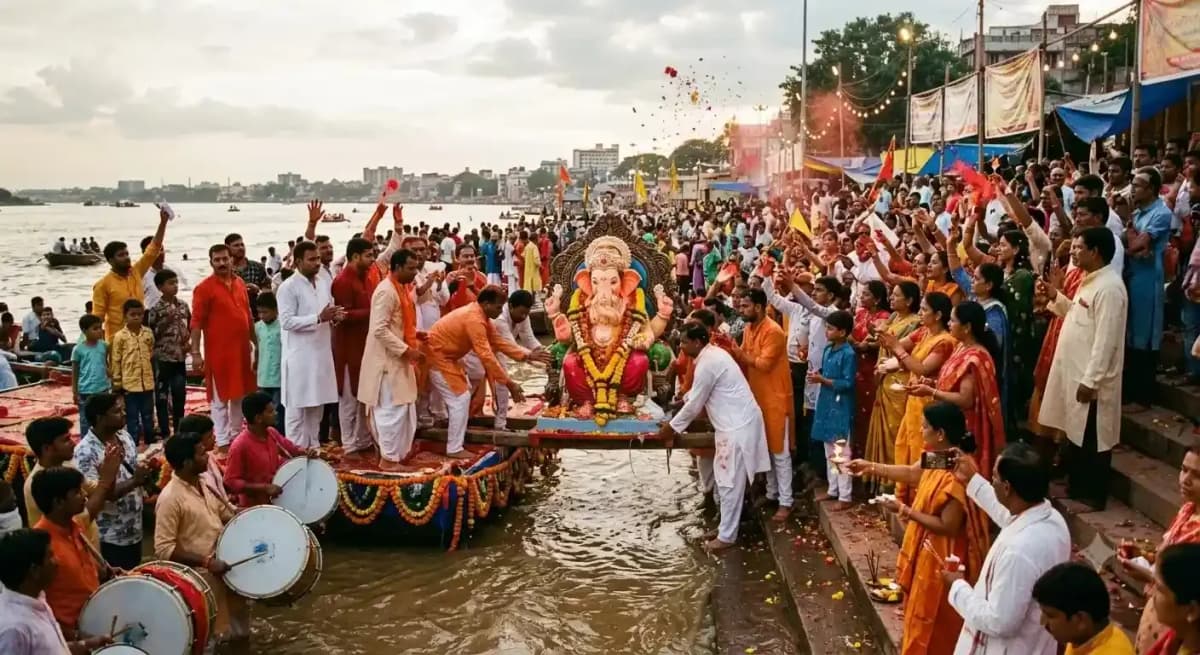
Ganesh Visarjan 2026 in North India: Delhi, Lucknow & NCR Immersion Guide
Bathukamma Songs & Nine-Day Rituals: Naivedyam, Folk Songs & Aatapata Guide

Champa Shashthi 2026: Date, Khandoba Worship & Jejuri's Golden Festival