Experiencing Dussehra in Mysore: A Traveler’s Guide
As the golden hues of autumn kiss the earth, the ancient city of Mysore awakens to the rhythmic beats of drums, the fragrance of jasmine garlands, and the…
As the golden hues of autumn kiss the earth, the ancient city of Mysore awakens to the rhythmic beats of drums, the fragrance of jasmine garlands, and the…
As the golden hues of autumn kiss the earth, the ancient city of Mysore awakens to the rhythmic beats of drums, the fragrance of jasmine garlands, and the divine glow of a thousand lamps. Imagine standing amidst a sea of devotees, your heart swelling with bhakti, as the majestic Mysore Palace transforms into a celestial jewel under 100,000 twinkling bulbs.
This is Dussehra—or Dasara, as it’s reverently known in Karnataka—not merely a festival, but a living tapestry of devotion, royalty, and triumph. For Hindus worldwide, Dussehra symbolizes the victory of good over evil, commemorating Lord Rama’s defeat of Ravana and Goddess Durga’s slaying of Mahishasura. In Mysore, it elevates into a state-sponsored spectacle, blending spiritual fervor with cultural opulence.
If you’re seeking a soul-stirring pilgrimage that marries the sacred with the spectacular, Mysore’s Dasara is your ultimate calling. This guide unveils the complete devotional journey—from dawn pujas to midnight illuminations—ensuring your visit to this UNESCO-recognized heritage city becomes an unforgettable odyssey of faith.
The Eternal Flame: History and Spiritual Significance
Rooted in the Vedas and Puranas, Dussehra is more than celebration; it is a profound spiritual reset, urging devotees to shed inner demons like ego and ignorance.
In Mysore, the festival traces back to the 17th century under the Wodeyar dynasty, who envisioned it as a royal affirmation of dharma. Legend whispers that Goddess Chamundeshwari, the fierce incarnation of Durga, vanquished the buffalo demon Mahishasura on these hills, bestowing her eternal blessings upon the land. The Wodeyars institutionalized Dasara as “Nadu Habba” (State Festival)—a 10-day homage to the divine feminine Shakti.
At its core, Mysore Dasara is a devotional symphony. Each day honors a different aspect of the goddess—from subtle (sukshma) to gross (stula)—culminating in Vijayadashami, the day of unalloyed victory. Rituals like Ayudha Puja, where tools and weapons are worshipped, remind us that every act of creation is sacred.
Led by Yaduveer Krishnadatta Chamaraja Wadiyar, the current scion of the Wodeyars, the festival bridges ancient lore with contemporary devotion, drawing over 50 lakh pilgrims annually. Amid incense-laden air and Vedic chants, one feels the pulse of Bharat’s sanatan dharma—timeless, inclusive, and transformative.
Best Time to Visit Mysore for Dasara 2025
Mysore’s climate is pleasant from October to March, with temperatures between 15°C and 30°C. But the true magic flows during Dasara, when the city pulses with prana (life force).
- 2025 Festival Dates: September 22 – October 2
- Grand Inauguration: September 22 at Chamundeshwari Temple (10:10–10:40 AM)
- Vijayadashami: October 2, Vijaya Muhurat 2:13–3:01 PM
Travel Tips:
- Arrive a day early (September 21) to acclimate.
- First week (Sept 23–29) is ideal for immersive devotionals.
- Finale (Sept 30–Oct 2) requires advance planning due to large crowds.
- Book flights, trains, and stays 3 months in advance; Dasara inflates prices by 50–100%.
For a quieter spiritual visit outside Dasara, spring (March–April) for Ugadi or summer (May–June) for the palace illuminations is recommended.
A Devotional Journey: Day-by-Day Highlights
Mysore Dasara is a 10-day pilgrimage, a spiritual circuit weaving through temples, rituals, and cultural spectacles.
Days 1–3: Awakening the Subtle Shakti (Sept 23–25)
- Chamundeshwari Temple: 1,000 steps up Chamundi Hills; 12th-century shrine of the eight-armed goddess.
- Join the royal inaugural pooja at 9 AM; offer personal archana for health and harmony.
- Visit the Bull Temple (Nandi Temple) en route for silent meditation.
- Evenings: Veda Parayanam at Mysore Palace’s Durbar Hall, 300 scholars reciting sacred texts.
Days 4–6: Manifesting the Gross Forms (Sept 26–28)
- Kote Anjaneya Temple: Dedicated to Hanuman.
- Ayudha Puja: Sanctification of tools and instruments, embodying karma yoga.
- Visit Shweta Varahaswamy Temple and explore Devaraja Market for ritual paraphernalia.
Days 7–9: Culminating in Cosmic Dance (Sept 29–Oct 1)
- Lakshmi Narayana Temple: Vedic fire rites (Narayana Homa).
- Navami Pooja: Grand adornment of the goddess atop Chamundi Hills.
- Offbeat shrines: Gayathri Temple, Adi Lakshmamma Temple, and women-led kolu displays narrating Ramayana.
Day 10: Vijayadashami – Triumph of the Spirit (Oct 2)
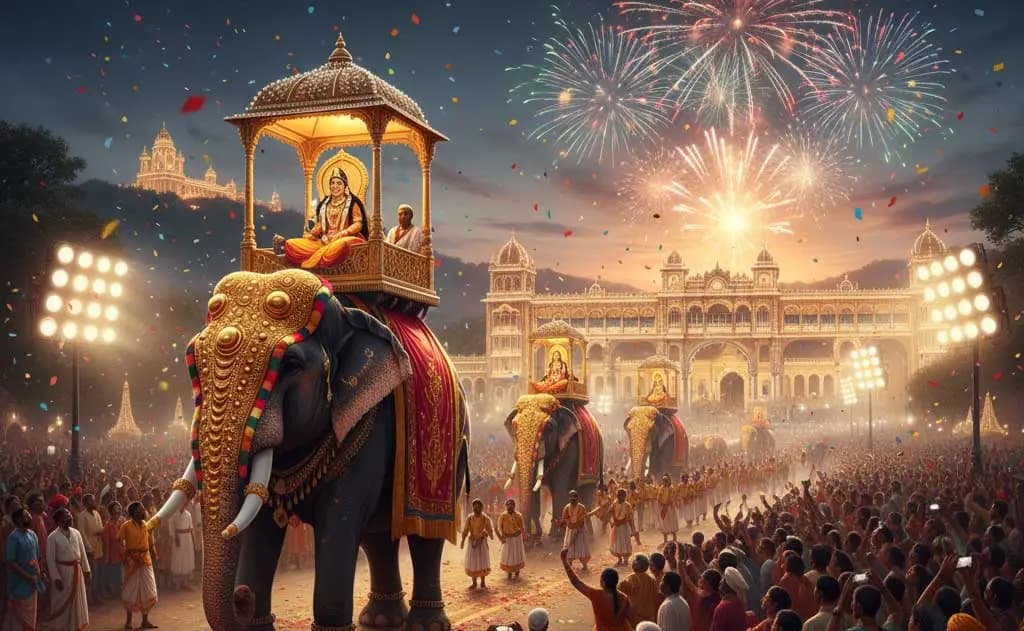
- Golden Howdah Procession: Goddess enthroned atop the majestic elephant “Kanjanur”.
- Participate in a personal Vijayadashami puja at Trinesvara Temple.
- Total devotional activity spans over 20 hours, connecting deeply with the eternal feminine.
Icons of Devotion: Palace Illumination & Jamboo Savari
- Mysore Palace Illumination: 97,000 eco-friendly LEDs, 7:00–7:45 PM, synchronized to devotional kritis.
- Jamboo Savari Procession: Oct 2, 12 PM; 750 kg golden howdah, 25 elephants, 30 bands, folk troupes, and royal escort.
- Other Highlights: Torchlight Parade (Sept 30) and Sarang Air Show (Sept 27).
These spectacles blend devotion with drama, celebrating valor, faith, and triumph.
Practical Tips for Festival Travelers
Reaching Mysore
- Flights: Mysore Airport (MYQ), direct from Bengaluru and Mumbai.
- Trains: Mysore Express from Chennai, Howrah-Mysore Duronto.
- Buses: Karnataka RTC, central hubs; taxis 140 km from Bengaluru ₹2,500–3,500.
Staying Options
- Heritage: Royal Orchid Metropole (~₹8,000/night)
- Budget: Ginger Hotel (~₹2,500/night), Zostel Hostel
- Luxury: Pai Vikram Heritage (~₹15,000/night)
Getting Around
- Autos: ₹20/km; cycle rickshaws, e-rickshaws.
- KSRTC shuttle buses loop festival zones free of charge.
- Scooters: ₹500/day; park at designated lots.
Insider Tips
- Crowds: Dawn darshans avoid peak rush.
- Etiquette: Cover shoulders/knees, vegetarian feasts.
- Health: Pack repellents; hydrate with filtered water.
- Sustainability: Avoid single-use plastics.
- Budget: Approx ₹40,000/person for 10 days (flights, stay, food/transport).
Epilogue: Carrying the Light Home
As the final aarti fades and the palace dims, Mysore Dasara leaves an indelible tilak on your soul. This is not merely a vacation—it’s a varadan (boon), a brush with the infinite, and an awakening of your inner light. Return home with memories, mantras, and stories to inspire others.
Jai Mata Di! Plan your 2025 pilgrimage at www.hindutone.com
Frequently Asked Questions
When is Experiencing Dussehra in Mysore?
Experiencing Dussehra in Mysore is observed on its traditional tithi in the Hindu lunar calendar; refer to the year's panchang for the exact date in your region.
What is the significance of Experiencing Dussehra in Mysore?
As the golden hues of autumn kiss the earth, the ancient city of Mysore awakens to the rhythmic beats of drums, the fragrance of jasmine garlands, and the divine glow of a thousand lamps. Imagine standing amidst a sea of devotees, your heart swelling with bhakti , as the majestic Mysore Palace transforms into a celestial jewel under 100,000 twinkling bulbs .
How is Experiencing Dussehra in Mysore celebrated?
Devotees observe it with puja, fasting or special offerings, visiting temples, chanting mantras, and gathering with family. Customs vary by region and tradition.
What should devotees do on Experiencing Dussehra in Mysore?
Take a sacred bath, perform the day's puja and charity (dana), observe any prescribed fast, and chant mantras with sincere devotion.
You might also like
Hindu Festival Calendar 2026 — Complete Guide for NRIs (Dates, Tithis, Puja)
The Resolve of a Monk – A Divine Incident Showcasing Kanchi Paramacharya’s Compassion

ISKCON to Serve Pure Sattvik Mid-Day Meals to School Children in Bengal | Suvendu Adhikari Initiative