Vijayadashami 2025: Inner Victory
Every year, as the festive season reaches its pinnacle, Dussehra — also known as Vijayadashami — arrives to remind us of the timeless truth: good will always…
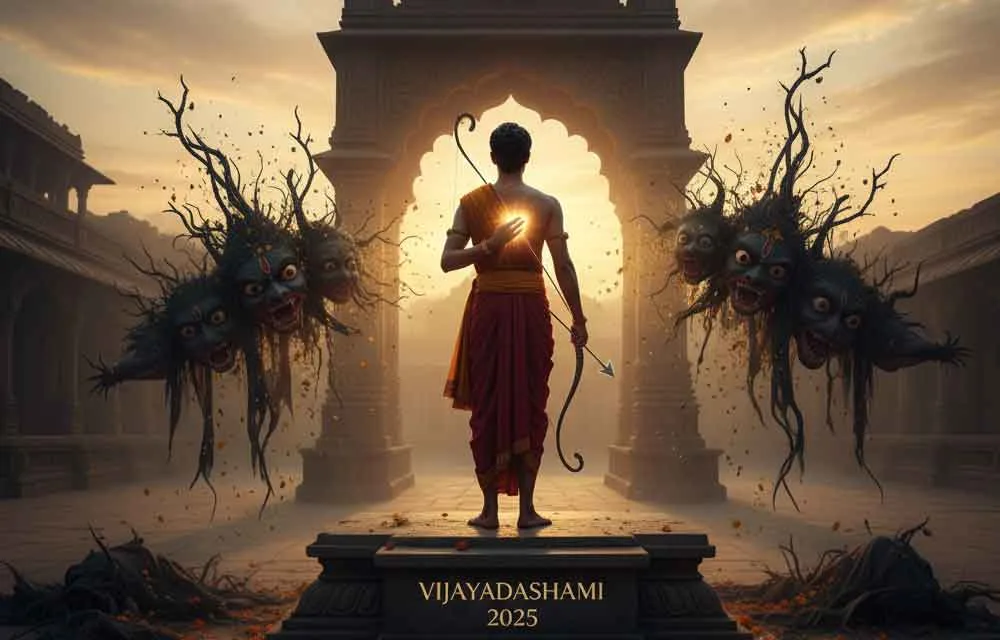
Every year, as the festive season reaches its pinnacle, Dussehra — also known as Vijayadashami — arrives to remind us of the timeless truth: good will always…
Every year, as the festive season reaches its pinnacle, Dussehra — also known as Vijayadashami — arrives to remind us of the timeless truth: good will always triumph over evil. While we celebrate Lord Rama’s victory over Ravana and Goddess Durga’s triumph over Mahishasura, the festival also carries a profound spiritual message that goes far beyond mythology.
The Symbolism of Ravana’s Ten Heads
Ravana, the mighty king of Lanka, was not just a figure of power and knowledge but also of arrogance and unchecked desires. His ten heads symbolize the negative traits that exist within all of us:
- Anger
- Greed
- Pride
- Lust
- Jealousy
- Selfishness
- Injustice
- Attachment
- Ego
- Hatred
Burning the effigy of Ravana each year is not just a ritual; it is a reminder that we too must conquer these inner demons.
Dussehra as a Journey Within
True victory is not only about defeating external enemies but also about winning over the battles we fight within. When we let go of envy, control our anger, and replace ego with humility, we experience our own Vijayadashami — an inner victory of the soul.
This Dussehra, let us:
🌿 Choose compassion over hatred.
🔥 Burn away arrogance with humility.
✨ Replace fear with courage.
💫 Walk the path of truth, just as Lord Rama did.
The Blessings of the Divine
May Goddess Durga fill us with strength to fight life’s battles with grace.
May Lord Rama inspire us to live a life of righteousness and dharma.
May this Vijayadashami 2025 mark the beginning of new victories in your personal and spiritual journey.
As the effigies of Ravana burn tomorrow, let us also burn the negativity within us — and rise, renewed, in light, truth, and positivity.
What do the scriptures actually say about Vijayadashami?
The Ramayana of Valmiki describes the tenth day of Ashvina's bright fortnight as the moment Rama finally slew Ravana after a fierce battle at Lanka — a battle that had been preceded by the Sharada Navaratri, nine nights of intense worship of the Divine Mother. The Devi Bhagavata Purana records a parallel victory: Goddess Durga, having fought the buffalo-demon Mahishasura for nine nights, decapitated him on the tenth day, which is why this tithi earned the name Vijayadashami — 'the tenth of victory.'
The Markandeya Purana's Devi Mahatmya (also called Durga Saptashati) contains the famous verse 'Ya Devi sarvabhuteshu shakti-rupena samsthita' — saluting the Goddess as the very power dwelling within all beings. Reading or hearing this text during Navaratri is considered a direct preparation for Vijayadashami, so that the devotee arrives at the tenth day already internally aligned with the force of dharma.
Why is Vijayadashami considered the most auspicious day for new beginnings?
Ancient Dharmashastra texts classify Vijayadashami as one of the three-and-a-half 'Muhurta-free' days (Sade-teen Muhurte) — moments so inherently auspicious that no separate astrological calculation is needed before starting a new venture. Traditionally, warriors consecrated their weapons (Ayudha Puja), merchants opened new ledgers, scholars began fresh studies, and farmers initiated the harvest season on this very day.
The tradition of Vidyarambha — formally initiating children into letters and learning — is widely observed on Vijayadashami, especially in Kerala's Saraswati temples such as Thunchan Parambu in Tirur and at the Saraswati shrine within the Sree Padmanabhaswamy Temple complex in Thiruvananthapuram. The logic is deeply Vedic: Saraswati, worshipped through Navaratri, is honoured on the tenth day by setting knowledge itself into motion.
In the Mysuru Dasara celebration — one of the grandest state observances in Karnataka — the royal tradition of the Wadiyar dynasty includes a procession of the golden howdah elephant and the ritual of 'Shami Puja,' worshipping the Shami tree. This custom traces back to the Mahabharata, where the Pandavas concealed their weapons (including Arjuna's Gandiva bow) in a Shami tree during their year of incognito exile and retrieved them on Vijayadashami before the Kurukshetra war.
How does the Goddess Durga narrative deepen the inner-victory message?
The Devi Mahatmya presents Mahishasura not simply as an external monster but as the embodiment of Tamas — the quality of inertia, delusion, and brute force that prevents a soul from recognising its own divine nature. Durga, whose name literally means 'she who removes difficulty (durgati),' represents the concentrated Shakti of all the devas. When they could not individually overcome Mahishasura, they pooled their energies into one luminous form — a teaching that inner transformation often requires the gathering of all one's inner resources rather than partial effort.
The Goddess's eighteen arms in iconography carry instruments belonging to different deities: Vishnu's Sudarshana Chakra, Shiva's Trishula, Indra's Vajra, Agni's flame. Each weapon corresponds to a quality — discernment, will, discipline, illumination. Vijayadashami thus invites the devotee to ask: which of these inner weapons have I developed through the nine nights of practice, and am I ready to wield them wisely?
What is the significance of Rama's Sharada Puja before battle, and what does it teach us?
The Krittivasi Ramayana (Bengali recension) and several Puranic commentaries describe that Rama, despite being an avatar of Vishnu, chose to worship Goddess Durga for nine days before confronting Ravana — a tradition called Akal Bodhan, the 'untimely awakening' of the Goddess, since autumn was not her traditional season of worship. This narrative carries a subtle teaching: even one who embodies righteousness prepares through devotion and self-purification before facing the greatest challenges.
Rama's act of surrender to the Divine Mother before battle is a model of the Vedantic principle that human effort (purusha-prayatna) must be accompanied by grace (Ishvara anugraha). The Vijayadashami that follows is therefore not just a reward for fighting, but the fruit of nine days of disciplined inner work — fasting, prayer, self-restraint, and surrender. This is the 'inner victory' the festival asks each devotee to replicate in their own life.
How is Vijayadashami observed differently across India's sacred geography?
At the Kulasekhara Perumal Temple precincts in Kollam and across Tamil Nadu, Navaratri concludes with Golu (the display of dolls representing divine hierarchy), and Vijayadashami marks the day students return their books to the altar and formally resume studies. In West Bengal, the same day is Vijaya Dashami within Durga Puja — the immersion (visarjan) of clay Durga murtis in the Ganga, Hooghly, or local water bodies, accompanied by the ritual of sindoor khela where married women apply vermilion to the Goddess and to each other.
In the Kullu Valley of Himachal Pradesh, Vijayadashami launches a seven-day Dussehra that is unique in India — here it begins rather than ends on the tenth day, with over two hundred local devatas (village deities) brought in palanquins from surrounding valleys to pay homage to Raghunathji (Rama) at the Dhalpur Maidan. The sheer breadth of regional practice illustrates how a single tithi can be simultaneously a moment of closure and of new beginning, of immersion and of emergence.
How can a modern practitioner translate Vijayadashami's message into daily sadhana?
The Bhagavad Gita's second chapter describes the sthitaprajna — one of steady wisdom — as someone who has conquered precisely the inner forces Ravana's ten heads represent: kama (desire), krodha (anger), and lobha (greed) being the triad the Gita identifies as the 'triple gate to hell' (16.21). Vijayadashami is an annual checkpoint: have these internal fires grown smaller over the past year, or larger?
A practical Vijayadashami sadhana can begin the evening before by writing down one quality from Ravana's ten-headed symbolism that has most troubled you in the year — not as self-condemnation but as clear seeing. On the day itself, take up one concrete discipline: a vow of silence for a morning, a deliberate act of forgiveness, or the beginning of a new study of scripture. The Shami-leaf exchange common in Maharashtra — where friends and family give each other Shami leaves saying 'Shami samati papam' (Shami destroys sin) — is a beautiful ritual acknowledgment that transformation is communal, not only individual.
As the Taittiriya Upanishad famously closes: 'Satyam vada, Dharmam chara' — speak truth, walk the path of dharma. Vijayadashami's deepest invitation is to make that instruction not a one-day resolution but the foundation of the year that now begins.
Frequently Asked Questions
When is Vijayadashami?
Vijayadashami is observed on its traditional tithi in the Hindu lunar calendar; refer to the year's panchang for the exact date in your region.
What is the significance of Vijayadashami?
Every year, as the festive season reaches its pinnacle, Dussehra — also known as Vijayadashami — arrives to remind us of the timeless truth: good will always triumph over evil . While we celebrate Lord Rama ’s victory over Ravana and Goddess Durga’s triumph over Mahishasura, the festival also carries a profound spiritual message that goes far beyond mytholog
How is Vijayadashami celebrated?
Devotees observe it with puja, fasting or special offerings, visiting temples, chanting mantras, and gathering with family. Customs vary by region and tradition.
What should devotees do on Vijayadashami?
Take a sacred bath, perform the day's puja and charity (dana), observe any prescribed fast, and chant mantras with sincere devotion.
You might also like
Gita Jayanti 2026 Prasad Recipes — Tulsi-Honoring Sweets, Krishna's Favourites & December 10 Bhog Plate
Shani Deva Temples Worldwide & Must-Performed Rituals — Complete Devotee's Guide
Maha Shivratri 2026 Vrat Recipes — Sabudana Khichdi, Singhada Halwa, Phalahara Foods Complete Fasting Guide