Navratri & Dussehra 2026: Complete Guide to 9 Days of Devi Worship
Introduction: The Divine 9 Nights That Move the World In the sacred rhythm of the Hindu calendar, few festivals stir the soul as deeply as Navratri — the…
Introduction: The Divine 9 Nights That Move the World In the sacred rhythm of the Hindu calendar, few festivals stir the soul as deeply as Navratri — the…
Introduction: The Divine 9 Nights That Move the World
In the sacred rhythm of the Hindu calendar, few festivals stir the soul as deeply as Navratri — the festival of nine divine nights. Meaning "Nav" (nine) + "Ratri" (nights) in Sanskrit, Navratri is not merely a festival; it is a cosmic event — a period when the divine feminine energy of the universe descends to Earth, blessing all who bow in devotion.
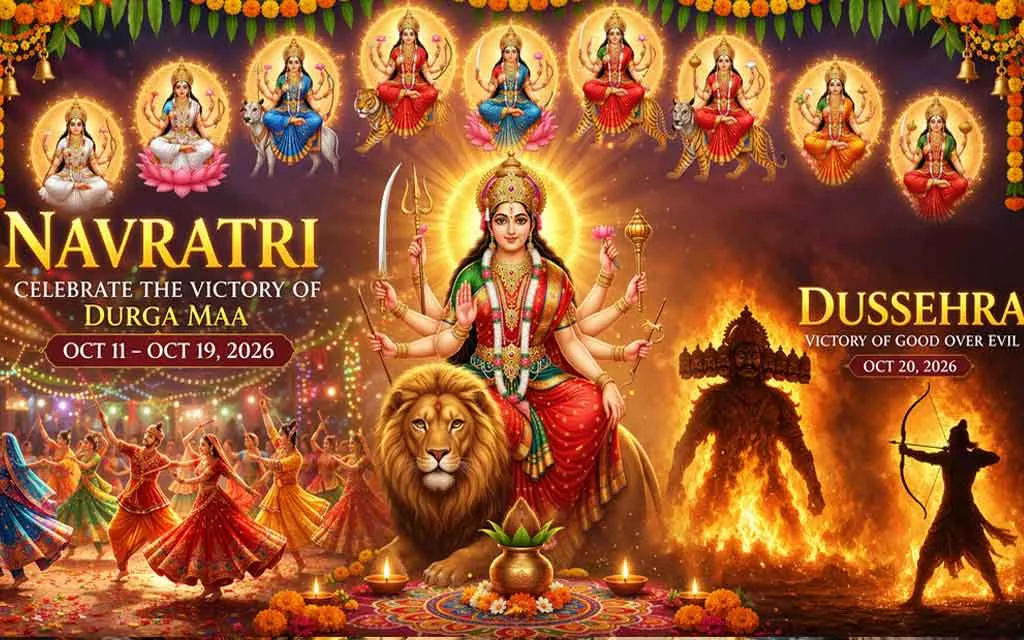
Sharad Navratri 2026 falls from Sunday, October 11 to Monday, October 19, followed by the grand triumph of Dussehra (Vijayadashami) on Tuesday, October 20, 2026. These ten days represent one of Hinduism's most sacred seasonal windows — a time for fasting, prayer, storytelling, dance, and the deepest form of surrender to Shakti, the Supreme Mother.
At HinduTone, we bring you this complete devotional guide — day by day, Goddess by Goddess — so your worship is informed, heartfelt, and spiritually abundant.
Navratri & Dussehra 2026: Complete Date Calendar
Ghatasthapana (Kalash Sthapana): October 11, 2026 — the sacred invocation of the Goddess begins the nine nights of worship.
The Sacred Origin: Why Is Navratri Celebrated?
The Legend of Mahishasura and Maa Durga
Long before time wore its present face, the demon king Mahishasura performed fierce penance and received a boon from Lord Brahma — that no man, no god, no creature could kill him. Drunk on this power, he overthrew the heavens, expelled the Devas, and unleashed terror across all three worlds.
The Devas, helpless and humiliated, gathered before Lord Brahma, Vishnu, and Shiva. As the three supreme lords heard of Mahishasura's atrocities, their divine wrath merged into a single blinding column of golden light. From this convergence of cosmic energy was born Maa Durga — the Supreme Goddess, the embodiment of all Shakti.
Every god surrendered his weapon to her. Shiva gave his trident, Vishnu his Sudarshana Chakra, Indra his thunderbolt, Vayu his bow, Agni his missiles, and Varuna his conch. The mighty lioness appeared as her mount. And so, resplendent and terrible in her divine glory, Maa Durga rode into battle.
For nine days and nine nights, the battle raged between the Goddess and the demon. Mahishasura changed forms ceaselessly — buffalo, lion, man, elephant — but every form was met and conquered by Durga's fierce compassion. On the tenth day — Vijayadashami — she drove her trident through his heart, and the universe exhaled.
The Devas rejoiced. The stars sang. And every year since, for nine nights, humanity remembers this cosmic victory. Navratri is not just a festival — it is the memory of the universe's greatest moment.
The Second Legend: Lord Rama and Navratri
In the Ramayana, when Ravana abducted Devi Sita and Lord Rama prepared to wage war against Lanka, the sage Agastya revealed to Rama the Aditya Hridayam — and also directed him to worship Maa Durga's nine forms for nine days before battle.
Lord Rama, the very avatar of Lord Vishnu, bowed before the Divine Mother and worshipped her with absolute devotion through nine nights. On the tenth day — Dussehra — armed with her blessings and divine grace, Rama slew the demon Ravana.
This is why Dussehra carries a dual cosmic meaning — it is both the day Durga defeated Mahishasura and the day Rama vanquished Ravana. Good triumphing over evil, not once but twice, in the same sacred moment of time.
The Nine Goddesses of Navratri: Navadurga Stories & Significance
Day 1 — Maa Shailputri (October 11, 2026)
Meaning: Shaila = Mountain; Putri = Daughter. Daughter of the Himalayas.
Story: In her previous life, Maa Shailputri was Sati, the devoted wife of Lord Shiva. When her father Daksha insulted Shiva at a grand yagna, Sati immolated herself in the sacred fire. In her next birth, she was born as Parvati, the daughter of the mountain king Himavan. This is her form as Shailputri — serene, powerful, rooted as the mountains themselves. She holds a trident in one hand and a lotus in the other, riding her bull Nandi.
Significance: She governs the Moon, influencing the mind and emotions. Worshipping her on Day 1 purifies the devotee's lunar energy, bringing mental calm and clarity.
Mantra: "Om Devi Shailputryai Namah"
Bhog (Offering): Cow's ghee — said to free devotees from illness and sorrow.
Color: Yellow — symbolizing happiness, optimism, and new beginnings.
Day 2 — Maa Brahmacharini (October 12, 2026)
Meaning: Brahma = Divine knowledge/tapas; Charini = One who pursues.
Story: To win Lord Shiva as her husband, Parvati undertook the most severe penance in cosmic history. For a thousand years she lived on only flowers. For three thousand more years, she survived on only dried leaves. Then for another thousand years, she stood with raised arms, enduring heat, cold, rain, and storm without shelter. Finally she subsisted on nothing at all — not even air. This form — austere, luminous, barefoot, holding a rosary and a water pot — is Brahmacharini, the embodiment of devotion, endurance, and spiritual fire.
Significance: She rules Saturn and Jupiter, blessing devotees with wisdom, detachment, and success in spiritual practice.
Mantra: "Om Devi Brahmacharinyai Namah"
Bhog: Sugar and panchamrit — for long life and good health.
Color: Green — growth, renewal, and the fertility of penance.
Day 3 — Maa Chandraghanta (October 13, 2026)
Meaning: The Goddess who wears the half-moon (Chandra) as a bell (Ghanta) on her forehead.
Story: After Shiva agreed to marry Parvati, he arrived at her father's home for the wedding in his most fearsome form — ash-smeared, accompanied by ghosts, snakes coiled around his neck. Parvati's family was terrified. In that moment, Parvati transformed herself into Chandraghanta — golden-hued, radiant, with ten arms holding weapons and a crescent moon gleaming like a bell on her brow. Her very roar drove away all negative forces, and the wedding proceeded auspiciously.
Significance: She governs the planet Venus. Her worship removes obstacles and fills life with sweetness and grace.
Mantra: "Om Devi Chandraghantayai Namah"
Bhog: Milk and milk-based sweets.
Color: Grey — the colour of strength, determination, and the stillness before a storm.
Day 4 — Maa Kushmanda (October 14, 2026)
Meaning: Ku = little; Ushma = warmth/energy; Anda = cosmic egg. The one who created the universe with her divine smile.
Story: Before creation existed, there was only a vast, dark void. Then the Supreme Goddess smiled — a smile so radiant, so full of divine warmth, that the cosmic egg was born and from it the entire universe expanded. Maa Kushmanda dwells at the center of the Sun itself, riding a lioness, wielding eight arms that carry weapons, a rosary, a pot of nectar, and a discus.
Significance: She is the source of all solar energy in the universe. Her worship brightens life, removes darkness, and energizes body, mind, and spirit.
Mantra: "Om Devi Kushmandayai Namah"
Bhog: Malpua (sweet pancakes) — for intelligence and better decision-making.
Color: Orange — warmth, vitality, sacred fire.
Day 5 — Maa Skandamata (October 15, 2026)
Meaning: Mother of Skanda (Kartikeya, the war god).
Story: When the demon Tarakasura terrorized the three worlds, only the son of Shiva could destroy him — a fact Tarakasura had engineered through his own boon. Lord Kartikeya (Skanda) was that son, born of Shiva's cosmic energy. In her form as Skandamata, Maa Durga holds her infant son Kartikeya lovingly in her lap while also wielding her divine power — a perfect embodiment of the truth that motherhood and fierce strength are never opposites. She is four-armed, white as snow, riding a fierce lion.
Significance: She governs Mercury, blessing devotees with intelligence, eloquence, and maternal grace.
Mantra: "Om Devi Skandamatayai Namah"
Bhog: Bananas — for spiritual and physical health.
Color: White — purity, peace, and the divine light of the moon.
Day 6 — Maa Katyayani (October 16, 2026)
Meaning: Born to the sage Katyayana as an answer to his prayers.
Story: The sage Katyayana performed immense penance to have the Divine Mother born as his daughter. His prayers were answered — Durga was born in his hermitage, and is thus called Katyayani. She is also the Goddess who helped the Gopis of Vrindavan — those devoted young women who prayed to her to receive Lord Krishna as their husband. Riding a magnificent lion with four arms, she holds a sword and a lotus, and her complexion shines like burning gold.
Significance: She is among the most fierce and warrior aspects of Durga, governing the planet Jupiter. Unmarried women pray to her for a devoted husband. She removes obstacles in love, marriage, and dharma.
Mantra: "Om Devi Katyayanyai Namah"
Bhog: Honey — for beauty, love, and blessings in relationships.
Color: Red — fierce love, courage, and the fire of devotion.
Day 7 — Maa Kalaratri (October 17, 2026)
Meaning: Kala = death/time/darkness; Ratri = night. The one who destroys darkness.
Story: When the demons Shumbha and Nishumbha threatened the cosmos, Maa Durga took on her most terrifying form. Her skin became dark as night, her hair unbound and wild, her three eyes burning like flames. From her nostrils came flashes of lightning, and she rode a donkey through the battlefield. But here is the divine paradox — this most fearsome form also carries in her right hand the gesture of Abhaya (fearlessness) and Varada (boon-giving). Even in her most terrible aspect, she is the Mother, protecting her children.
This form represents the truth that darkness must be faced — not avoided — to reach the light.
Significance: She governs Saturn, removing negativity, cutting through illusions, destroying evil forces and bad karma.
Mantra: "Om Devi Kalaratryai Namah"
Bhog: Jaggery — for protection and warding off negative energies.
Color: Royal Blue — depth, infinity, and the vastness of divine protection.
Day 8 — Maa Mahagauri (Maha Ashtami — October 18, 2026)
Meaning: Maha = great; Gauri = extremely fair, luminous.
Story: After years of burning austerities, Parvati's skin had become dark from the scorching heat and exposure. When Shiva finally accepted her devotion and agreed to marry her, he bathed her with the sacred waters of the Ganga. In that moment, her skin transformed — radiant, luminous, whiter than jasmine, more beautiful than the moon. This is Mahagauri — the Goddess purified and renewed by love and devotion. She is serene and gentle, dressed in pure white, holding a trident and a damaru (drum), riding her white bull.
Significance: She purifies devotees of all past sins and karmas. Worshipping her on Ashtami — the most powerful night of Navratri — brings complete transformation and spiritual renewal.
Mantra: "Om Devi Mahagauryai Namah"
Bhog: Coconut — for purity, peace, and renewal.
Color: Pink — compassion, nurturing love, and the joy of devotion.
Maha Ashtami Rituals: Kanjak Puja (worshipping young girls as embodiments of the Goddess), Havan (sacred fire ritual), and sandhi puja — the most auspicious moment at the juncture of Ashtami and Navami tithis, when the Goddess slew Chand and Mund, her most powerful demon adversaries.
Day 9 — Maa Siddhidatri (Maha Navami — October 19, 2026)
Meaning: Siddhi = supernatural powers/perfection; Datri = bestower. The Goddess who grants all divine perfections.
Story: According to the Devi Bhagavata Purana, at the beginning of creation, Lord Shiva himself worshipped Maa Siddhidatri to receive the eight divine Siddhis — supernatural powers including Anima (becoming infinitesimally small), Mahima (becoming infinitely large), Garima (becoming infinitely heavy), Laghima (becoming weightless), Prapti (obtaining anything), Prakamya (fulfilling any desire), Ishitva (supreme power), and Vashitva (commanding all elements). It was Siddhidatri who completed Shiva — blessing him with the feminine half of his being, transforming him into Ardhanarishvara (half man, half woman). She sits on a lotus, four-armed, calm beyond measure — the final form of the Goddess who holds all the universe within her.
Significance: She is worshipped by gods, sages, Siddhas, and humans alike. On Navami, worshipping her is said to grant liberation itself — the ultimate Siddhi.
Mantra: "Om Devi Siddhidatryai Namah"
Bhog: Sesame seeds — for fulfillment of all desires and spiritual liberation.
Color: Purple — wisdom, mysticism, and the royalty of divine grace.
Maha Navami Rituals: Havan, Kanya Puja (feeding nine young girls representing the nine Durgas), distribution of prasad, and the ceremonial conclusion of the nine-day vrat.
Dussehra 2026 — The Tenth Day of Divine Triumph (October 20)
What is Dussehra?
Dussehra — from Dasha (ten) + Hara (defeat) — marks the tenth day after Navratri, the day the universe witnessed good defeat evil not once but in two separate, simultaneous triumphs across cosmic time.
"Dussehra 2026 falls on Tuesday, October 20, the Dashami tithi of Shukla Paksha in Ashvin."
The Two Great Victories of Dussehra
1. Goddess Durga's Victory Over Mahishasura On this tenth day, Maa Durga drove her divine trident through Mahishasura after nine days of fierce cosmic battle. The demon who had terrorized the universe fell. The Devas sang. The heavens rained flowers. This day is celebrated as Vijayadashami — the Tenth Day of Victory.
2. Lord Rama's Victory Over Ravana On this same tenth day, empowered by nine nights of worshipping Maa Durga, Lord Rama shot the final arrow that pierced Ravana's heart, liberating Sita and restoring dharma to the world. Across North India, giant effigies of Ravana, his brother Kumbhakarna, and his son Meghnad are set ablaze in massive Ramlila celebrations — the fire consuming the symbols of ego, lust, and arrogance.
Dussehra Rituals and Traditions
Aparajita Puja — Worship of the "undefeated" Goddess, performed during the afternoon hours (Aparahna Kaal) on Vijayadashami. This is considered among the most auspicious rituals.
Shami Puja — Worship of the Shami tree, sacred since the Mahabharata, when the Pandavas hid their weapons in its branches during their year of exile. On Dussehra, the tree is honored as a symbol of victory.
Seema Avalanghan — Symbolically crossing the boundary of one's village or city — a tradition from the days when kings set off on auspicious campaigns on this day.
Ayudha Puja — In South India, weapons, tools, instruments, and vehicles are worshipped — a practice of honoring the instruments of one's livelihood.
Ravana Dahan — Burning of Ravana's effigy, symbolizing the destruction of one's inner demons — ego, hatred, greed, lust, and pride.
Sindoor Khela — In West Bengal, married women apply sindoor on each other and bid farewell to Goddess Durga as she returns to Kailash.
Navratri Puja Vidhi: How to Worship the Goddess
Ghatasthapana (Day 1)
The foundation of all Navratri worship, Ghatasthapana involves:
- Purify the space — Clean the puja room and sprinkle Ganga jal.
- Prepare the Kalash — Fill an earthen pot with clean water, place mango leaves at the rim, and top with a coconut.
- Sow Saptadhanya — Seven sacred grains (barley, sesame, paddy, wheat, moong, chana, rice) are sown in a clay pot of soil beneath the Kalash.
- Invoke the Goddess — Place an image or idol of Maa Durga, light a lamp, and invoke her presence with mantras.
- Light the Akhand Jyot — The sacred flame that burns continuously for all nine days.
Daily Puja Vidhi
- Wake before sunrise and take a ritual bath (Snana).
- Wear the day's auspicious color.
- Light incense (dhoop) and a ghee lamp.
- Offer fresh flowers, especially marigold and hibiscus (favorite of Durga).
- Chant the Devi Mahatmya (Durga Saptashati) — 700 verses in praise of the Goddess.
- Offer the day's specific Bhog (food offering).
- Recite the Durga Chalisa and the Aarti.
- Conclude with Pradakshina (circumambulation of the deity) and prostration.
Navratri Fasting Rules (Vrat Vidhi)
Fasting during Navratri is a sacred act of spiritual discipline, not deprivation. The body is purified so the soul may shine.
Permitted Foods (Sattvic):
- All fruits — bananas, apples, pomegranates, papaya, coconut
- Rock salt (Sendha namak) — NOT regular iodized salt
- Milk, curd, paneer, ghee, buttermilk
- Sabudana (tapioca pearls) — khichdi, vadas, kheer
- Amaranth flour (Rajgira) — rotis, parathas
- Singhara flour (water chestnut) — pooris, halwa
- Kuttu ka atta (buckwheat flour)
- Potatoes, sweet potatoes, arbi (colocasia)
- Dry fruits — almonds, cashews, raisins
- Makhana (fox nuts)
Prohibited Foods:
- Wheat, rice, barley, maize, and all regular grains
- Regular table salt (iodized salt)
- Pulses and lentils (dal, chana, rajma)
- Onions and garlic (considered tamasic)
- Non-vegetarian food — meat, fish, eggs
- Alcohol in any form
- Processed or packaged food
Essential Mantras for Navratri 2026
The Maha Mantra of Navratri:
"Ya Devi Sarva-Bhuteshu Shakti-Rupena Samsthita| Namas-tasyai Namas-tasyai Namas-tasyai Namo Namah"
"Salutations to the Goddess who resides in all beings in the form of Power. Salutations again and again."
Durga Beej Mantra:
"Om Aim Hreem Kleem Chamundaye Vichche"
Navadurga Dhyana Mantra:
"Shailputri cha Brahmacharini Chandraghanta Kushmanda| Skandamata Katyayani Kalaratri Mahagauri cha Siddhidatri"
Dussehra Mantra (Aparajita Puja):
"Om Aparajitayai Namah — Sarva Shatru Nasha| Om Vijayayai Namah — Sarva Siddhi Pradayai Namah"
Navratri 2026 Colors — Significance Chart
Tip: Wear the day's color during puja and throughout the day for maximum divine blessings.
Navratri Celebrations Across India
Gujarat — The Garba Capital of the World
Gujarat transforms into the world's greatest stage of devotional dance during Navratri. Garba (circular dance honoring the Goddess) and Dandiya Raas (stick dance) run through the night for nine consecutive nights. Millions of devotees — dressed in chaniya cholis and kediyu — dance in concentric circles around a central lamp representing Maa Durga. UNESCO has recognized Garba on its Cultural Heritage list.
West Bengal — Durga Puja: Art Meets Devotion
In West Bengal, Navratri is experienced as Durga Puja — a five-day spectacle of breathtaking artistic pandals, massive clay idols of Durga slaying Mahishasura, community feasts, cultural performances, and the heart-wrenching farewell on Vijayadashami when the idol is immersed in water.
North India — Ram Lila and Ramlila Grounds
From Delhi's Ram Lila Maidan to Varanasi's ghats, North India stages elaborate theatrical enactments of the Ramayana over nine nights, culminating in the burning of Ravana on Dussehra. The Delhi Ramlila draws lakhs of devotees annually.
Mysuru (Karnataka) — The Royal Dasara
Mysore's Dasara is among the most magnificent festivals on Earth — proclaimed a state festival, featuring a decorated elephant procession, cultural performances, and a torchlight parade that transforms the royal city into a sea of gold and light.
Himachal Pradesh — The Mountain Navratri
The temples of Mata Vaishno Devi (Jammu), Naina Devi, Chintpurni, and Jwalamukhi receive millions of pilgrims during Navratri who climb mountains in bare feet as a testament to their devotion.
Kanya Puja — Worshipping the Living Goddess
On Ashtami and Navami, one of Navratri's most sacred rituals unfolds in homes across India — Kanya Puja (also called Kumari Puja or Kanjak). Nine young girls between the ages of 2 and 10 are invited home, their feet washed, foreheads marked with kumkum, and they are worshipped as living embodiments of the nine Durgas.
They are offered a traditional feast of poori, chana, halwa, and kheer, and are gifted with dakshina (a monetary offering) and bangles.
Why girls? Because in every little girl, the Goddess breathes. Kanya Puja teaches that divine femininity is not abstract — it lives, it plays, it laughs, it exists in every home, in every daughter.
Spiritual Significance: What Navratri Really Means
Beyond the rituals and celebrations, Navratri is the inner journey of the soul.
The three trios of three days each carry a profound spiritual map:
- Days 1–3 (Shailputri, Brahmacharini, Chandraghanta): Worship of Durga — the destruction of ego, negative qualities, and impurities. This is the phase of Tamas (darkness being cleansed).
- Days 4–6 (Kushmanda, Skandamata, Katyayani): Worship of Lakshmi — the cultivation of wealth, not just material, but the wealth of virtues, relationships, and spiritual merit. This is the phase of Rajas (activity, cultivation).
- Days 7–9 (Kalaratri, Mahagauri, Siddhidatri): Worship of Saraswati — the dawning of wisdom, knowledge, and spiritual illumination. This is the phase of Sattva (purity, enlightenment).
The soul, having shed its impurities, cultivated its virtues, and awakened its wisdom, arrives at Vijayadashami — Dussehra — victorious. Not victorious over any external demon, but over the greatest demon of all: the ego-self that keeps us from realizing we are one with the Divine.
Navratri Devi Stotram: Mahishasura Mardini
(Sung in temples across India during Navratri Aarti)
"Ayi giri nandini nandita medini vishwa vinodini nandanute| Giri vara vindhya shirodhini vasini vishnu vilasini jisnute| Bhagavati he shiti kantha kutumbini bhoori kutumbini bhoori krute| Jaya jaya he mahishasura mardini ramya kapardini shailasute"
"O Daughter of the Mountain, who delights in the Earth, who entertains the universe — you who dwell atop the great Vindhya peaks, beloved of Vishnu, O Divine Mother, consort of the blue-throated One — Victory, Victory to you, O Destroyer of Mahishasura, O beautiful one with matted locks, O Daughter of the Mountain!"
Quick FAQs: Navratri & Dussehra 2026
Q: When is Navratri 2026?
A: Sharad Navratri 2026 starts on Sunday, October 11 and ends on Monday, October 19, 2026.
Q: When is Dussehra 2026?
A: Dussehra (Vijayadashami) 2026 is on Tuesday, October 20, 2026.
Q: Is there another Navratri in 2026?
A: Yes. Chaitra Navratri 2026 was celebrated from March 19 to March 27, 2026. There are also two Gupt Navratris — Magha (January 19–27) and Ashadha (July 15–23).
Q: What is the difference between Navratri and Durga Puja?
A: Both celebrate Goddess Durga. Navratri (nine nights) is the broader national celebration featuring Garba and daily puja. Durga Puja is the cultural name for the same festival in West Bengal, celebrated with massive pandals and idol worship during the final five days (Panchami to Vijayadashami).
Q: Can non-Hindus participate in Navratri?
A: Navratri's spirit of devotion, dance, and joyful community celebration welcomes all. Many non-Hindu friends participate in Garba nights and feel the spiritual warmth of the festival.
Q: What is Kanjak Puja?
A: Kanjak or Kanya Puja is the ritual of worshipping young girls as incarnations of the nine forms of the Goddess, performed on Ashtami or Navami.
Q: Why is Dussehra considered auspicious for new beginnings?
A: Vijayadashami is called Aparajita — the "Undefeated" day. Ancient kings began new campaigns on this day. Even today, it is considered ideal for starting new ventures, businesses, buying vehicles, or beginning education.
[image: 🌺] Closing Prayer: The Blessing of Nine Nights
As the sacred nine nights draw to a close and Dussehra arrives with its torchlight and triumph, may every devotee carry within them the true victory of Navratri — not just the burning of a demon's effigy, but the burning away of every shadow that keeps them from their truest, brightest self.
May Maa Durga's trident cut through every fear.
May Maa Lakshmi's lotus lift every sorrow.
May Maa Saraswati's veena fill every heart with music.
Jai Mata Di.
Related Articles on HinduTone
- Navratri Aarti Lyrics in Hindi and English (2026)
- Durga Chalisa with Meaning — Complete Text
- Garba Songs for Navratri 2026 — Playlist Guide
- Kanya Puja Vidhi: How to Perform Kumari Puja at Home
- Dussehra 2026: Ravana Dahan Timings Near Your City
- Devi Mahatmya / Durga Saptashati — Chapter-by-Chapter Guide
- Navratri Special Vrat Recipes 2026 — Fasting Meal Ideas
- Goddess Durga's 108 Names with Meaning (Ashtottara Shatanamavali)
- Chaitra Navratri 2027 Dates and Calendar
Published by HinduTone — www.hindutone.com
"Bringing the Wisdom of Sanatan Dharma to Every Heart"
Tags: navratri 2026, dussehra 2026, sharad navratri 2026 dates, navadurga, navratri colors 2026, dussehra vijayadashami, durga puja 2026, navratri puja vidhi, navratri fasting rules, maa durga stories, kanya puja, garba 2026, devi worship, hindu festivals 2026, ghatasthapana 2026, mahishasura mardini, navratri mantras, vijayadashami 2026, navratri vrat, navratri significance
Frequently Asked Questions
When is Navratri & Dussehra 2026?
Navratri & Dussehra 2026 falls on October 20, 2026.
What is the significance of Navratri & Dussehra?
Introduction: The Divine 9 Nights That Move the World In the sacred rhythm of the Hindu calendar, few festivals stir the soul as deeply as Navratri — the festival of nine divine nights. Meaning "Nav" (nine) + "Ratri" (nights) in Sanskrit, Navratri is not merely a festival; it is a cosmic event — a period when the divine feminine energy of the universe descen
How is Navratri & Dussehra celebrated?
Devotees observe it with puja, fasting or special offerings, visiting temples, chanting mantras, and gathering with family. Customs vary by region and tradition.
What should devotees do on Navratri & Dussehra?
Worship Goddess Durga, perform the day's puja and offerings, observe the fast where prescribed, and chant the associated mantras with devotion.
You might also like
Navratri 2026 Apartment-Friendly Puja Vidhi: 9-Day Diaspora Guide for NRIs in USA, UK, Canada, Australia & UAE
Sharadiya Durga Navratri 2026 Australia Guide: Dates, Day-Wise Puja Vidhi, Mantras, Colors, Fasting Rules & Complete Devotional Celebration for Indian Families in Australia | Hindutone
Gita Jayanti 2026 Prasad Recipes — Tulsi-Honoring Sweets, Krishna's Favourites & December 20 Bhog Plate