Rama, Parashurama and the Mystery of Non-Duality — a Contemplation on Vishnu’s Avatars
If Rama and Parashurama are both Vishnu’s avatars, what does it mean for one to "lose"? A contemplative Advaita reflection on Sri Rama as Paripurna-avatara, Bhargavarama as Amsha-avatara, the oneness of Rama and Hanuman, Ramana Maharshi’s cosmic communion, and Bāba’s teaching that you too are God — only unrecognized.
If Rama and Parashurama are both Vishnu’s avatars, what does it mean for one to "lose"? A contemplative Advaita reflection on Sri Rama as Paripurna-avatara, Bhargavarama as Amsha-avatara, the oneness of Rama and Hanuman, Ramana Maharshi’s cosmic communion, and Bāba’s teaching that you too are God — only unrecognized.
Rama and Parashurama — both Vishnu avatars, so where is the war?
Rama and Parashurama — both are avatars of Lord Vishnu. Then what does it mean to say that Parashurama "lost"?
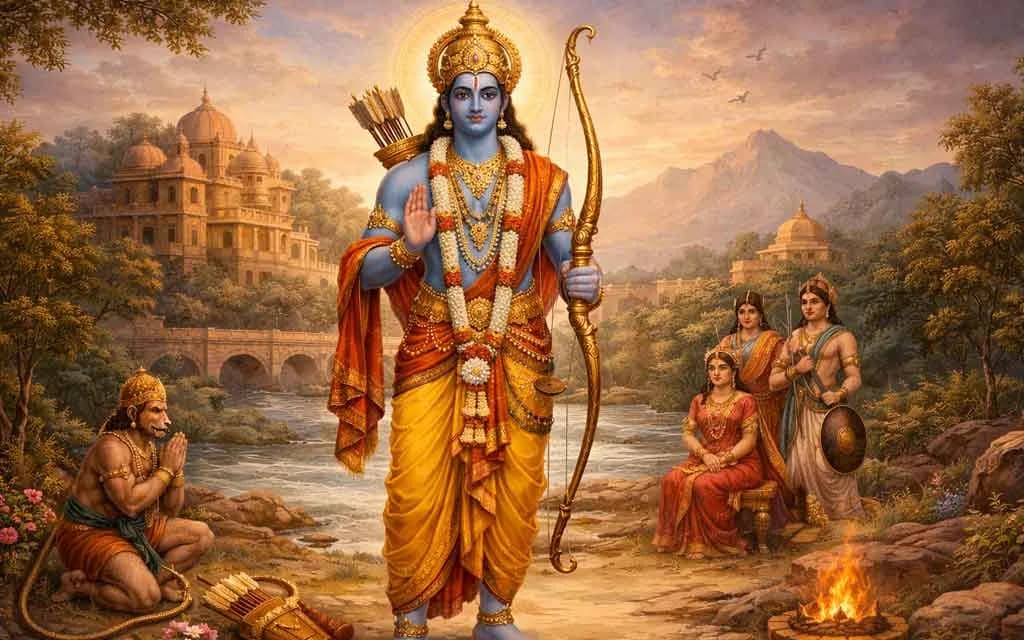
Sri Ramachandra is a Paripurna-avatara — the complete avatar. Parashurama — Bhargavarama — is an Amsha-avatara — an avatar of a portion of the divine. There was no battle between them. The moment Bhargava simply handed over the Vishnu Chapa (Lord Vishnu’s bow), he recognized who stood before him. Their meeting is itself a daiva-leela — a divine play whose depth cannot be fathomed from outside.
How does a limited mind grasp the limitless?
"Can the Paramatma be confined to a single embodiment?" — this is the kind of question that endlessly circles inside a limited mind like mine.
After all, Shiva and Keshava are non-different. Why then do we see them as two? Even as we recite in our Sandhyavandanam "do not see them as separate", the next breath we slip back into maya. That is the work of small ones like me.
Ramana Maharshi — a soul tuned to the cosmic Self
Ramana Maharshi spoke with a monkey. He spoke with a cow. How?
Did he read some "Learn Monkey-Language in 30 Days" book? Did he take a training course in animal speech? (Can anyone offer such a course?) Then how was it possible?
Anyone who is connected to the all-pervading Paramatma is, by the same connection, in contact with the Atman in every living being. That is the secret.
If I cannot understand the meeting of Bhargava and Sri Rama, how will I ever understand the meeting and the agreement between Varaha Swami and Venkateswara? When my vision is narrow, how will I uncover the Sri Rama-tattva hidden in the resonance of Valmiki’s Ramayana, folded deep into its silences? Why do I see Rama and Hanuman — two forms of the same Parabrahma — as if they were two?
Baba’s answer — "you too are God; I have only recognized it"
Here I remember a saying of Bāba. Someone once asked him:
"Are you God?" "Yes, my golden one (bangaru)," he said. "How?" He smiled and said, "You too are God. You have not yet recognized it; I have. That is all, my golden one."
Rama and Hanuman — a plunge in the Triveni Sangam
If Sri Rama and Hanuman appear in the Ramayana like the Ganga and the Yamuna flowing side by side, then the awareness that the two are one is the invisible Saraswati running beneath. That is the Triveni Sangam. To dip into it is to come into that recognition. Otherwise — like me — one tosses about in maya, born and dying again and again in ignorance.
Until then, the truth that "there is nothing other than Rama" will not be grasped. One only thrashes about in nonsense questions — "Is Rama a god or a man? Aryan or Dravidian?" — like a fly trapped in mucus, stuck in the cycle of births and deaths.
A closing prayer
"Rama, will you not, in your mercy, let me understand?"
— Dr. Surya Narayana Vennati
Translated and adapted from the Telugu original; care has been taken to preserve the contemplative voice and the cultural terms (Paripurna-avatara, Amsha-avatara, Sandhyavandanam, Parabrahma, Triveni Sangam) rather than over-Anglicize them.
For more reflective Sanatana Dharma writing, follow Hindutone.com. Last updated: May 16, 2026.
Frequently Asked Questions
What is Rama, Parashurama and the Mystery of Non?
Rama and Parashurama — both Vishnu avatars, so where is the war? Rama and Parashurama — both are avatars of Lord Vishnu.
What are the key points about Rama, Parashurama and the Mystery of Non?
Then what does it mean to say that Parashurama "lost"? Sri Ramachandra is a Paripurna-avatara — the complete avatar.
Why does Rama, Parashurama and the Mystery of Non matter in Hinduism?
It deepens a devotee's connection with Lord Rama and with the values of Sanatana Dharma — clarity, devotion and dharmic living.
How can devotees apply Rama, Parashurama and the Mystery of Non in daily life?
By reflecting on its teaching, incorporating the related practices or observances into daily routine, and approaching it with sincere devotion and understanding.
You might also like
108 Shakti Peethas: The Divine Geography of the Goddess — Complete Guide
Sacred Hindu Numbers: The Complete Story of 108 and Its Divine Significance
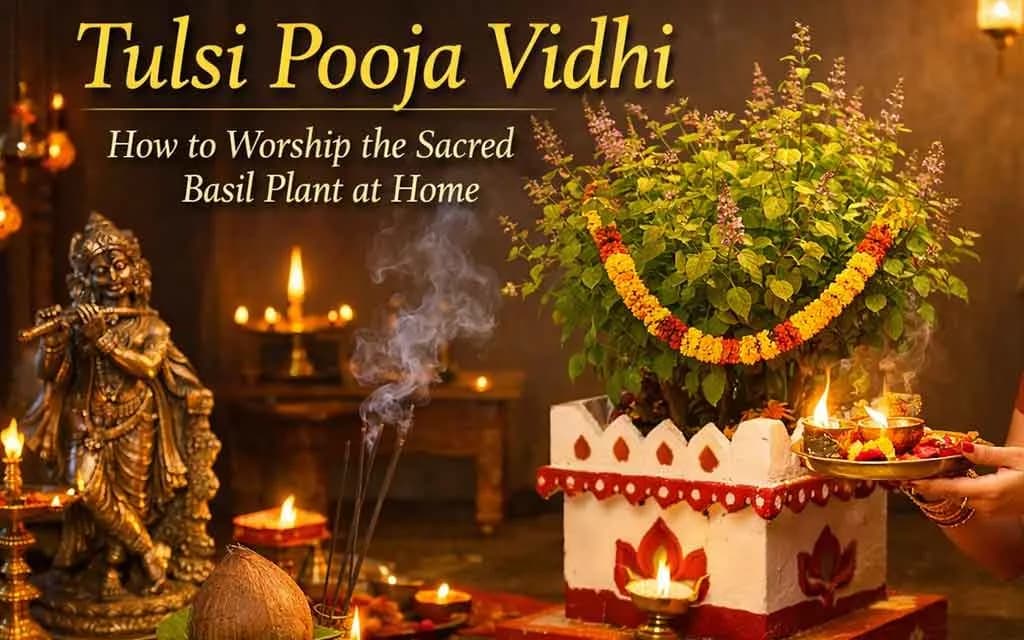
Tulsi Pooja Vidhi – How to Worship the Sacred Basil Plant at Home