
Dussehra 2026 in Oman, City by City: Date, Vijay Muhurat and Hindu Temples
Vijayadashami falls on Tuesday 20 October 2026 across Oman. Local Vijay Muhurat, Aparahna and Dashami times for Muscat, Ruwi, Sohar, Salalah and Nizwa, Muscat's historic Shiva and Krishna temples, Indian Social Club branches, and how to mark the day at home.
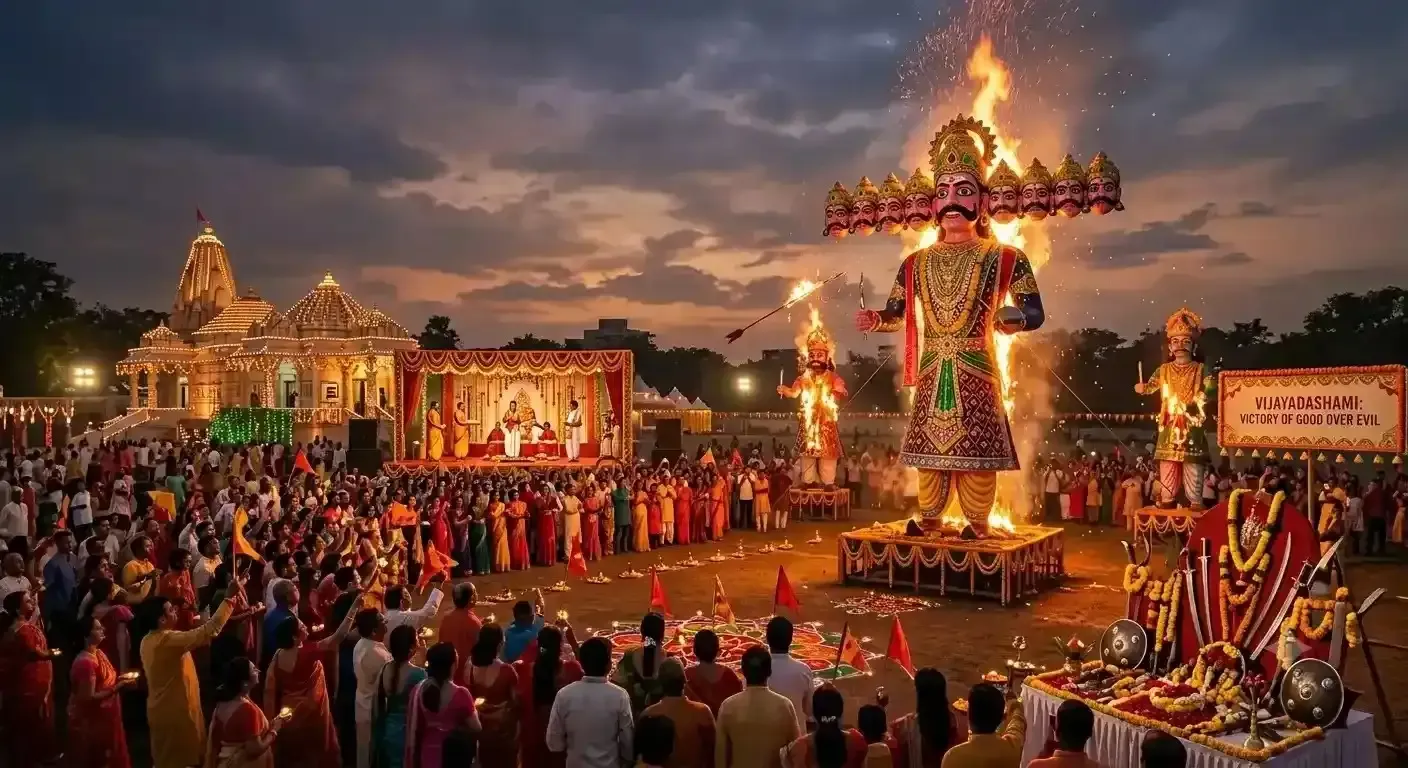
Vijayadashami falls on Tuesday 20 October 2026 across Oman. Local Vijay Muhurat, Aparahna and Dashami times for Muscat, Ruwi, Sohar, Salalah and Nizwa, Muscat's historic Shiva and Krishna temples, Indian Social Club branches, and how to mark the day at home.
Quick answer: Dussehra (Vijayadashami) 2026 in Oman is on Tuesday 20 October 2026 in every city. The Vijay Muhurat, calculated by the Drik Panchang method, is 1:46 PM – 2:32 PM in Muscat, 1:52 PM – 2:38 PM in Sohar, 1:49 PM – 2:36 PM in Nizwa and 2:05 PM – 2:52 PM in Salalah (Oman time, UTC+4). Navratri runs from Sunday 11 to Monday 19 October 2026.
Editor's note (5 October 2026): The local times on this page were calculated for each city from the Drik Panchang tithi (Dashami from 12:50 PM IST on 20 October to 2:11 PM IST on 21 October 2026), shown in Oman's own time zone, which does not change its clocks. The Vijay Muhurat is the 11th of the 15 daytime muhurtas, calculated by the Drik Panchang method. We do not list 2026 event schedules, because temples and associations announce their own programmes; please check with them directly.
Oman has one of the oldest Hindu presences in the Arabian Peninsula. Gujarati, Kutchi and Sindhi trading families, among them the Bhatia community, were settled in Muttrah, Muscat, Sur and Sohar centuries ago, and the Motishwar Mandir in Old Muscat is one of the oldest Hindu temples in the Middle East. Today the Indian community is very large and diverse, with workers, professionals and business families from Kerala, Tamil Nadu, Andhra Pradesh and Telangana, Karnataka, Maharashtra, Gujarat, Rajasthan, Bengal and the Hindi-speaking north, alongside Nepalese Hindus. That mix shows in how Navratri is kept: Gujarati garba, Bengali Durga Puja, Tamil Golu, Kerala Vidyarambham, Telugu Bathukamma and North Indian Ram katha all find a place, mostly within temple grounds, clubs, schools and private halls.
Dussehra 2026 in Oman: dates and Vijay Muhurat by city
The whole of Oman is on Gulf Standard Time (UTC+0400) all year round, so there is no summer-time question. The Dashami tithi begins and ends at the same moment everywhere in the country, and only the sun-based windows differ from city to city. Muscat and Ruwi, on the coast in the north-east, have the earliest Vijay Muhurat; Salalah, far to the south-west in Dhofar, is about twenty minutes later.
| Region | City | Dussehra date | Vijay Muhurat (Drik Panchang method) | Dashami begins → ends |
|---|---|---|---|---|
| Muscat | Muscat | Tue 20 Oct | 1:46 PM – 2:32 PM | Tue 20 Oct, 11:20 AM → Wed 21 Oct, 12:41 PM |
| Muscat | Ruwi | Tue 20 Oct | 1:45 PM – 2:31 PM | Tue 20 Oct, 11:20 AM → Wed 21 Oct, 12:41 PM |
| North Al Batinah | Sohar | Tue 20 Oct | 1:52 PM – 2:38 PM | Tue 20 Oct, 11:20 AM → Wed 21 Oct, 12:41 PM |
| Dhofar | Salalah | Tue 20 Oct | 2:05 PM – 2:52 PM | Tue 20 Oct, 11:20 AM → Wed 21 Oct, 12:41 PM |
| Ad Dakhiliyah | Nizwa | Tue 20 Oct | 1:49 PM – 2:36 PM | Tue 20 Oct, 11:20 AM → Wed 21 Oct, 12:41 PM |
The Aparahna (afternoon period) is the traditional window for Aparajita and Shami puja, and sunset marks the time for any evening aarti or symbolic Ravan Dahan:
| City | Aparahna, 20 Oct | Sunset, 20 Oct |
|---|---|---|
| Muscat | 1:00 PM – 3:18 PM | 5:36 PM |
| Ruwi | 12:59 PM – 3:17 PM | 5:36 PM |
| Sohar | 1:06 PM – 3:24 PM | 5:42 PM |
| Salalah | 1:18 PM – 3:38 PM | 5:59 PM |
| Nizwa | 1:03 PM – 3:22 PM | 5:40 PM |
Key Navratri and Dussehra dates 2026
| Observance | Date (2026) |
|---|---|
| Navratri begins (Ghatasthapana) | Sunday 11 October |
| Durga Ashtami and Maha Navami | Monday 19 October |
| Dussehra / Vijayadashami in Oman | Tuesday 20 October |
| Dashami tithi, Oman time | Tue 20 Oct, 11:20 AM → Wed 21 Oct, 12:41 PM |
| Bijoya Dashami / Sindoor Khela (India, Bengal tradition) | Wednesday 21 October |
Ashtami and Navami share Monday 19 October in India's calendar this year, so families who do Kanya pujan on either day will hold it then. In every Omani city the Dashami tithi begins well before the Aparahna and covers all of it on 20 October, by more than two hours, so there is no doubt about the date. The Vijay Muhurat falls comfortably inside Dashami everywhere.
Hindu temples in Oman for Navratri & Dussehra
Oman has two officially recognised Hindu temples, both in the capital, and community life outside Muscat is organised mainly through the Indian Social Club and its regional branches. These temples and organisations have been confirmed to exist in each city or region. We list name and area only; check their own websites or social pages for opening hours and festival plans. Temples and community groups usually announce Navratri garba, Durga Puja, Ramlila and Ravan Dahan programmes a few weeks ahead — check their websites/social pages.
Muscat governorate: Muscat and Ruwi
Muscat's Vijay Muhurat is 1:46 PM – 2:32 PM, with the Aparahna from 1:00 PM – 3:18 PM and sunset at 5:36 PM. In Ruwi, the busy commercial district that is home to many Indian businesses, it is 1:45 PM – 2:31 PM (Aparahna 12:59 PM – 3:17 PM, sunset 5:36 PM). The capital area holds most of Oman's Indian families, and both temples are within a short drive of Ruwi.
- Motishwar Mandir (Shri Adi Motishwar Mahadev and Shri Motishwar Mahadev temples) — Muttrah / Old Muscat, near Al Alam Palace. A Shiva temple complex with a Hanumanji shrine, built more than a century ago by the Bhatia trading community. It draws huge crowds at Maha Shivaratri and is a focal point for Hindu festivals in Muscat.
- Shri Krishna Temple — Darsait, Muscat. Established by the Indian community in 1987 and renovated in 2013, it has shrines to Lord Krishna, Ganesha and Mataji, and a hall used for large festival gatherings, which makes it a natural centre for Navratri worship of the Devi.
- Indian Social Club Oman — Muscat. The main umbrella body for the Indian community, with many linguistic and cultural wings. Its Bengali wing organises Sharadotsav celebrations, and other wings hold regional festivals through the year.
At Navratri, Muscat's temples typically see evening aarti, bhajans and special Devi pujas through the nine nights, with extra crowds on Ashtami and on Vijayadashami. Garba and dandiya nights are usually held in club grounds, school halls and hotel ballrooms, often on the weekend, while Bengali groups hold Durga Puja with dhak drumming, pushpanjali, bhog and cultural evenings.
North Al Batinah: Sohar
Sohar's Vijay Muhurat is 1:52 PM – 2:38 PM (Aparahna 1:06 PM – 3:24 PM, sunset 5:42 PM). The port and industrial city has a sizeable Indian workforce linked to Sohar Port and Freezone, refineries, steel and logistics, as well as long-settled trading families. We could not confirm a Hindu temple in Sohar through reliable listings, so families usually mark Navratri at home and through community gatherings, or drive to Muscat for temple worship on the weekend.
- Indian Social Club Sohar — Sohar. One of the club's regional branches, which organises cultural programmes for Indian families in the Batinah region.
Dhofar: Salalah
Salalah's Vijay Muhurat is 2:05 PM – 2:52 PM (Aparahna 1:18 PM – 3:38 PM, sunset 5:59 PM), the latest in Oman because the city lies far to the south-west. Salalah has a long-established Indian community, with many families from Kerala, Tamil Nadu and Gujarat working in trade, the port, healthcare and education. We could not confirm a dedicated Hindu temple in Salalah, and Muscat is roughly a thousand kilometres away, so most Navratri worship here happens at home and through community groups.
- Indian Social Club Salalah — Salalah. The club's Dhofar branch, a natural contact for community festival gatherings in the south.
Malayali and Tamil families in Salalah often keep Navaratri with Golu displays, Saraswati Puja on Navami, Ayudha Puja for tools and vehicles, and Vidyarambham for young children on Vijayadashami morning.
Ad Dakhiliyah: Nizwa
Nizwa's Vijay Muhurat is 1:49 PM – 2:36 PM (Aparahna 1:03 PM – 3:22 PM, sunset 5:40 PM). The historic interior city has a smaller Indian community, many working in education, healthcare, retail and construction. We could not confirm a Hindu temple or a dedicated Indian community branch in Nizwa. Families usually celebrate at home or travel to Muscat, about two hours away by road, for temple visits and larger events.
Further along the coast, the Indian Social Club also has a branch in Sur, the old dhow-building town where Indian traders were present for centuries; families in Ash Sharqiyah can use Muscat's times on this page as a close guide, but a panchang set for Sur will be a few minutes earlier.
How Oman celebrates Navratri and Dussehra
Because Navratri nights in 2026 mostly fall on working days, much of the community celebration in Oman gathers around the Friday–Saturday weekends. Gujarati families and wider Indian groups hold garba and dandiya nights with a central Mataji image, aarti at the start and chaniya choli and kediyu in bright colours. Bengali associations organise Durga Puja with an idol, pushpanjali, bhog, cultural programmes and Bijoya greetings at the end. Tamil, Kannada and Telugu families set up Golu or Bombe displays of dolls on stepped shelves and visit each other's homes, Telugu women may celebrate Bathukamma with flower stacks and circle songs, and Kerala families keep books and tools for Pooja Veppu before Vidyarambham on Vijayadashami. Nepalese families observe Dashain with tika and jamara.
Large open-air Ramlila and Ravan Dahan as seen in India are not part of public life in Oman. Religious celebrations take place within temple premises and private or licensed venues, and fireworks and open fires are regulated by the local authorities. Where groups mark Ravan Dahan, it is usually as a Ramayana play, a dance drama or a story session for children. Many North Indian families watch Ramlila online from India and tell children the story of Rama's victory at home.
Dussehra puja at home
If you cannot reach a temple on a Tuesday, a short puja at home in the afternoon is entirely traditional. Ideally do it during your city's Vijay Muhurat, or at least within the Aparahna:
- Aparajita puja: draw an eight-petalled lotus with kumkum or rice flour, place a lamp, and worship Devi Aparajita, the goddess of victory, with flowers, akshat and a simple prayer for success over obstacles.
- Shami puja: if you have Shami leaves (or apta/bauhinia leaves, which some Indian stores stock before Dussehra), offer them to the Devi and exchange them with family as "gold", a Maharashtrian and Karnataka custom.
- Ayudha Puja / Shastra puja: clean and decorate tools, books, laptops and the car, apply kumkum and offer flowers, thanking them for their service.
- Vidyarambham: Vijayadashami is the traditional day for small children to begin learning, writing "Om" or the first letters of the alphabet in a plate of rice.
- New beginnings: starting a course, opening new account books or signing a new venture are traditional on this day.
A simple order: bathe, light a lamp, pray to Ganesha, do the Aparajita and Shami puja, then Ayudha puja, offer naivedya (sweets, fruit), do aarti and share prasad. For full step-by-step vidhi and the stories behind the festival, see our Dussehra / Vijayadashami 2026 pillar guide.
Practical tips for Dussehra in Oman
- Working day: Tuesday 20 October is a normal working and school day. The Vijay Muhurat falls in the early afternoon, so consider a short break or doing the puja later within the Aparahna if you can, and plan temple visits or community events for the evening or the weekend.
- Respect local rules: keep worship and celebrations within temple premises, homes and licensed venues. Fireworks, open fires and effigy burning are controlled by the local authorities, so do not use them without permission.
- Getting to the temples: parking near the Motishwar Mandir in Muttrah and around Darsait is limited on festival evenings. Car-share or use a taxi where you can, and expect heavier traffic around Ruwi and Muttrah after office hours.
- Weather: October afternoons are still warm across much of Oman, so carry water if you are queuing at a temple. Sunset is between 5:36 PM and 5:59 PM depending on the city.
- Puja items: Indian grocers in Ruwi, Muttrah, Sohar and Salalah stock flowers, kumkum and sweets, but buy a few days early as stock runs short before Navratri weekends.
- Muhurat: use your own city's times from the table above; never convert India's times into Oman time.
Frequently asked questions
When is Dussehra 2026 in Oman?
Tuesday 20 October 2026 in every Omani city. The Dashami tithi begins at 11:20 AM Oman time on 20 October and ends at 12:41 PM on Wednesday 21 October, so it covers the whole afternoon of the 20th.
What is the Vijay Muhurat in Muscat on Dussehra 2026?
Calculated by the Drik Panchang method, the Vijay Muhurat in Muscat is 1:46 PM – 2:32 PM on Tuesday 20 October 2026 (Ruwi 1:45 PM – 2:31 PM). Sohar is 1:52 PM – 2:38 PM, Nizwa 1:49 PM – 2:36 PM and Salalah 2:05 PM – 2:52 PM, all in Oman time (UTC+4).
Can I convert India's Dussehra muhurat into Oman time?
No. The Vijay Muhurat depends on local sunrise and sunset, so it has to be calculated for your own city. Use the Omani times on this page or your temple's calendar rather than shifting India's times by the time difference.
When is Bijoya Dashami and Sindoor Khela for Bengali families in Oman?
In India, Bengal-tradition Bijoya Dashami and Sindoor Khela fall on Wednesday 21 October 2026 (Drik Panchang, Kolkata). Durga Pujas in Oman, such as those organised by Bengali community groups in Muscat, follow their own committee's schedule, so check their announcements.
Which Hindu temples in Oman celebrate Navratri?
Oman's two officially recognised Hindu temples are both in Muscat: the Motishwar Mandir (Shiva temple) in Muttrah near Al Alam Palace, and the Shri Krishna Temple in Darsait. Temples and community groups usually announce Navratri garba, Durga Puja, Ramlila and Ravan Dahan programmes a few weeks ahead — check their websites/social pages.
Is Dussehra a holiday in Oman?
No. Tuesday 20 and Wednesday 21 October 2026 are normal working and school days in Oman, where the weekend is Friday and Saturday. Many families do the afternoon puja at home and join temple or community celebrations in the evening or on the weekend.
Related guides
- Dussehra / Vijayadashami 2026: complete guide
- Navratri 2026: complete guide for NRI families
- Dussehra 2026 in Dubai & UAE, emirate by emirate
- Navratri 2026 in Dubai & UAE: dates and garba guide
- Dussehra 2026 in Qatar, city by city
- Dussehra 2026 in Kuwait, city by city
- Dussehra 2026 in Bahrain, city by city
- October 2026 Hindu festival calendar
You might also like
Dussehra 2026 in Victoria, BC: Date, Vijay Muhurat, Temples and Navratri Celebrations
Dussehra 2026 in Surrey: Date, Vijay Muhurat, Temples and Navratri Celebrations
Dussehra 2026 in Vancouver: Date, Vijay Muhurat, Temples and Navratri Celebrations