Raksha Bandhan 2026 for NRIs: USA, UK, Canada, Australia, UAE, Europe and Singapore Guide
Raksha Bandhan 2026 is Friday 28 August. This flagship diaspora guide explains the date, the India-converted window versus a local-morning window, region-by-region timing for the USA, UK, Canada, Australia, UAE, Europe and Singapore, sending rakhi internationally, and warm, inclusive ways to celebrate abroad.
Raksha Bandhan 2026 is Friday 28 August. This flagship diaspora guide explains the date, the India-converted window versus a local-morning window, region-by-region timing for the USA, UK, Canada, Australia, UAE, Europe and Singapore, sending rakhi internationally, and warm, inclusive ways to celebrate abroad.
Quick answer: Raksha Bandhan 2026 falls on Friday 28 August across India and most of the world. Because the Purnima is present at sunrise on the 28th and the inauspicious Bhadra period sits on the 27th, the 28th is the widely accepted day. NRIs may tie the rakhi during their own local daytime on the 28th or convert an auspicious India window to their timezone.
For families spread across continents, Raksha Bandhan is one of the most emotionally charged days of the year — a moment when a small thread carries the weight of a whole relationship across oceans and time zones. In 2026 that thread will travel on Friday 28 August, the date accepted across India and by the overwhelming majority of Hindu communities worldwide. This guide is written specifically for the diaspora: for the sister in New Jersey whose brother is asleep in Delhi, for the family split between Dubai, London and Toronto, and for the children born abroad who are learning what this day means for the first time.
Celebrating from abroad is genuinely different, and it helps to name why. You are not simply doing the same ceremony a few hours later — you are deciding, often for the first time, which clock to honour. Do you follow India's auspicious window converted to your city, or do you keep the ceremony in your own local morning where the festival is unfolding around you? Both are defensible, and this guide walks through each so you can choose with confidence rather than anxiety.
- Festival: Raksha Bandhan (Rakhi Purnima)
- Date 2026: Friday, 28 August 2026
- Governing rule: Shravana Purnima present at sunrise; Bhadra avoided
- Bhadra 2026: Falls on 27 August, which is why the 28th is chosen
- Best time-of-day: Aparahna / afternoon in India; local morning-to-midday abroad
- Also observed: Narali Purnima, Gamha Purnima, Jhulan, Avani Avittam overlap
- Confirm windows via: Your own city panchang or local temple
Why Raksha Bandhan 2026 is Friday 28 August
The date of Raksha Bandhan is decided by Shravana Purnima, the full-moon day of the month of Shravana. The traditional rule is simple: the rakhi should be tied on the day the Purnima tithi is present during the important part of the day, and it should never be tied during Bhadra, an inauspicious period associated with the tithi's early portion. In 2026, the arithmetic of the tithi places Bhadra on 27 August and leaves the Purnima cleanly present at sunrise on 28 August. Because the full moon governs the sunrise of the 28th and Bhadra has already passed, the 28th is the day scholars, panchangs and temples overwhelmingly point to.
You may still see a stray reference to the 27th online, which is why we keep a dedicated explainer. If you want the fuller reasoning, read our page on the Raksha Bandhan 2026 date — 27 or 28 Augustdate explainer, and the Bhadra Kaal explanation, so you can reassure any relative who is unsure.
One gentle word about Bhadra: it is a scheduling tradition, a preference about timing, not a warning that harm will follow if you get the minute wrong. Families have tied rakhis lovingly for generations without stopwatch precision. Treat it as guidance that helps you pick a beautiful moment, not as a source of worry.
The two defensible windows: India-converted vs local-morning
Here is the question every NRI eventually asks: should I tie the rakhi at the time it is auspicious in India (converted to my clock), or at a naturally auspicious time in my own city on the 28th? Both approaches have long traditional support, and neither is wrong.
The India-converted window means you take an auspicious time in India — traditionally the afternoon (aparahna) is favoured for tying rakhi, and many families also use the full daylight window after Bhadra ends — and translate it into your local time. This keeps you synchronised with the ceremony as it happens in the ancestral home. The local-morning window means you observe the festival within your own daytime on the 28th, reasoning that the Purnima is present over a long stretch and that a clear, sunlit local morning-to-midday is itself a worthy time. Classical texts support tying during daylight after Bhadra, and a bright local morning satisfies that spirit.
If your family cannot agree, follow the household elders or your local temple. For a deeper treatment of choosing between calendars abroad, see our guide on which panchang NRIs should follow. For India-side windows, our muhurat timings page describes the times of day; always confirm exact minutes with your own city panchang.
Region-by-region: what the 28th looks like where you live
Because time zones differ so widely, the India afternoon lands at very different local moments around the world. The table below describes the time-of-day and local date you are likely to experience — it is a broad orientation, not a per-minute schedule. Always confirm precise windows from your city panchang or temple.
| Region | When India's daytime window lands locally | Practical note |
|---|---|---|
| USA & Canada (East) | Late morning to evening of 27 August locally | Many tie rakhi on the evening of the 27th to match India's 28th daytime |
| USA & Canada (West) | Morning to afternoon of 27 August locally | A 27th-evening video call reaches India's 28th afternoon comfortably |
| UK & Ireland | Middle of the night into early 28 August | Consider a local 28th-morning ceremony instead of a 3am call |
| Continental Europe | Late night 27th into early 28 August | Local 28th morning is usually the calmer choice |
| UAE & Gulf | Early morning of 28 August locally | Only about ninety minutes behind India — very convenient |
| Singapore & Malaysia | Midday to afternoon of 28 August | Aligns closely with India's daytime; easy to sync |
| Australia (East) | Afternoon to evening of 28 August | Ahead of India, so a local 28th afternoon works well |
| New Zealand | Evening of 28 August locally | Convenient local 28th observance; call India earlier in your day |
The headline takeaways: North America generally lands on the evening of 27 August if you want to match India's 28th daytime; the UK and Europe hit the middle of the night, so a local 28th morning is kinder; the Gulf is barely offset and can simply follow India; and Singapore, Australia and New Zealand are comfortably placed to observe their own 28th.
Timing a video-call ceremony so both ends are awake
If the rakhi will be tied over a screen, the goal is a slot where nobody is bleary at 3am. Work backwards from India: pick an India daytime hour on the 28th, then check what that is for you. For North America an India-afternoon slot is your morning or the previous evening; for Europe it may be your very early morning; for the Gulf and Asia-Pacific it is a comfortable daytime call.
- Agree the India end's preferred hour on 28 August first, since the ceremony is usually anchored to the ancestral home.
- Convert that hour to your local time and check whether it falls in your waking hours.
- If the converted time is the middle of your night, propose a local-morning ceremony on the 28th instead and simply record a message for India.
- Send the physical rakhi and thali items ahead of time so both households have theirs ready on screen.
- Test the call the day before — lighting, sound, and a small table set with the thali make the moment feel real.
Sending rakhi internationally: realistic expectations
Posting a rakhi across borders rewards early planning. International parcels move through customs, and timelines vary widely by origin, destination and season, so start weeks ahead rather than days. We deliberately avoid quoting specific carrier deadlines, fees or guarantees here because those change constantly and differ by route — confirm current cut-off dates and costs directly with your chosen courier or postal service.
- Post early. Cross-border mail can be delayed by customs inspection, and the pre-festival period is busy; a comfortable buffer removes most stress.
- Keep it light and non-perishable. Many countries restrict or prohibit importing certain foods — sweets, dairy-based mithai, seeds and some agricultural items are common problem categories. When in doubt, leave edible items out and send them separately or order them locally at the destination.
- Declare contents honestly and describe the rakhi as a decorative gift of low value; accurate customs paperwork prevents hold-ups.
- Consider a tracked service so both sender and recipient can follow the parcel.
- Include a printed note or card — if a food item cannot travel, a heartfelt letter often means more anyway.
Ordering within India for local delivery
Often the simplest path is to order a rakhi and sweets from a seller inside the recipient's own country or city, avoiding customs entirely. A brother in Hyderabad can receive a locally sourced rakhi and mithai on the day itself, while you tie a matching rakhi over video. This sidesteps import rules and perishability, and it usually arrives more reliably. If you go this route, place the order with enough lead time for the seller's own local delivery schedule, and confirm the delivery date with them directly rather than assuming.
Assembling a rakhi thali abroad — and smart substitutes
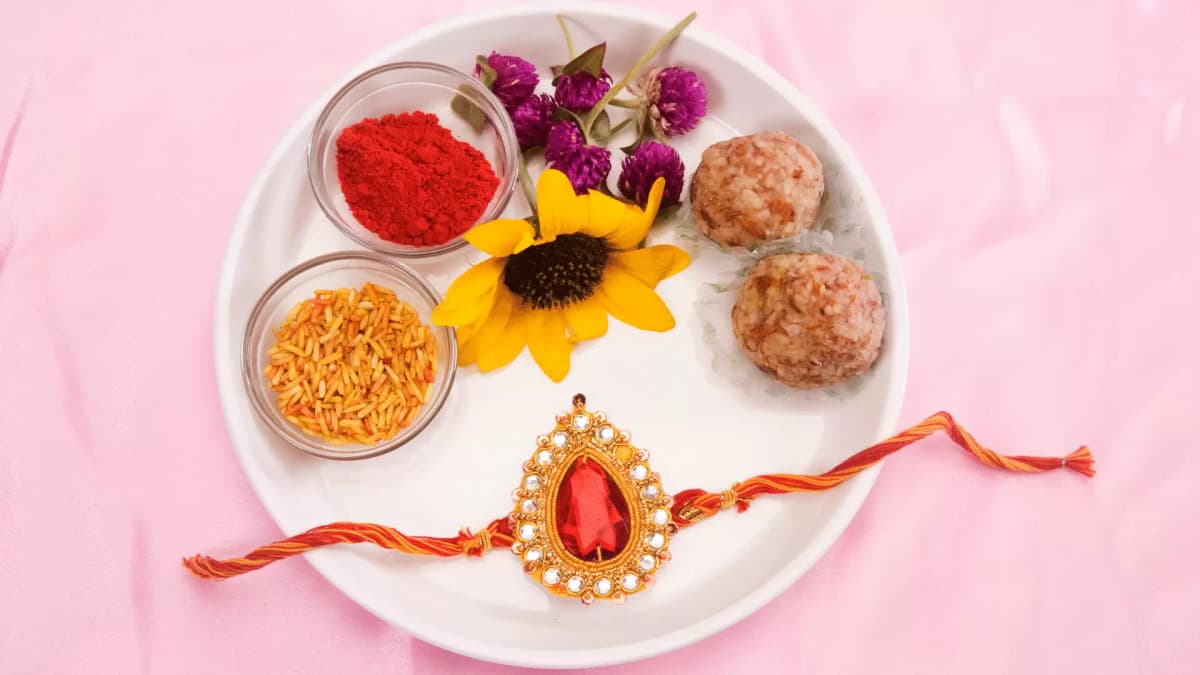
A traditional thali holds a rakhi, roli or kumkum, rice grains (akshata), a diya or lamp, sweets, and sometimes a coconut. Abroad, some items are easy and some need substitutes. The ceremony's meaning survives every substitution — intention matters more than a perfect tray.
| Traditional item | Purpose | Substitute abroad |
|---|---|---|
| Rakhi thread | The bond itself | Any clean thread; a child's handmade rakhi is deeply valued |
| Roli / kumkum | Tilak on the forehead | Turmeric-based paste, sandalwood, or store-bought sindoor |
| Akshata (rice) | Blessing grains | Plain uncooked rice mixed with a pinch of turmeric |
| Diya / lamp | Light and auspiciousness | A small oil lamp, tealight, or even a candle |
| Sweets | Sharing joy | Any local mithai, or dates, chocolate, or a homemade treat |
| Coconut / offering | Auspicious gift | A fruit or a small symbolic gift if coconut is unavailable |
Celebrating across three countries at once
Many diaspora families are now spread across three or more nations — say India, the Gulf and North America. A single synchronous call rarely suits everyone's clock. A gentle solution is a rolling celebration: each household observes its own local 28th daytime, records a short blessing, and shares it to a family group. The thread is tied in three living rooms across a single global day, and every message lands as morning reaches each city. Nobody is excluded by a time zone, and the day feels larger, not smaller, for being shared across the world.
Teaching children born abroad
For children raised outside India, Raksha Bandhan can feel abstract until it is made tangible. Let them make the rakhi by hand, explain in simple words that it is a promise of care between people who look out for each other, and let the meaning stretch to include cousins and close friends where there is no sibling. When children help set the thali and speak to relatives on screen, the festival stops being a foreign ritual and becomes their own. For the wider story and history, our Raksha Bandhan 2026 pillar guide is a good place to start reading together.
Regional traditions you may share the day with
Shravana Purnima carries many observances at once, and honouring your own is part of the day's richness. Marathi and coastal Konkan families keep Narali Purnima, offering coconuts to the sea. In Odisha it is Gamha Purnima. In Bengal it coincides with Jhulan Purnima and its swing festivals for Radha and Krishna. Across much of South India and among many Brahmin families it overlaps with Avani Avittam or Veda Upakarma, the day of renewing the sacred thread and Vedic study. Each of these is equally valid; if your family keeps one of them, the rakhi and these observances belong together on the 28th.
A warm word for every reader
Not everyone comes to this day with a living brother or sister to tie a thread for, and it would be wrong to assume otherwise. If your sibling has passed, tying a rakhi at their photo, lighting a diya, or simply sitting with the memory is a complete and honoured observance. If a relationship is estranged, you owe no performance — a quiet blessing sent silently is enough, and so is stepping back this year. And if you have no sibling at all, the day is still yours: cousins, chosen family, and close friends have received rakhis for as long as the festival has existed. Raksha Bandhan is about protection and care in every form love takes, not about a single kind of family.
Related reading
- Raksha Bandhan 2026 pillar guide
- Raksha Bandhan 2026 date — 27 or 28 August
- Raksha Bandhan 2026 muhurat timings
- Bhadra Kaal and Raksha Bandhan 2026
- Which panchang should NRIs follow?
Frequently Asked Questions
Is Raksha Bandhan on 27 or 28 August 2026?
Raksha Bandhan 2026 is on Friday 28 August. The 28th is chosen because the Shravana Purnima tithi is present at sunrise that day, while the inauspicious Bhadra period falls on 27 August. A stray reference to the 27th usually comes from confusing Bhadra's presence with the actual festival day; panchangs and temples point firmly to the 28th.
Why does Bhadra make the 27th unsuitable for tying rakhi?
Bhadra is a period linked to the early portion of the Purnima tithi and is traditionally avoided for tying rakhi. In 2026 it sits on 27 August. Rather than a threat, treat Bhadra as timing guidance that steers families toward a clear, auspicious moment; the 28th, with Purnima present at sunrise and Bhadra past, is that moment.
How do NRIs decide between India time and local time for the ceremony?
Both are traditionally defensible. You can convert an auspicious India daytime window to your own clock to stay synchronised with the ancestral home, or you can observe a bright local morning-to-midday on the 28th, since the Purnima is present over a long stretch. If your family is unsure, follow your household elders or local temple, and confirm exact minutes with your city panchang.
What time does the ceremony fall in the USA and Canada?
India's 28th daytime window generally lands on the evening of 27 August in North America, with the East Coast a few hours ahead of the West. Many families tie the rakhi on the evening of the 27th locally to match India's 28th afternoon over a video call, or simply hold their own ceremony during the local 28th.
When is a good time to celebrate in the UK, Europe and the Gulf?
For the UK and continental Europe, India's daytime window arrives in the middle of the night, so a calmer choice is a local 28th-morning ceremony. In the UAE and the Gulf, the offset from India is small, so early morning on the 28th aligns naturally and you can comfortably follow India's day directly.
How can I time a video call so both ends are awake?
Anchor to the India end first: pick their preferred daytime hour on the 28th, then convert it to your clock. If that lands in your waking hours, use it. If it falls in the middle of your night — common for the UK and Europe — hold a local-morning ceremony instead and send a recorded blessing, so nobody is exhausted at 3am.
Can I mail sweets and food items with a rakhi abroad?
Often you should not. Many countries restrict or prohibit importing sweets, dairy-based mithai, seeds and certain agricultural items, and food can be seized or delayed at customs. Send a light, non-perishable rakhi with an honest low-value declaration, and either order sweets locally at the destination or replace them with a heartfelt note.
What if I have no sibling, an estranged sibling, or a sibling who has died?
The day still belongs to you. Cousins, chosen family and close friends have always received rakhis, so the bond need not be a blood sibling. If a sibling has passed, tying a rakhi at their photo or lighting a diya is a complete observance. If a relationship is estranged, a quiet blessing — or simply stepping back this year — is entirely valid.
Related guides you may find helpful
- Varalakshmi Vratam 2026 for NRIs: USA, UK, Canada, Australia, UAE and Singapore Guide
- Pitru Paksha 2026 for NRIs: How to Perform Shraddha and Tarpan Abroad
Raksha Bandhan 2026 by country
You might also like
Bathukamma & Dasara 2026 in Canada: Dates, Telangana Association Celebrations & City-by-City Guide
Bathukamma and Dasara 2026 in Australia: Dates, Telangana Association Celebrations, Muhurat and City-by-City Guide

Jagaddhatri Puja 2026: Dates, Chandannagar's Dazzling Lights & Significance