Soundarya Lahari: Adi Shankaracharya's 100-Verse Hymn to the Divine Mother — Complete Guide
The supreme Shakti hymn — 100 verses on the beauty and power of Tripura Sundari, composed by Adi Shankaracharya. Discover the Ananda Lahari and Soundarya Lahari division, the tantric Sri Vidya tradition, key verses with their associated siddhis, and why each verse is itself considered a complete mantra.

The supreme Shakti hymn — 100 verses on the beauty and power of Tripura Sundari, composed by Adi Shankaracharya. Discover the Ananda Lahari and Soundarya Lahari division, the tantric Sri Vidya tradition, key verses with their associated siddhis, and why each verse is itself considered a complete mantra.
Among all the hymns composed by Adi Shankaracharya in the 8th century CE, the Soundarya Lahari ("Waves of Beauty") stands apart. Where the Bhaja Govindam is philosophical and direct, the Soundarya Lahari is tantric and dense. Where the Vivekachudamani teaches discrimination, the Soundarya Lahari worships beauty. The 100-verse hymn is dedicated to Goddess Lalita Tripura Sundari — the supreme Shakti of the Sri Vidya tradition — and tradition holds that each of its 100 verses is not merely poetry but a complete tantric mantra, capable of granting specific siddhis (powers) when recited with the appropriate yantra and sadhana.
This HinduTone guide opens the Soundarya Lahari: its dual structure (Ananda Lahari + Soundarya Lahari), the foundational Sri Vidya theology, the relationship between each verse and a specific yantra/siddhi, key verses with meaning, and why this single hymn is considered the supreme expression of Goddess-worship in the Hindu tradition.
Origin: A Hymn Half-Recovered from Mount Kailash
The traditional account of the Soundarya Lahari's composition is itself layered with myth. According to the Anandagiri commentary and the broader Shankara tradition, Adi Shankara obtained the original text from Lord Shiva's personal library at Mount Kailash. There are two versions of the story:
Version 1 (more common): Shankara visited Kailash and was permitted to read the complete 100-verse Soundarya Lahari composed by Shiva himself in praise of his wife. Shankara memorised all 100 verses. As he was descending Mount Kailash, Nandi the bull (Shiva's vahana) caught him and demanded the verses back. Shankara surrendered the first 41 verses (the Ananda Lahari — the inner, most secret tantric portion); Nandi took those back to Kailash. The remaining 59 verses (the Soundarya Lahari proper — the goddess's physical beauty description) Shankara was permitted to keep and bring to earth.
Version 2: Shankara, having seen the original on Kailash but not being permitted to take it, composed the first 41 verses himself from memory (this would explain why those are slightly different in style from the rest). The remaining 59 he composed in a vision of the goddess.
Either way, the structural division is real: verses 1-41 are the Ananda Lahari (Waves of Bliss — the tantric core), and verses 42-100 are the Soundarya Lahari proper (Waves of Beauty — the descriptive eulogy from the crown of the goddess's head to the soles of her feet).
The Sri Vidya Tradition: One Hymn, 100 Yantras
In the Sri Vidya tradition — the central tantric school of Goddess worship in South India — each of the Soundarya Lahari's 100 verses corresponds to a specific yantra (geometric diagram) and a specific siddhi (spiritual or worldly power). The tradition holds that reciting a specific verse, before its specific yantra, with the appropriate ritual offerings, produces precise results.
A small sample of the verse-yantra-siddhi correspondences:
- Verse 1: Removes all sin; the Sri Yantra in its full nine-triangle form is meditated upon.
- Verse 11: Conquers the senses; recited before a tongue-yantra.
- Verse 14: Attracts wealth; recited with the Bhuvaneshwari yantra.
- Verse 25: Removes incurable diseases; recited with a special healing yantra and bhasma application.
- Verse 27: Grants moksha (liberation); the most powerful verse, recited at the end of a Sri Vidya initiation.
- Verse 41: Closes the Ananda Lahari portion; the tantric kundalini awakening verse.
- Verse 100: The phala-shruti — fruits of complete recitation.
In serious Sri Vidya practice, the Soundarya Lahari is not "just" recited. It is performed — a single verse may be recited 1,000 or 10,000 times across days or weeks, with daily worship of its specific yantra, until the corresponding siddhi manifests. This is one of the most demanding tantric practices in living tradition.
Key Verses with Meaning
Verse 1: Shiva-Shakti Inseparability
शिवः शक्त्या युक्तो यदि भवति शक्तः प्रभवितुं | न चेदेवं देवो न खलु कुशलः स्पन्दितुमपि ||
Shivah Shaktya Yukto, Yadi Bhavati Shaktah Prabhavitum | Na Chedevam Devo Na Khalu Kushalah Spanditum-api ||
"When Shiva is united with Shakti, then he is capable of action. Without her, this Lord cannot even stir."
This is the foundational verse: the male principle (consciousness) requires the female principle (energy) even to move. The two are inseparable. Without Shakti, Shiva is inert; without Shiva, Shakti has no support. The verse opens the entire hymn with the tantric proposition that the goddess is not auxiliary to god — she is the very capacity-for-existence.
Verse 8: The Bindu and the Kundalini
सुधासिन्धोर्मध्ये सुरविटपिवाटीपरिवृते मणिद्वीपे नीपोपवनवति चिन्तामणिगृहे | शिवाकारे मञ्चे परमशिवपर्यङ्कनिलयां भजन्ति त्वां धन्याः कतिचन चिदानन्दलहरीम् ||
"In the centre of the ocean of nectar, surrounded by celestial wishing-trees, on the gem-island, in the grove of kadamba trees, in the wishing-jewel mansion, on the auspicious-shaped couch, on the lap of Param Shiva — there worship you, O wave of consciousness-bliss, the few rare souls who are blessed."
This single verse contains the complete tantric geography: ocean of nectar, gem-island, wishing-jewel mansion, the couch of Param Shiva. Each element corresponds to specific yogic centres in the body. Mastery of this verse alone, traditional Sri Vidya teachers say, can take a lifetime.
Verse 41: The Threshold of Awakening
"By her grace alone, by the goddess's direct intervention, the kundalini rises and the seeker enters the realm of bliss-consciousness."
This is the final verse of the Ananda Lahari portion. After this verse, the hymn shifts in character — from inner tantric instruction to outer poetic description of the goddess's beauty.
Verse 42 onwards: The Beauty of the Goddess
From verse 42, Shankara begins the head-to-foot description (the Kesa-adi pada-anta varnana). The hair, the forehead, the eyes, the smile, the breasts, the waist, the thighs, the knees, the ankles, the feet — each verse takes a single part of the goddess's body and describes it with extraordinary poetic richness.
Examples: Verse 42 describes her hair as a "swarm of bees gathered around the lotus of her face." Verse 50 describes her smile as "the moon rising through the gap in the clouds, between her lips." Verse 71 describes her waist as "thin to the point of disappearing." Verse 89 describes her feet as "the only mercy I require."
Verse 100: The Conclusion
"The wave of beauty rises from the ocean of consciousness — and when it returns, it carries the seeker with it. To recite these hundred verses is to be carried by that wave."
Why the Soundarya Lahari Remains the Supreme Devi Hymn
Twelve hundred years after Shankara composed (or transmitted) it, the Soundarya Lahari remains the central scriptural text of Sri Vidya. It is recited by serious tantric practitioners across decades. It is set to music. It is debated by scholars. Its individual verses are still given as initiations by traditional Sri Vidya gurus.
No other Hindu text combines philosophical depth, tantric precision, devotional intensity, and poetic beauty in the same way. The Soundarya Lahari is at once a hymn, a manual, a meditation, and a yantra-system. Shankara — the supreme exponent of the doctrine that the world is illusion — wrote this work celebrating the world as the goddess's beauty. The apparent paradox is the heart of the tradition.
Hrim Sri Lalitayai Namah. Shivayai Namo Namah.
Frequently asked questions
How is the Soundarya Lahari divided?
The 100 verses split into the Ananda Lahari (verses 1-41, the tantric core) and the Soundarya Lahari proper (verses 42-100, the description of the goddess from head to foot).
How did Adi Shankaracharya receive the Soundarya Lahari?
As commonly told, Shankara read the 100 verses at Mount Kailash and memorised them. In the more common version Nandi took back the first 41 verses, and Shankara kept the remaining 59.
What is the connection between Soundarya Lahari and Sri Vidya?
The hymn is the central text of the Sri Vidya tradition of Goddess worship in South India. Each verse is said to correspond to a specific yantra and siddhi, and is treated as a complete mantra.
What does the first verse of the Soundarya Lahari mean?
It says that Shiva is capable of action only when united with Shakti; without her he cannot even stir. It opens the hymn with the idea that the goddess is the very capacity for existence.
Is the Soundarya Lahari only recited, or practised in a special way?
In serious Sri Vidya practice a single verse may be recited 1,000 or 10,000 times over days or weeks, with daily worship of its yantra. Traditional gurus give individual verses as initiations, so guidance from a teacher is the norm.
You might also like

Bhaja Govindam: Adi Shankaracharya's Most Beloved Philosophical Hymn — Complete Guide to 31 Verses
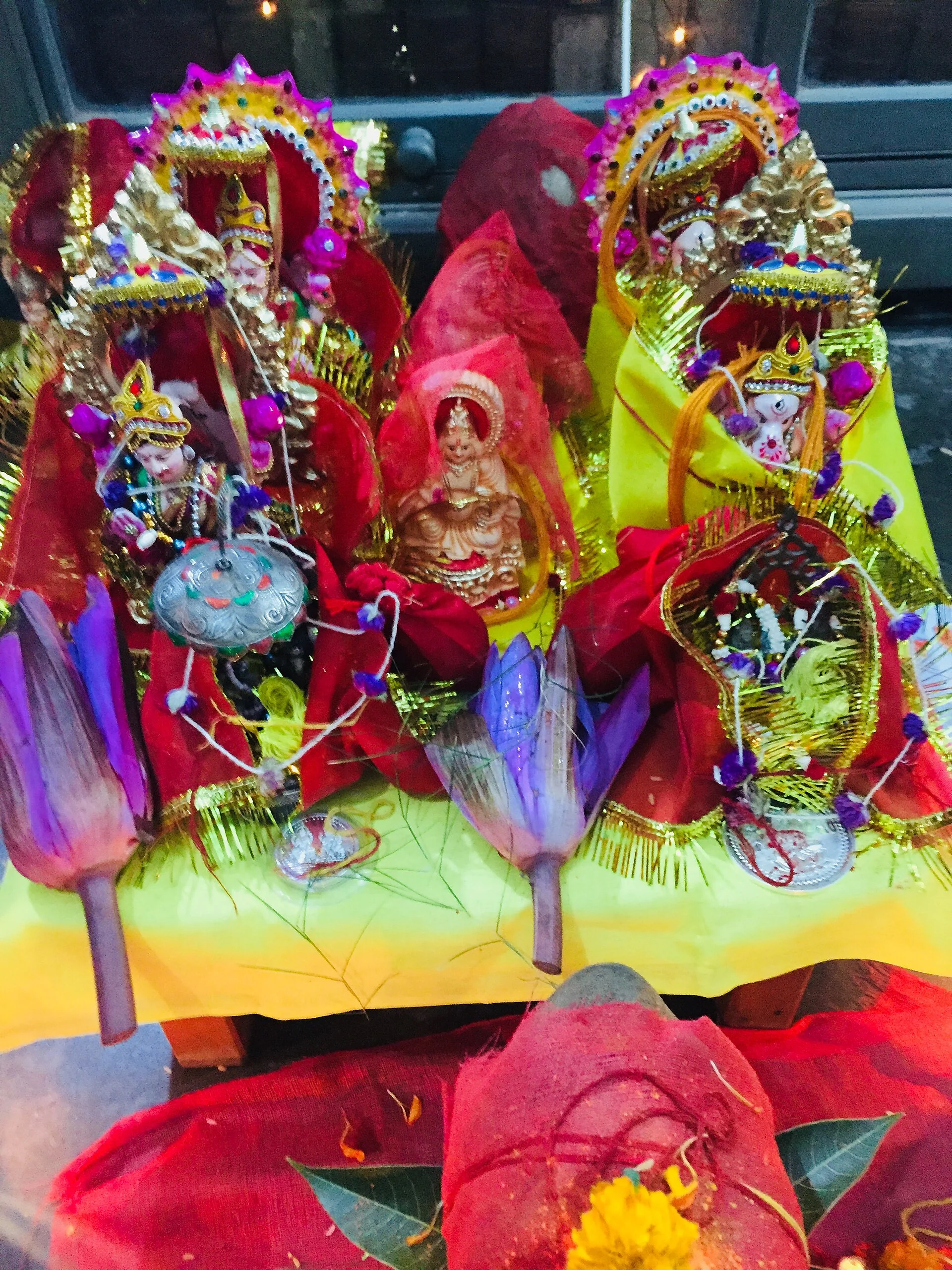
Sri Suktam: Complete Guide to the 15-Verse Vedic Hymn to Goddess Lakshmi
Purusha Suktam: Complete Guide to the Cosmic Hymn from Rig Veda 10.90