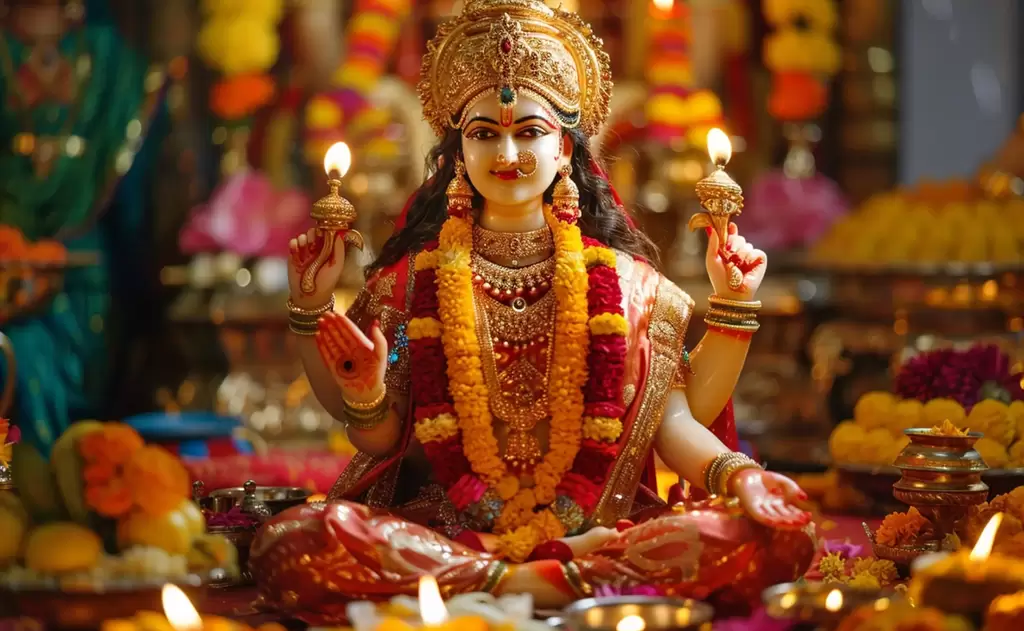
The Eternal Story of Bhai Dooj: When Love Defeated Yama Himself
Bhai Dooj – November 11, 2026 | Kartik Shukla Dwitiya Once upon a time in the celestial realms, Lord Yama, the stern God of Death, ruled with justice but…
Bhai Dooj – November 11, 2026 | Kartik Shukla Dwitiya Once upon a time in the celestial realms, Lord Yama, the stern God of Death, ruled with justice but…
Bhai Dooj – November 11, 2026 | Kartik Shukla Dwitiya
Once upon a time in the celestial realms, Lord Yama, the stern God of Death, ruled with justice but carried the weight of separating souls from their loved ones. His twin sister, Yamuna, the sacred river goddess, longed to see him—not as a deity, but as her beloved brother.
One fateful day during Kartik Shukla Dwitiya (now celebrated as Bhai Dooj), Yamuna invited Yama to her divine abode. She bathed in her own holy waters, prepared a grand feast with kheer, puri, and 36 kinds of delicacies, and decorated her palace with rangoli of rice and flowers.
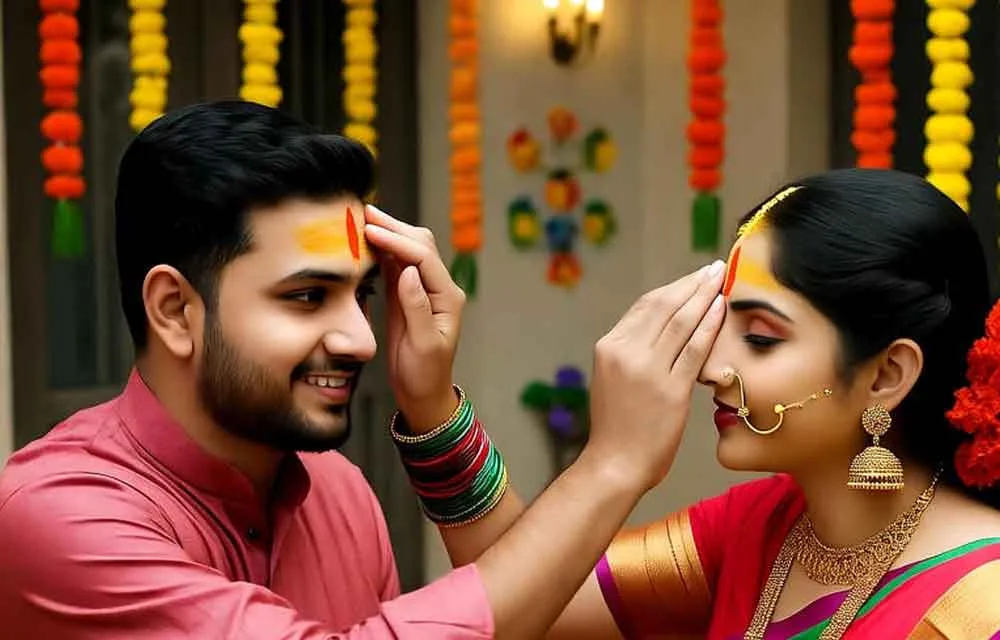
When Yama arrived, Yamuna welcomed him with tears of joy. She performed his aarti, applied a protective tilak of chandan and akshat on his forehead, and fed him the first bite with her own hands. Touched by her pure love, Yama asked:
“Sister, what boon do you desire?”
Yamuna replied:
“Grant that every sister who performs this tilak ritual for her brother on this day shall protect him from your grasp. Let no brother who receives this love ever fear untimely death!”
Yama, moved to his core, declared:
“From this day forward, any brother who receives a sister’s tilak, aarti, and prasad on Kartik Shukla Dwitiya will be blessed with long life and prosperity. Even I, Yama, shall bypass his door!”
And so, Bhai Dooj was born — not just a festival, but a divine promise: A sister’s love is stronger than death. A tilak can rewrite destiny. A sweet fed with devotion becomes amrit (nectar of immortality).
Another Legend: Krishna & Subhadra After slaying Narakasura, Lord Krishna visited his sister Subhadra. She welcomed him with a grand aarti, applied tilak, and fed him sweets. Krishna blessed her:
“This day shall forever celebrate the bond between brothers and sisters.”
That’s why even today, sisters chant:
“Bhaiya ki lambi umar ho, Yamraj bhi dar jaaye!” (May my brother live long — even Yama trembles!)
Moral of the Story: The tilak isn’t just vermilion — it’s a sister’s vow. The sweet isn’t just mithai — it’s amrit of protection. The gift isn’t just shagun — it’s gratitude returned.
This Bhai Dooj, let every dot of tilak carry this ancient promise. Tag your sibling & share this story — because love, once celebrated, becomes eternal.
#BhaiDooj #YamaDwitiya #SiblingBond #SanatanStories #HinduMythology
May your tilak shield your brother like Yamuna shielded Yama!
What do the Puranas actually say about Yama and Yamuna's sibling bond?
The Markandeya Purana and the Vishnu Purana both describe Yama and Yamuna as twin children of Surya, the Sun God, and Sanjna, his radiant consort. Because they share the same solar womb, their bond carries a cosmic significance that goes beyond ordinary fraternal affection — it is a union of dharma (righteousness, embodied by Yama) and bhakti (devotion, embodied by the river goddess Yamuna). This pairing encodes a theological truth: when dharma is tempered by loving devotion, even the most unyielding law can bend toward compassion.
The Padma Purana elaborates that Yamuna's waters are themselves considered amrita-tulya — equal to the nectar of immortality — precisely because she is born of the same divine light as the Lord of Death. Bathing in the Yamuna river on Kartik Shukla Dwitiya (Bhai Dooj) is therefore said to wash away the fear of Yama's danda, his staff of judgment. Many pilgrims travel to Mathura and Vrindavan on this very tithi to take a holy dip, connecting the festival's personal ritual to a much older cosmological narrative.
How is Bhai Dooj connected to the five-day Diwali festival cycle?
Bhai Dooj does not stand alone — it is the fifth and final day of the Deepotsava (festival of lights) cycle that begins with Dhantrayodashi (Dhanteras) on Kartik Krishna Trayodashi. Each day of this Panchaka carries its own presiding deity and its own form of divine protection: Dhanteras invokes Dhanvantari for health, Narak Chaturdashi removes sin, Diwali proper honours Lakshmi's arrival, Govardhan Puja celebrates Krishna's protection of Braj, and Bhai Dooj seals the cycle by invoking Yama's own grace over the household. The sequence moves from cosmic abundance to death itself being propitiated — a profoundly complete spiritual arc.
In Jyotisha (Vedic astrology), the Kartik Shukla Dwitiya tithi on which Bhai Dooj falls in 2026 is considered especially auspicious because Kartik month is presided over by Lord Vishnu, who is said to awaken from his Chaturmas yogic sleep (Devotthan Ekadashi follows shortly after). The protective tilak applied on a brother's forehead during this charged lunar fortnight is thus doubly sanctified — by the awakening of Vishnu's protective energy and by Yama's ancient promise to Yamuna.
What is the correct ritual procedure for performing the Bhai Dooj tilak and why does each step matter?
The traditional ritual begins with the sister rising before her brother, taking a purifying bath, and setting up a small puja thali containing chandan (sandalwood paste), kumkum, akshat (unbroken rice grains coloured with turmeric), a lit diya, flowers, and sweets. The unbroken rice is key: akshat symbolises completeness and longevity, as broken grain is considered inauspicious in Vedic ritual. The sister faces east or north while applying the tilak, directions associated with auspicious energy and the realm of the devas.
She applies the chandan-kumkum tilak on the brother's forehead at the Ajna chakra — the space between the eyebrows — which is considered in both Tantric and Ayurvedic thought to be the seat of intellect and divine consciousness. Following this, she performs aarti in a clockwise direction (pradakshina-krama), symbolising the removal of negative forces. The brother then places a gift — traditionally cloth, jewellery, or money — in her hands as a formal acknowledgement of her protection and love. The feeding of sweets by the sister's own hand mirrors exactly what Yamuna did for Yama, consciously reenacting the mythic moment when a sister's love defeated death.
How do different regions of India celebrate Bhai Dooj under different names?
While northern India celebrates the festival as Bhai Dooj, Maharashtra knows it as Bhau Beej — 'bhau' being the Marathi word for brother — and the coastal community of Goa celebrates it alongside the Diwali season with great fervour, sisters offering coconut-based sweets called modak-pede rather than the kheer-puri tradition of the Gangetic plains. In Bengal, the same festival is observed as Bhai Phonta, where 'phonta' refers specifically to the mark drawn with sandalwood paste and kajal on the brother's forehead; Bengali sisters recite a specific couplet: 'Bhaiyer kopale dilam phonta, Yamraj duware parlo kanta' — meaning 'I place the mark on my brother's forehead; may Yama find thorns at his door.'
In Nepal, the festival is called Bhai Tika and is one of the most elaborate of the Tihar (Diwali) celebrations. Nepalese sisters create a mandala of flowers and seeds called the Sapta-rangi Tika — a seven-colour mark — placed on the brother's forehead. The ritual includes offering a garland of makhamali flowers (globe amaranth) and a traditional feast of sel roti and seasonal fruits. Despite regional variations in name, food, and exact ritual, every tradition across the Indian subcontinent preserves the same theological core: a sister invoking divine protection over her brother by reenacting Yamuna's original act of love.
Why does the Krishna-Subhadra legend give Bhai Dooj a Dwapara Yuga dimension?
The Bhagavata Purana and the Harivamsa both describe Subhadra as the beloved sister of Sri Krishna, born of Vasudeva and Rohini (or Devaki, in some recensions), making her the only sister of the complete avatar of Vishnu. When Krishna returned to Dwarka after slaying Narakasura — an event commemorated on Narak Chaturdashi, the day before Diwali — the reunion with Subhadra added a second layer of meaning to the Kartik festival cycle. Subhadra's aarti of her victorious brother is thus not merely a domestic gesture but a goddess-sister welcoming a god-brother back from a cosmic battle.
This legend grounds Bhai Dooj firmly in the Vaishnava tradition and explains why the festival is observed with particular enthusiasm in Vaishnava strongholds such as Mathura, Vrindavan, Dwarka, and Puri. At the Jagannath Temple in Puri, Odisha, there is a special ritual called Yamadwitiya Seva performed on this tithi inside the temple precincts, where the Bhai-Bhagini (brother-sister) divine relationship is honoured with Vedic rites. The convergence of the Yama-Yamuna myth and the Krishna-Subhadra narrative on the same tithi means the festival carries the sanction of both the cosmic order (Dharmaraj Yama's promise) and the personal grace of the Supreme Lord (Krishna's blessing to Subhadra) — making it doubly inviolable.
What deeper spiritual meaning does the tilak carry beyond its protective symbolism?
In the Atharva Veda, protective marks applied to the body with sacred substances are called raksha-bandha in the broadest sense — bonds of protection created through intention, mantra, and sacred material. The Bhai Dooj tilak falls within this ancient category. Chandan (sandalwood) is considered sheetala — cooling — and calms the fire of aggression or fate; kumkum is associated with Shakti and vitality; akshat with Vishnu's completeness. Together they form a three-layered shield addressing mind, life-force, and wholeness simultaneously.
At a deeper metaphysical level, the act of the sister applying the tilak represents the feminine divine (Shakti) extending her protective grace over her male counterpart — mirroring the cosmic relationship between Lakshmi and Vishnu, Parvati and Shiva, or Yamuna and Yama himself. Swami Sivananda of the Divine Life Society wrote that every sacred domestic ritual (samskara) is a microcosmic yajna — a fire-offering — in which the participants temporarily become the deities whose myth they are enacting. In that sense, every sister who performs the Bhai Dooj tilak for even a few sacred moments embodies Yamuna herself, and her brother stands protected by a love that Yama once promised he would never override.
Share the Diwali 2026 blessing
Bhai Dooj closes the festival of lights with the gentlest flame of all, the love between a sister and her brother. As commonly told, Yamuna's tilak and heartfelt prayer moved even Yama, the lord of death, to bless her brother with long life. As you light the lamp and offer sweets this Diwali 2026, may Maa Lakshmi's grace fill your home and may the inner light keep every sibling safe. Share one of these blessings with your brother, sister and whole family today.
Deepa shloka: the lamp prayer
शुभं करोति कल्याणम् आरोग्यं धनसम्पदा। शत्रुबुद्धिविनाशाय दीपज्योतिर्नमोऽस्तु ते॥
Shubham karoti kalyanam arogyam dhana-sampada, shatru-buddhi-vinashaya deepa-jyotir namostu te.
Meaning: I bow to the light of the lamp, which brings what is auspicious and good, health and prosperity, and destroys ill-will. Many families recite it as they light the evening diya.
Lakshmi mantra for Diwali
ॐ श्रीं महालक्ष्म्यै नमः॥
Om Shreem Mahalakshmyai Namah.
Meaning: Salutations to Mahalakshmi. Shreem is the seed syllable traditionally associated with Lakshmi.
Diwali 2026 messages to share
🪔 Happy Bhai Dooj, dear brother! May the tilak on your forehead carry my prayers for your long life, good health and a heart always full of light. ✨ Share on WhatsApp
🌸 To my dearest sister on Bhai Dooj: thank you for your love that protects me like Yamuna's prayer. May your path always shine bright. 🙏 Share on WhatsApp
🙏 Respected Maa and Papa, your blessings are the lamp that keeps our sibling bond glowing. Happy Bhai Dooj and a blessed Diwali 2026 to you! 🪔 Share on WhatsApp
✨ Happy Bhai Dooj to my friends who became my brothers and sisters! May our bond stay sweet as mithai and bright as a diya. 🪔 Share on WhatsApp
🪔 May Maa Lakshmi bless every brother and sister with harmony, health and grace this Bhai Dooj. Wishing your family a joyful festival of lights! 🌸 Share on WhatsApp
🙏 As Lord Rama's homecoming lit up Ayodhya, may the love of siblings light up your home this Bhai Dooj. Jai Shri Ram! 🪔✨ Share on WhatsApp
A short Diwali prayer
Maa Lakshmi and Lord Ganesha, I bow before you with a grateful heart on this Bhai Dooj. Please protect my brothers and sisters, keep them healthy and guide them on the right path. Remove the obstacles that divide us, and let love, patience and harmony grow in our family. Help me make honest effort each day and keep the lamp of devotion burning in my heart.
Use the share buttons on this page to send these blessings to your family and friends.
Frequently Asked Questions
What is the story behind Bhai Dooj?
As commonly told, Yamuna invited her twin brother Yama, applied a tilak and fed him. Moved, Yama promised long life to any brother who receives his sister's tilak, aarti and prasad on Kartik Shukla Dwitiya.
When is Bhai Dooj in 2026?
Bhai Dooj falls on Wednesday, November 11, 2026 in India (Tuesday, November 10 in the USA, Canada and UK), on Kartik Shukla Dwitiya. It is the fifth and final day of the Diwali festival cycle.
How do sisters perform the Bhai Dooj tilak?
After a purifying bath, the sister sets a thali with chandan, kumkum, akshat, a diya, flowers and sweets. She applies the tilak between the brother's eyebrows, performs aarti clockwise and feeds him sweets, and he gives a gift.
What is the Krishna and Subhadra legend of Bhai Dooj?
After slaying Narakasura, Krishna visited his sister Subhadra, who welcomed him with aarti, tilak and sweets. Krishna blessed the day as a celebration of the bond between brothers and sisters.
What is Bhai Dooj called in other regions?
It is Bhau Beej in Maharashtra, Bhai Phonta in Bengal and Bhai Tika in Nepal, where it is part of Tihar. The core idea of a sister invoking protection for her brother is the same.
Why do people bathe in the Yamuna on Bhai Dooj?
Yamuna's waters are considered equal to the nectar of immortality, and bathing on Kartik Shukla Dwitiya is said to wash away the fear of Yama's danda. Many pilgrims go to Mathura and Vrindavan for the dip.
You might also like
Akshaya Tritiya – The Eternal Promise of Prosperity and Success
Sita Rama Kalyanam: The Divine Union – Eternal Love, Dharma & Bhakti
Akshaya Tritiya 2026 — The Eternal Wealth Day of the Hindu Calendar