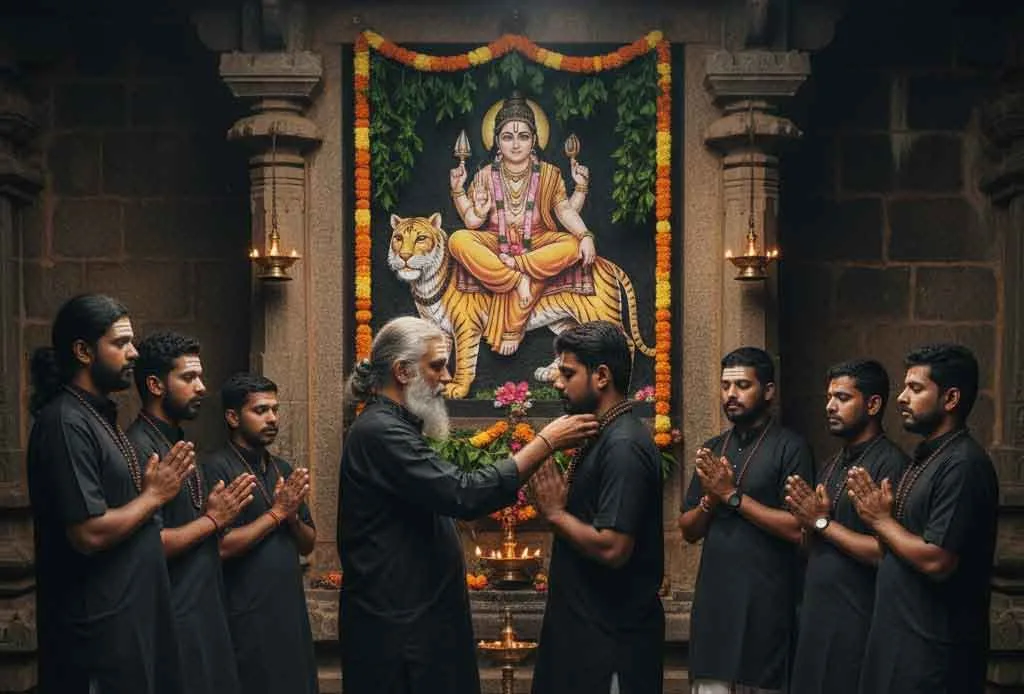
Thiruvabharanam: The Sacred Ornaments of Lord Ayyappa and the Procession from Pandalam to Sabarimala
The Thiruvabharanam, the sacred ornaments of Lord Ayyappa, are kept at Pandalam and carried in procession to Sabarimala before Makaravilakku. This guide explains the tradition, the Pandalam royal family's place in the Ayyappa story as commonly told, the difference between Makaravilakku and Makara Jyothi, and what it all means for pilgrims, including NRIs.
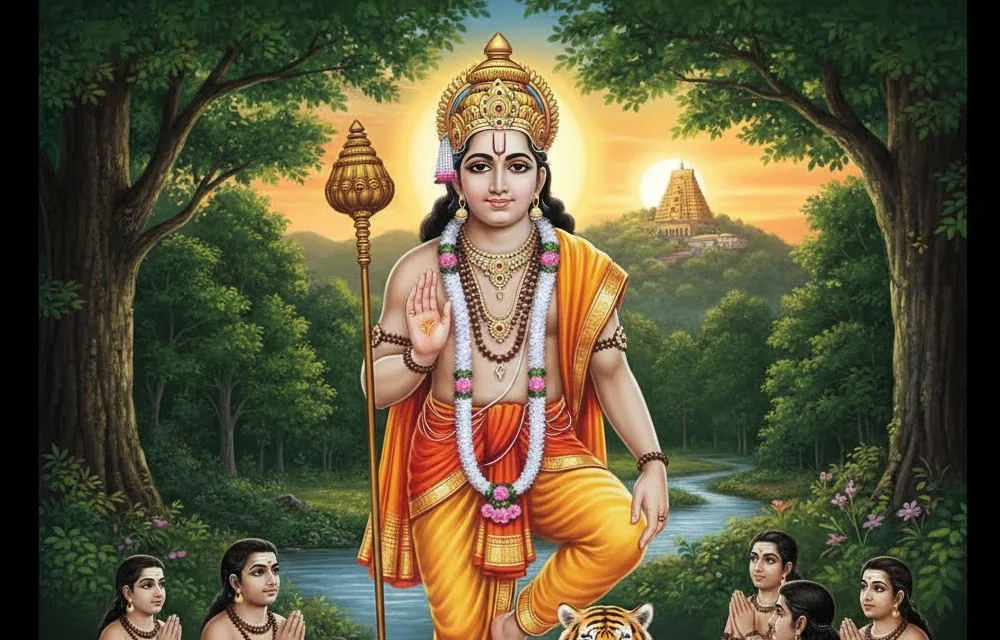
The Thiruvabharanam, the sacred ornaments of Lord Ayyappa, are kept at Pandalam and carried in procession to Sabarimala before Makaravilakku. This guide explains the tradition, the Pandalam royal family's place in the Ayyappa story as commonly told, the difference between Makaravilakku and Makara Jyothi, and what it all means for pilgrims, including NRIs.
Quick answer: The Thiruvabharanam are the sacred ornaments of Lord Ayyappa, kept at Pandalam, the home of the royal family who, as commonly told, raised the young Ayyappa as their son Manikandan. Before Makaravilakku, the ornaments are carried in a devotional procession to Sabarimala, where they adorn the deity for the festival. Makaravilakku is expected on Thursday 14 January 2027; please confirm with the Travancore Devaswom Board (TDB), as official 2026-27 dates had not been published when we wrote this.
Few moments in the Sabarimala season move devotees like the arrival of the Thiruvabharanam. After weeks of vratham, tens of thousands of voices calling "Swamiye Saranam Ayyappa" greet the ornament caskets as they reach the hill shrine. This guide explains what the ornaments are, why they travel from Pandalam, how the story behind them is commonly told, and what the procession means for pilgrims, including NRIs planning a Makaravilakku visit. For the full season, see our Sabarimala 2026-27 season guide.
What the Thiruvabharanam are
The word combines "thiru" (sacred, auspicious) and "abharanam" (ornament). The Thiruvabharanam are the set of ornaments believed by devotees to have been made for Lord Ayyappa by his foster father, the King of Pandalam. They are kept at Pandalam through the year, not at Sabarimala, and travel to the hill shrine only for the Makaravilakku festival.
We do not list the individual pieces or their history here, because detailed descriptions vary between sources and we prefer not to repeat claims we cannot verify. What matters to devotees is simple: these are the ornaments of the Lord, carried with the love of his family, and seeing them is considered a great blessing.
During the season, many pilgrims who pass through Pandalam stop to pay their respects at the shrine associated with the ornaments. If you plan to do this, check current arrangements locally, as access and display customs are set by the temple and the family, not by us.
The Pandalam royal family in the Ayyappa story, as commonly told
The story at the heart of the Thiruvabharanam tradition is told in many homes across Kerala, Tamil Nadu, Andhra Pradesh, Telangana and Karnataka, with small differences from family to family. As commonly told:
- King Rajasekhara of Pandalam and his queen had no children and prayed for a child.
- While hunting near the Pamba river, the king found a radiant baby wearing a bell (mani) around his neck. He took the child home and named him Manikandan, "the one with a bell at his neck".
- Manikandan grew up as the prince of Pandalam. Later a son was born to the queen, and court intrigue followed. The queen, misled by a minister, feigned illness and was told only tigress's milk could cure her.
- The young Manikandan went into the forest to fetch it, defeated the demoness Mahishi along the way, and returned riding a tigress, revealing his divine nature.
- He then told the king he must go to Sabarimala, where a shrine should be built for him. The grieving king asked how he could still serve his son, and the tradition of the Pandalam family's devotion, including the ornaments, flows from that bond.
Because of this story, devotees regard the Pandalam family as the Lord's earthly family. A representative of the family traditionally accompanies the Thiruvabharanam procession, and the family's connection to the Sabarimala festival is honoured to this day. For the fuller story, read Ayyappa Swamy's story from Manikanta's birth to Sabarimala darshan.
The procession from Pandalam to Sabarimala
By tradition, the ornaments are placed in caskets and carried from Pandalam to Sabarimala on foot by bearers who are themselves keeping strict vratham. The journey takes a few days and passes through villages, forest paths and the hill approach to the sannidhanam. Along the way, devotees gather to receive the procession with lamps, flowers and the chant "Swamiye Saranam Ayyappa".
A detail that devotees love to share, as commonly told, is that a Garuda (a kite, revered as the eagle-vehicle of Vishnu) is said to circle above the procession. Devotees take it as a sign of divine blessing. We report it as part of popular devotion, not as a claim we can verify.
We deliberately do not publish procession timings, halt points with times or route schedules. These are set and announced by the authorities each year and can change. If you wish to see the procession on its route, follow the TDB's announcements and local police and district advisories closer to the date.
When the procession reaches the sannidhanam, the ornaments are received with great ceremony and taken inside, and Lord Ayyappa is adorned with them for the evening deeparadhana on Makaravilakku. For many devotees, the sight of the Lord in the Thiruvabharanam is the high point of the entire pilgrimage.
Makaravilakku and Makara Jyothi: two different things
The Thiruvabharanam are closely linked with Makaravilakku, and that brings up a common confusion. The two names are often used interchangeably, but devotees and the temple distinguish them:
| Term | What it refers to |
|---|---|
| Makaravilakku | The festival on Makara Sankranti, and the lamp (vilakku) seen on Ponnambalamedu hill, across the valley from the shrine, after the evening deeparadhana. It is lit as a ritual. |
| Makara Jyothi | The name many devotees give to the bright star seen in the sky on that evening, regarded as auspicious. |
| Thiruvabharanam | The sacred ornaments that adorn Lord Ayyappa for the deeparadhana on Makaravilakku day. |
Understanding the difference does not make the evening any less sacred. The meaning lies in the devotion of the pilgrims, the Lord adorned in his ornaments and the light shown in his name. Read more in our sibling guides on Makaravilakku 2027 and Makara Jyothi 2027.
Expected 2026-27 dates around the Thiruvabharanam
The Travancore Devaswom Board had not published official dates for the Kollavarsham 1202 (2026-27) Mandala-Makaravilakku festival when we wrote this on 7 October 2026. The dates below are expected, calculated from the Malayalam solar calendar. Every one of them must be confirmed with the Travancore Devaswom Board before you book travel.
| Event | Expected date (confirm with the TDB) |
|---|---|
| Temple opens for Mandalam | Evening of Monday 16 November 2026 (expected) |
| Mandala season begins (Vrischikam 1) | Tuesday 17 November 2026 (expected) |
| Mandala Pooja | Sunday 27 December 2026 (expected) |
| Temple reopens for Makaravilakku | Wednesday 30 December 2026 (expected) |
| Makaravilakku, when the Thiruvabharanam adorn the deity | Thursday 14 January 2027 (expected) |
| Season closes | Around Wednesday 20 January 2027 (expected) |
The procession leaves Pandalam a few days before Makaravilakku by tradition. The exact departure day and arrangements are announced each year, so please confirm them with the Travancore Devaswom Board.
What the Thiruvabharanam mean to devotees
For most devotees, the Thiruvabharanam are not about the value of gold or stones. They are about relationship. A father's love for his son, offered every year through the ornaments, mirrors the devotee's own relationship with Ayyappa. The procession turns that love into something the whole community can see and join.
Some devotees and teachers offer symbolic readings. These are interpretations, not doctrine:
- Interpretation: the Lord comes to his people. The procession carries the ornaments through ordinary villages, a reminder that the divine is not only on the hilltop but along the road.
- Interpretation: devotion adorns God. Just as the ornaments adorn the deity, the 41-day vratham of the pilgrims is said to be their own ornament offered to him.
- Interpretation: humility in service. The bearers walk on foot under strict discipline, a picture of the humility the pilgrimage asks of every devotee.
Whatever reading speaks to you, the practical lesson is the same: keep your vratham sincerely, and arrive at the sannidhanam with a quiet, grateful mind.
For NRI devotees: planning a Makaravilakku visit
Many devotees from the USA, the UK, Canada, Singapore, Malaysia and the Gulf dream of seeing Lord Ayyappa in the Thiruvabharanam. If you are planning it, keep these points in mind:
- Virtual-Q is mandatory. The Travancore Devaswom Board states: "Online booking of Virtual-Q is mandatory for all pilgrims visiting Sabarimala". Book through the official Sabarimala channel only and keep your confirmation with you.
- Confirm dates before buying flights. Makaravilakku is expected on Thursday 14 January 2027; confirm with the Travancore Devaswom Board, and leave a buffer in your plans.
- Begin vratham at home. Many NRIs take the mala abroad under a Guru Swami at a local Ayyappa temple and keep the 41 days before flying. See our guide to Ayyappa deeksha for NRIs in the USA and UK.
- Travel with an experienced group. Makaravilakku is the busiest time of the season. A Guru Swami who has made the journey many times is invaluable for Kanni Ayyappans. See our first-timer's guide for Kanni Ayyappans.
- Look after your health. Jet lag, the climb and the crowds add up. Rest after landing, stay hydrated and speak with your doctor before the trip if you have any condition.
If you cannot travel this year, you can still join in spirit: watch for the ornaments' arrival at the sannidhanam on official broadcasts, light a lamp at home and listen to Harivarasanam with its meaning, the lullaby sung as the temple closes each night.
Frequently asked questions
What is Thiruvabharanam in Sabarimala?
Thiruvabharanam means 'sacred ornaments'. It refers to the set of ornaments of Lord Ayyappa kept at Pandalam, the place associated with his childhood as Manikandan. By tradition, the ornaments are carried in procession to Sabarimala before Makaravilakku and adorn the deity for the festival.
Where are the Thiruvabharanam kept during the year?
By tradition, the sacred ornaments are kept at Pandalam, in the care associated with the Pandalam royal family, and devotees visit to see them during the season. They travel to Sabarimala only for the Makaravilakku festival and are then returned to Pandalam.
When does the Thiruvabharanam procession reach Sabarimala in 2027?
By tradition, the procession arrives at the sannidhanam on Makaravilakku day. Makaravilakku is expected on Thursday 14 January 2027. Official 2026-27 dates had not been published as of 7 October 2026, so please confirm with the Travancore Devaswom Board before you plan around it.
Is Makaravilakku the same as Makara Jyothi?
No, though people often use the names loosely. Makaravilakku is the festival day and the lamp (vilakku) seen on Ponnambalamedu hill after the evening deeparadhana. Makara Jyothi is the name many devotees give to the star seen in the sky that evening. Both are part of the same sacred evening but are not the same thing.
Why is the Pandalam royal family connected to Ayyappa?
As commonly told, the childless King Rajasekhara of Pandalam found a radiant baby on the banks of the Pamba river and raised him as his son, Manikandan. That child is revered as Lord Ayyappa, so the Pandalam family is seen as his earthly family and has a traditional role in the Thiruvabharanam procession.
Can I see the Thiruvabharanam procession if I am travelling from abroad?
Many devotees line the traditional route or wait at the sannidhanam to see the procession arrive, but crowds around Makaravilakku are very heavy. NRIs should book Virtual-Q, which is mandatory per the TDB, confirm the expected dates with the Travancore Devaswom Board and travel with an experienced Guru Swami or group.
Sources & verification
Dates in this article are expected dates calculated by HinduTone from the Malayalam solar calendar; no official 2026-27 dates had been published by the Travancore Devaswom Board as of 7 October 2026. Confirm all dates, procession arrangements and Virtual-Q booking with the Travancore Devaswom Board and the official Sabarimala website before travel. Stories in this article are presented as commonly told and vary between regions and families; symbolic readings are labelled as interpretations.
Editor's note (7 October 2026)
We rewrote this guide in October 2026. We do not publish procession timings, fees or unverified historical dates. We will update the expected dates once the Travancore Devaswom Board announces the official 2026-27 schedule. If your family tells the Pandalam story differently, that is part of the richness of the tradition; follow your own Guru Swami's guidance.
Related guides
You might also like

Makaravilakku 2027 at Sabarimala: Expected Date (14 January), Thiruvabharanam, Makara Sankranti and How NRIs Observe It
Neyyabhishekam at Sabarimala: Meaning of the Ghee Coconut and How the Ritual Is Done
Sabarimala 18 Steps (Pathinettam Padi): Meaning, the Irumudi Rule and Padi Pooja