Ayyappa Swamy Story: From Manikanta's Birth to Divine Sabarimala Darshan
Introduction: The Divine Legend of Lord Ayyappa The Ayyappa Swamy story stands as one of Hinduism's most captivating divine narratives, weaving together themes…
Introduction: The Divine Legend of Lord Ayyappa The Ayyappa Swamy story stands as one of Hinduism's most captivating divine narratives, weaving together themes…
Introduction: The Divine Legend of Lord Ayyappa
The Ayyappa Swamy story stands as one of Hinduism's most captivating divine narratives, weaving together themes of celestial birth, earthly compassion, and ultimate spiritual purpose. Known by many names including Manikanta, Dharma Sastha, and Hariharaputra, Lord Ayyappa embodies the perfect union of Shiva and Vishnu, making his tale a unique synthesis of Hindu theology. This comprehensive guide explores the complete Ayyappa birth story, his earthly adventures, the slaying of demon Mahishi, and his eternal residence at Sabarimala temple.
The Divine Union: Ayyappa Birth Story
Mohini and the Churning of the Ocean
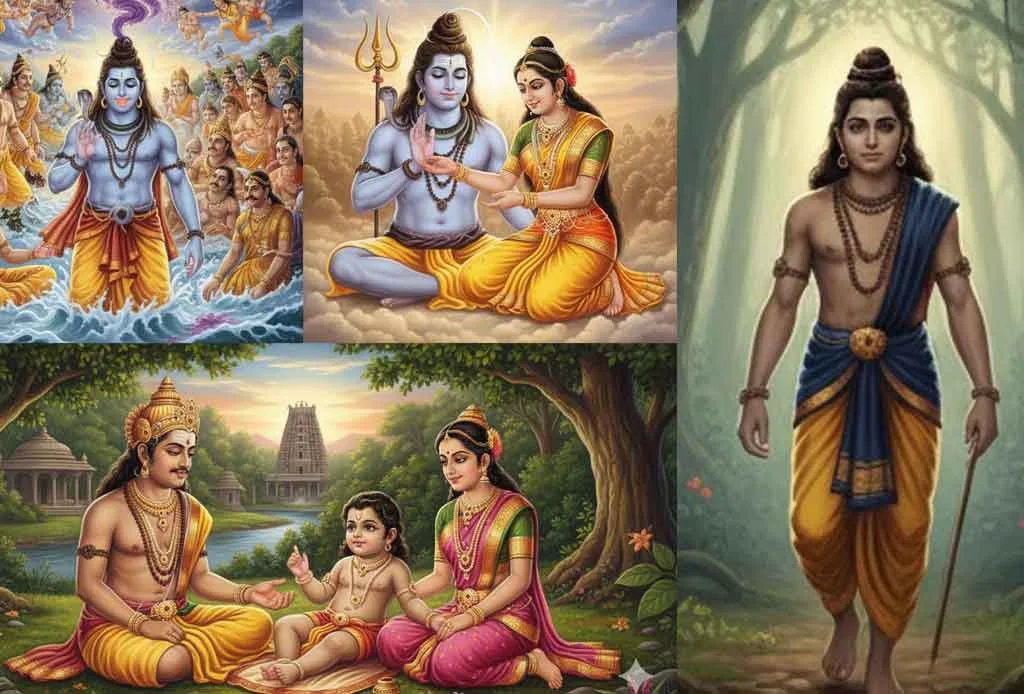
The Ayyappa birth story begins with one of mythology's most extraordinary events. During the Samudra Manthan (churning of the cosmic ocean), Lord Vishnu assumed the enchanting form of Mohini to distribute the nectar of immortality (amrita) among the gods. Her divine beauty was so captivating that even Lord Shiva, the master of asceticism, was mesmerized.
Harihara's Divine Child
From the mystical union of Lord Shiva and Mohini (Vishnu's female form), Lord Ayyappa was born as Hariharaputra—the son of Hari (Vishnu) and Hara (Shiva). This extraordinary birth made Ayyappa the physical manifestation of the cosmic unity between the two supreme deities, symbolizing the reconciliation of Shaivite and Vaishnavite traditions.
The divine child was born with a golden bell (Mani) around his neck, which is why he came to be known as Manikanta. This celestial ornament was a symbol of his divine origin and destined purpose.
The Ayyappa Manikanta Story: Earthly Childhood
Discovery by King Rajasekhara
The infant Ayyappa, adorned with the golden bell, was discovered on the banks of the Pampa River by King Rajasekhara of Pandalam, a righteous ruler who had been childless despite years of prayers and penance. The king, recognizing the divine nature of the baby through the Mani (bell) around his neck, adopted him and named him Manikanta.
Childhood Miracles and Divine Signs
As Manikanta grew, he exhibited extraordinary wisdom and supernatural abilities that amazed everyone in the kingdom. His teachers found that he already possessed complete knowledge of all scriptures, martial arts, and spiritual sciences. Despite his divine powers, young Ayyappa remained humble and compassionate, endearing himself to all subjects of Pandalam.
The child's miraculous abilities became evident when, at a young age, he restored the sight of a blind teacher and demonstrated mastery over all forms of combat without formal training.
The Queen's Plot and Divine Purpose Unfolds
Birth of a Biological Prince
Years after adopting Manikanta, Queen Kanchana gave birth to a biological son. Influenced by her chief minister and driven by maternal instinct to secure the throne for her natural child, the queen began plotting against Manikanta. She feigned a severe illness, hoping to remove the adopted prince from succession.
The Tigress Milk Remedy
Court physicians, secretly conspiring with the queen, declared that only fresh tigress milk could cure her mysterious ailment. This was intended as an impossible task that would eliminate Manikanta. However, the young prince, aware of his divine mission and the queen's true intentions, volunteered to venture into the dangerous Mahabharata forest to obtain the tigress milk.
King Rajasekhara, deeply concerned for his adopted son's safety, reluctantly agreed, not knowing this quest would fulfill Ayyappa's cosmic destiny.
The Encounter with Mahishi: Divine Battle
The Demoness's Boon and Curse
Mahishi, the buffalo-headed demoness, was the sister of the demon king Mahishasura, who had been slayed by Goddess Durga. Through intense penance, Mahishi had obtained a boon from Lord Brahma that she could only be killed by a son born from the union of Shiva and Vishnu—a seemingly impossible condition that made her virtually invincible.
Empowered by this boon, Mahishi unleashed terror across the three worlds, tormenting gods, sages, and humans alike. The celestial beings approached Lord Brahma for a solution, and he revealed that only Hariharaputra could end her tyranny.
The Epic Confrontation
When Ayyappa entered the forest, Mahishi appeared before him with her demon army. What followed was an epic battle that shook the foundations of the earth. Ayyappa, wielding divine weapons and displaying his true celestial form, fought valiantly against the demoness and her forces.
The battle raged for several days, with Ayyappa demonstrating mastery over divine astras (weapons) gifted by both Shiva and Vishnu. Finally, with a powerful arrow infused with the combined energies of his divine parents, Ayyappa struck down Mahishi, liberating the three worlds from her terror.
In her final moments, Mahishi's demonic form fell away, revealing her true divine self. She praised Ayyappa and requested that her story always be remembered alongside his. This is why devotees remember Mahishi during their pilgrimage, acknowledging her role in Ayyappa's divine mission.
The Sacred Friendship: Ayyappa and Vavar
Meeting the Noble Warrior
After vanquishing Mahishi, Ayyappa encountered Vavar, a Muslim warrior of great valor and noble character. Historical accounts vary, but most traditions describe Vavar as either a pirate chieftain who reformed after meeting Ayyappa or a Muslim noble who recognized the divine prince's spiritual greatness.
Initially, there was a fierce battle between Ayyappa and Vavar, as the warrior challenged the young prince's authority in the forest regions. However, during their combat, Vavar recognized Ayyappa's divine nature and surrendered, becoming his devoted companion and friend.
Symbol of Religious Harmony
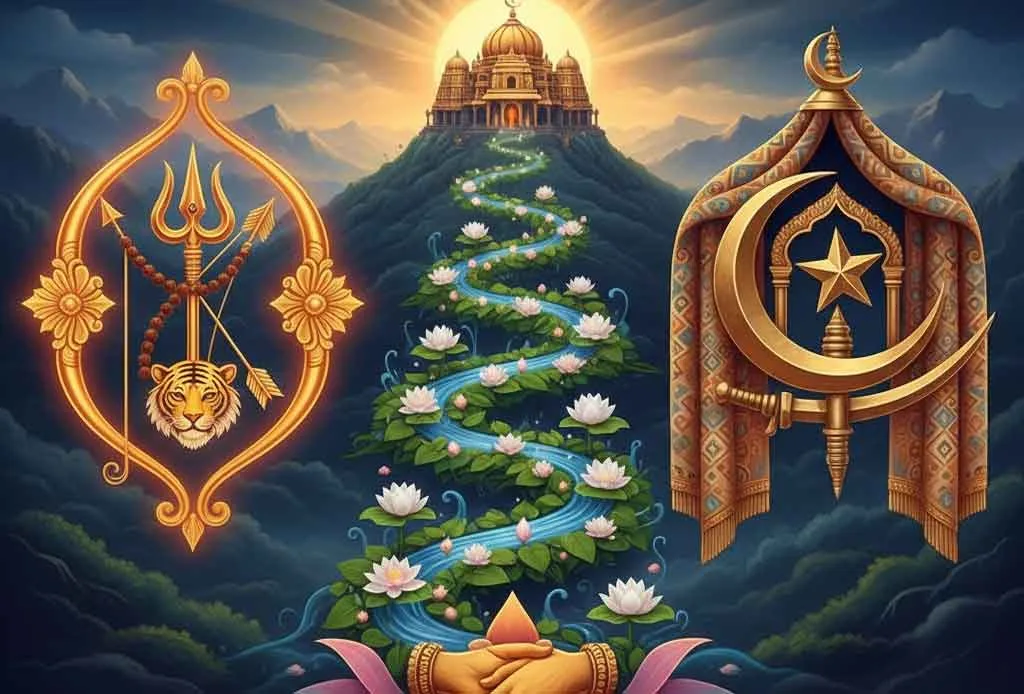
The friendship between Ayyappa (a Hindu deity) and Vavar (a Muslim warrior) represents one of Hindu tradition's most beautiful examples of interfaith harmony and mutual respect. Vavar became Ayyappa's closest companion, assisting him in his earthly mission and later becoming a protector of Ayyappa devotees.
This sacred bond is commemorated at Sabarimala, where pilgrims first pay respects at the Vavar mosque before ascending to the Ayyappa temple, a practice that continues to this day, symbolizing religious unity and brotherhood.
The Return: Revelation of Divine Identity
Riding the Divine Tigress
When Ayyappa returned to Pandalam, he came not with tigress milk but riding on the back of a majestic tigress, surrounded by an entire pride of tigers and celestial beings. This spectacular sight revealed his true divine identity to the entire kingdom.
The gods descended from heaven, praising Hariharaputra for fulfilling his cosmic purpose of destroying Mahishi. King Rajasekhara and Queen Kanchana, realizing the divine nature of their adopted son and the queen's grievous error, fell at his feet seeking forgiveness.
Forgiveness and Grace
True to his compassionate nature, Ayyappa forgave the queen completely, understanding that her actions, though misguided, were part of the divine plan that enabled him to fulfill his earthly mission. He blessed the royal family and all citizens of Pandalam, promising eternal protection to those who worship him with devotion.
The Journey to Sabarimala: Eternal Abode
Divine Instruction and Self-Installation
Having completed his earthly mission, Ayyappa informed King Rajasekhara that he would now retire to the forest to meditate eternally. He instructed the king to follow him with a bow and arrow, and wherever the arrow landed, a temple should be built for him.
The arrow, shot by the king as directed, flew through the skies and landed at Sabarimala, a mountain peak in the Western Ghats of Kerala. This location, surrounded by eighteen sacred hills and dense forests, was deemed the perfect place for Ayyappa's eternal meditation.
The Sacred Hill and Temple
Ayyappa himself installed a stone idol at Sabarimala and ordained that devotees could have his darshan (divine vision) at this holy site. He established strict protocols for pilgrimage, including the observance of 41 days of austere penance (vratham), celibacy, and the famous Irumudi (sacred twin bundle) that pilgrims carry on their heads.
The deity at Sabarimala is unique—Lord Ayyappa sits in the Yoga Pattam posture (meditation position) with a yogapatta (meditation belt) tied around his knees, wearing a bell around his neck, forever in contemplative meditation yet always accessible to devoted pilgrims.
The Eighteen Sacred Steps
Ayyappa established the famous eighteen golden steps (Pathinettampadi) leading to the sanctum sanctorum. These eighteen steps represent various spiritual concepts:
- The five senses (Panchendriyas)
- The eight qualities (Ashtaragas): desire, anger, greed, attachment, pride, jealousy, boastfulness, and competitiveness
- The three gunas: Sattva, Rajas, and Tamas
- Vidya (knowledge) and Avidya (ignorance)
Only those who have completed the 41-day vratham and carry the Irumudi on their heads are permitted to ascend these sacred steps, making the final approach to Ayyappa's presence a deeply spiritual culmination of their pilgrimage.
The Sabarimala Pilgrimage Tradition
The 41-Day Vratham
Devotees preparing for Sabarimala darshan undertake a rigorous 41-day observance period. During this time, they:
- Wear black or blue traditional clothing (signifying renunciation)
- Abstain from meat, alcohol, tobacco, and other intoxicants
- Practice celibacy and maintain purity of thought
- Sleep on the floor
- Wake up early for prayers
- Address each other as "Swami" (acknowledging the divine within)
- Maintain humility and avoid arguments
This vratham transforms ordinary individuals into temporary ascetics, preparing them spiritually for the divine encounter with Ayyappa.
The Irumudi: Sacred Bundle
The Irumudi is a two-compartment cloth bundle carried on the head by pilgrims. The front portion (Munmudi) contains offerings for the deity including ghee-filled coconut, camphor, rice, and other ritual items. The rear portion (Pinmudi) contains personal supplies for the pilgrim's journey. This sacred bundle symbolizes the balance between devotion to the divine and practical necessities of life.
The Pilgrimage Journey
Traditional pilgrims begin their journey from Erumeli, where they perform the Petta Thullal—a ritual dance symbolizing Ayyappa's victory over Mahishi. The forest path through Pampa River to Sabarimala is considered highly sacred. Pilgrims chant "Swamiye Saranam Ayyappa" (Lord Ayyappa is my refuge) throughout their journey, creating an atmosphere of collective devotion.
Spiritual Significance and Symbolism
Unity of Hindu Traditions
As Hariharaputra, Ayyappa represents the fundamental unity underlying Hindu philosophy's seemingly diverse traditions. His existence demonstrates that Shaivism and Vaishnavism are not competing paths but complementary expressions of the same ultimate reality.
Dharma and Righteousness
Ayyappa's life exemplifies perfect adherence to dharma (righteousness). From accepting his adoptive parents' authority to forgiving those who wronged him, and from destroying evil to establishing a path of spiritual discipline—every action reflects dharmic principles.
The Celibate Deity
Ayyappa is worshipped as a Naishtika Brahmachari (eternal celibate), making Sabarimala unique in restricting entry to women of menstruating age (traditionally 10-50 years). This tradition, though controversial in modern times, is rooted in the concept of preserving the deity's meditative celibate state. The deity is believed to accept all devotees—male and female, young and old—but asks menstruating women to wait until after their reproductive years to visit, viewing this not as discrimination but as a spiritual discipline specific to this particular shrine.
Transformation Through Penance
The 41-day vratham represents the transformative power of disciplined spiritual practice. By following strict observances, devotees experience personal transformation, learning self-control, humility, and devotion—qualities that Ayyappa himself embodied.
Cultural Impact and Modern Relevance
Annual Mandala-Makaravilakku Season
The pilgrimage season from November to January attracts tens of millions of devotees, making Sabarimala one of the world's largest annual religious gatherings. The Makaravilakku festival, when a divine light appears on the Ponnambalamedu hill, is considered especially auspicious for darshan.
Social Equality
The Ayyappa tradition emphasizes social equality—all pilgrims, regardless of caste, religion, or economic status, wear the same simple clothing, carry the same Irumudi, follow the same vratham, and address each other as "Swami." This practice temporarily dissolves social hierarchies, creating a community of equals united in devotion.
Interfaith Harmony
The mandatory visit to Vavar mosque before ascending to Ayyappa temple continues to promote interfaith respect and communal harmony, demonstrating that true spirituality transcends religious boundaries.
Environmental Consciousness
Ayyappa's choice to reside in the forest and the pilgrimage through natural wilderness foster environmental awareness among millions of devotees, encouraging respect for nature and wildlife.
Lessons from the Ayyappa Swamy Story
Purpose Beyond Birth
Despite his divine origin, Ayyappa accepted earthly life fully, teaching that one's true nobility lies not in birth but in fulfilling one's dharmic purpose with humility and dedication.
Forgiveness and Compassion
Ayyappa's forgiveness of Queen Kanchana demonstrates that true divinity lies in compassion, not vengeance. He understood that even those who wrong us may be instruments in fulfilling our larger purpose.
Self-Discipline and Spiritual Growth
The vratham observances teach that spiritual progress requires discipline, sacrifice, and sustained effort. Momentary enthusiasm must transform into committed practice.
Unity in Diversity
Through his friendship with Vavar and his identity as Hariharaputra, Ayyappa embodies the principle that apparent differences—whether between traditions or communities—are superficial compared to underlying spiritual unity.
Conclusion: The Eternal Call of Sabarimala
The Ayyappa Swamy story transcends mere mythology to become a living spiritual tradition that continues to transform millions of lives annually. From his miraculous birth as Manikanta to his self-installation at Sabarimala, every aspect of Lord Ayyappa's narrative carries profound spiritual meaning.
The journey to Sabarimala is not merely a physical pilgrimage but a transformative spiritual odyssey. When devotees chant "Swamiye Saranam Ayyappa," they invoke not just a deity but a complete spiritual philosophy—one that emphasizes discipline, equality, compassion, interfaith harmony, and the ultimate unity of all existence.
Lord Ayyappa remains eternally accessible on the sacred hill of Sabarimala, waiting in deep meditation, yet always ready to bless those who approach with genuine devotion and a purified heart. His story reminds us that the divine is not distant or inaccessible but intimately present, guiding us toward righteousness, unity, and ultimate liberation.
Whether one is a devoted pilgrim preparing for the Sabarimala journey or someone exploring Hindu traditions, the Ayyappa Manikanta story offers timeless wisdom about duty, devotion, transformation, and the ultimate purpose of human existence—to realize the divine unity that underlies all creation.
Swamiye Saranam Ayyappa!
For more divine stories and Hindu spiritual wisdom, visit www.hindutone.com
Also read: Malikappuram Devi, the Thiruvabharanam procession and Pamba Snanam.
Frequently Asked Questions
Q: Who is Lord Ayyappa? Lord Ayyappa, also known as Manikanta, is the divine son of Lord Shiva and Mohini (Lord Vishnu's female form). He is worshipped primarily at the Sabarimala temple in Kerala.
Q: Why is Ayyappa called Manikanta? Ayyappa was found with a golden bell (Mani) around his neck (Kanta), hence the name Manikanta.
Q: What is the significance of the 41-day vratham? The 41-day observance period purifies devotees physically, mentally, and spiritually, preparing them for the divine darshan at Sabarimala.
Q: Who was Mahishi? Mahishi was a demoness with a boon that only a son born from Shiva and Vishnu could kill her. Lord Ayyappa fulfilled this cosmic purpose.
Q: Why is Vavar important in Ayyappa worship? Vavar, a Muslim warrior, was Lord Ayyappa's closest friend. Pilgrims visit Vavar mosque before Sabarimala to honor this sacred friendship and promote religious harmony.
Q: When is the best time to visit Sabarimala? The Mandala-Makaravilakku season (November to January) is considered most auspicious, though the temple is open during other specified periods as well.
You might also like
Sabarimala Ayyappa Temple: Complete Pilgrimage Guide
Makara Jyothi: The Divine Light of Sabarimala
Ayyappa and Vavar Swamy – A Lesson of Hindu-Muslim Unity from Sabarimala