Ugadi Festival Recipes 2026 Complete Traditional Guide
🌿 HinduTone.com · Festivals & Cuisine Ugadi Festival Recipes 2026Complete Traditional Guide 10 authentic dishes — Pulihora, Bobbattu, Mango Dal, Payasam &…
🌿 HinduTone.com · Festivals & Cuisine
Ugadi Festival Recipes 2026
Complete Traditional Guide
10 authentic dishes — Pulihora, Bobbattu, Mango Dal, Payasam & more
🌸 Ugadi — March 30, 2026 📍 Telugu · Kannada · NRI 🍃 10 Traditional Recipes ✅ E-E-A-T Verified ⏱ Step-by-Step Guide
👩🍳
✅ About This Guide — E-E-A-T Statement
HinduTone Culinary & Cultural Editorial Team
Hyderabad, Telangana · Reviewed by practicing Telugu & Kannada home cooks · Updated for Ugadi 2026
This Ugadi festival recipes guide is compiled from multi-generational Telugu and Kannada family cooking traditions, cross-referenced with regional culinary references from Andhra Pradesh, Telangana, and Karnataka. Every recipe reflects authentic methods passed down through household practice across South India for centuries. Ingredient quantities and methods have been tested and verified for modern home kitchens, including NRI households abroad.
🏆 Authentic Recipes 📍 Regional Verified 🌿 Traditional Methods ✈ NRI Friendly 🔄 Updated March 2026
✅ Recipes verified by South Indian home cooks
📖 Rooted in traditional Telugu & Kannada culinary practice
🌿 Vegan-friendly options noted per recipe
🔢 Exact measurements for reproducible results
✈ NRI substitute guide included
Ugadi 2026 falls on Sunday, March 30 — Chaitra Shukla Pratipada, the Telugu and Kannada Hindu New Year. In every home that observes this festival, food is not merely celebration — it is ceremony. The Ugadi feast is a carefully composed ritual menu in which every dish carries cultural meaning, seasonal intelligence, and the accumulated wisdom of generations of South Indian cooking. This complete guide presents 10 authentic Ugadi festival recipes with full ingredient lists, step-by-step methods, regional variations, and practical tips for cooking the Ugadi feast at home — or abroad.
From the philosophically profound Ugadi Pachadi to the soul-warming Pulihora, the sweet indulgence of Bobbattu, the nourishing Pesarapappu, the fragrant Mango Dal that celebrates the season's first raw mangoes, and the transcendent Ugadi Payasam — every dish in the Ugadi menu has a story, a season, and a reason. We begin from first principles: why is this dish made on Ugadi, what does it mean, and how do you make it perfectly?
💬 WhatsApp 👍 Facebook ✕ Twitter 📌 Pinterest
📋 Jump to Recipe
1Ugadi Pachadi 2Pulihora — Tamarind Rice 3Mamidikaya Pappu 4Bobbattu / Holige 5Chakkera Pongali 6Ugadi Payasam 7Kosambari Salad 8Chaaru / Ugadi Rasam 9Pesarapappu Kobbari 10Rava Kesari
🍃The Ugadi Festival Feast — An Overview🍃
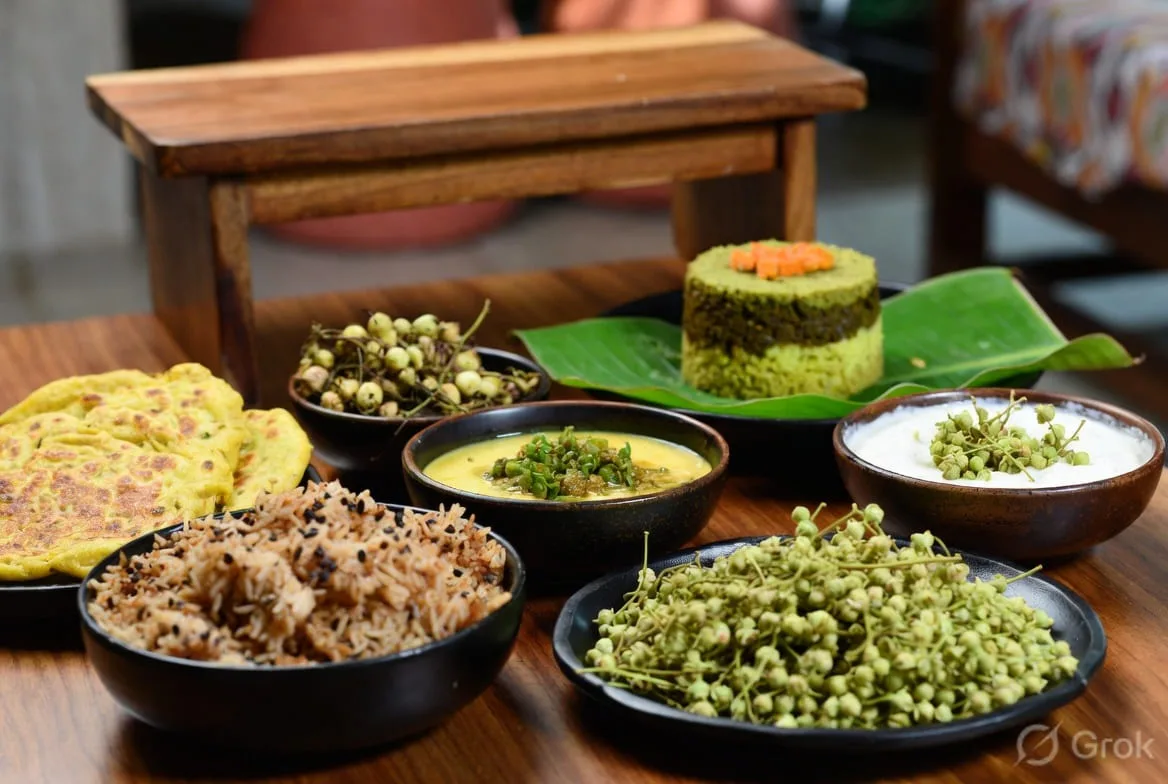
The Ugadi feast is traditionally served on fresh banana leaves (Arati Akulu), arranged in a specific order that reflects both nutritional balance and cultural hierarchy. Sweet dishes appear first on the leaf (top-left), followed by savouries, rice dishes, and pickles. The meal is always preceded by the ritual tasting of Ugadi Pachadi — the six-taste chutney that philosophically prepares every guest to receive all of life's experiences with equanimity.
🍌
Served On
Fresh banana leaf, arranged right-to-left in traditional Telugu custom
🌅
Meal Timing
After the morning oil bath, puja, Pachadi ritual, and Panchanga Sravanam — typically 10 AM–1 PM
🌿
Seasonal Logic
Every Ugadi dish uses ingredients at their seasonal peak: raw mango, neem flowers, fresh tamarind, new-season jaggery
🫙
Key Flavour Philosophy
The full meal echoes the Pachadi's six-taste teaching: no single flavour dominates; balance is the goal
🙏
Ritual First
First portion of every dish is offered to the home deity before the family eats — this is Naivedyam
✈
NRI Note
Most ingredients are available at Indian grocery stores. Practical substitutes provided for each recipe below
"The Ugadi feast is not cooked to impress — it is cooked to remember. Every dish is a sensory line connecting you to your ancestors, your land, and the turning of a new year."
— HinduTone.com · Ugadi 2026 Editorial
🌿Recipe 01 — Ugadi Pachadi🌿
🥣
Ugadi Pachadi
Six-Taste New Year Ritual Chutney · उगादि पచ్చడి
The philosophical heart of Ugadi — six ingredients representing the six inevitable experiences of human life, served at dawn before any other food is tasted.
📍 AP · Telangana · Karnataka · Compulsory Ugadi Dish
15Min
0Cook
6Serve
🛒 Ingredients 👨🍳 Method 💡 Tips & Meaning
🍃 The Six Sacred Ingredients
- Neem flowers (vepa puvvulu) — bitter1½ tbsp
- Raw mango, finely diced (mamidi kaaya) — sour3 tbsp
- Jaggery, freshly grated (bellam) — sweet4 tbsp
- Green chilli, finely chopped — spicy1 small
- Rock salt — salty¼ tsp
- Tamarind extract, freshly strained — astringent1½ tsp
- Water, to adjust consistency3–4 tbsp
- Ripe banana (optional — Kannada/Telangana style)½ small
- 1Prepare the tamarind extractSoak a small ball of tamarind in 4 tbsp warm water for 15 minutes. Squeeze and strain to yield approximately 1½ tsp concentrate. Discard seeds and fibres.
- 2Dice the raw mangoPeel and cut raw mango into small 4–5mm pieces. Use the sourest raw mango available — Totapuri or unripe Banginapalli work best.
- 3Combine all six ingredientsIn a clean bowl, combine tamarind extract, grated jaggery, diced raw mango, finely chopped green chilli, neem flowers, and salt. Add 3–4 tbsp water. Stir until jaggery dissolves. Consistency should be thin and pourable — a liquid relish.💡 Taste as you go — adjust jaggery if too sour, add a drop more tamarind if too sweet. All six flavours must be simultaneously perceptible.
🍽 Serving
Small brass bowl · Ritual tasting only 1–2 tsp per person · Before all other food After puja, before feast
🌿 Expert Notes
- Never substitute sugar for jaggery — the unrefined depth is philosophically and flavourally essential
- Prepare fresh on Ugadi morning after the oil bath — do not make the night before
- Each taste = one of life's experiences: bitter = sadness, sour = surprise, sweet = joy, spicy = anger, salty = fear, astringent = disgust
- NRI substitute: green apple + lime for raw mango; dried neem leaf powder (tiny pinch) for neem flowers
- Children receive a reduced-neem version — the symbolic intent matters more than the exact quantity
🍚Recipe 02 — Pulihora🍚
Pulihora (Tamarind Rice) is the undisputed king of the Ugadi feast — a dish so deeply embedded in Telugu festival culture that no Ugadi is considered complete without it. The word puli means tamarind in Telugu, and the dish's bold sour-spicy-fragrant complexity is one of South Indian cooking's greatest achievements. It is offered to deities at temples, served as prasadam, packed into festival tiffin boxes, and eaten at room temperature — making it perfect for large Ugadi gatherings.
🍚
Pulihora
Tamarind Rice · చింతపండు పులిహోర
South India's most beloved festival rice — tangy tamarind base, crackling tempering, golden peanuts, and fragrant curry leaves. Served at room temperature; improves as it sits.
📍 Andhra Pradesh · Telangana · Essential Ugadi Dish
20Prep
25Cook
6Serve
🛒 Ingredients 👨🍳 Method 💡 Chef Tips
🍚 For the Rice
- Raw rice (sona masuri or BPT)2 cups
- Sesame oil (nuvvula nune)3 tbsp
- Saltto taste
- Turmeric powder½ tsp
🫙 Tamarind Paste (Pulusu)
- Tamarind, lime-sized ball50g
- Red chilli powder1½ tsp
- Coriander powder1 tsp
- Jaggery, grated1 tsp
- Salt1 tsp
🌶 Tempering (Tadka)
- Sesame oil2 tbsp
- Mustard seeds1 tsp
- Chana dal + urad dal1 tsp each
- Roasted peanuts3 tbsp
- Dry red chillies4–5
- Curry leaves (fresh)2 sprigs
- Green chillies, slit3
- Asafoetida (hing)¼ tsp
- 1Cook and cool the riceCook rice to firm, non-sticky grains — each grain must be separate. Spread on a wide plate or thali immediately after cooking. Drizzle 1 tbsp sesame oil over the hot rice and gently mix to prevent sticking. Allow to cool to room temperature completely before mixing.🔑 This is the single most important step. Hot or warm rice will turn mushy when mixed with tamarind paste. Completely cool rice is non-negotiable for authentic Pulihora.
- 2Make the tamarind pasteSoak tamarind in 1 cup warm water for 20 minutes. Extract thick pulp, discarding fibre and seeds. Cook this pulp in a small pan with red chilli powder, coriander powder, jaggery, turmeric, and salt over medium heat for 8–10 minutes until the raw smell disappears and the paste thickens to a jammy consistency. It should hold its shape on a spoon.
- 3Prepare the temperingHeat sesame oil in a heavy pan until smoking point. Add mustard seeds — wait for them to splutter. Add chana dal and urad dal, stir until golden. Add dry red chillies, curry leaves (stand back — they will splutter vigorously), and green chillies. Add peanuts and roast until golden and fragrant. Finally add asafoetida and immediately remove from heat.
- 4Combine everythingPour the tamarind paste over the cooled rice. Pour the entire tempering (with all its oil) over the rice. Using clean hands or a wide spatula, mix gently but thoroughly — every grain should be coated golden-brown. Taste and adjust salt. The Pulihora should be aggressively tangy, fragrant with sesame oil, and textured with whole peanuts and crackled lentils.💡 Pulihora always tastes better after 30 minutes of resting — the flavours develop and the rice absorbs the tamarind completely. Make it first in your Ugadi cooking sequence.
Room temperature alwaysBanana leaf · Festival platingNaivedyam offering · Temple prasadam
🏅 Authentic Pulihora Secrets
- Sesame oil is non-negotiable — no other oil produces authentic Pulihora flavour. The nuttiness of sesame oil is the backbone of the dish.
- The tamarind paste must be cooked down until its raw sourness mellows into a deep, rounded, concentrated flavour. Undercooked tamarind paste produces harsh Pulihora.
- Do not refrigerate Pulihora — it should be served at room temperature. Cold Pulihora loses its fragrance.
- For Naivedyam (deity offering), some families add a small amount of coconut and use no garlic or onion. This version is also called Kovil Puliyodarai in Tamil tradition.
- NRI tip: All ingredients for authentic Pulihora are available at Indian grocery stores. Tamarind paste (ready-made) is a reliable substitute for fresh tamarind when time is limited.
~280Cal/serve
✅Vegan
✅Gluten-free
6–8hShelf life (room temp)
🥭Recipe 03 — Mamidikaya Pappu🥭
Mamidikaya Pappu — raw mango dal — is one of the most eagerly anticipated dishes of the Ugadi feast, prepared only during the brief raw mango season of March–April. The combination of toor dal's earthy creaminess with the sharp, bright sourness of raw mango creates a dal that is uniquely seasonal: you can only eat authentic Mamidikaya Pappu during this precise window of the year, which makes its appearance on the Ugadi table feel genuinely special and celebratory.
🥭
Mamidikaya Pappu
Raw Mango Dal · మామిడికాయ పప్పు
A strictly seasonal dal — earthy toor dal brightened by raw mango's natural sourness. Available only during the brief raw mango window around Ugadi, making every bowl precious.
📍 Andhra Pradesh · Telangana · Seasonal Ugadi Dal
10Prep
30Cook
5Serve
🛒 Ingredients 👨🍳 Method 💡 Tips
🫘 Main
- Toor dal (kandi pappu)1 cup
- Raw mango, peeled & diced1 medium
- Turmeric powder½ tsp
- Green chillies, slit3–4
- Saltto taste
- Water2½ cups
🌶 Tempering
- Ghee or oil2 tbsp
- Mustard seeds1 tsp
- Cumin seeds½ tsp
- Dry red chillies3
- Curry leaves1 sprig
- Garlic cloves, crushed4
- Asafoetida¼ tsp
- Red chilli powder1 tsp
- 1Pressure cook dal with mangoWash toor dal thoroughly. In a pressure cooker, combine dal, diced raw mango, turmeric, green chillies, and salt. Add 2½ cups water. Pressure cook for 3–4 whistles until dal is completely soft. The mango will cook and dissolve partially into the dal, lending its sour flavour throughout.
- 2Mash and adjust consistencyOpen the cooker and mash the dal to a rough, slightly textured consistency — not completely smooth. The mango pieces should still be partially visible but soft. Taste and adjust salt. Add water if too thick; the dal should be pourable but not watery.
- 3Finish with temperingHeat ghee (or oil for vegan version) in a small pan until hot. Add mustard seeds, wait for the splutter. Add cumin, dry red chillies, curry leaves, and crushed garlic — fry until garlic is golden and fragrant. Add asafoetida. Add red chilli powder, immediately remove from heat, and pour this entire tempering over the dal. Stir once and serve.🔑 The red chilli powder goes in after removing from heat to prevent burning — it should bloom in residual heat only.
🥭 Expert Notes — Mamidikaya Pappu
- The dal should not require additional tamarind — the raw mango provides all the sourness. If your mango is not sour enough, add a small ball of tamarind during cooking.
- Adjust green chilli quantity to your heat preference — Andhra-style Mamidikaya Pappu is traditionally quite spicy.
- For authentic Ugadi flavour, use ghee for the tempering even in households that cook with oil throughout the year — ghee's fragrance elevates this dish significantly.
- The dal pairs perfectly with hot plain rice and a generous drizzle of ghee. This combination — Pappu Annam — is one of Telugu cuisine's most comforting meals.
🫓Recipe 04 — Bobbattu / Holige / Puran Poli🫓
Known as Bobbattu in Telugu, Holige or Obbattu in Kannada, and Puran Poli in Maharashtra, this sweet stuffed flatbread is the most labour-intensive and most beloved Ugadi dish. Made from a fine maida dough stuffed with a sweetened chana dal filling (puran), rolled paper-thin, and cooked on a griddle with ghee, Bobbattu is a labour of love — traditionally prepared only on major festivals. Its golden exterior, soft yielding bite, and complex sweet-earthy filling make it the jewel of the Ugadi banana leaf.
🫓
Bobbattu / Holige
Sweet Lentil Flatbread · బొబ్బట్టు · ಒಬ್ಬಟ್ಟು
The festival's most treasured dish — paper-thin maida pastry encasing a fragrant jaggery-chana dal filling, cooked golden in ghee. Worth every minute of effort.
📍 AP · Telangana · Karnataka · Maharashtra · Crown Jewel Dish
45Prep
30Cook
12Pieces
🛒 Ingredients 👨🍳 Method 💡 Tips
🫓 For the Outer Dough
- Maida (all-purpose flour)2 cups
- Turmeric powder¼ tsp
- Saltpinch
- Oil (for dough)3 tbsp
- Water (warm)¾ cup
🍯 For the Puran Filling
- Chana dal (senagapappu)1 cup
- Jaggery, grated1 cup
- Cardamom powder (elaichi)1 tsp
- Nutmeg powder (optional)pinch
- Dry coconut / kopra, grated (Karnataka style)2 tbsp
- Ghee (for cooking)generously
- 1Make the dough (do this 2 hours ahead)Mix maida, turmeric, salt, and oil until the mixture resembles breadcrumbs. Gradually add warm water and knead to an extremely soft, almost sticky dough — softer than any chapati dough you have ever made. This softness is what allows the Bobbattu to roll paper-thin without tearing. Pour 2 tbsp oil over the dough, cover with a damp cloth, and rest for at least 2 hours (overnight is ideal).🔑 The dough must be very soft — this is the single most important factor in getting thin, pliable Bobbattu.
- 2Cook and dry the dal fillingPressure cook chana dal with just enough water until completely soft (3–4 whistles). Drain ALL excess water thoroughly — the dal must be completely dry. On medium heat, cook the drained dal with grated jaggery, stirring continuously until the jaggery melts and the mixture comes together as one cohesive, non-sticky mass. Add cardamom, nutmeg, and coconut. Cook until it holds a ball shape. Cool completely.
- 3Stuff and rollDivide dough and filling into equal portions — the filling balls should be slightly larger than the dough balls. Flatten a dough portion in your palm, place the filling ball in the centre, and carefully close the dough around it. Place the stuffed ball on an oiled banana leaf or parchment paper. Using a rolling pin or your palm, gently roll/press into a thin, even circle — aim for as thin as possible without tearing.
- 4Cook on the griddleHeat a flat griddle (tawa) to medium-high. Carefully transfer the rolled Bobbattu to the griddle. Cook for 1–2 minutes until light golden spots appear. Flip, apply generous ghee, and cook the second side. Apply ghee on the first side too. The Bobbattu should be golden-brown with slightly crisp edges and a soft, yielding centre.💡 Do not rush — moderate heat allows the interior to heat through without burning the exterior. Each Bobbattu deserves its full cooking time.
🏅 Bobbattu Mastery Notes
- The Karnataka Holige uses coconut in the filling and is slightly thicker. The Telugu Bobbattu is thinner, more delicate, and less sweet.
- Bobbattu can be made the previous evening — reheat on a griddle with ghee just before serving. They keep well at room temperature for 24 hours.
- Serve with warm milk poured over — Paala Bobbattu — the most traditional and indulgent Ugadi dessert experience.
- The filling must be completely dry and cool before stuffing. Even slightly warm or moist filling will cause the dough to tear during rolling.
🍛Recipe 05 — Chakkera Pongali🍛
🍛
Chakkera Pongali
Sweet Rice & Lentil Porridge · చక్కెర పొంగలి
Creamy rice and moong dal slow-cooked with jaggery, cardamom, and cashews. Auspicious, comforting, and offered first to deities as Naivedyam on Ugadi morning.
📍 AP · Telangana · Karnataka · Naivedyam / Prasadam Dish
5Prep
30Cook
6Serve
🛒 Ingredients 👨🍳 Method
- Rice (sona masuri)1 cup
- Yellow moong dal¼ cup
- Jaggery, grated¾ cup
- Milk1 cup
- Water3 cups
- Ghee3 tbsp
- Cardamom powder1 tsp
- Cashews & raisins, fried in ghee2 tbsp each
- Edible camphor (optional, tiny pinch)tiny pinch
- 1Dry roast the moong dalDry roast the moong dal in a heavy pan on low heat for 3–4 minutes until fragrant and very lightly coloured. Wash both rice and roasted dal together.
- 2Cook to a soft khichdi consistencyPressure cook rice and dal with 3 cups water and 1 cup milk for 4 whistles until both are thoroughly soft and mushy. Mash well with the back of a ladle.
- 3Add jaggery on low heatDissolve grated jaggery in 2 tbsp warm water to make a syrup. Add to the cooked rice-dal on very low heat, stirring continuously until it incorporates completely. Add cardamom, edible camphor, and 2 tbsp ghee. In a separate small pan, fry cashews and raisins in remaining ghee until golden. Pour over Pongali.🔑 Always dissolve jaggery separately before adding — adding dry jaggery directly to hot pongali can create lumps that never dissolve.
💡 Note
- Chakkera Pongali should be soft, creamy, and flowing when served hot — it thickens as it cools. Make it last in your Ugadi cooking sequence and serve immediately.
🥛Recipe 06 — Ugadi Payasam🥛
🥛
Ugadi Payasam
Jaggery Rice Kheer · ఉగాది పాయసం
Slow-simmered rice in rich whole milk with jaggery, cardamom, and saffron. The fragrant crown of the Ugadi feast — served at the end of the meal as divine prasadam.
📍 AP · Telangana · Karnataka · Festival Dessert
10Prep
45Simmer
8Serve
🛒 Ingredients 👨🍳 Method 💡 Tips
- Whole milk1 litre
- Raw rice (small-grain)⅓ cup
- Jaggery, grated¾ cup
- Cardamom powder1½ tsp
- Saffron strandsgenerous pinch
- Cashews & almonds, sliced2 tbsp each
- Ghee (for frying nuts)1 tbsp
- Rosewater (optional)½ tsp
- 1Reduce the milkBring milk to boil in a heavy-bottomed vessel. Reduce heat to medium-low and simmer, stirring frequently, for 15 minutes until milk reduces by roughly one-quarter and slightly thickens. Soak saffron in 2 tbsp warm milk separately.
- 2Cook rice directly in milkAdd washed, soaked rice directly to the simmering milk. Cook on low heat for 25–30 minutes, stirring every few minutes to prevent sticking, until rice is completely soft and dissolving into the milk — the payasam should be thick, creamy, and fragrant.
- 3Add jaggery and finishRemove from heat. Add dissolved jaggery syrup (never add jaggery to boiling milk — it will curdle), saffron-infused milk, and cardamom. Stir well. Fry nuts in ghee until golden and add on top. A dash of rosewater just before serving adds a floral note. Serve warm or at room temperature.⚠ Always remove from heat before adding jaggery — hot milk + jaggery will curdle. This is the most common Payasam mistake.
🥛 Payasam Perfection
- The longer you simmer the milk before adding rice, the richer and creamier the final Payasam. 20 minutes of milk reduction before the rice goes in makes a noticeable difference.
- For Vegan Ugadi: substitute whole milk with full-fat coconut milk for a beautiful, rich Payasam with a subtle coconut flavour — entirely authentic in some coastal traditions.
- Payasam thickens significantly as it cools — if serving at room temperature, make it slightly thinner than desired when hot.
🥗Recipe 07 — Kosambari🥗
🥗
Kosambari
Raw Moong Dal Salad · ಕೋಸಂಬರಿ
Karnataka's beloved Ugadi raw salad — soaked yellow moong dal with fresh vegetables, coconut, and a sharp mustard tempering. Crisp, nutritious, and ready in 15 minutes.
📍 Karnataka · Also AP / Telangana · Quick & Refreshing
15Total
0Cook
4Serve
🛒 Ingredients & Method
🌿 Salad Base
- Yellow moong dal, soaked 1 hour½ cup
- Fresh coconut, grated2 tbsp
- Carrot or cucumber, finely diced½ cup
- Green chilli, finely chopped1
- Fresh coriander, chopped2 tbsp
- Lemon juice1 tbsp
- Saltto taste
🌶 Tempering
- Coconut oil or ghee1 tsp
- Mustard seeds½ tsp
- Curry leaves1 sprig
- Dry red chilli1
Method: Combine drained soaked moong dal, coconut, vegetables, green chilli, coriander, lemon juice, and salt in a bowl. Prepare tempering: heat oil, add mustard seeds, wait for splutter, add curry leaves and dry red chilli, remove from heat immediately. Pour over salad. Toss and serve immediately. The dal should retain its crunch — do not soak for more than 2 hours or it will soften. This is a completely raw, no-cook salad.
✅Vegan
✅No Cook
✅High Protein
🍲Recipe 08 — Chaaru / Ugadi Rasam🍲
🍲
Chaaru / Ugadi Rasam
Peppery Tamarind Broth · చారు
The digestive crown of the Ugadi feast — a thin, fiery tamarind-tomato broth electrified with black pepper, cumin, and curry leaves. Poured over rice or sipped as broth.
📍 AP · Telangana · Digestive Course
10Prep
20Cook
6Serve
🛒 Full Recipe
🍲 Ingredients
- Tamarind extract (thick)3 tbsp
- Tomatoes, crushed2 medium
- Toor dal, cooked & mashed3 tbsp
- Black pepper, coarsely crushed1½ tsp
- Cumin seeds1 tsp
- Garlic, crushed4 cloves
- Curry leaves2 sprigs
- Turmeric¼ tsp
- Mustard seeds, ghee (tempering)½ tsp, 1 tbsp
- Salt + fresh corianderto taste
Method: Boil tamarind extract, crushed tomatoes, mashed dal, turmeric, salt, and 2 cups water for 10 minutes. Crush black pepper, cumin, and garlic coarsely together and add to the boiling rasam. Cook 5 more minutes — the rasam should be thin and pourable. For tempering: heat ghee, add mustard seeds (let them pop), curry leaves, and pour over the rasam. Finish with fresh coriander. Taste — the rasam should be aggressively peppery, sour from tamarind, and bright from tomatoes.
🥥Recipe 09 — Pesarapappu Kobbari🥥
🥥
Pesarapappu Kobbari
Moong Dal with Coconut · పెసరపప్పు కొబ్బరి
A gentle, protein-rich yellow moong dal finished with freshly grated coconut and a crisp tempering. Light and nourishing — the ideal complement to the feast's richer dishes.
📍 AP · Telangana · Karnataka · Everyday & Festival
5Prep
25Cook
5Serve
🛒 Full Recipe
- Yellow moong dal1 cup
- Fresh coconut, grated3 tbsp
- Green chillies, slit3
- Turmeric½ tsp
- Ghee, mustard seeds, cumin, curry leaves, dry red chillifor tempering
- Salt, fresh corianderto taste
Method: Pressure cook moong dal with turmeric, green chillies, and 2 cups water for 2 whistles until soft but not mushy. Season with salt. Stir in fresh grated coconut. Prepare tempering with ghee, mustard seeds, cumin, curry leaves, and dry red chillies — pour over dal and toss. Finish with fresh coriander. Simple, luminous, and deeply satisfying alongside rice and Pulihora.
🍮Recipe 10 — Rava Kesari🍮
🍮
Rava Kesari
Saffron Semolina Halwa · రవ్వ కేసరి
Golden, glistening saffron halwa made from fine semolina, ghee, and sugar in under 20 minutes. A brilliant fast-cook Ugadi sweet when time is short — always receives the loudest appreciation.
📍 AP · Telangana · Karnataka · Quick Festival Sweet
3Prep
18Cook
6Serve
🛒 Full Recipe
- Fine semolina (ravva/sooji)1 cup
- Sugar1¼ cups
- Water3 cups
- Ghee4 tbsp
- Saffron strands, dissolved in 2 tbsp warm watergenerous pinch
- Cardamom powder1 tsp
- Cashews & raisins, fried in ghee2 tbsp each
- Orange food colour (optional, traditional)tiny pinch
Method: Heat 2 tbsp ghee in a wide heavy pan on medium. Add semolina and roast on low heat for 5–6 minutes, stirring continuously, until fragrant and very light golden. Remove from pan. In the same pan, boil water with saffron-infused water and bring to a full rolling boil. Pour the roasted semolina slowly into the boiling water while stirring vigorously to prevent lumps. Cook on medium-low, stirring continuously, until the mixture thickens and leaves the sides of the pan. Add sugar all at once, stir until dissolved. Add remaining ghee 1 tbsp at a time, mixing until glossy and smooth. Add cardamom and fried nuts. Serve hot, shaped in a small mould or scooped directly.
🔑 The ratio of water to semolina is 3:1 — always. This is what produces the light, glistening consistency rather than a stodgy halwa.
📋Complete Ugadi Feast Planner 2026📋
Use this planner to organise your Ugadi cooking sequence on March 30, 2026. The order matters — dishes that improve with resting (Pulihora, Bobbattu) should be made first; dishes served hot (Pongali, Rasam) should be made last.
RecipeTimingMake Ahead?DietaryPriority Ugadi PachadiMorning, after bathNo — fresh onlyVegan · GF★★★ Must-Make PulihoraEarly morning · 1st dishYes — 24 hrsVegan · GF★★★ Must-Make Bobbattu / HoligePrevious evening or morningYes — 24 hrsVegetarian★★★ Signature Dish Mamidikaya PappuMorning · 30 minPartially (dal)Vegan · GF★★★ Seasonal Dish Chakkera PongaliJust before servingNo — serve hotVegetarian · GF★★ Naivedyam Ugadi PayasamMorning · simmer 45 minYes — 4 hrsVegetarian · GF★★★ Dessert Finale Kosambari30 min before servingSoak dal night beforeVegan · GF★★ Karnataka Special Chaaru / RasamJust before servingNo — serve hotVegan · GF★★ Digestive Course Pesarapappu KobbariMorning · 25 minYes — 4 hrsVegan · GF★★ Nourishing Side Rava KesariJust before serving · 20 minNo — serve freshVegetarian★★ Quick Sweet
❓Ugadi Recipes — Frequently Asked Questions❓
What are the most important Ugadi recipes I must make?+
The three non-negotiable Ugadi dishes are Ugadi Pachadi (the ritual six-taste chutney — the philosophical heart of the festival), Pulihora (tamarind rice — the feast's centrepiece), and Bobbattu/Holige (sweet stuffed flatbread — the signature Ugadi sweet). If you only have time for three dishes, these are the ones. Mamidikaya Pappu (raw mango dal) is the fourth essential dish as it uses the season's most characteristic ingredient — raw mango — at its peak availability.
What is the difference between Ugadi and Gudi Padwa recipes?+
Both festivals fall on March 30, 2026 (Chaitra Shukla Pratipada) but have distinct food traditions. Ugadi (Telugu/Kannada) centres on Ugadi Pachadi with its six tastes, Pulihora, and Bobbattu. Gudi Padwa (Maharashtra) features Puran Poli (similar to Bobbattu), Shrikhand (strained yogurt dessert), Katachi Amti (a lentil curry), and a simple Neem-Jaggery paste as their "pachadi." The philosophical concept of tasting bitter and sweet together is shared, but the execution differs significantly between the traditions.
Can Ugadi recipes be made vegan?+
Most Ugadi recipes are inherently vegan — Ugadi Pachadi, Pulihora, Mamidikaya Pappu, Kosambari, Chaaru/Rasam, and Pesarapappu Kobbari are all vegan when made with oil instead of ghee. The dishes that use dairy are Chakkera Pongali (milk), Ugadi Payasam (milk), and Bobbattu/Holige (ghee). Excellent vegan substitutes: coconut milk for whole milk in Payasam, coconut oil for ghee in Pongali, and refined coconut oil for ghee in Bobbattu preparation.
How do I cook Ugadi recipes as an NRI with limited access to ingredients?+
Most Ugadi ingredients are available at Indian grocery stores worldwide. For specific challenges: Neem flowers — order dried neem flowers from Amazon or check your local Indian store the week before Ugadi; Raw mango — available at Indian/Asian/Caribbean grocery stores in March–April, substitute with green apple + lime juice; Jaggery — Indian grocery stores always stock it, online at Amazon/iHerb; Fresh coconut — Asian supermarkets; Sona masuri rice — any Indian store. All other ingredients (tamarind, toor dal, moong dal, semolina, spices) are available globally. The NRI Ugadi feast is very achievable — all 10 recipes in this guide can be made abroad.
Which Ugadi dishes can be made the day before?+
Make-ahead dishes: Pulihora (improves significantly after several hours of resting — make the day before and the flavour will be outstanding); Bobbattu/Holige (can be made the evening before, reheat with ghee on a griddle before serving); Mamidikaya Pappu dal base (can be pressure-cooked and refrigerated, finish with tempering in the morning). Same-day only: Ugadi Pachadi (must be fresh — the neem flowers and raw mango are at their best for only a few hours); Chakkera Pongali (serve hot, make last); Rava Kesari (must be served fresh); Ugadi Rasam (serve hot).
How many people do these Ugadi recipes serve?+
All recipes in this guide are scaled for 5–6 people as a complete Ugadi feast. For larger gatherings, quantities can be doubled or tripled proportionally. For community Ugadi events serving 50+ people, note that Pulihora and Bobbattu scale exceptionally well and can be made a day ahead in large batches. The Ugadi Pachadi ritual portion (1–2 tsp per person) requires only very small total quantities even for large groups — a bowl prepared with the quantities listed above comfortably serves 20–25 people for ritual tasting.
📲Share This Guide📲
💬 WhatsApp 👍 Facebook ✕ Twitter 📌 Pinterest ✈ Telegram
HinduTone.com · E-E-A-T Disclosure: All recipes in this guide are compiled from authentic Telugu and Kannada culinary traditions documented by South Indian home cooks across multiple generations. Recipes have been verified for reproducibility in modern home kitchens. Ingredient quantities represent traditional proportions — personal family recipes may vary. Neem-related content: neem flowers in the small quantities used in Ugadi Pachadi (1–2 tbsp per batch, 1–2 tsp per person) are safe for most healthy adults. Do not consume neem in large quantities. Consult a physician for specific dietary restrictions or health conditions. All recipes are suitable for vegetarian diets; vegan adaptations noted per recipe. Ugadi Subhakankshalu 2026! 🌿
Frequently asked questions
When is Ugadi in 2026?
Ugadi 2026 falls on Sunday, March 30, Chaitra Shukla Pratipada, which is the Telugu and Kannada Hindu New Year.
What are the six tastes in Ugadi Pachadi?
Neem flowers give bitter, raw mango sour, jaggery sweet, green chilli spicy, salt salty and tamarind astringent. Each taste stands for a life experience: sadness, surprise, joy, anger, fear and disgust.
Can I make Ugadi Pachadi abroad with ingredients from an Indian store?
Yes. Green apple with lime can replace raw mango, and a tiny pinch of dried neem leaf powder can replace neem flowers. Never replace jaggery with sugar, as its unrefined depth is essential.
Why must rice be cooled completely before making Pulihora?
Hot or warm rice turns mushy when mixed with tamarind paste. Cook the rice firm with separate grains, drizzle sesame oil, and cool it fully to room temperature before mixing.
How is the Ugadi feast served and when is it eaten?
It is served on a fresh banana leaf, after the morning oil bath, puja, Pachadi ritual and Panchanga Sravanam, typically between 10 AM and 1 PM. The first portion of every dish is offered to the home deity as Naivedyam.
Can Ugadi Pachadi be made the night before?
No. It is prepared fresh on Ugadi morning after the oil bath. It is tasted in small portions, 1 to 2 tsp per person, before all other food.
Share this with family and friends
Send it on WhatsApp, post it, or copy the link.
More from Ugadi
- Ugadi Celebrations Worldwide: Country-Wise Guide for Indian Diaspora & NRIs – 2026 Edition
- Ugadi Celebrations in South Africa: Province-Wise, City-Wise Guide for Indian Diaspora & NRIs – 2026 Edition
- Ugadi Celebrations in Canada: Province-Wise, City-Wise Guide for Indian Diaspora & NRIs – 2026 Edition
- Ugadi Celebrations in the UK & Ireland: City-Wise Guide for Indian Diaspora & NRIs – 2026 Edition
- Ugadi Celebrations in New Zealand: State-Wise, City-Wise Guide for Indian Diaspora & NRIs – 2026 Edition
You might also like
Ugadi 2026 Celebrations in India: Traditions, Rituals and Auspicious Beginnings

Ugadi 2026 Puja Vidhi: Step-by-Step Devotional Guide for Parabhava Hindu New Year (NRI Edition)

Ugadi Celebrations in the UAE: Emirate-Wise, City-Wise Guide for Indian Diaspora & NRIs – 2026 Edition