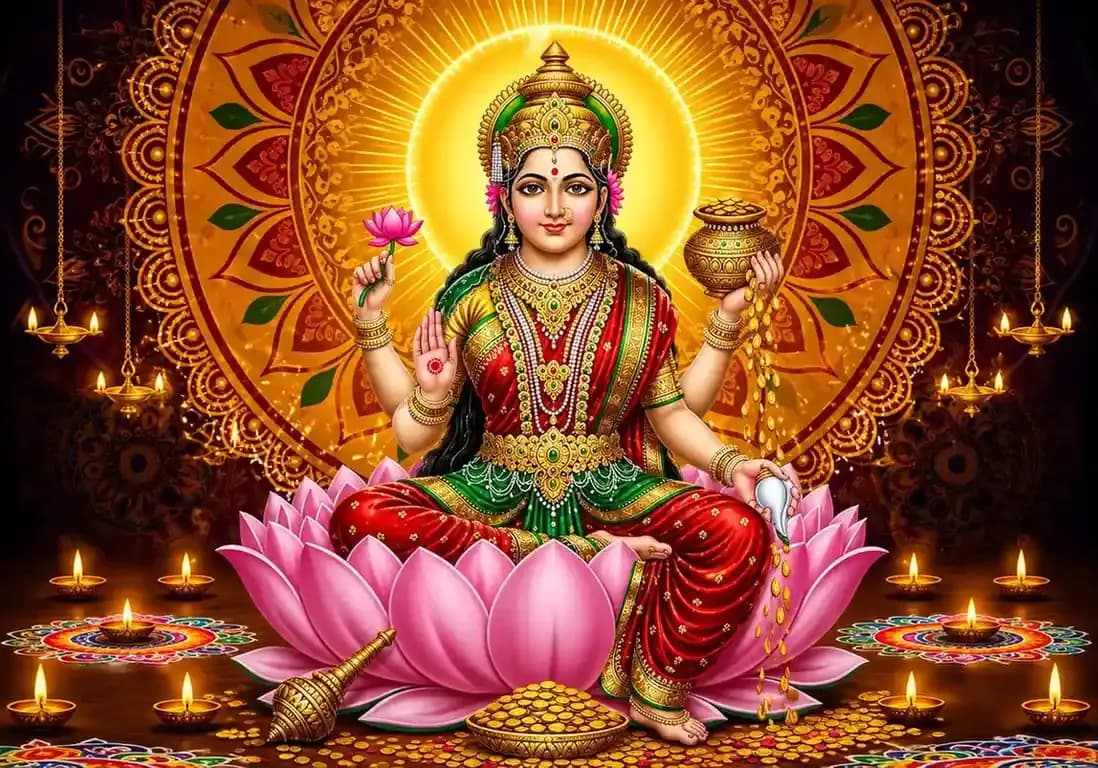
Varalakshmi Vratam 2026 Australia: Date, AEST Puja Timings, Kalasam and Guide
A complete Australia guide to Varalakshmi Vratam 2026: how the IST time difference makes the muhurat land conveniently mid-morning, three practical observance versions, where to source kalasam and mango leaves in Sydney, Melbourne, Brisbane, Perth and Adelaide, and apartment-safe puja tips.

A complete Australia guide to Varalakshmi Vratam 2026: how the IST time difference makes the muhurat land conveniently mid-morning, three practical observance versions, where to source kalasam and mango leaves in Sydney, Melbourne, Brisbane, Perth and Adelaide, and apartment-safe puja tips.
Quick answer: Varalakshmi Vratam 2026 in Australia falls on Friday 21 August 2026 in most Telugu, Tamil and Kannada panchangs, though some panchangs mark it on Friday 28 August 2026. Because Australia is 4.5-5.5 hours ahead of IST, an early-morning Indian muhurat lands mid-morning to midday local time. Confirm the date and lagna windows from a local drik panchang and follow your family tradition.
Varalakshmi Vratam is a Friday vratam dedicated to Goddess Varalakshmi, a boon-granting form of Lakshmi, observed in the month of Shravana. For families in Australia, the standout fact is a happy one: because Australia runs 4.5 to 5.5 hours ahead of Indian Standard Time, an auspicious early-morning muhurat in India lands at a genuinely convenient mid-morning to midday hour in Sydney, Melbourne and Brisbane. This page explains the date, how to read your timings across AEST, ACST and AWST, and how to keep the vratam beautiful and safe in an Australian winter.
Australia observes this as a devotional tradition. Nothing here promises a specific worldly outcome. We present regional and temple variations as equally valid, and where families differ on the date or on who may keep the vratam, we describe the range of practice rather than ruling anyone out.
Quick facts for Australia
- Festival: Varalakshmi Vratam 2026
- Most panchangs (Telugu/Tamil/Kannada): Friday, 21 August 2026
- Some panchangs: Friday, 28 August 2026
- Month: Shravana (Sravana Masam)
- Deity: Goddess Varalakshmi (boon-granting Lakshmi)
- Australia vs IST: 4.5 to 5.5 hours ahead (varies by state and daylight saving)
- Season in Australia: Late winter
- Confirm timings from: a local Australian drik panchang
Varalakshmi Vratam 2026 date in Australia: 21 or 28 August?
The core date question is the same for Australia as anywhere in the diaspora. Most Telugu, Tamil and Kannada panchangs place Varalakshmi Vratam on Friday, 21 August 2026, while some panchangs mark it on Friday, 28 August 2026. Both are the second Friday and last Friday of Shravana respectively, and different lineages count the month differently. Neither is wrong.
The vratam is tied to the tithi, and because Australia is hours ahead of India, the tithi can begin or end on a different local calendar day than it does in India. This is exactly why a local reference matters. Read the full explanation on our Varalakshmi Vratam 2026 date page, and when the two dates diverge, follow your family, kula or local-temple tradition.
For a broader look at why diaspora dates shift and how to choose a reliable calendar, see our guide on which panchang NRIs should follow. If your Australian temple or Telugu association announces a date, that is a sound anchor for the community observance.
The day-boundary effect: why the muhurat is convenient in Australia
Here is the good news for Australian families. In India, the most auspicious lagna windows for Varalakshmi puja typically fall early in the morning. Australia sits 4.5 to 5.5 hours ahead of IST, so that same window shifts forward into mid-morning or midday local time. Instead of waking before dawn, many families can complete a proper puja after the morning school run and still be done by lunch. It is one of the few festivals where the time difference works in your favour.
The traditional teaching names four lagna (ascendant) windows suitable for the vratam: Simha (Leo), Vrishchika (Scorpio), Kumbha (Aquarius) and Vrishabha (Taurus). Vrishabha lagna, which falls in the morning, is the most commonly chosen for a fresh, sattvic start. Because clock times for these windows depend on your exact city and on daylight saving, we do not print specific times here. Confirm the four windows for your city from a local drik panchang.
There is a second effect to watch. Because the tithi can cross local midnight differently in Australia, a tithi-based window that a family in India observes on one calendar day may fall on the adjacent local day in Sydney or Perth. This is normal. Anchor to the tithi as your local panchang reports it, not to the Indian clock.
How the lagna windows relate across Australian time zones
The table below shows how the four lagna windows relate across India and the Australian zones. It describes relationships, not clock times, because your exact minutes depend on your city and the season. Read your actual windows from a local panchang.
| Lagna window | IST | AEST (Sydney/Melbourne/Brisbane) | ACST (Adelaide/Darwin) | AWST (Perth) | Local day |
|---|---|---|---|---|---|
| Vrishabha (Taurus) | Early morning | Roughly mid-morning, several hours ahead | About 30 min behind AEST | Behind AEST by ~2 hrs | Usually same local day |
| Simha (Leo) | Late morning | Early to mid afternoon | Just behind AEST | Late morning to midday | Same local day |
| Vrishchika (Scorpio) | Around midday | Afternoon | Just behind AEST | Early afternoon | Same local day |
| Kumbha (Aquarius) | Afternoon | Late afternoon to evening | Just behind AEST | Afternoon | Same local day, occasionally shifts near a tithi boundary |
Note that most of eastern Australia does not observe daylight saving in August (it is winter), so AEST is UTC+10, ACST is UTC+9:30, and AWST is UTC+8. Western Australia is a full 2.5 hours behind Sydney. Adelaide and Darwin share the half-hour ACST offset. Always let your local panchang do the final arithmetic.
Three ways to observe Varalakshmi Vratam in Australia
Work, school runs and building rules make a rigid schedule hard. Here are three honest versions. All are valid; the fuller the version, the closer to the traditional form.
1. The 30-minute before-work version
If you must be at work, a short, sincere puja is entirely acceptable and widely practised in the diaspora.
- Bathe, wear clean clothes, and set a small clean space facing east.
- Place a kalasam (or a substitute vessel, see below) with a coconut and mango leaves, and a Lakshmi mukham or picture if you have one.
- Light a lamp (or a battery diya if open flame is not allowed), offer turmeric, kumkum, flowers and a simple naivedyam.
- Tie the toram (sacred thread) on your wrist, recite the Varalakshmi ashtottara or a few names of Lakshmi you know, and offer heartfelt prayer.
- Do a short aarti, take a moment of stillness, and continue the fuller puja in the evening if you wish.
2. The full traditional version
If your Friday is free, or you take the day off, follow the complete vidhi: a decorated kalasam as Varalakshmi with saree and jewellery, elaborate alankaram, the full ashtottara and vratam katha, nine-thread toram, thamboolam for married women, and a proper naivedyam of sweets. Our step-by-step guide walks through each stage.
Follow the complete method on our Varalakshmi Vratam puja vidhi guide, which covers the alankaram, ashtottara and udyapana in order.
3. The evening or after-work option
Many working families in Australia perform the puja in the evening after returning home. Honestly, the traditional preference is a morning muhurat, and the day-boundary advantage means morning is unusually achievable in Australia. But if morning is impossible, an evening puja done with devotion is far better than skipping the vratam. Some families do a brief morning sankalpam and lamp-lighting, then the main puja after work. Confirm any evening lagna window from your local panchang.
Sourcing your puja items in Australia
August is late winter in Australia, so fresh mango leaves and banana leaves are seasonal and not always on the shelf as they would be in monsoon India. The good news: Indian grocery corridors in every major city stock most items, and there are clean substitutes for the rest.
| Traditional item | Where to find it in Australia | Acceptable substitute |
|---|---|---|
| Mango leaves (torana/kalasam) | Indian grocers in Harris Park, Carrum Downs, Clayton, Perth's Indian shops; some sell frozen or preserved | Fresh betel leaves, tulsi sprigs, or a clean small-leaf branch; even a printed torana is accepted by many |
| Banana leaf (naivedyam) | Indian/Sri Lankan/Asian grocers, often frozen | A clean steel or silver plate; a fresh green leaf; parchment as a last resort |
| Kalasam vessel | Indian utensil shops in Parramatta, Dandenong, Perth; online Indian stores ship nationally | Any clean brass, silver or steel pot or even a stainless tumbler |
| Lakshmi mukham (face) | Temple shops and Indian stores in major cities; ordered online | A framed Varalakshmi/Lakshmi picture placed on the kalasam |
| Toram (sacred thread) | Indian grocers and temples stock yellow thread and turmeric | Plain yellow cotton thread dipped in turmeric, tied with nine knots |
| Turmeric root / haldi | Every Indian grocer; fresh turmeric root at some | Turmeric powder made into a paste |
| Flowers | Winter markets, supermarkets, florists | Seasonal winter flowers (chrysanthemums, marigold if available); clean fresh flowers of any auspicious kind |
If you cannot get a kalasam or prefer a simpler setup, you can still keep a complete and meaningful vratam. See our dedicated guide to Varalakshmi Vratam without a kalasam for a framed-photo and lamp method.
Apartment, strata and safety realities
Many Indian-Australian families live in apartments and strata-titled townhouses in Parramatta, Westmead, Point Cook, Clayton and inner-city Brisbane and Perth. Fire safety and building rules matter, and none of them prevent a full-hearted puja.
- Smoke detectors: incense and camphor aarti can trigger sensitive apartment smoke alarms. Keep smoke minimal, crack a window, and never disable a detector.
- Open flame: many strata by-laws restrict open flame on balconies and in common areas. Keep lamps on a stable heat-proof surface indoors, away from curtains, and never leave a lamp unattended.
- Battery diyas: LED or battery diyas are a fully accepted substitute where open flame is not permitted, and they let you keep a lamp glowing safely all day.
- Camphor and dhoop: use sparingly indoors; a small camphor aarti near an open window is usually fine, but read your building rules.
- Winter ventilation: Australian winter means closed windows and heaters running, so ventilate deliberately before lighting anything.
- Neighbours: a quiet, contained puja rarely troubles anyone; if you host a larger gathering, mind noise and parking rules in your complex.
Community observance in Australian cities
Across Australia, temples, Telugu associations, Tamil sangams and apartment communities organise Varalakshmi Vratam gatherings, often on the Friday or the nearest weekend. These are wonderful for families who want the collective katha, group aarti and thamboolam exchange.
- Sydney: strong South Indian communities around Parramatta, Harris Park, Westmead and Blacktown; temples and associations commonly host group vratams.
- Melbourne: families in Carrum Downs, Point Cook, Tarneit and Clayton; temples in the south-east and west run community observances.
- Brisbane: growing Telugu and Tamil communities with temple-led gatherings.
- Perth: Indian community hubs support temple and association events.
- Adelaide and Canberra: smaller but active communities, often organising through temples and cultural associations.
Because programme dates, venues and timings vary each year and are set locally, confirm details directly with your temple or association rather than assuming last year's schedule.
A note on eligibility
Traditionally, married women keep Varalakshmi Vratam, often with their mothers and daughters. In practice across the diaspora, unmarried women, widows and anyone who wishes to worship Lakshmi with devotion do observe it, and many families and temples welcome all. There is a genuine range of view here. Follow your family and kula tradition, and know that sincere devotion is honoured in every version.
Related reading
- Varalakshmi Vratam 2026 date: 21 or 28 August
- Which panchang should NRIs follow?
- Varalakshmi Vratam 2026 complete pillar guide
- Varalakshmi Vratam 2026 puja vidhi (step by step)
- How to keep the vratam without a kalasam
- Varalakshmi Vratam 2026 NRI global guide
Frequently Asked Questions
When is Varalakshmi Vratam 2026 in Australia?
In most Telugu, Tamil and Kannada panchangs it falls on Friday, 21 August 2026, while some panchangs mark it on Friday, 28 August 2026. Because Australia is hours ahead of India, confirm the local calendar day from an Australian drik panchang, and follow your family, kula or local-temple tradition when the dates differ.
Why does the muhurat feel convenient in Australia?
Australia runs 4.5 to 5.5 hours ahead of Indian Standard Time. An auspicious early-morning muhurat in India therefore lands at mid-morning to midday in Sydney, Melbourne and Brisbane. Many families can complete a full morning puja after the school run and still finish by lunch, which is unusually convenient compared with other diaspora regions.
What are the four lagna windows for the puja?
The traditional windows are Simha (Leo), Vrishchika (Scorpio), Kumbha (Aquarius) and Vrishabha (Taurus). Vrishabha lagna in the morning is most commonly chosen for a fresh, sattvic start. The exact clock times depend on your city and daylight saving, so confirm all four windows from a local Australian drik panchang rather than an Indian one.
Where can I buy mango leaves and a kalasam in Australia?
Indian grocers in Harris Park, Carrum Downs, Clayton, Dandenong and Perth stock mango leaves (sometimes frozen), banana leaves and utensils. Kalasam vessels are available at Indian utensil shops in Parramatta and Dandenong and online. If mango leaves are hard to find in winter, betel leaves, tulsi or a clean small-leaf branch are accepted substitutes.
Can I do the puja in a strata apartment?
Yes. Keep incense and camphor smoke minimal so you do not trigger the smoke detector, and never disable it. Use a battery or LED diya where open flame is restricted by strata by-laws. Keep any lamp on a stable heat-proof surface indoors, away from curtains, and never leave it unattended. Ventilate before lighting anything.
Can I observe Varalakshmi Vratam in the evening after work?
Yes, and an evening puja done with devotion is far better than skipping the vratam. Honestly, the traditional preference is a morning muhurat, and the day-boundary advantage makes morning unusually achievable in Australia. If morning is impossible, do a brief morning sankalpam and lamp-lighting, then the main puja after work, confirming any evening window with a local panchang.
Does August being winter in Australia affect the puja?
Somewhat. August is late winter, so fresh mango leaves, banana leaves and traditional flowers are seasonal and not always stocked as they are in monsoon India. Indian grocers usually have frozen or preserved options, and winter flowers such as chrysanthemums work well. Betel leaves, tulsi and a clean plate are all accepted substitutes where the traditional item is unavailable.
Who can keep Varalakshmi Vratam?
Traditionally married women keep it, often alongside their mothers and daughters. Across the diaspora, unmarried women, widows and anyone who wishes to worship Lakshmi with devotion also observe it, and many families and temples welcome all. There is a real range of view. Follow your family and kula tradition, knowing sincere devotion is honoured in every version of the vratam.
Related guides you may find helpful
You might also like

Rama Ekadashi 2026: Date, Vrat Katha, Puja Vidhi & Significance

Champa Shashthi 2026: Date, Khandoba Worship & Jejuri's Golden Festival
Kati Bihu 2026: Date, Rituals & Assam's Festival of Earthen Lamps