Black Magic and Demons in Hinduism: What the Scriptures Actually Say
Hinduism acknowledges abhichara (harmful ritual) yet has no Satan, no eternal hell and no cosmic adversary. What the Vedas, the Gita, the Puranas and the Tantras actually teach about black magic and demonic beings.

Hinduism acknowledges abhichara (harmful ritual) yet has no Satan, no eternal hell and no cosmic adversary. What the Vedas, the Gita, the Puranas and the Tantras actually teach about black magic and demonic beings.
Someone in the family falls sick without explanation. A business collapses in a season. A marriage sours overnight. Sooner or later a relative lowers their voice and says the words: "Evaro cheshtunnaru." "Kisi ne kuch kar diya hai." Somebody has done something.
It is one of the most searched questions among Hindus everywhere, and one of the least honestly answered. Does Sanatana Dharma actually accept the existence of black magic? Is there a Devil in Hinduism the way there is in other faiths? And if unseen beings exist, what does our own tradition prescribe — fear, or something considerably stronger?
The scriptural answer is more interesting than either the sceptic or the superstitious camp expects.
Does Hinduism Believe in Black Magic?
Yes — but not as a supernatural exception to the universe. Hinduism treats harmful ritual as a technology that exists, works within the law of karma, and is spiritually catastrophic for the one who uses it.
The evidence is old and unambiguous. The Atharva Veda, the fourth Veda, is the most candid document on this subject in world religious literature. It contains hymns of two opposite kinds side by side: abhichara rites intended to harm, and krityapratiharana rites intended to neutralise harm sent by another. The Veda does not pretend the first category is imaginary. It records it, then supplies the counter-measure.
The Rig Veda is equally direct. Hymn 7.104 is a sustained invocation to Indra and Soma against yatudhanas — practitioners of hostile sorcery — and asks that their designs recoil upon them. The same hymn appears, expanded, as Atharva Veda 8.4.
So the tradition never denied the phenomenon. What it did was subordinate it to a larger law. In a universe governed by karma, an intention released into the world is itself an action with consequences — for the sender first.
Hindutone does not publish ritual procedures for harmful rites. This article explains what the scriptures classify and why they forbid it. That is a deliberate editorial line, and it matches the position of the texts themselves.
The Sanskrit Vocabulary: What the Texts Actually Call It
English collapses everything into "black magic." Sanskrit is far more precise, and the precision matters — several of these words have been badly mistranslated in popular usage.
- Abhichara — "Proceeding against" — The umbrella term for ritual directed at harming another
- Kritya — "That which is made" — A hostile force or entity generated by ritual intent
- Kshudra prayoga — "Petty application" — The classical dismissal — petty use of sacred technique
- Mantravada — "Doctrine of mantra" — Ritual specialism; regionally used for both healing and harm
- Yatu / Yatudhana — "Sorcery / sorcerer" — Vedic term for a malefic practitioner
- Drishti / Nazar — "Sight" — The folk concept of the evil eye — envy transmitted by attention
Within the Tantric corpus these acts are systematised as the Shatkarmani — the six ritual operations. Only the first is benign; the remaining five are precisely the reason serious lineages restricted the material.
- Shanti — pacification, healing, removal of affliction
- Vashya (vashikaran) — bringing another under one's will
- Stambhana — arresting or paralysing an action
- Vidveshana — creating discord between people
- Uchatana — driving someone away, unsettling the mind
- Marana — destruction of life
Note what unites the last five: every one of them overrides another person's free will. That is the operative sin in Hindu ethics, not the use of mantra as such. The same syllables that heal in a Shanti rite destroy in a Marana rite; the difference is entirely in the intention of the operator. This is why authentic guru-parampara never handed this material to the emotionally unstable, the vengeful, or the commercially motivated.
Vashikaran, incidentally, is the term most abused on the modern internet. Advertisements promising to make a specific person fall in love are selling — in the tradition's own vocabulary — a violation, not a blessing.
Is There a Devil in Hinduism?
No. And this is the single most important theological distinction in the entire discussion.
Hinduism has no Satan. There is no fallen angel, no eternal adversary of God, no rival kingdom of darkness, and no permanent hell to be consigned to. The Abrahamic architecture of a cosmic war between two ultimate principles simply does not exist in Sanatana Dharma.
What exists instead is avidya — ignorance. Evil in the Hindu view is not an independent power opposing the Divine; it is a distortion, a covering, a forgetting of one's own nature. Darkness has no substance of its own. It is the absence of light, and it ends the moment light arrives.
That said, the tradition describes a rich taxonomy of beings who are not human and not necessarily benevolent.
- Asura — Powerful beings opposed to the devas; half-brothers of the gods, sons of Kashyapa. Ambitious, not damned.
- Daitya / Danava — Asura clans descended from Diti and Danu
- Rakshasa — Beings of great strength and appetite; some noble, some predatory
- Pishacha — Flesh-eating spirits of the lowest disposition
- Bhuta — Elemental or earthbound spirits
- Preta — A departed soul in an unsettled transitional state, addressed by shraddha rites
- Vetala — Spirit occupying a corpse; famous from the Vikramaditya cycle
- Brahmarakshasa — A learned man who misused knowledge — arguably the tradition's real warning
- Yaksha — Nature and treasure spirits, ambivalent rather than evil
The detail everyone misses: asuras are not condemned
This is where Hinduism diverges sharply from every dualistic religion. Being an asura is a disposition, not a damnation. The tradition's most beloved devotees include:
- Prahlada, son of the asura king Hiranyakashipu, the very model of unwavering bhakti
- Bali Chakravarti, an asura emperor so righteous that Vishnu's own devotee-testing left him honoured, not destroyed — and Kerala celebrates his annual homecoming as Onam
- Vibhishana, a rakshasa who chose dharma over kinship and was crowned king of Lanka
- Ravana himself — a Brahmin by lineage, a master of the Vedas, and the composer of the Shiva Tandava Stotram
No adversary in Hindu cosmology is beyond redemption, because none of them is outside Brahman. That is a structurally different universe from one containing a Devil.
The Gita's Verdict: Two Dispositions, Not Two Species
Chapter 16 of the Bhagavad Gita — Daivasura Sampad Vibhaga Yoga — is Krishna's direct treatment of this theme, and he relocates the entire question. The divine and demoniac are not two races of beings. They are two tendencies present in every human being.
The daivi sampada includes fearlessness, purity of heart, charity, self-restraint, non-violence, truthfulness, absence of anger, compassion and freedom from envy. The asuri sampada is listed in 16.4 as ostentation (dambha), arrogance (darpa), conceit (abhimana), anger (krodha), harshness (parushya) and ignorance (ajnana).
Read that list again with black magic in mind. Every quality that drives a person toward abhichara — envy, rage, the craving to dominate — is already catalogued as the demoniac disposition. In the Gita's framework, the moment someone decides to harm another through ritual, the asura in the story is not the target. It is the practitioner.
Krishna adds a striking observation in 17.4: people of sattva worship the devas; those of rajas worship yakshas and rakshasas; and those of tamas worship pretas and bhutas — ghosts and spirits. The verse is not describing metaphysics. It is describing the worshipper's own consciousness, and it explains exactly why the tradition regards spirit-propitiation for personal gain as a downward path.
Karma: Why Abhichara Cannot Escape the Ledger
Hindu law-texts do not treat harmful ritual as fantasy. They treat it as a punishable act.
Manusmriti 11.64 lists abhichara and kritya-karma among the upapatakas — secondary sins requiring prayaschitta (expiation). Manusmriti 9.290 prescribes punishment by the king for those practising root-witchcraft and hostile rites. The Yajnavalkya Smriti carries comparable provisions. A civilisation does not legislate against something it considers non-existent — nor does it legislate against something it considers acceptable.
The Puranas make the point in narrative form, and the sharpest example is Bhasmasura (Vrikasura, Bhagavata Purana 10.88). He performs severe austerity and wins a boon from Shiva: whatever head he touches will turn to ash. His first thought is to test it on Shiva himself. Vishnu appears as the enchantress Mohini, draws him into imitating her dance, and at the right moment places her hand on her own head. Bhasmasura copies the gesture and burns himself to ash.
The story is not about a trick. It is the tradition's clearest statement of a principle: a power acquired to harm eventually finds its own owner. The same arc governs Hiranyakashipu, Ravana and Kamsa. Boons are granted; character determines the outcome.
Why the Greatest Yogis Refused These Powers
Patanjali devotes most of the third pada of the Yoga Sutras to siddhis — genuine paranormal capacities arising from advanced samyama. He catalogues them in detail. Then, in Sutra 3.37, he delivers the verdict: te samādhāv upasargāḥ — these attainments are obstacles to samadhi, however impressive they may appear to an outward-turned mind.
This is the most sophisticated position any tradition takes on the subject. Patanjali does not say the powers are fake. He says they are real, and that being interested in them is the failure. A yogi who stops to use them has substituted a lesser prize for liberation.
Sri Ramakrishna put it in blunter language: siddhis are like clumps of dirt on the road to God, and a man who stops to collect them never reaches the destination. Across sampradayas, the marker of an authentic teacher has been the refusal to trade in these powers — which is precisely the inverse of how contemporary "specialists" advertise themselves.
Traditional Protection: What the Tradition Actually Prescribes
Where a person feels afflicted, Hindu practice does not respond with counter-attack. It responds with fortification — raising one's own vibration until hostile intent finds nothing to grip.
- Hanuman Chalisa — The classic recourse against fear and spirit-affliction — "Bhoot pishach nikat nahi aave, Mahabir jab naam sunave"
- Narasimha Kavacham — Prahlada's own armour; invoked for protection against hostile forces
- Devi Kavacham & Durga Saptashati — Comprehensive protection of body, family and household
- Maha Mrityunjaya Mantra — Healing, longevity, deliverance from affliction (Rig Veda 7.59.12)
- Sri Rudram — Vedic purification of home and self
- Sudarshana Homa — Removal of obstructive influences
- Pratyangira Devi / Sharabha — Specifically invoked in tradition to neutralise abhichara
- Bagalamukhi — The Mahavidya of stambhana — stilling hostile intent
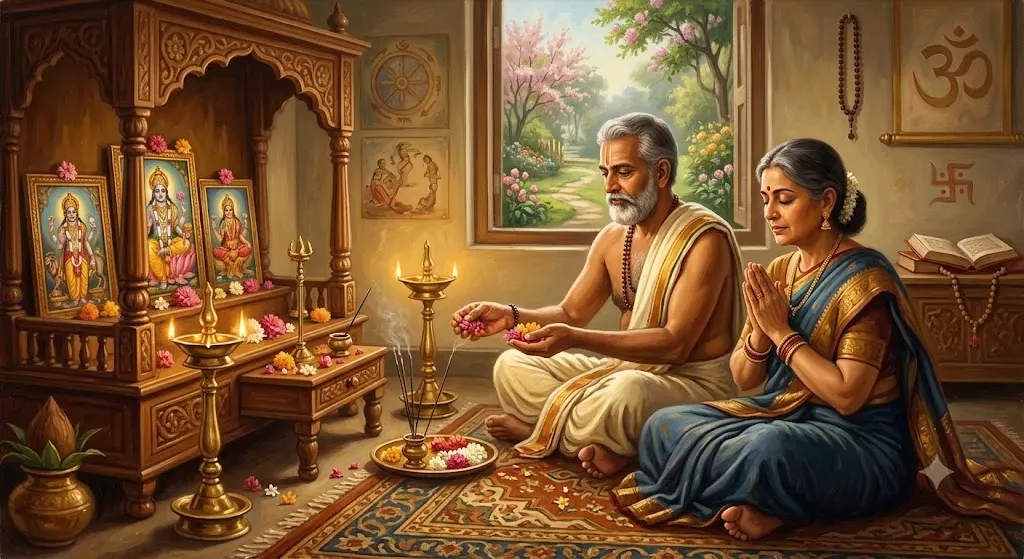
Household practices carry the same logic: the daily lamp, camphor arati, tulsi in the courtyard, guggul or loban dhoop, drishti removal with salt or chillies, the black thread on an infant's wrist, the nazar battu at a shop entrance. Anthropologists call these folk custom; the tradition's own reading is simpler — they are gestures that direct the mind toward protection instead of toward dread.
The essential principle in every case: protection in Hinduism is generated, not purchased. Japa, satsang, ethical conduct, sattvic food, a clean and lamp-lit home, and regular remembrance of one's ishta devata constitute the actual armour. There is no ritual shortcut that substitutes for character.
A Necessary Word on Fear, Fraud and Discernment
This is the section most articles on this topic omit, and it may be the most important one.
Fear is the vulnerability, not the curse. The Brihadaranyaka Upanishad states it at the root: dvitīyād vai bhayaṃ bhavati — fear arises only where there is a second, an other. A mind convinced it is under attack will read every ordinary misfortune as evidence, and that spiral does real damage regardless of whether anything was ever sent.
Most attributed cases have ordinary causes. Chronic fatigue, unexplained pain, sleep disturbance, personality change, sudden anxiety and hallucination are the presenting symptoms of many treatable medical and psychological conditions — thyroid disorders, anaemia, vitamin deficiency, depression, epilepsy, psychosis. Dharma has never asked anyone to skip a doctor. Seeing a physician and lighting a lamp are not competing acts of faith.
The commercial exploitation is severe. Families in India and across the diaspora are routinely stripped of savings by operators who diagnose a curse, escalate the fee, and produce a permanent dependency. Some cases have ended in serious abuse and even death, which is why states including Maharashtra (2013) and Karnataka (2017) enacted specific anti-black-magic and anti-inhuman-practices legislation. Any practitioner who begins by frightening you, insists on secrecy from your family, or scales fees with your desperation is describing themselves accurately — the Gita's list of asuric traits fits the "remedy specialist" far more often than the alleged attacker.
Sanatana Dharma's own emphasis is fearlessness. Abhayam heads Krishna's list of divine qualities in Gita 16.1 — before purity, before charity, before everything else. And the final verse of his teaching, 18.66, closes with two words that settle the entire subject: mā śucaḥ — do not grieve.
The Vedantic Bottom Line
Ask Advaita Vedanta whether black magic can touch you, and the answer reframes the question.
If Brahman alone is real, then no force exists outside it — including any force allegedly aimed at you. The Atman is aja, unborn; nitya, eternal; acchedya, uncuttable. What can be reached by ritual is the body, the circumstances, the mind's peace. What you actually are was never in the transaction.
This is not a dismissal of the phenomenon. It is a statement about jurisdiction. Hostile intent operates in the field of names and forms, and in that field it can genuinely disturb a life. But it operates only where fear gives it purchase, and it always bills its sender.
The householder's conclusion is therefore practical rather than mystical: keep the lamp lit, keep the mind clean, keep company that elevates you, see a doctor when the body complains, keep your money in your own pocket, and stop searching for enemies. That is the whole protection, and every scripture quoted above converges on it.
Frequently Asked Questions
Does Hinduism believe black magic is real?
Yes. The Atharva Veda records both harmful rites (abhichara) and rites to counteract them, and Manusmriti classifies abhichara as a punishable sin. Hinduism accepts the phenomenon but treats it as spiritually destructive for the practitioner, since it operates entirely within the law of karma.
Is there a Devil or Satan in Hinduism?
No. Sanatana Dharma has no eternal adversary of God, no fallen angel and no permanent hell. Evil is understood as avidya — ignorance and forgetting of one's true nature — rather than an independent cosmic power. Asuras and rakshasas are classes of beings, not damned souls, and several became great devotees.
What is the difference between an asura and a rakshasa?
Asuras are the powerful half-brothers of the devas, descended from Kashyapa through Diti and Danu, often ambitious and opposed to the gods but capable of great righteousness. Rakshasas are beings of immense strength and appetite described chiefly in the epics. Both categories include noble figures such as Prahlada, Bali and Vibhishana.
What does the Bhagavad Gita say about demonic qualities?
Chapter 16 divides human tendencies into daivi sampada (fearlessness, purity, compassion, truthfulness) and asuri sampada (ostentation, arrogance, conceit, anger, harshness, ignorance). Krishna presents these as dispositions within every person rather than two separate species of being.
Which mantras protect against black magic in Hinduism?
Traditionally recommended are the Hanuman Chalisa, Narasimha Kavacham, Devi Kavacham, Durga Saptashati, the Maha Mrityunjaya Mantra and Sri Rudram, along with Sudarshana Homa and the worship of Pratyangira Devi. The tradition treats consistent practice and ethical living as the real protection, not any single ritual.
Is vashikaran allowed in Hinduism?
No. Vashikaran belongs to the five harmful operations of the Shatkarmani, all of which override another person's free will. Classical texts restricted this material severely, and the Dharmashastras classify such use as sin requiring expiation.
Can black magic affect a devotee?
The traditional position is that sincere practice, ethical conduct and remembrance of one's ishta devata form a protective field, and that fear itself is the main vulnerability. Advaita goes further: the Atman is uncuttable and cannot be reached by any ritual at all.
How do I know if a "remedy specialist" is genuine?
Authentic teachers do not advertise siddhis, do not induce fear, do not demand secrecy from your family, and do not escalate fees. Patanjali's Yoga Sutra 3.37 calls siddhis obstacles to realisation — anyone selling them has already declared their position.
Hindutone publishes scripture-based explanations of Hindu belief and practice for readers worldwide. This article is educational and is not a substitute for medical, psychological or legal advice. If you or someone in your family is experiencing unexplained physical or mental symptoms, please consult a qualified doctor.
You might also like

Hindu Financial Ethics: How Sanatana Dharma Frames Money, Wealth and Debt
Karma, Rebirth, and Remembrance of God – Why Worship God Even During Good Times?
12 Types of Kaal Sarp Yoga – Effects, Remedies & Worship Guide