Kalki Avatar — The Tenth Incarnation of Vishnu: Prophecy, Signs of Kali Yuga, Sambhal Birthplace & The End of the Cosmic Cycle
Kalki Avatar — Vishnu's tenth and final incarnation per Hindu tradition. Prophecy of the end of Kali Yuga, signs of his appearance, Sambhal birthplace, the new cosmic cycle.

Kalki Avatar — Vishnu's tenth and final incarnation per Hindu tradition. Prophecy of the end of Kali Yuga, signs of his appearance, Sambhal birthplace, the new cosmic cycle.
Quick Answer: Kalki — meaning "destroyer of darkness" (from kal = darkness/ignorance) — is the tenth and final of Vishnu's ten avatars and the only avatar still to come. According to the Kalki Purana, Bhagavata Purana, and other Hindu texts, Kalki will appear at the end of the Kali Yuga (the present cosmic age) riding a white horse named Devadatta, wielding a flaming sword, to destroy the forces of adharma, end the corrupt cycle of Kali, and inaugurate the new Satya Yuga (golden age of truth). His birthplace is traditionally identified as Sambhal (Uttar Pradesh), where he will be born to Vishnuyasha and Sumati in a Brahmin family. The current Kali Yuga, traditionally said to have begun in 3,102 BCE with Krishna's departure, has a total duration of 432,000 years — meaning Kalki's appearance is many millennia in the future. However, Hindu thought also frames Kalki as a perennial cosmic principle, with multiple "Kalki-like" appearances at moments of severe adharma throughout history.
1. The Kalki Prophecy in Hindu Scripture
The Kalki avatar is described in multiple Hindu texts:
- Kalki Purana — the dedicated text for the avatar
- Bhagavata Purana (Skandha 12, Chapter 2) — most detailed canonical description
- Vishnu Purana — references to the avatar
- Mahabharata (Vana Parva) — mentions Kalki as future restorer
- Agni Purana — additional details
The core prophecy: at the end of Kali Yuga, when adharma (unrighteousness) has overwhelmed the world, when mlecchas (uncivilised forces) rule, when Brahmins have forgotten the Vedas, when dharma has only one foot left to stand on (in earlier Yugas dharma stands on four feet, decreasing across Yugas), Vishnu will descend as Kalki.
2. Signs of Kali Yuga's End
The Bhagavata Purana lists specific signs that mark Kali Yuga's progressive decline. By the time Kalki is born, these will be at their most extreme:
Spiritual decline:
- Vedas forgotten or distorted
- True teachers rare; false teachers common
- Religion measured by wealth and external display
- Vegetarianism abandoned; animal violence widespread
- Spiritual realisation considered impossible
Social decline:
- Marriage based purely on attraction and convenience
- Family bonds weakened
- Children disobedient to parents
- Truth-telling rare
- Honesty considered foolishness
Political decline:
- Rulers exploit rather than serve
- Justice can be bought
- Borders meaningless; nations in constant conflict
- Heavy taxation crushes ordinary people
Environmental decline:
- Rains irregular; crops failing
- Forests destroyed
- Rivers polluted
- Earth's fertility diminishing
Personal decline:
- Lifespans shortened
- Bodies weakened
- Minds distracted; meditation difficult
- Lust, anger, greed dominate
Many Hindu thinkers note that several of these signs have already intensified dramatically in the past century, suggesting Kali Yuga is progressing toward its conclusion (though even at accelerated rates, the literal cosmic timeline remains long).
3. Kalki's Appearance
Birthplace and lineage
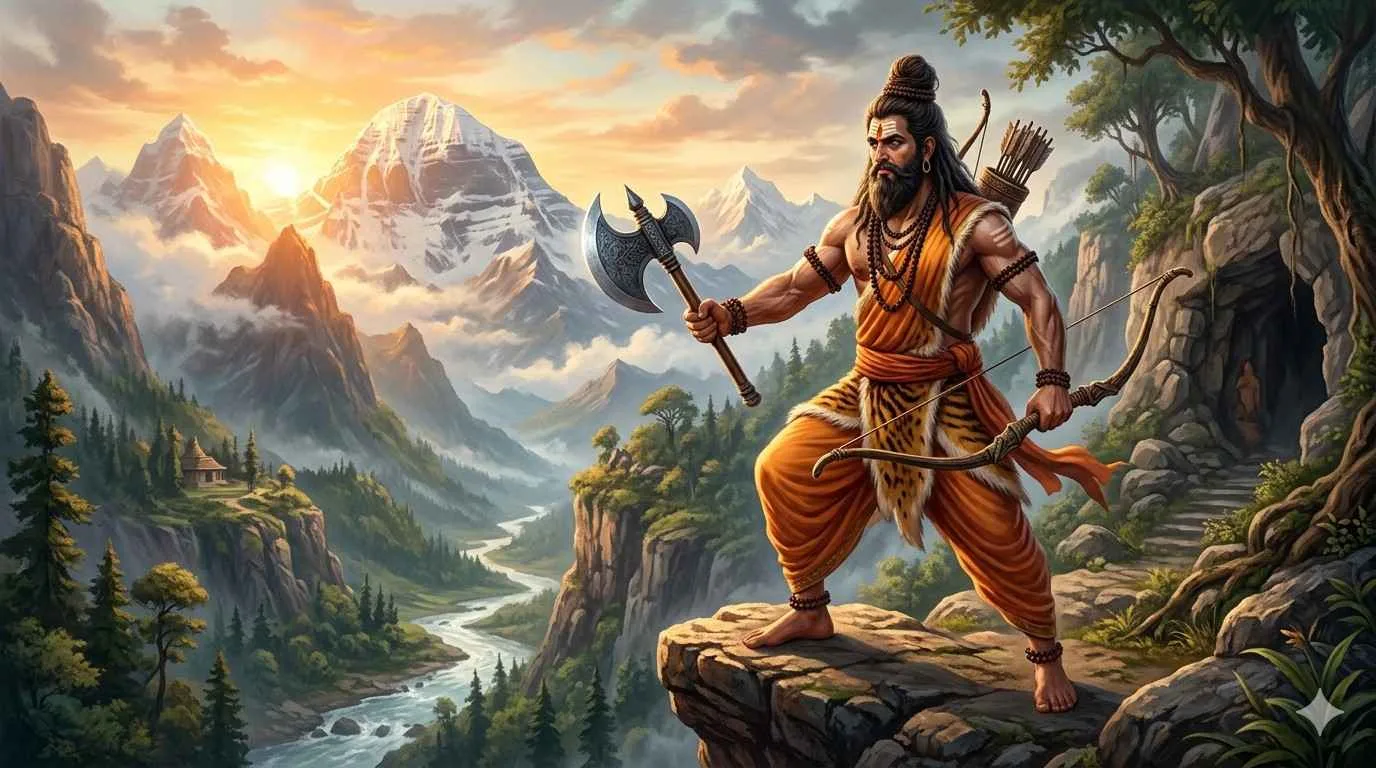
Kalki will be born in Sambhal (Uttar Pradesh, near Delhi) — a town traditionally identified with this prophecy. His father will be Vishnuyasha, a great Brahmin; his mother Sumati. He will receive supreme weapons training and yogic initiation from Parashurama (the sixth avatar, who as a Chiranjivi/immortal continues to live in tapas).
Divine attributes
- Devadatta — his white horse (a divine being who will assist him)
- Flaming sword — his weapon
- Discus, conch, mace — Vishnu's standard symbols
- Garuda's blessing — he will be borne by Garuda in some traditions
Marriage
Kalki will marry Padma (also called Padmavati), daughter of King Brihadratha of Simhala (a southern kingdom). The marriage will fulfill the destined union of the avatar's masculine and feminine principles.
4. The Mission
Kalki's task is comprehensive:
- Destroy adharma — eliminate the corrupt rulers, false teachers, and demonic forces dominating the end of Kali Yuga
- Restore dharma — re-establish the Vedic dharmic order
- End the Kali Yuga — through his cosmic intervention, the present age dissolves
- Begin the Satya Yuga — initiate the new golden age where truth, righteousness, longevity, and spiritual awareness flourish again
The transition from Kali Yuga to Satya Yuga is described as a complete cosmic reset — not gradual reform but total restoration. The four Yugas (Satya, Treta, Dvapara, Kali) cycle continuously; each Kalki manifestation marks the closing of one Kali age and opening of the next Satya age.
5. When Will Kalki Actually Come?
The traditional calculation:
- Kali Yuga duration: 432,000 years
- Kali Yuga began: approximately 3,102 BCE (with Krishna's departure)
- Years elapsed: approximately 5,128 years (as of 2026)
- Years remaining: approximately 426,872 years
So per the literal traditional calculation, Kalki's appearance is still in the distant future.
However, multiple Hindu interpretive traditions modify this:
- Some traditions hold that Yuga durations are not linear cosmic time but represent qualitative states
- Some traditions hold that Kali Yuga has "Kalki-like" manifestations periodically when adharma intensifies (without yet being the final cosmic Kalki)
- Some traditions hold that the literal 432,000 years applies to subtle planes; on the earthly plane, cycles are shorter
- Sri Aurobindo and modern mystics have suggested that a "Kalki Avatara" is unfolding now through collective spiritual awakening
The Hindu tradition therefore allows multiple interpretations of when and how Kalki appears — literal cosmic prophecy, periodic intervention principle, current spiritual awakening, or some combination.
6. Kalki Temples and Centres
Few Kalki-specific temples exist (since the avatar is yet to come). Notable sites:
- Sambhal, Uttar Pradesh — traditional Kalki birthplace; some Kalki shrines and Vishnu temples
- Kalki Bhagavan Centre (various locations — controversial; led by Sri Bhagavan, claiming a Kalki-related mission)
- ISKCON temples worldwide include Kalki representations in Dasavataram displays
- Sri Venkateswara Tirumala Dasavataram sequence includes Kalki
- Khajuraho — 11th-century Kalki sculptures
Most Vishnu temples worldwide include Kalki in Dasavataram iconographic programmes, but no major Kalki-specific pilgrimage circuit exists.
7. Modern Interpretations — Kalki as Principle
Beyond literal future prophecy, modern Hindu thought engages Kalki in multiple ways:
Kalki as restoration principle
The Kalki avatar represents the cosmic principle that adharma cannot permanently dominate. Every period of darkness has its threshold beyond which restoration becomes inevitable. Kalki is the personification of this principle.
Kalki as spiritual awakening
Some contemporary thinkers (Sri Aurobindo, later disciples) interpret Kalki as the collective spiritual awakening of humanity rather than a singular historical figure. The "Supramental descent" that Sri Aurobindo predicted is in this lineage of interpretation.
Kalki as cyclical reformer
Some traditions hold that the great reformers across history — Adi Shankara, Ramanuja, Madhva, Chaitanya, modern saints — each carry partial Kalki energy, performing periodic restorations of dharma within the Kali Yuga.
Kalki as personal awakening
A devotional interpretation: each devotee's own awakening from inner adharma to inner dharma is a personal Kalki moment. The cosmic prophecy is internalised as individual spiritual transformation.
8. Lessons for NRI Hindus in 2026
Lesson 1: Adharma has limits
The Kalki prophecy assures that no corrupt order is eternal. For NRI Hindus dealing with bureaucratic injustice (immigration systems, workplace discrimination, political polarisation), the structural Hindu confidence that adharma will eventually be corrected — even if the timeline is generational — provides patience.
Lesson 2: Be ready for transitions
The end of Kali Yuga is described as turbulent — cosmic-scale change in compressed time. The lesson: do not be invested in any particular configuration of the world. Markets, technologies, governments, even religions in their current forms are temporary. Be light-footed.
Lesson 3: Don't despair at signs of Kali Yuga
The signs the Bhagavata Purana lists are recognizable in 2026 (and have been in every era). But despair is not the Hindu response. Recognise the conditions; do dharmic work in the conditions you're given; trust the cosmic order. Each individual's dharmic action contributes to the eventual restoration.
Lesson 4: The hero is yet to come
Modern hero-narratives often emphasize "we are the heroes we've been waiting for." The Hindu Kalki teaching is a different and complementary insight: some restorations are beyond individual human capacity. The cosmic-scale problems (climate change, mass extinction, civilizational adharma) may require divine intervention; human work is to be ready and to do one's part.
Lesson 5: Sambhal — small towns carry cosmic weight
Kalki will be born in Sambhal — a small UP town, not a mega-city. The teaching: divine action does not require the centres of worldly power. NRI Hindus tempted to overvalue Mumbai, Delhi, New York, London — Sambhal reminds us that cosmic-scale events can begin anywhere.
Lesson 6: The Yuga cycle is structural
The Hindu tradition does not imagine linear infinite progress. It sees cycles — Satya, Treta, Dvapara, Kali — each carrying its own qualities and challenges. The Kalki teaching is that cycles complete and renew. For NRI Hindus living through what feel like accelerating crises, the Yuga framework provides cosmic perspective.
9. Mantras, FAQs
Mantras
Kalki bija mantra:
Om Kalkiine Namah
Kalki Gayatri:
Om Vishnuputrayaaya Vidmahe
Mahavalantaya Dhimahi
Tanno Kalki Prachodayat
Dasavatara Stotra verse for Kalki (Jayadeva):
Mlechha nivaha nidhane kalayasi karavalam
Dhumaketum iva kim api karalam
Kesava dhrita Kalki sharira Jaya Jagadisha Hare
(O Keshava, who in the form of Kalki will wield the sword like a fearsome comet to destroy the corrupt — victorious is the Lord of the universe.)
FAQs
Q: Is Kalki the only future avatar?
A: In the standard Dasavataram list, Kalki is the tenth and final. Some traditions hold the cosmic cycle continues with new sets of avatars after the Satya Yuga.
Q: When literally will Kalki come?
A: Per traditional calculation, 426,000+ years from now. Per various modern interpretations, sooner or already-underway.
Q: Are claims of "Kalki has come" legitimate?
A: Several modern figures have claimed to be Kalki or partial Kalki manifestations. Hindu civilisation has generally not endorsed any such claim as the cosmic Kalki. Engaging such claims requires significant discernment.
Q: What's the relationship between Kalki and Christian/Islamic eschatology?
A: Similar end-times prophecies exist in many religions — Second Coming of Christ, Mahdi, Maitreya Buddha. Comparative religion notes the patterns; theological interpretations vary. Some thinkers see common cosmic-pattern recognition across traditions; others maintain religious specificity.
Q: How can I prepare for Kalki?
A: Practice the Hindu spiritual path now — dharmic action, daily mantra, scripture study, service. The Bhagavad Gita's teaching of Yoga Karmasu Kaushalam (skill in action) is the same teaching whether the cosmic cycle is at its beginning, middle, or end.
Q: Why is Sambhal Kalki's specific birthplace?
A: The Kalki Purana names Sambhal. The town is in modern-day Sambhal district, Uttar Pradesh, between Delhi and Lucknow. Some Kalki shrines exist there.
Q: Can a Hindu live without engaging the Kalki prophecy?
A: Yes — many Hindus engage Hindu life through immediate devotional, ethical, or philosophical practice without focusing on Kalki specifically. The avatar framework is one Hindu interpretive lens, not a mandatory belief.
Final Words
Kalki Avatar represents the structural Hindu confidence that the cosmic order will be restored. The forces of adharma may seem overwhelming in the late Kali Yuga; the loss of Vedic knowledge may seem complete; the moral degradation may seem irreversible. But the Hindu cosmology holds the long view — eventually, inevitably, the cycle completes. Kalki will appear. Satya Yuga will dawn.
For NRI Hindus in 2026 — facing political polarisation in the diaspora countries, civilisational uncertainties about climate and AI, generational worries about whether children will sustain dharma — the Kalki teaching offers structural patience without naive optimism. Yes, the conditions are difficult. Yes, the long term restoration is assured. Yes, your dharmic work in the meantime matters and contributes to the eventual transformation.
The Dasavataram sequence is now complete: Matsya → Kurma → Varaha → Narasimha → Vamana → Parashurama → Rama → Krishna → Buddha → Kalki. Ten avatars across cosmic time, demonstrating that the Divine consistently engages reality to preserve dharma. The pattern is not random; it is the eternal nature of Vishnu's relationship with creation.
Om Kalkiine Namah. Jaya Jagadisha Hare!
Yada yada hi dharmasya glanir bhavati Bharata
Abhyutthanam adharmasya tadatmanam srjamy aham
Paritranaaya sadhunaam, vinaashaaya cha dushkrtaam
Dharma samsthapanaarthaaya, sambhavaami yuge yuge
(Whenever dharma declines and adharma rises, I incarnate myself — for the protection of the good, the destruction of the evil, the establishment of dharma — age after age.) — Bhagavad Gita 4.7-8
Jai Kalki Bhagavan! Jai Vishnu Avatar 10 of 10! Jai Sanatana Dharma!
HinduTone Editorial Team · Tags: Kalki Avatar, Vishnu Tenth Avatar, Kali Yuga End, Sambhal Birthplace, Devadatta Horse, Satya Yuga, Kalki Purana, Hindu Prophecy, Dasavataram Complete
Frequently Asked Questions
What is Kalki Avatar?
Kalki — meaning "destroyer of darkness" (from kal = darkness/ignorance) — is the tenth and final of Vishnu's ten avatars and the only avatar still to come. According to the Kalki Purana , Bhagavata Purana , and other Hindu texts, Kalki will appear at the end of the Kali Yuga (the present cosmic age) riding a white horse named Devadatta , wielding a flaming s
What are the key points about Kalki Avatar?
His birthplace is traditionally identified as Sambhal (Uttar Pradesh), where he will be born to Vishnuyasha and Sumati in a Brahmin family. The current Kali Yuga, traditionally said to have begun in 3,102 BCE with Krishna's departure, has a total duration of 432,000 years — meaning Kalki's appearance is many millennia in the future.
Why does Kalki Avatar matter in Hinduism?
It deepens a devotee's connection with Lord Vishnu and with the values of Sanatana Dharma — clarity, devotion and dharmic living.
How can devotees apply Kalki Avatar in daily life?
By reflecting on its teaching, incorporating the related practices or observances into daily routine, and approaching it with sincere devotion and understanding.
You might also like
Buddha Avatar — The Ninth Incarnation of Vishnu: Hindu Perspective on Siddhartha Gautama & Bridge Between Sanatana Dharma and Buddhism
Krishna Avatar — The Eighth Incarnation of Vishnu: Bhagavad Gita, Mahabharata, Vrindavan Leelas & Eternal Wisdom for 2026
Rama Avatar — The Seventh Incarnation of Vishnu: Ramayana, Ayodhya, the Ideal Man & Eternal Dharma Lessons for 2026