Hobart (Tasmania): Shiva as the Silent Witness of Nature and Inner Stillness
In the pristine island state of Tasmania, where untouched wilderness, mountains, and oceans coexist in meditative harmony, Maha Shivaratri 2026 unfolds in…
In the pristine island state of Tasmania, where untouched wilderness, mountains, and oceans coexist in meditative harmony, Maha Shivaratri 2026 unfolds in…
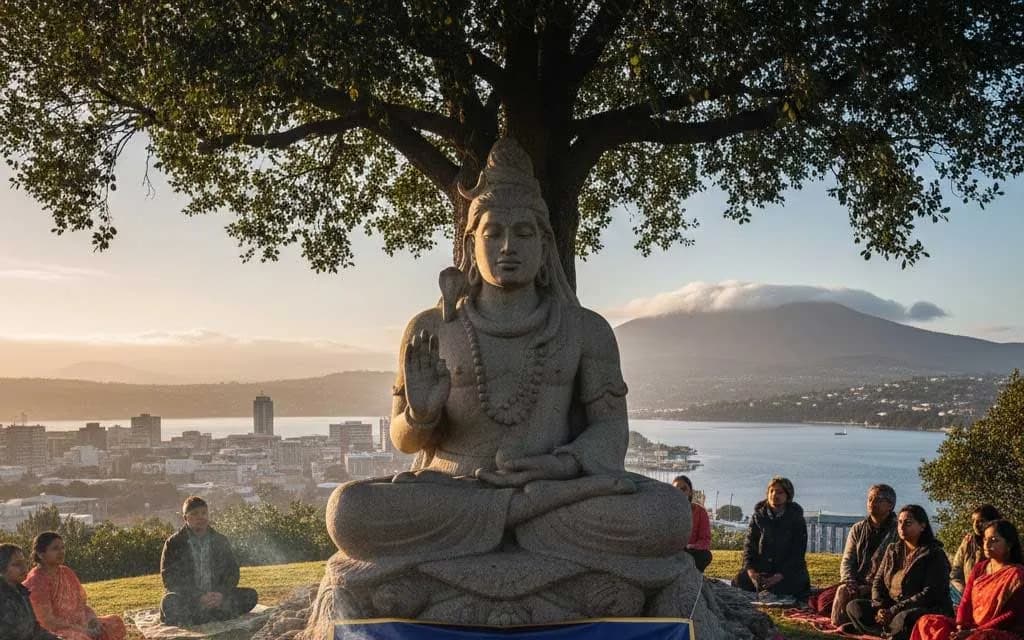
In the pristine island state of Tasmania, where untouched wilderness, mountains, and oceans coexist in meditative harmony, Maha Shivaratri 2026 unfolds in quiet reverence. Hobart may have a smaller Hindu population compared to mainland cities, yet the devotion here is profound—pure, personal, and deeply introspective, mirroring Lord Shiva’s ascetic essence.
Intimate Shivaratri Observances in Hobart
The Tasmanian Hindu Temple and Community Centre (Hobart region) becomes the spiritual nucleus on Sunday, February 15, 2026, hosting a simple yet powerful Maha Shivaratri program. The evening begins with Ganapati Puja, followed by Shiva Abhishekam using milk, water, and bilva leaves, symbolizing purification of body, mind, and soul.
Unlike grand melas, Hobart’s observance emphasizes:
- Silent meditation (Dhyana)
- Rudram chanting in small groups
- Personal sankalpa prayers for family well-being and inner peace
Devotees often describe the experience as “Shiva speaking through silence”—where fewer rituals allow deeper communion with Mahadev.
Shiva and Tasmania’s Natural Energy
Tasmania’s raw landscapes resonate strongly with Shiva’s cosmic form as Bhuteshwara, the lord of the five elements. Many devotees choose to observe partial fasts and spend the daytime in contemplation, later gathering at the temple or in homes for night prayers.
Families and individuals who cannot attend temple ceremonies often perform home-based Shivaratri puja, lighting a single lamp and chanting Om Namah Shivaya 108 times—believed to be equally potent when done with devotion.
For Hindus living in Hobart, Maha Shivaratri is not about scale but about sincerity—a reminder that Shiva does not seek grandeur, only truth.
Spiritual Reflection for Tasmania Devotees
Hobart’s Shivaratri reminds us of Dakshinamurthy Shiva, the silent teacher who imparts wisdom without words. In a world of constant noise, this city teaches devotees that stillness itself is worship.
“Where there is silence, Shiva speaks.
Where there is surrender, Shiva resides.”
Who is Dakshinamurthy, and Why Does Tasmania Resonate With His Teaching?
Dakshinamurthy is one of the most philosophically profound forms of Lord Shiva, described in detail in the Dakshinamurthy Stotra composed by Adi Shankaracharya. He is depicted seated beneath a banyan tree on Mount Meru, facing south, transmitting the highest knowledge of Brahman through absolute silence. His four disciples — the maharshis Sanaka, Sanandana, Sanatana, and Sanatkumara — received this wisdom not through spoken words but through the unbroken stillness of his presence, a mode of teaching called mauna vyakhya, or instruction through silence.
Tasmania's ancient wilderness, some of whose forests and geological formations are among the oldest on Earth, carries a similar quality of undisturbed stillness. For Hobart's Hindu community, spending time near the Huon Valley, Mount Wellington (kunanyi), or the shores of the Derwent River during Shivaratri is not merely a scenic choice — it becomes a living meditation, a direct encounter with the same primordial silence that Dakshinamurthy embodies. The natural world here functions as a kind of open-air temple.
What is the Deeper Significance of the Shiva Abhishekam Performed in Hobart?
The Abhishekam — the ritual bathing of the Shivalinga — is rooted in both the Shiva Purana and the Rudrashtadhyayi section of the Krishna Yajurveda. Each substance used in the ritual carries precise symbolic weight: milk represents purity and nourishment of the soul, water signifies the cleansing of accumulated karma, and bilva (bael) leaves — offered in sets of three — correspond to the three gunas (tamas, rajas, sattva) being surrendered to Shiva. The Shiva Purana explicitly states that offering even a single bilva leaf with sincere devotion is equal in merit to performing a great yajna.
In Hobart, where elaborate ritual infrastructure is naturally more limited than in larger cities, this simplicity of Abhishekam materials becomes a spiritual asset rather than a constraint. The Taittiriya Samhita of the Krishna Yajurveda contains the Sri Rudram, whose eleven anuvaka-s form the scriptural backbone of Shiva worship worldwide. Even a small group chanting the Namakam and Chamakam portions around a Shivalinga in Hobart replicates a worship tradition that stretches back thousands of years across the Indian subcontinent, now carried to the southern hemisphere with undiminished sanctity.
Why is the Night Vigil — Jaagaran — Central to Maha Shivaratri?
The word Shivaratri itself means 'the night of Shiva,' and staying awake through the four praharas (roughly three-hour watches) of the night is the defining vow of this festival. The Shiva Purana narrates the story of a hunter named Guha who, lost in a forest on this night, climbed a bilva tree to avoid wild animals and inadvertently dropped leaves onto a Shivalinga below while keeping himself awake — and by that unintentional act of devotion, attained liberation. The story underscores that the combination of nightlong wakefulness, bilva offering, and sincere heart is sufficient for Shiva's grace, regardless of whether the devotee is a scholar or a layperson.
In Hobart, where the February night in the Southern Hemisphere retains a cool, clear quality, the jaagaran takes on an especially contemplative character. Small groups gathering in homes or at the community centre keep the vigil through rounds of Om Namah Shivaya japa, readings from the Shiva Purana, and periods of silent meditation. The four praharas are sometimes marked by four successive Abhishekam offerings, aligning the devotee's consciousness with Shiva's four cosmic aspects: creation, sustenance, dissolution, and liberation (anugraha).
How Does the Panchabhutas — Shiva as Lord of the Five Elements — Connect to Tasmania's Landscape?
Shaiva philosophy, particularly as articulated in the Shaiva Agamas, identifies Shiva with the Panchabhutas: Prithvi (earth), Jala (water), Agni (fire), Vayu (wind), and Akasha (space). This theology finds its most celebrated geographic expression in the five Pancha Bhuta Stalas of South India — Chidambaram, Tiruvanaikaval, Thiruvannamalai, Kalahasti, and Kanchipuram — each temple enshrining Shiva as a specific element. Yet Shaiva thought equally teaches that these elements are universally present, and that any sincere worshipper can perceive Shiva's elemental presence wherever nature's forces are undiluted.
Tasmania, with its UNESCO World Wilderness Heritage listing covering nearly one-quarter of the island, offers a landscape where all five elements manifest with rare intensity: ancient dolerite mountains (earth), the wild Southern Ocean and glacial lakes (water), the Southern Lights and starlit skies (space/akasha), the roaring Roaring Forties winds (vayu), and the volcanic geological heritage visible in formations around Hobart (fire/agni). Hobart's Hindu community, many of whom are scientists, academics, and nature-aware professionals, find in this Panchabhutas connection a bridge between their Vedic heritage and their daily life in Tasmania — allowing Maha Shivaratri to become not just a calendar observance but an ongoing ecological and spiritual awareness.
What Practice of Sankalpa Can Hobart Devotees Adopt for Maha Shivaratri 2026?
A sankalpa is a sacred vow or resolve, traditionally stated aloud at the beginning of a puja or ritual, identifying the devotee, the occasion, and the spiritual intention. In classical Vedic practice, the sankalpa begins with a detailed recitation of cosmic time — the current Kalpa, Manvantara, Yuga, and tithi (lunar date) — grounding the individual act of worship within the vast continuum of universal time. For Maha Shivaratri 2026, the tithi falls on the Chaturdashi of the Krishna Paksha in the month of Magha (Maasi in Tamil reckoning), corresponding to the night of Sunday, February 15, 2026.
For devotees in Hobart who may be practising at home, a simple but powerful sankalpa can be to dedicate the night's japa and fast to one of Shiva's three core blessings described in the Shiva Purana: jnana (spiritual knowledge), vairagya (freedom from excessive attachment), or arogya (health and wholeness). Writing this intention down before the evening puja, placing it before the lamp, and returning to it in the morning creates a tangible thread of devotional accountability across the full arc of the Shivaratri night — a practice entirely accessible in any home, in any city in the world, including quiet, contemplative Hobart.
How Can Families With Children in Hobart Make Maha Shivaratri Meaningful?
The Skanda Purana and several regional Shaiva traditions place great emphasis on introducing children to Shiva not through fear or abstraction but through story and symbol. The narrative of Shiva drinking the Halahala poison at the churning of the cosmic ocean (Samudra Manthan) — holding it in his throat and thus earning the name Neelakantha, 'the blue-throated one' — teaches children a profound lesson: that strength is the willingness to absorb difficulty for the protection of others. Retelling this story on Shivaratri night, using simple illustrated books or oral narration, plants a seed of dharmic courage in young minds.
Families in Hobart can also engage children by allowing them to prepare the Abhishekam materials — washing bilva leaves, arranging flowers, and pouring a small cup of milk over the Shivalinga or a picture of Shiva. The Shiva Purana assures that worship offered by a child with a pure heart carries the same spiritual weight as elaborate priestly ritual. Older children can be introduced to the mantra Om Namah Shivaya by explaining its meaning: 'I bow to that which is my truest self' — since Namah in this context points not merely to external salutation but to the recognition that the divine and the devotee share the same essential nature, Sat-Chit-Ananda.
Frequently Asked Questions
What is Hobart (Tasmania)?
In the pristine island state of Tasmania, where untouched wilderness, mountains, and oceans coexist in meditative harmony, Maha Shivaratri 2026 unfolds in quiet reverence. Hobart may have a smaller Hindu population compared to mainland cities, yet the devotion here is profound—pure, personal, and deeply introspective, mirroring Lord Shiva’s ascetic essence .
What are the key points about Hobart (Tasmania)?
Intimate Shivaratri Observances in Hobart The Tasmanian Hindu Temple and Community Centre (Hobart region) becomes the spiritual nucleus on Sunday, February 15, 2026 , hosting a simple yet powerful Maha Shivaratri program. The evening begins with Ganapati Puja , followed by Shiva Abhishekam using milk, water, and bilva leaves , symbolizing
Why does Hobart (Tasmania) matter in Hinduism?
It deepens a devotee's connection with Lord Shiva and with the values of Sanatana Dharma — clarity, devotion and dharmic living.
How can devotees apply Hobart (Tasmania) in daily life?
By reflecting on its teaching, incorporating the related practices or observances into daily routine, and approaching it with sincere devotion and understanding.
You might also like
Lord Shiva: The Three Faces NRI Devotees Should Know in 2026
Shiva Vrats of June 2026: Kalashtami (June 8) & Masik Shivaratri (June 13)

The Twelve Jyotirlingas of Lord Shiva: A Complete Pilgrim's Guide Across India