Hanumadrudramukhyeshasamastakapidehabhrit
Hanumadrudramukhyeshasamastakapidehabhrit (हनुमद्रुद्रमुख्येशसमस्तकपिदेहभृत्) is a Sanskrit-origin Hindu boy-name meaning “Bearer of the bodies of all monkeys led by Hanuman and Rudra”. Find pronunciation, origin, deity association, popularity and similar Hindu baby names.
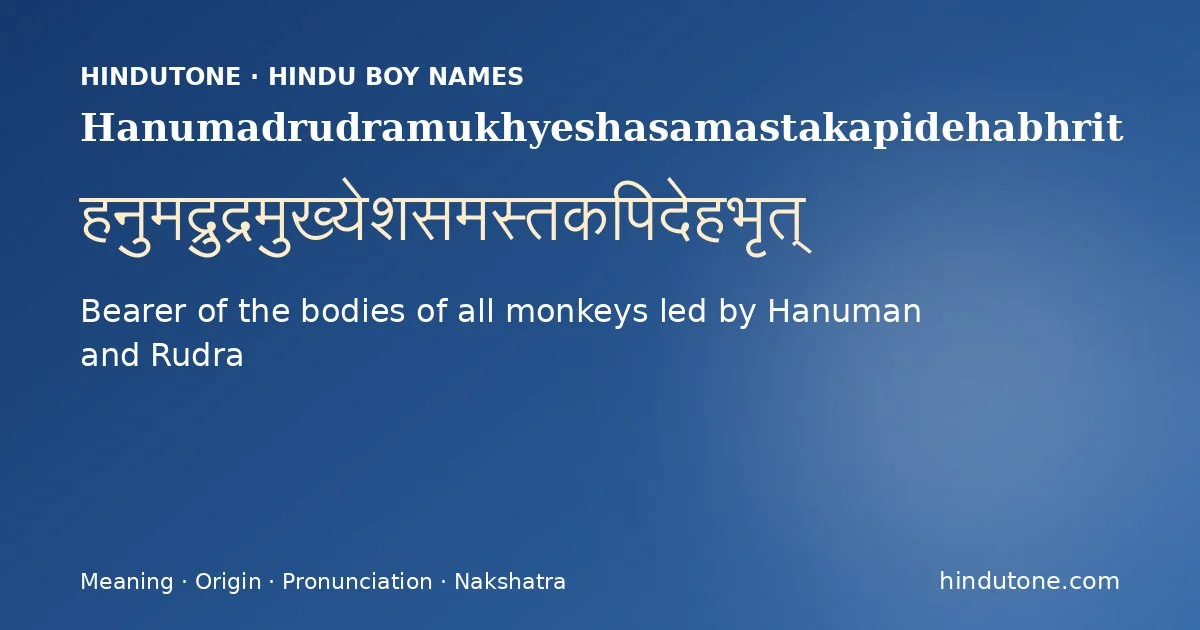
Hanumadrudramukhyeshasamastakapidehabhrit (हनुमद्रुद्रमुख्येशसमस्तकपिदेहभृत्) is a Sanskrit-origin Hindu boy-name meaning “Bearer of the bodies of all monkeys led by Hanuman and Rudra”. Find pronunciation, origin, deity association, popularity and similar Hindu baby names.
Hanumadrudramukhyeshasamastakapidehabhrit (हनुमद्रुद्रमुख्येशसमस्तकपिदेहभृत्, IAST: Hanumadrudramukhyeśasamastakapidehabhṛt) is a Sanskrit-origin Hindu boy-name meaning “Bearer of the bodies of all monkeys led by Hanuman and Rudra”. From Hanumat (Hanuman) + Rudra + mukhya (chief) + īśa (lord) + samasta (all) + kapi (monkey) + deha (body) + bhṛt (bearer/sustainer), this name honours the Lord who contains within Himself the entire host of divine vānara warriors.
Meaning, etymology & significance
This majestic compound honours Vishnu in His avatar as Rama, who embodies and sustains the entire vānara army — from the foremost leaders Hanuman and Rudra-born warriors to every monkey-warrior who served in the divine cause. The root bhṛt (from bhṛ, to bear or sustain) indicates that the Lord not only leads but ontologically upholds all these divine forms within Himself. The theological depth here is that the vānara host are understood in certain traditions as partial manifestations of devas, and Rama as their ultimate substratum.
This epithet is applied to Lord Vishnu-as-Rama in the devotional context of the Sahasranama; as a personal given name it is far too extended for practical use. It is pronounced ha-nu-mad-rud-ra-mukh-yay-sha-sa-mas-ta-ka-pi-day-ha-bhrit.
Scriptural source
Hanumadrudramukhyeshasamastakapidehabhrit appears in the Vishnu Sahasranama, among the sacred names of Vishnu.
Astrology — nakshatra, rashi & numerology
By the standard Vedic correspondence between a name’s first syllable and the lunar mansion, Hanumadrudramukhyeshasamastakapidehabhrit aligns with the Punarvasu nakshatra, under the Mithuna rashi (Moon sign). Its Chaldean name-number is 5.
Hanumadrudramukhyeshasamastakapidehabhrit — Name Facts
- Meaning
- Bearer of the bodies of all monkeys led by Hanuman and Rudra
- Gender
- Hindu boy name
- Nakshatra
- Punarvasu
- Rashi
- Mithuna (Gemini)
- Numerology
- 5
Frequently asked questions
What does the name Hanumadrudramukhyeshasamastakapidehabhrit mean?
Hanumadrudramukhyeshasamastakapidehabhrit is a Sanskrit-origin Hindu boy name meaning “Bearer of the bodies of all monkeys led by Hanuman and Rudra”.
Is Hanumadrudramukhyeshasamastakapidehabhrit a boy or girl name?
Hanumadrudramukhyeshasamastakapidehabhrit is traditionally a Hindu boy name.
Which nakshatra and rashi suit the name Hanumadrudramukhyeshasamastakapidehabhrit?
By the first-syllable rule of Vedic naming, Hanumadrudramukhyeshasamastakapidehabhrit aligns with the Punarvasu nakshatra, under the Mithuna (Gemini) rashi.
What is the numerology number of Hanumadrudramukhyeshasamastakapidehabhrit?
The Chaldean name number of Hanumadrudramukhyeshasamastakapidehabhrit is 5.
Explore more: Punarvasu nakshatra names · Mithuna rashi names · Hindu boy names with H · All Hindu names A–Z