Pareshvara
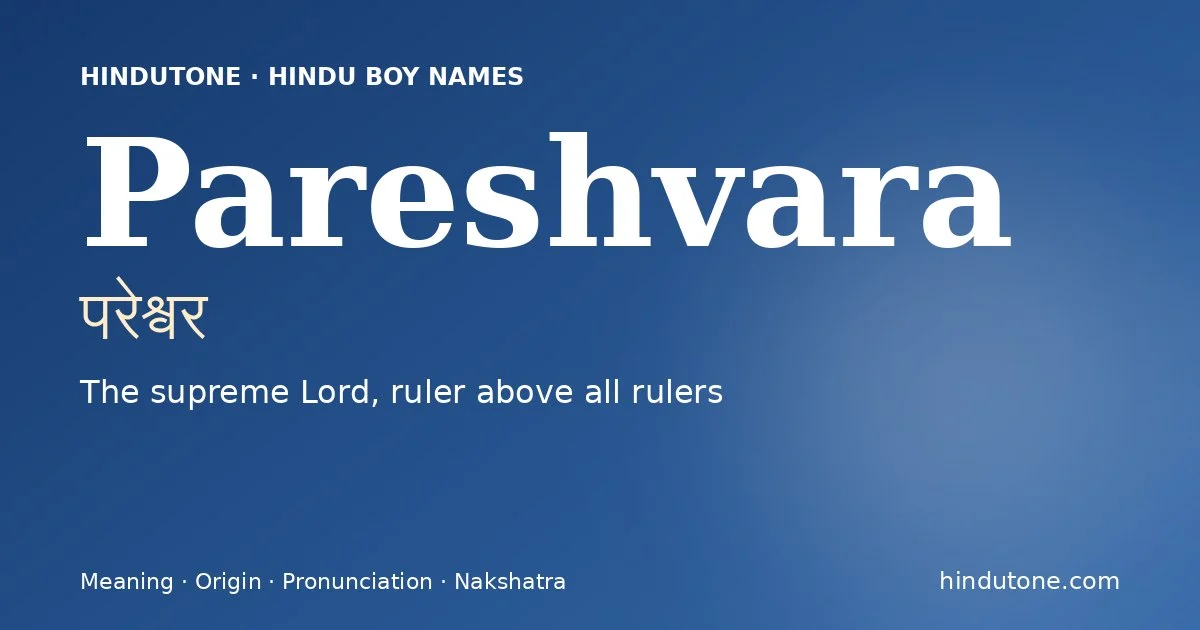
Pareshvara (परेश्वर) is a Sanskrit-origin Hindu boy-name meaning “The supreme Lord, ruler above all rulers”. Find pronunciation, origin, deity association, popularity and similar Hindu baby names.
Pareshvara (परेश्वर) is a Sanskrit-origin Hindu boy-name meaning “The supreme Lord, ruler above all rulers”. Find pronunciation, origin, deity association, popularity and similar Hindu baby names.
Pareshvara (परेश्वर, IAST: Pareśvara) is a Sanskrit-origin Hindu boy-name meaning “The supreme Lord, ruler above all rulers”. Combining 'para' (supreme) and 'īśvara' (Lord, controller), Pareshvara proclaims Vishnu as the highest sovereign who governs all other lords and cosmic powers without exception.
Meaning, etymology & significance
The title 'Ishvara' is itself exalted, denoting the Lord who commands all creation; 'para' elevates it to the absolute, affirming that no sovereignty stands above Vishnu's own. This epithet encapsulates the Vaishnava conviction that all deities and rulers ultimately operate under the sanction of the Supreme. It is both a philosophical declaration and a devotional salutation.
Pareshvara appears across Vaishnava texts as one of Vishnu's grand titles; it is also applied to Shiva in Shaiva traditions, reflecting the universal acknowledgement of a single supreme Lordship. Pronounced pah-RESH-vah-rah, it flows naturally as a given name for a boy.
Scriptural source
Pareshvara appears in the Vishnu Sahasranama, among the sacred names of Vishnu.
Astrology — nakshatra, rashi & numerology
By the standard Vedic correspondence between a name’s first syllable and the lunar mansion, Pareshvara aligns with the Uttara phalguni nakshatra, under the Kanya rashi (Moon sign). Its Chaldean name-number is 7.
Pareshvara — Name Facts
- Meaning
- The supreme Lord, ruler above all rulers
- Gender
- Hindu boy name
- Nakshatra
- Uttara Phalguni
- Rashi
- Kanya (Virgo)
- Numerology
- 7
Frequently asked questions
What does the name Pareshvara mean?
Pareshvara is a Sanskrit-origin Hindu boy name meaning “The supreme Lord, ruler above all rulers”.
Is Pareshvara a boy or girl name?
Pareshvara is traditionally a Hindu boy name.
Which nakshatra and rashi suit the name Pareshvara?
By the first-syllable rule of Vedic naming, Pareshvara aligns with the Uttara Phalguni nakshatra, under the Kanya (Virgo) rashi.
What is the numerology number of Pareshvara?
The Chaldean name number of Pareshvara is 7.
Explore more: Uttara Phalguni nakshatra names · Kanya rashi names · Hindu boy names with P · All Hindu names A–Z