Sadashiva
Sadashiva (सदाशिव) is a Sanskrit-origin Hindu boy-name meaning “Eternally auspicious, ever the benevolent one”. Find pronunciation, origin, deity association, popularity and similar Hindu baby names.
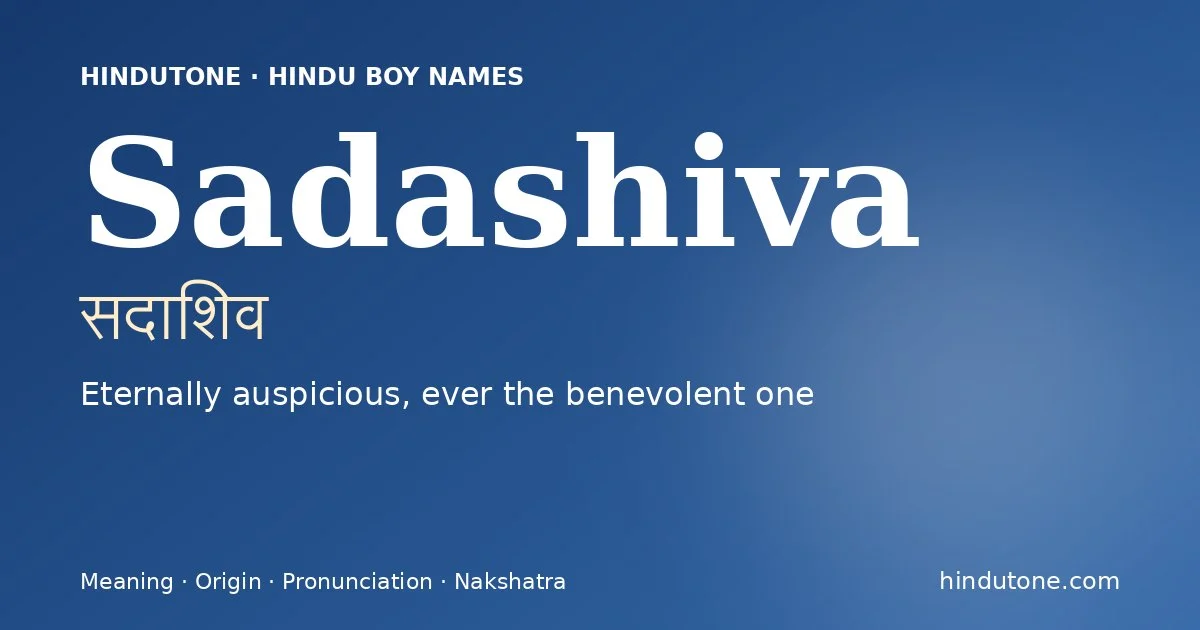
Sadashiva (सदाशिव) is a Sanskrit-origin Hindu boy-name meaning “Eternally auspicious, ever the benevolent one”. Find pronunciation, origin, deity association, popularity and similar Hindu baby names.
Sadashiva (सदाशिव, IAST: Sadāśiva) is a Sanskrit-origin Hindu boy-name meaning “Eternally auspicious, ever the benevolent one”. Uniting sadā (always) with Śiva (the auspicious, the benevolent), this name — though closely associated with Śaiva theology — appears in the Viṣṇu Sahasranāma to affirm the non-dual teaching that the supreme auspiciousness is one and undivided.
Meaning, etymology & significance
In Śaiva Siddhānta, Sadāśiva is the highest of five manifestations of Śiva, representing pure, untainted grace. Its presence in the Viṣṇu Sahasranāma reflects the Vedāntic vision of Hari-Hara unity, where the attributes of ultimate goodness belong equally to the Supreme. The name reminds the devotee that genuine auspiciousness is not ritual but the very nature of the absolute.
Sadāśiva is one of the most widely recognized sacred names in Hindu tradition, used across Vaiṣṇava and Śaiva communities and found in monastic names throughout India. Pronounced sa-dā-śi-va, with the retroflex śi softly aspirated.
Scriptural source
Sadashiva appears in the Vishnu Sahasranama, among the sacred names of Vishnu.
Astrology — nakshatra, rashi & numerology
By the standard Vedic correspondence between a name’s first syllable and the lunar mansion, Sadashiva aligns with the Shatabhisha nakshatra, under the Kumbha rashi (Moon sign). Its Chaldean name-number is 7.
Sadashiva — Name Facts
- Meaning
- Eternally auspicious, ever the benevolent one
- Gender
- Hindu boy name
- Nakshatra
- Shatabhisha
- Rashi
- Kumbha (Aquarius)
- Numerology
- 7
Frequently asked questions
What does the name Sadashiva mean?
Sadashiva is a Sanskrit-origin Hindu boy name meaning “Eternally auspicious, ever the benevolent one”.
Is Sadashiva a boy or girl name?
Sadashiva is traditionally a Hindu boy name.
Which nakshatra and rashi suit the name Sadashiva?
By the first-syllable rule of Vedic naming, Sadashiva aligns with the Shatabhisha nakshatra, under the Kumbha (Aquarius) rashi.
What is the numerology number of Sadashiva?
The Chaldean name number of Sadashiva is 7.
Explore more: Shatabhisha nakshatra names · Kumbha rashi names · Hindu boy names with S · All Hindu names A–Z