Samastapitribhitighna
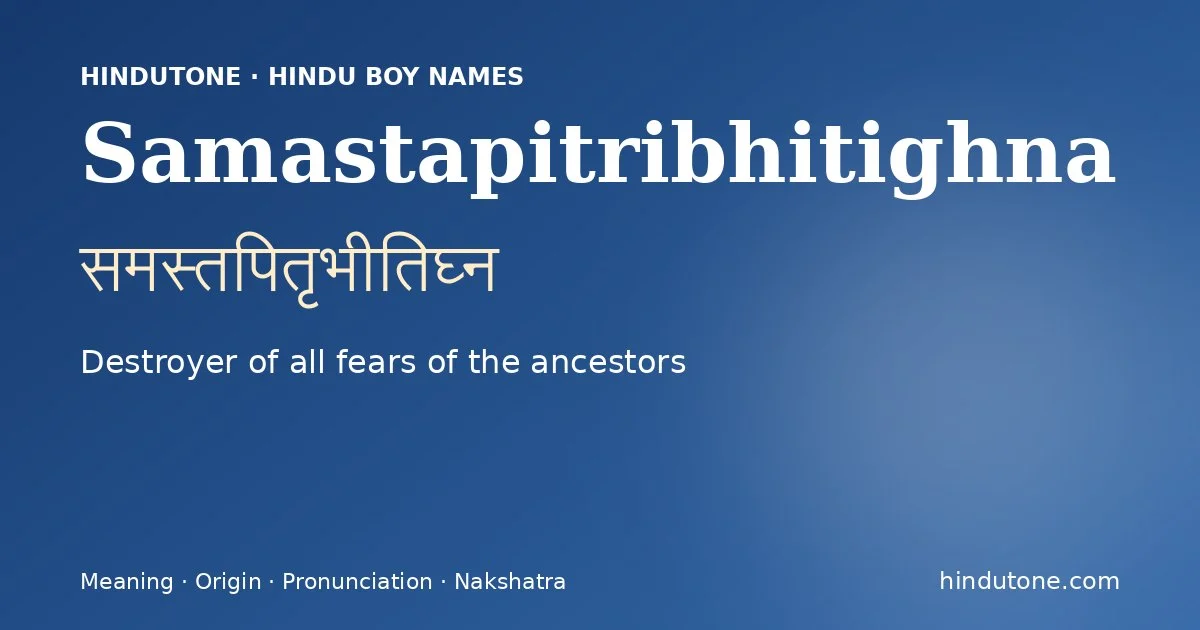
Samastapitribhitighna (समस्तपितृभीतिघ्न) is a Sanskrit-origin Hindu boy-name meaning “Destroyer of all fears of the ancestors”. Find pronunciation, origin, deity association, popularity and similar Hindu baby names.
Samastapitribhitighna (समस्तपितृभीतिघ्न) is a Sanskrit-origin Hindu boy-name meaning “Destroyer of all fears of the ancestors”. Find pronunciation, origin, deity association, popularity and similar Hindu baby names.
Samastapitribhitighna (समस्तपितृभीतिघ्न, IAST: Samastapitṛbhītighna) is a Sanskrit-origin Hindu boy-name meaning “Destroyer of all fears of the ancestors”. From 'samasta' (all, entire), 'pitṛ' (ancestors, fathers), 'bhīti' (fear, dread), and 'ghna' (destroyer, remover), this name declares that Vishnu eradicates every apprehension or suffering from which the souls of departed ancestors might be afflicted.
Meaning, etymology & significance
Samasta means 'the totality of,' pitṛ refers to the ancestral spirits (pitaras) who inhabit their own realm and depend on living descendants' offerings, bhīti conveys fear or anguish, and ghna from the root han (to strike, to dispel) designates the one who destroys. Together they present Vishnu as the supreme refuge not only of the living but of the departed, whose fears — whether of incomplete rites, inauspicious conditions, or the journey through the afterlife — are entirely dissolved by His grace. This name thus extends Vishnu's protective sovereignty across the boundary of death itself.
This epithet is deeply meaningful for families who observe pitṛ-pakṣa (the fortnight of ancestral rites) and who invoke Vishnu's protection for their forebears; it appears in the Sahasranama as a reassurance that no soul related to a Vishnu devotee need suffer unassuaged. As a compound descriptive epithet it is not suitable as a given name but is powerful in sacred recitation.
Scriptural source
Samastapitribhitighna appears in the Vishnu Sahasranama, among the sacred names of Vishnu.
Astrology — nakshatra, rashi & numerology
By the standard Vedic correspondence between a name’s first syllable and the lunar mansion, Samastapitribhitighna aligns with the Shatabhisha nakshatra, under the Kumbha rashi (Moon sign). Its Chaldean name-number is 6.
Samastapitribhitighna — Name Facts
- Meaning
- Destroyer of all fears of the ancestors
- Gender
- Hindu boy name
- Nakshatra
- Shatabhisha
- Rashi
- Kumbha (Aquarius)
- Numerology
- 6
Frequently asked questions
What does the name Samastapitribhitighna mean?
Samastapitribhitighna is a Sanskrit-origin Hindu boy name meaning “Destroyer of all fears of the ancestors”.
Is Samastapitribhitighna a boy or girl name?
Samastapitribhitighna is traditionally a Hindu boy name.
Which nakshatra and rashi suit the name Samastapitribhitighna?
By the first-syllable rule of Vedic naming, Samastapitribhitighna aligns with the Shatabhisha nakshatra, under the Kumbha (Aquarius) rashi.
What is the numerology number of Samastapitribhitighna?
The Chaldean name number of Samastapitribhitighna is 6.
Explore more: Shatabhisha nakshatra names · Kumbha rashi names · Hindu boy names with S · All Hindu names A–Z