Sarvasureshvara
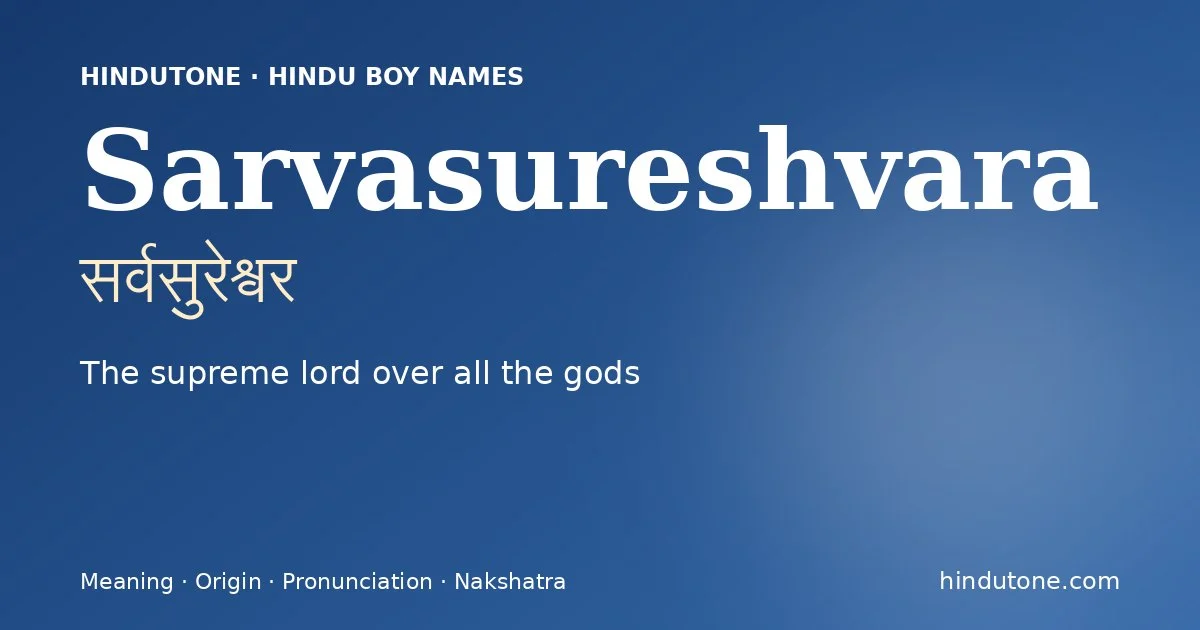
Sarvasureshvara (सर्वसुरेश्वर) is a Sanskrit-origin Hindu boy-name meaning “The supreme lord over all the gods”. Find pronunciation, origin, deity association, popularity and similar Hindu baby names.
Sarvasureshvara (सर्वसुरेश्वर) is a Sanskrit-origin Hindu boy-name meaning “The supreme lord over all the gods”. Find pronunciation, origin, deity association, popularity and similar Hindu baby names.
Sarvasureshvara (सर्वसुरेश्वर, IAST: Sarvasureśvara) is a Sanskrit-origin Hindu boy-name meaning “The supreme lord over all the gods”. Formed from sarva (all) + sura (divine being, deity) + īśvara (lord, master), this name proclaims Viṣṇu as the sovereign who reigns over every one of the countless devas, himself being their ultimate refuge and ruler.
Meaning, etymology & significance
The compound sureśvara is a classical Sanskrit dvandva-tatpuruṣa formation meaning 'lord of the gods,' and is frequently used for both Viṣṇu and Indra in different contexts; but with the prefix sarva, the title is elevated beyond any particular divine hierarchy to signify absolute, universal lordship. In the Purāṇic tradition, all devas—Brahmā, Indra, Śiva in his cosmic role—are described as bowing before Viṣṇu, making this epithet a cornerstone of Vaiṣṇava theology. The name thus asserts that divinity itself, in all its myriad expressions, is ultimately governed by one supreme being.
Sarvasureśvara appears in stotras dedicated to Viṣṇu and Nārāyaṇa across the Purāṇas; the shortened form Sureśvara is a recognized given name for boys in many Hindu communities. Pronunciation: sar-va-su-reś-va-ra, with the palatal śa in sureśvara.
Scriptural source
Sarvasureshvara appears in the Vishnu Sahasranama, among the sacred names of Vishnu.
Astrology — nakshatra, rashi & numerology
By the standard Vedic correspondence between a name’s first syllable and the lunar mansion, Sarvasureshvara aligns with the Shatabhisha nakshatra, under the Kumbha rashi (Moon sign). Its Chaldean name-number is 2.
Sarvasureshvara — Name Facts
- Meaning
- The supreme lord over all the gods
- Gender
- Hindu boy name
- Nakshatra
- Shatabhisha
- Rashi
- Kumbha (Aquarius)
- Numerology
- 2
Frequently asked questions
What does the name Sarvasureshvara mean?
Sarvasureshvara is a Sanskrit-origin Hindu boy name meaning “The supreme lord over all the gods”.
Is Sarvasureshvara a boy or girl name?
Sarvasureshvara is traditionally a Hindu boy name.
Which nakshatra and rashi suit the name Sarvasureshvara?
By the first-syllable rule of Vedic naming, Sarvasureshvara aligns with the Shatabhisha nakshatra, under the Kumbha (Aquarius) rashi.
What is the numerology number of Sarvasureshvara?
The Chaldean name number of Sarvasureshvara is 2.
Explore more: Shatabhisha nakshatra names · Kumbha rashi names · Hindu boy names with S · All Hindu names A–Z