Bhaktahardatamobhedabhanumadbbhanusantati
Bhaktahardatamobhedabhanumadbbhanusantati (भक्ताहार्दतमोभेदभानुमद्भानुसन्ततिः) is a Sanskrit-origin Hindu girl-name meaning “She who is the sunlit lineage dispelling darkness in the devotee's heart”. Find pronunciation, origin, deity association, popularity and similar Hindu baby names.
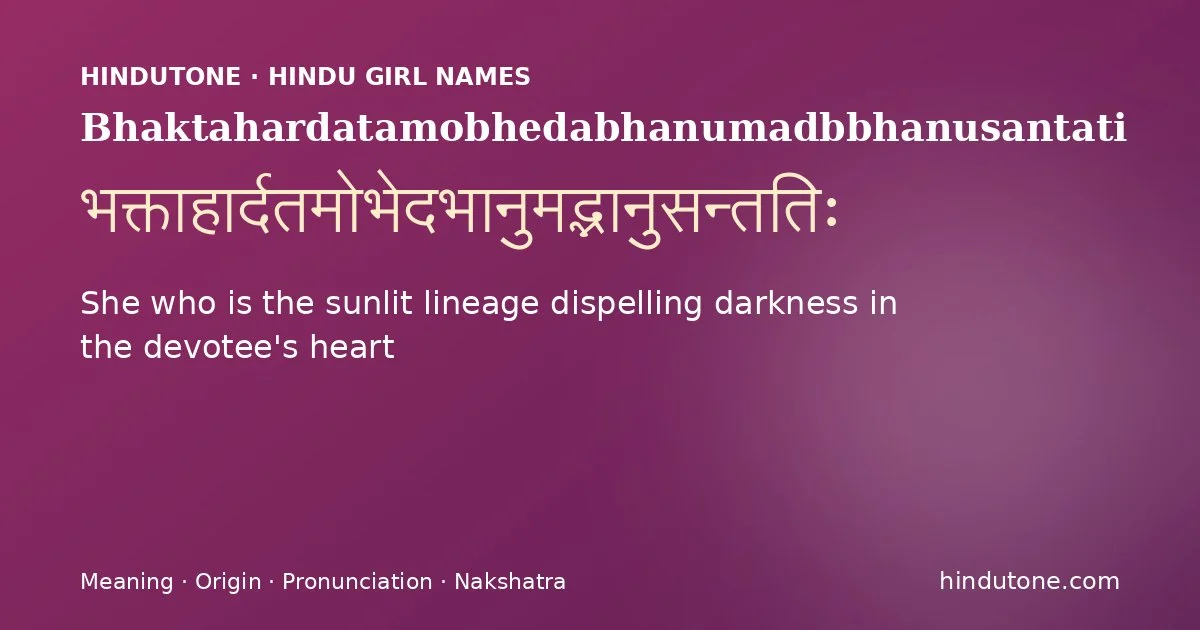
Bhaktahardatamobhedabhanumadbbhanusantati (भक्ताहार्दतमोभेदभानुमद्भानुसन्ततिः) is a Sanskrit-origin Hindu girl-name meaning “She who is the sunlit lineage dispelling darkness in the devotee's heart”. Find pronunciation, origin, deity association, popularity and similar Hindu baby names.
Bhaktahardatamobhedabhanumadbbhanusantati (भक्ताहार्दतमोभेदभानुमद्भानुसन्ततिः, IAST: bhaktāhārdatamobhedabhānumadbhānusantatyai) is a Sanskrit-origin Hindu girl-name meaning “She who is the sunlit lineage dispelling darkness in the devotee's heart”. This compound links bhakta (devotee), āhārda (of the heart/inner being), tamas/tamo (darkness, ignorance), bheda (splitting, dispelling), bhānumat (possessed of brilliant solar radiance), and bhānusantati (lineage or stream of sunlight), composing an image of Lalitā as a continuous ray of solar brilliance that tears apart the inner darkness of her devotees.
Meaning, etymology & significance
The darkness spoken of here — tamas in the heart of the devotee — is not merely ignorance but the accumulated suffering, confusion, and contraction of the spiritual heart. Lalitā is described as a lineage (santati) of sunlight, suggesting not a single flash but a sustained, living stream of illumination that flows without ceasing into those who turn to her. Bhānumat, 'possessed of solar radiance,' evokes the Gāyatrī, the solar prayer of liberation, suggesting that the Goddess herself is the answer to the devotee's deepest cry for light.
This compound epithet is among the most philosophically dense and poetically powerful in the Sahasranāma; it is clearly a devotional title and not practical as a given name. The concept it encodes — the Goddess as inner-light dispelling heart-darkness — may inspire a family to name a daughter Bhanumati or Santati; pronounced bhuk-taa-haar-duh-tuh-mo-bhay-duh-bhaa-nu-mud-bhaa-nu-sun-tuh-tih.
Scriptural source
Bhaktahardatamobhedabhanumadbbhanusantati appears in the Lalitha Sahasranama, among the sacred names of Lalitha.
Astrology — nakshatra, rashi & numerology
By the standard Vedic correspondence between a name’s first syllable and the lunar mansion, Bhaktahardatamobhedabhanumadbbhanusantati aligns with the Mula nakshatra, under the Dhanu rashi (Moon sign). Its Chaldean name-number is 3.
Bhaktahardatamobhedabhanumadbbhanusantati — Name Facts
- Meaning
- She who is the sunlit lineage dispelling darkness in the devotee's heart
- Gender
- Hindu girl name
- Nakshatra
- Mula
- Rashi
- Dhanu (Sagittarius)
- Numerology
- 3
Frequently asked questions
What does the name Bhaktahardatamobhedabhanumadbbhanusantati mean?
Bhaktahardatamobhedabhanumadbbhanusantati is a Sanskrit-origin Hindu girl name meaning “She who is the sunlit lineage dispelling darkness in the devotee's heart”.
Is Bhaktahardatamobhedabhanumadbbhanusantati a boy or girl name?
Bhaktahardatamobhedabhanumadbbhanusantati is traditionally a Hindu girl name.
Which nakshatra and rashi suit the name Bhaktahardatamobhedabhanumadbbhanusantati?
By the first-syllable rule of Vedic naming, Bhaktahardatamobhedabhanumadbbhanusantati aligns with the Mula nakshatra, under the Dhanu (Sagittarius) rashi.
What is the numerology number of Bhaktahardatamobhedabhanumadbbhanusantati?
The Chaldean name number of Bhaktahardatamobhedabhanumadbbhanusantati is 3.
Explore more: Mula nakshatra names · Dhanu rashi names · Hindu girl names with B · All Hindu names A–Z