Bhandaputravadhodyuktabalaavikramamanandita
Bhandaputravadhodyuktabalaavikramamanandita (भण्डपुत्रवधोद्युक्तबालाविक्रमनन्दिता) is a Sanskrit-origin Hindu girl-name meaning “She who is delighted by Bālā's valor in slaying Bhaṇḍa's sons”. Find pronunciation, origin, deity association, popularity and similar Hindu baby names.
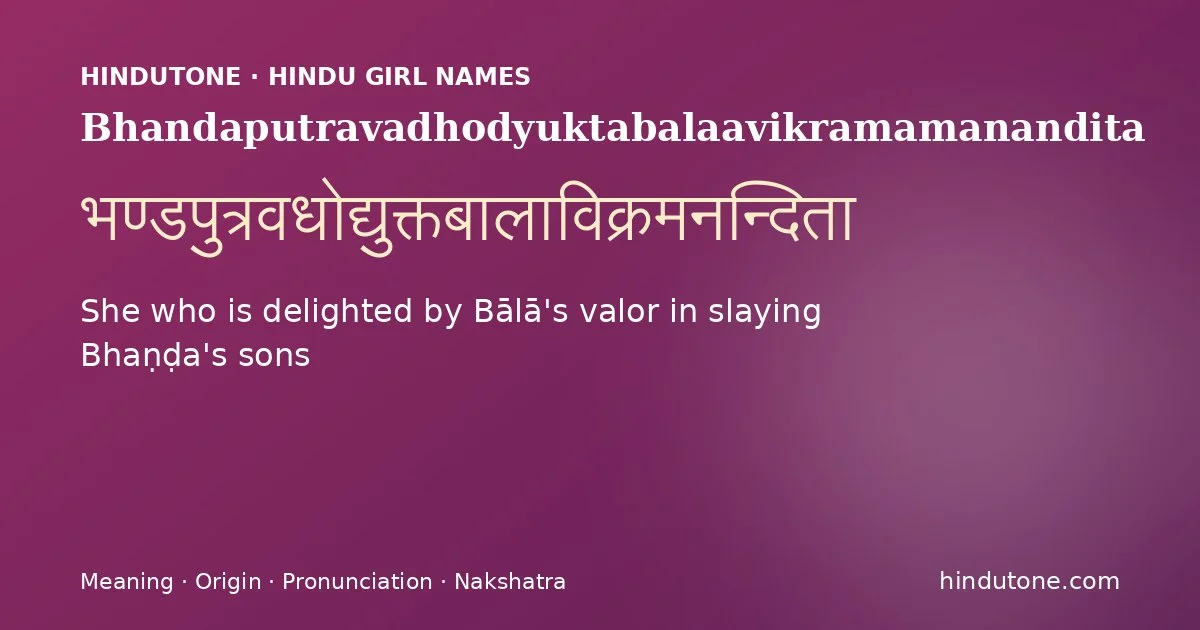
Bhandaputravadhodyuktabalaavikramamanandita (भण्डपुत्रवधोद्युक्तबालाविक्रमनन्दिता) is a Sanskrit-origin Hindu girl-name meaning “She who is delighted by Bālā's valor in slaying Bhaṇḍa's sons”. Find pronunciation, origin, deity association, popularity and similar Hindu baby names.
Bhandaputravadhodyuktabalaavikramamanandita (भण्डपुत्रवधोद्युक्तबालाविक्रमनन्दिता, IAST: Bhaṇḍaputravadhodyuktabālāvikramananditā) is a Sanskrit-origin Hindu girl-name meaning “She who is delighted by Bālā's valor in slaying Bhaṇḍa's sons”. Bhaṇḍa-putra (sons of the demon Bhaṇḍa), vadhodyukta (engaged in their slaughter), Bālā (the child-goddess, a form of Lalitā herself), vikrama (valor), and nanditā (filled with bliss) — this name reveals Lalitā rejoicing in the triumphant deeds of her own youthful manifestation.
Meaning, etymology & significance
Bālā Tripurasundarī is venerated as the maiden or child-form of Lalitā, representing the fresh, unconquerable creative power of the Goddess; her slaying of Bhaṇḍa's sons is a celebrated episode in the Lalitopākhyāna. Nanditā, from the root nand (to rejoice, to be glad), is a beautiful word implying the deepest inner joy — here it describes Lalitā's bliss as her own younger form achieves victory, like a mother's heart overflowing with pride.
This epithet belongs to Lalitā Mahātripurasundarī alone within the battle narrative of the Brahmāṇḍa Purāṇa; the compound is not suitable as a given name. The embedded name Bālā, however, is a cherished and usable name in Śākta households, and Nanditā is widely given to Hindu girls.
Scriptural source
Bhandaputravadhodyuktabalaavikramamanandita appears in the Lalitha Sahasranama, among the sacred names of Lalitha.
Astrology — nakshatra, rashi & numerology
By the standard Vedic correspondence between a name’s first syllable and the lunar mansion, Bhandaputravadhodyuktabalaavikramamanandita aligns with the Mula nakshatra, under the Dhanu rashi (Moon sign). Its Chaldean name-number is 5.
Bhandaputravadhodyuktabalaavikramamanandita — Name Facts
- Meaning
- She who is delighted by Bālā's valor in slaying Bhaṇḍa's sons
- Gender
- Hindu girl name
- Nakshatra
- Mula
- Rashi
- Dhanu (Sagittarius)
- Numerology
- 5
Frequently asked questions
What does the name Bhandaputravadhodyuktabalaavikramamanandita mean?
Bhandaputravadhodyuktabalaavikramamanandita is a Sanskrit-origin Hindu girl name meaning “She who is delighted by Bālā's valor in slaying Bhaṇḍa's sons”.
Is Bhandaputravadhodyuktabalaavikramamanandita a boy or girl name?
Bhandaputravadhodyuktabalaavikramamanandita is traditionally a Hindu girl name.
Which nakshatra and rashi suit the name Bhandaputravadhodyuktabalaavikramamanandita?
By the first-syllable rule of Vedic naming, Bhandaputravadhodyuktabalaavikramamanandita aligns with the Mula nakshatra, under the Dhanu (Sagittarius) rashi.
What is the numerology number of Bhandaputravadhodyuktabalaavikramamanandita?
The Chaldean name number of Bhandaputravadhodyuktabalaavikramamanandita is 5.
Explore more: Mula nakshatra names · Dhanu rashi names · Hindu girl names with B · All Hindu names A–Z