Sadashivapativrata
Sadashivapativrata (सदाशिवपतिव्रता) is a Sanskrit-origin Hindu girl-name meaning “She who is perfectly devoted to Lord Sadāśiva”. Find pronunciation, origin, deity association, popularity and similar Hindu baby names.
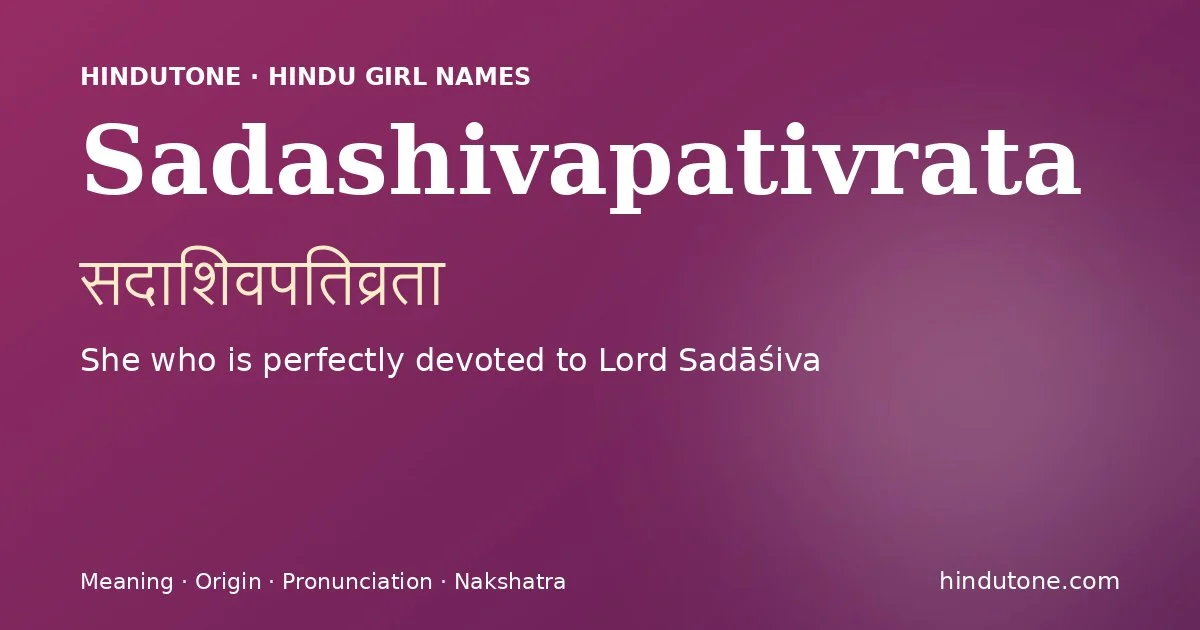
Sadashivapativrata (सदाशिवपतिव्रता) is a Sanskrit-origin Hindu girl-name meaning “She who is perfectly devoted to Lord Sadāśiva”. Find pronunciation, origin, deity association, popularity and similar Hindu baby names.
Sadashivapativrata (सदाशिवपतिव्रता, IAST: Sadāśivapativratā) is a Sanskrit-origin Hindu girl-name meaning “She who is perfectly devoted to Lord Sadāśiva”. Sadāśiva (the eternally auspicious Śiva) + pativratā (a wife of unshakable devotion) reveals Lalitā as the supreme ideal of conjugal and cosmic devotion, whose loyalty to Śiva is not social convention but the union of absolute Śakti with absolute Śiva.
Meaning, etymology & significance
Pativratā is one of the most honored titles in the Hindu tradition, denoting a woman whose entire being is devoted to her husband as a sacred discipline; in Lalitā's case, this vow is not human but cosmic — her union with Sadāśiva is the very ground of all creation and dissolution. The compound Sadāśiva-pativratā thus encodes the tantric teaching that Śakti and Śiva are inseparable, and that her 'devotion' is the dynamic energy that animates the motionless Absolute.
Temples of Lalitā throughout South India celebrate this epithet during the Ālinganamūrti (embracing form) representations of Śiva and Śakti, symbolizing the non-dual unity of the divine pair. As a given name it is lengthy; Pativratā alone is sometimes used for girls as a name celebrating devotional virtue.
Scriptural source
Sadashivapativrata appears in the Lalitha Sahasranama, among the sacred names of Lalitha.
Astrology — nakshatra, rashi & numerology
By the standard Vedic correspondence between a name’s first syllable and the lunar mansion, Sadashivapativrata aligns with the Shatabhisha nakshatra, under the Kumbha rashi (Moon sign). Its Chaldean name-number is 8.
Sadashivapativrata — Name Facts
- Meaning
- She who is perfectly devoted to Lord Sadāśiva
- Gender
- Hindu girl name
- Nakshatra
- Shatabhisha
- Rashi
- Kumbha (Aquarius)
- Numerology
- 8
Frequently asked questions
What does the name Sadashivapativrata mean?
Sadashivapativrata is a Sanskrit-origin Hindu girl name meaning “She who is perfectly devoted to Lord Sadāśiva”.
Is Sadashivapativrata a boy or girl name?
Sadashivapativrata is traditionally a Hindu girl name.
Which nakshatra and rashi suit the name Sadashivapativrata?
By the first-syllable rule of Vedic naming, Sadashivapativrata aligns with the Shatabhisha nakshatra, under the Kumbha (Aquarius) rashi.
What is the numerology number of Sadashivapativrata?
The Chaldean name number of Sadashivapativrata is 8.
Explore more: Shatabhisha nakshatra names · Kumbha rashi names · Hindu girl names with S · All Hindu names A–Z