9 Navratri Color Ideas 2025 and Their Spiritual Significance: Complete Devotional Guide
Navratri, the nine-night festival dedicated to Maa Durga and her nine divine forms (Navadurga), is one of the most sacred Hindu celebrations.
Navratri, the nine-night festival dedicated to Maa Durga and her nine divine forms (Navadurga), is one of the most sacred Hindu celebrations.
Navratri, the nine-night festival dedicated to Maa Durga and her nine divine forms (Navadurga), is one of the most sacred Hindu celebrations. Each day of Navratri is associated with a specific color, representing the qualities of the goddess worshipped on that day. Devotees wear these colors, decorate their homes, and align their prayers with the divine vibrations of each shade.
In 2025, Navratri will be celebrated from September 21 to September 29, leading into Dussehra on September 30. Here’s your complete guide to the 9 Navratri colors of 2025 and what they symbolize.
🌸 Day 1 – September 21, 2025
Color: Orange
Goddess: Shailaputri (Daughter of the Mountains)
Orange radiates energy, enthusiasm, and new beginnings. On the first day, devotees invoke Goddess Shailaputri, symbolizing strength and purity. Wearing orange inspires positivity and devotion to start the festival on an auspicious note.
🌼 Day 2 – September 22, 2025
Color: White
Goddess: Brahmacharini
White stands for peace, purity, and serenity. This day honors Goddess Brahmacharini, who embodies devotion, penance, and wisdom. Devotees wearing white invite harmony, spiritual growth, and calmness into their lives.
💛 Day 3 – September 23, 2025
Color: Red
Goddess: Chandraghanta
Red symbolizes courage, passion, and strength. On this day, devotees worship Goddess Chandraghanta, known for her bravery and grace. Wearing red enhances confidence and determination in overcoming life’s challenges.
🌿 Day 4 – September 24, 2025
Color: Royal Blue
Goddess: Kushmanda
Royal Blue reflects prosperity, creativity, and divine energy. Goddess Kushmanda, the creator of the universe, is worshipped on this day. Wearing blue is believed to bring balance, good fortune, and renewed energy.
🩷 Day 5 – September 25, 2025
Color: Yellow
Goddess: Skandamata
Yellow is the color of joy, optimism, and wisdom. Devotees worship Goddess Skandamata, the nurturing mother of Skanda (Kartikeya). Wearing yellow attracts positivity, clarity, and maternal blessings.
💚 Day 6 – September 26, 2025
Color: Green
Goddess: Katyayani
Green represents growth, fertility, and harmony. On this day, Goddess Katyayani, the warrior goddess, is invoked for courage and blessings in relationships. Wearing green promotes peace, love, and success in personal bonds.
💙 Day 7 – September 27, 2025
Color: Grey
Goddess: Kalaratri
Grey signifies protection, power, and transformation. Day seven is dedicated to Goddess Kalaratri, who destroys ignorance and darkness. Wearing grey invokes inner strength and shields devotees from negativity.
❤️ Day 8 – September 28, 2025
Color: Purple
Goddess: Mahagauri
Purple stands for spirituality, devotion, and purification. Goddess Mahagauri, known for her beauty and calmness, is worshipped on this day. Wearing purple helps seekers connect with divinity and attain inner peace.
🌞 Day 9 – September 29, 2025
Color: Peacock Green
Goddess: Siddhidatri
Peacock Green symbolizes fulfillment, wisdom, and divine blessings. On the final day, devotees worship Goddess Siddhidatri, who bestows spiritual powers (siddhis). Wearing this shade attracts prosperity, blessings, and spiritual enlightenment.
✨ Conclusion: Embrace Navratri Colors with Devotion
Wearing the Navratri 2025 colors is not just about tradition—it’s about aligning yourself with the cosmic energy of the goddess. Each color resonates with a different aspect of Maa Durga, reminding us to live with courage, wisdom, purity, and compassion.
Celebrate this Navratri with devotion, joy, and vibrant colors that strengthen your connection to the divine. 🌸🙏
What do the Vedas and Puranas say about color as a form of divine worship?
The association of color with divinity is not a modern decorative choice — it is rooted in the Tantric and Agamic traditions that underpin Shakta worship. The Devi Bhagavata Purana describes each form of the Goddess as radiating a distinct cosmic hue (varna), which is understood as a visible frequency of her shakti. Wearing or meditating upon that color is considered a form of upasana — a direct alignment of the devotee's consciousness with the goddess's energy field.
The Rigveda's Devi Sukta (10.125) establishes that the Goddess pervades all creation in varied expressions, and later Tantric commentators interpreted these expressions through color symbolism. The Sharada Tilaka Tantra specifically links chromatic offerings — colored cloth, flowers, and powders — to the activation of specific energy centers (chakras) in the human body, tying the festival's daily color sequence to a progressive spiritual ascent from the Muladhara to the Sahasrara chakra over the nine nights.
How does each Navadurga form connect to a specific cosmic principle beyond color?
Each of the nine goddesses worshipped during Navratri represents a distinct tattva, or cosmic principle. Shailaputri governs the earth element (Prithvi tattva) and is linked to stability and material grounding. Brahmacharini embodies tapas — disciplined spiritual austerity — and is associated with fire (Agni tattva), explaining why her white color paradoxically contains intense inner heat. Chandraghanta, worshipped on Day 3, rules over sound (Nada) and her crescent-bell form is said in the Kalika Purana to destroy negative astral entities through sacred vibration.
Kushmanda, worshipped on Day 4, is described in the Markandeya Purana as the Adi Shakti who created the universe from her cosmic smile (hence her name: 'ku' = small, 'ushma' = warmth, 'anda' = egg — the one who created the cosmic egg). Skandamata on Day 5 integrates the energy of motherhood with martial valor, reflecting the dual nature of Shakti as both creator and protector. Understanding these tattvas deepens the significance of wearing each day's color as more than custom — it becomes a conscious invocation of a specific aspect of universal energy.
Which temples across India observe distinct Navratri color traditions and rituals?
At the Vaishno Devi Shrine in Katra, Jammu, the three primary pindis — representing Mahakali, Mahalakshmi, and Mahasaraswati — are adorned with color-matched drapery on each of the nine days, drawing hundreds of thousands of pilgrims annually. At the Kamakhya Temple in Guwahati, Assam, the Sharadiya Navratri observance includes a rigorous Tantric color-based puja sequence called Navarana Vidhi, in which the deity's shringar (adornment) follows the prescribed chromatic order from the Tantrasara.
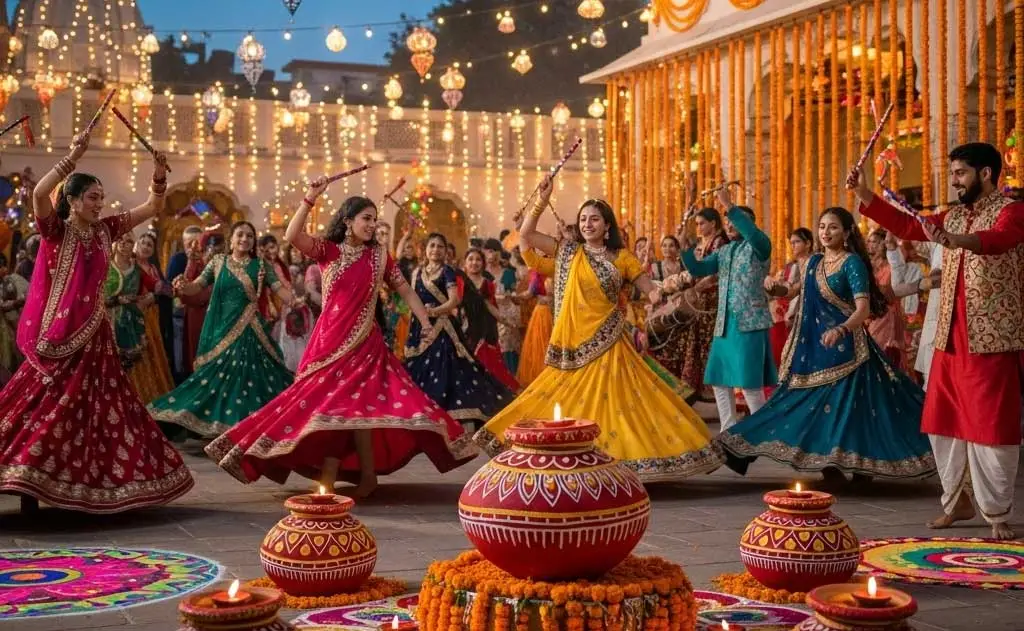
In Gujarat, the Ambaji Temple in Banaskantha district and the Bhadrakali Temple in Vadodara are considered the spiritual epicenters of Navratri celebration. Here, the Garba dance performed each night is traditionally color-coded — devotees are expected to match their garments to the day's designated shade, creating a visually unified field of collective devotion. The Mysuru Dasara, anchored at the Chamundeshwari Temple atop Chamundi Hill in Mysuru, Karnataka, maintains a nine-day royal procession in which the presiding deity's attire changes color each day according to the same Navadurga sequence.
How should a devotee practically incorporate the Navratri color sequence into daily sadhana?
Beyond simply wearing the designated color, classical Shakta tradition recommends coordinating one's entire devotional environment — the altar cloth (asana vastra), the flower offerings (pushpanjali), and even the color of the lamp wick's flame-enhancing material — with the day's hue. For instance, on Day 4 (Royal Blue, Kushmanda), offering blue flowers such as aparajita (Clitoria ternatea) is considered especially auspicious, as this flower is explicitly named in the Devi Puja Paddhati texts as dear to the goddess in her creative aspect.
Devotees maintaining a nine-day vrat (fast) are advised by Shakta Agamic texts to chant each goddess's specific beeja mantra alongside the color meditation. For Shailaputri, the beeja is 'Hreem Shrim Kleem'; for Brahmacharini, 'Hreem'; and for Chandraghanta, 'Aim Hreem Kleem Chandraghantayai Namah.' Sitting before a cloth or image of the day's color while chanting these mantras is described in the Sharada Tilaka as an act of Bhavana Upasana — worship through conscious feeling and chromatic visualization.
What is the spiritual significance of Navratri culminating in Dussehra on September 30, 2025?
The tenth day, Vijayadashami (Dussehra), is inseparable from the nine-night arc of Navratri. The Devi Mahatmya, the central scripture of Shakta devotion (forming chapters 81–93 of the Markandeya Purana), narrates that Goddess Durga defeated the buffalo-demon Mahishasura after nine nights of battle, with the tenth dawn marking her ultimate victory — Vijaya, or conquest. This is why Vijayadashami is considered the most auspicious day for beginning new ventures, journeys, and learning.
The transition from the nine colors to the white light of victory on Dussehra carries a profound esoteric meaning: the nine shades, like the nine notes of Indian classical music or the nine planets (Navagraha), are understood as differentiated expressions of the one undivided Shakti. By journeying through each color consciously over nine days, the devotee arrives at Vijayadashami in a state of inner integration — what the Tantric tradition calls Samapatti, or complete absorption in the divine — symbolized by the effulgent, colorless light of pure consciousness.
Are there regional variations in the Navratri color list, and why do they differ?
The standardized nine-color list widely circulated today is a relatively recent synthesis, drawing on multiple regional calendrical traditions. In Maharashtra, the color sequence is often published by Panchang committees affiliated with the Shri Siddhivinayak and Tulja Bhavani temples, and minor variations occur when a particular tithi (lunar day) spans two solar days. In Bengal, where Navratri overlaps with Durga Puja (Shashthi to Dashami), the chromatic emphasis shifts — Saptami, Ashtami, and Navami receive far greater ritual elaboration than earlier days, and the color tradition is less rigorously observed as the focus moves to the sculptural Pratima (idol) and the Sandhi Puja at midnight between Ashtami and Navami.
In South India, particularly in Tamil Nadu and Andhra Pradesh, Navratri takes the form of Golu (the display of decorated dolls on stepped platforms), and color is integrated into the arrangement of doll tiers rather than daily clothing. Each tier of the Golu often features dolls in the colors of the corresponding Navadurga, making the display itself a visual, three-dimensional yantra of the nine-night spiritual journey. These regional differences are not contradictions but reflections of the Agamic principle of Desh-Kala-Patra — adapting worship to place, time, and community context — which is itself enshrined in the Tantric Pancharatra tradition.
Frequently Asked Questions
When is 9 Navratri Color Ideas and Their Spiritual?
9 Navratri Color Ideas and Their Spiritual falls on September 21, 2025.
What is the significance of 9 Navratri Color Ideas and Their Spiritual?
Navratri , the nine-night festival dedicated to Maa Durga and her nine divine forms (Navadurga) , is one of the most sacred Hindu celebrations. Each day of Navratri is associated with a specific color , representing the qualities of the goddess worshipped on that day.
How is 9 Navratri Color Ideas and Their Spiritual celebrated?
Devotees observe it with puja, fasting or special offerings, visiting temples, chanting mantras, and gathering with family. Customs vary by region and tradition.
What should devotees do on 9 Navratri Color Ideas and Their Spiritual?
Take a sacred bath, perform the day's puja and charity (dana), observe any prescribed fast, and chant mantras with sincere devotion.
You might also like
Jyeshtha Masam 2026: Dates, Significance, Festivals, Mantras, and Danas – Complete Guide
Gita Jayanti 2026 Prasad Recipes — Tulsi-Honoring Sweets, Krishna's Favourites & December 10 Bhog Plate
Navratri 2026 — Sharad Navaratri Dates (October 2-11), 9 Goddess Forms, Garba Events & Complete NRI Celebration Guide