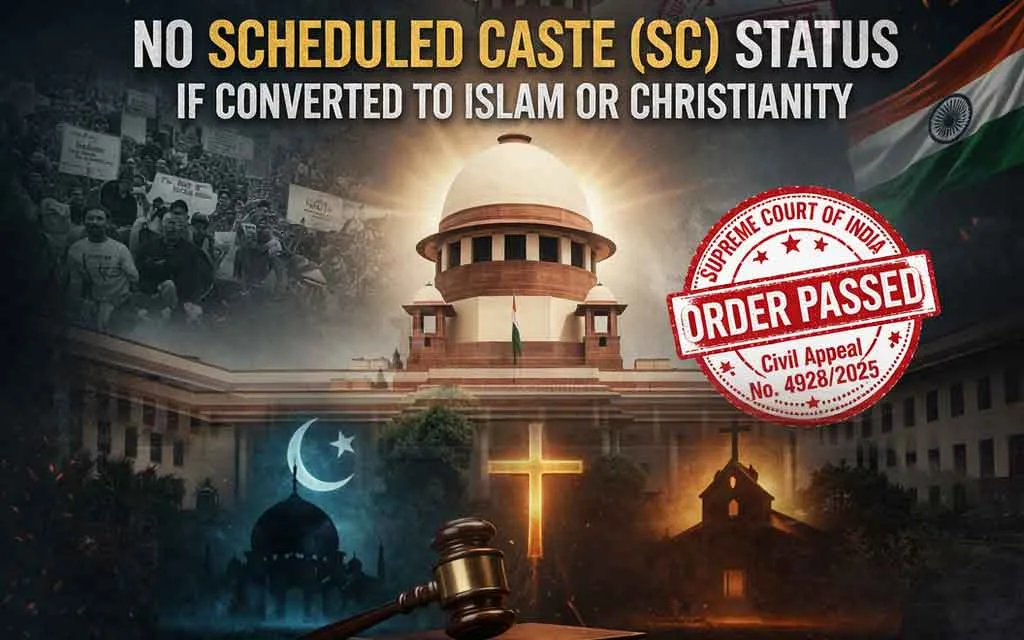
No Scheduled Caste status if converted to Islam, Christianity
The Supreme Court of India has not delivered a single sweeping new "verdict" in 2024–2026 that fundamentally changes the law on Scheduled Caste (SC) status for…
The Supreme Court of India has not delivered a single sweeping new "verdict" in 2024–2026 that fundamentally changes the law on Scheduled Caste (SC) status for…
The Supreme Court of India has not delivered a single sweeping new "verdict" in 2024–2026 that fundamentally changes the law on Scheduled Caste (SC) status for converts to Islam or Christianity. Instead, the position remains consistent with long-standing constitutional provisions and judicial precedents: under the Constitution (Scheduled Castes) Order, 1950 (as amended), SC status and its associated benefits (reservations in education, jobs, and protections under the SC/ST Atrocities Act) are available only to persons who profess Hinduism, Sikhism, or Buddhism. Converts to Christianity or Islam are generally not eligible.
Core Legal Position
Paragraph 3 of the 1950 Order explicitly states that no person who professes a religion different from Hindu, Sikh, or Buddhist shall be deemed a member of a Scheduled Caste. This has been upheld repeatedly by the Supreme Court and High Courts. The reasoning is that SC status was designed to address historical caste-based discrimination and untouchability rooted in the Hindu social order (and extended to Sikhism and Buddhism, which the Constitution recognizes as having similar social dynamics in this context). Christianity and Islam do not recognize the caste system in the same way, so the "stigma" or backwardness linked to SC identity is considered to cease upon genuine conversion.
Key Recent Supreme Court Observations (November 2024)
In C. Selvarani vs. Special Secretary-cum-District Collector (judgment dated 26 November 2024), a Division Bench of the Supreme Court ruled that a woman who had converted to and was actively practicing Christianity could not claim SC status or benefits by continuing to identify as Hindu solely for reservation purposes. The Court described such dual claims as a "fraud on the Constitution" that defeats the social ethos of reservations, which aim to uplift communities facing specific historical disadvantages within the recognized framework. The bench emphasized:
- Genuine conversion involves actual belief and practice of the new faith.
- Conversion undertaken primarily to derive reservation benefits (without sincere faith) is impermissible.
- Upon conversion to Christianity, the person ceases to belong to the original caste for the purposes of the 1950 Order.
This ruling reinforced earlier precedents, such as:
- Soosai vs. Union of India (1985): Caste may persist socially, but SC benefits require proof that the disabilities continue with the same severity in the new religious community (a high bar rarely met for Christian/Muslim converts).
- Other cases affirming that conversion to a religion without caste recognition leads to loss of SC eligibility unless there is reconversion to Hinduism/Sikhism/Buddhism with acceptance by the original community.
The 2024 judgment was widely reported with headlines like "No Scheduled Caste status if converted to Islam, Christianity," which accurately reflects the operative legal effect, even if the case itself involved a specific individual claiming benefits post-conversion.
High Court Rulings Citing the Supreme Court
Several High Courts have applied this principle firmly in 2025–2026:
- Allahabad High Court (November/December 2025): Directed the Uttar Pradesh government to identify and stop SC benefits for those who convert to Christianity, calling retention of benefits a "fraud on the Constitution." It explicitly cited the 2024 Supreme Court ruling in C. Selvarani. The court noted there is no caste system in Christianity, so claiming SC status post-conversion distorts reservation policy.
- Andhra Pradesh High Court and others have similarly held that converts to Christianity lose SC/ST Act protections and cannot claim caste-based status where the new religion does not recognize it.
Ongoing Broader Debate
Petitions seeking to extend SC status to Dalit Christians and Dalit Muslims (arguing that caste discrimination persists regardless of religion) have been pending in the Supreme Court for nearly two decades. The Centre has opposed this, arguing that:
- Untouchability and the specific social backwardness targeted by SC reservations are not prevalent in Christianity or Islam.
- Extending benefits would amount to religion-based reservation, which the Constitution does not permit for SCs.
A Commission headed by former CJI K.G. Balakrishnan (set up in 2022) is examining the issue and has received extensions (latest till at least 2025). The Supreme Court has at times pushed for a decision but has also allowed the government process to continue. No final ruling has expanded SC status to these groups as of early 2026.
Reconversion and Exceptions
- If a person reconverts to Hinduism, Sikhism, or Buddhism and is accepted by the community, SC status can revive (subject to scrutiny to prevent fraud).
- Mere performance of rituals does not amount to "professing" a religion for these purposes; an open declaration and consistent practice matter.
Summary of the "Complete Story"
The headline "No Scheduled Caste status if converted to Islam, Christianity" is a correct encapsulation of the prevailing legal position under the 1950 Order and affirmed by the Supreme Court in multiple cases, including the 2024 Selvarani judgment. It is not a brand-new blanket ban invented recently but a consistent application of constitutional policy. Courts have repeatedly warned that claiming SC benefits while genuinely following Christianity or Islam (or converting strategically for quotas) undermines the purpose of affirmative action.
The issue remains politically and socially contentious, with arguments on both sides about whether caste discrimination truly disappears upon conversion. Until Parliament amends the 1950 Order or the Supreme Court rules otherwise in the pending batch of cases (after the Balakrishnan Commission report), the law stands as described above.
For the full official judgment in C. Selvarani (2024), it is available on the Supreme Court website (Writ Petition or Civil Appeal related to SC certificate denial post-conversion). High Court orders in UP and other states have operationalized this by directing authorities to verify and cancel ineligible claims.
Frequently Asked Questions
Can a person who converts to Islam or Christianity keep Scheduled Caste status?
Generally no. Under the Constitution (Scheduled Castes) Order, 1950, SC status is available only to people who profess Hinduism, Sikhism or Buddhism.
What did the Supreme Court decide in C. Selvarani vs. Special Secretary-cum-District Collector?
In its judgment dated 26 November 2024, the Court held that a woman practising Christianity could not claim SC benefits by identifying as Hindu only for reservation. It called such dual claims a fraud on the Constitution.
Can SC status be regained after reconversion to Hinduism, Sikhism or Buddhism?
Yes, SC status can revive if the person reconverts and is accepted by the original community, subject to scrutiny to prevent fraud. An open declaration and consistent practice matter, not mere rituals.
Is there a new law or ban on SC benefits for converts?
No. This is a consistent application of the 1950 Order and earlier precedents such as Soosai vs. Union of India (1985), not a new blanket ban.
Are petitions for Dalit Christians and Dalit Muslims still pending?
Yes. Petitions seeking SC status for them have been pending in the Supreme Court for nearly two decades. A commission headed by former CJI K.G. Balakrishnan is examining the issue, and no ruling had expanded SC status as of early 2026.
What have High Courts said about SC benefits after conversion?
The Allahabad High Court directed Uttar Pradesh to identify and stop SC benefits for converts to Christianity, citing Selvarani. The Andhra Pradesh High Court held that converts lose SC/ST Act protections.
You might also like
Shani Deva Temples Worldwide & Must-Performed Rituals — Complete Devotee's Guide
Jyeshtha Masam 2026: Dates, Significance, Festivals, Mantras, and Danas – Complete Guide
ISKCON to Serve Pure Sattvik Mid-Day Meals to School Children in Bengal | Suvendu Adhikari Initiative