PM Modi Srisailam Temple Visit: Offers Prayers at Bhramaramba Mallikarjuna Swamy Devasthanam for India's Prosperity
Prime Minister Narendra Modi visited the sacred Sri Bhramaramba Mallikarjuna Swamy Varla Devasthanam in Srisailam, Andhra Pradesh, today, offering prayers and…
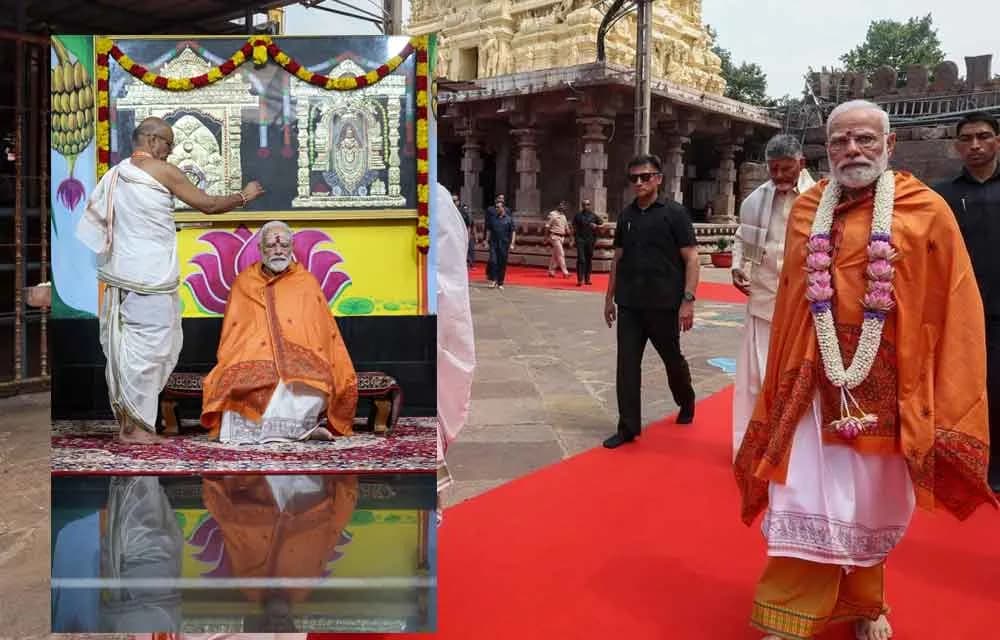
Prime Minister Narendra Modi visited the sacred Sri Bhramaramba Mallikarjuna Swamy Varla Devasthanam in Srisailam, Andhra Pradesh, today, offering prayers and…
Prime Minister Narendra Modi visited the sacred Sri Bhramaramba Mallikarjuna Swamy Varla Devasthanam in Srisailam, Andhra Pradesh, today, offering prayers and seeking blessings for the health, happiness, and prosperity of all Indians. This spiritual sojourn highlights PM Modi's deep-rooted connection to India's ancient temples and his vision for national unity and well-being, echoing the sentiments of devotees who pray for fellow citizens' sukh saubhagyam (happiness and fortune).
PM Modi's Spiritual Darshan at One of India's 12 Jyotirlingas
Nestled amid the serene Nallamala hills, the Srisailam temple—home to Lord Mallikarjuna Swamy, a revered Jyotirlinga, and Goddess Bhramaramba, a powerful Shakti Peetha—attracted PM Modi for a poignant prayer session. Accompanied by Andhra Pradesh Chief Minister N. Chandrababu Naidu, the Prime Minister participated in the traditional Rudrabhishekam ritual, using Panchamritas to honor the divine. Devotees chanted "Har Har Mahadev" as PM Modi bowed in humility, praying specifically for the aarogyam (health) and saubhagyam (prosperity) of every Indian, much like the heartfelt prayers shared by pilgrims at this historic site.
This PM Modi Srisailam temple visit marks a significant moment, blending faith with leadership. Thousands of devotees gathered, inspired by the Prime Minister's devotion, which reinforces the temple's role as a pillar of Sanatan Dharma and cultural heritage.
Blend of Faith and Development: Projects Worth ₹13,430 Crore Unveiled
Following the darshan, PM Modi paid respects at the Sree Shivaji Spoorthi Kendra, tributing Chhatrapati Shivaji Maharaj's legacy. He then proceeded to Kurnool to launch infrastructure projects valued at over ₹13,430 crore, aimed at boosting Andhra Pradesh's economy under the Atmanirbhar Bharat initiative.
Key highlights include:
- Industrial Growth: Mega Industrial Hubs in Orvakal and Kopparthy (₹4,920 crore), expected to draw ₹21,000 crore in investments and generate 1 lakh jobs.
- Energy Boost: Power transmission projects (₹2,880 crore) adding 6,000 MVA capacity for renewable energy.
- Connectivity Enhancements: Road and rail developments (₹960 crore), alongside defence and petroleum infrastructure.
These initiatives align with PM Modi's 'Sabka Saath, Sabka Vikas' mantra, fostering inclusive progress while honoring spiritual roots.
Echoes of Devotee Prayers: Wishing Well-Being for All Indians
In a touching parallel, devotees like those who recently prayed at the Bhramaramba Mallikarjuna Swamy temple for their fellow Indians' health and happiness find resonance in PM Modi's visit. His prayers for national sukh saubhagyalu (peace and prosperity) inspire unity, reminding us that true progress stems from faith and collective aspiration.
PM Modi's temple visits, including this one at Srisailam—one of the holiest Jyotirlinga sites—continue to uplift India's spiritual tourism and cultural pride. As pilgrims depart with renewed hope, the nation looks forward to a healthier, more prosperous future.
Stay updated with Hindutone.com for the latest on PM Modi news, Srisailam temple updates, and Andhra Pradesh development stories. Keywords: PM Modi Srisailam visit, Modi prayers Mallikarjuna Swamy, Bhramaramba temple darshan, Andhra Pradesh infrastructure projects, Indian spiritual heritage.
Why Srisailam Holds a Unique Dual Sacred Status in Hindu Tradition
Srisailam is one of the rarest pilgrimage sites in India where both a Jyotirlinga and a Shakti Peetha are enshrined within the same temple complex. Lord Mallikarjuna Swamy is counted as the second among the twelve Jyotirlingas, as enumerated in the Shiva Purana's Kotirudra Samhita, which declares: 'Srisaile Mallikarjunam.' Simultaneously, Goddess Bhramaramba is revered as one of the eighteen Maha Shakti Peethas, where — according to Tantric tradition — a part of Sati Devi's body is said to have fallen after Lord Vishnu's Sudarshana Chakra divided her form.
The name 'Bhramaramba' derives from the Sanskrit word 'Bhramara,' meaning bee, and the Devi Bhagavata Purana narrates how the goddess slew the demon Arunasura in the form of a swarm of bees. This dual sanctity makes Srisailam an extraordinarily potent tirtha — a pilgrim who receives darshan here is considered to have simultaneously obtained the blessings of both Shaiva and Shakta traditions, a convergence rarely available at a single kshetra.
What is Rudrabhishekam and Why is it Considered the Highest Form of Shiva Worship
Rudrabhishekam is the ceremonial bathing of the Shivalinga with sacred substances while reciting the Sri Rudram — a hymn found in the Krishna Yajurveda's Taittiriya Samhita (chapters 4.5 and 4.7). The Sri Rudram consists of the Namakam (eleven Anuvakas invoking Rudra by his many names) and the Chamakam (eleven Anuvakas petitioning the Lord for specific blessings including health, prosperity, and progeny). Recitation of the complete Sri Rudram during abhishekam is believed to purify the atmosphere and invoke divine grace for the entire community on whose behalf the ritual is performed.
The Panchamritas used in the abhishekam — milk (dugdha), curd (dadhi), ghee (ghrita), honey (madhu), and sugar (sharkara) — are drawn from Agamic prescriptions and symbolise the nourishment of both the deity and the devotee's inner self. PM Modi's participation in this ritual, specifically offered for the aarogyam and saubhagyam of all Indians, mirrors the ancient Vedic concept of 'Sarve Bhavantu Sukhinah' — the prayer for universal well-being — transforming a personal act of faith into a collective spiritual offering.
The Ancient History and Architecture of Sri Bhramaramba Mallikarjuna Devasthanam
The Srisailam temple's recorded history stretches back at least to the second century CE, with inscriptional evidence found on the temple's granite walls referencing patronage by the Satavahana dynasty. Subsequent rulers — including the Ikshvakus, Pallavas, Chalukyas of Badami, Kakatiyas, and the Vijayanagara kings — all contributed to the temple's expansion. The magnificent Gopuram (tower gateway) and the intricately carved Mukha Mandapa bear the stylistic hallmarks of Vijayanagara-era craftsmanship from the 15th–16th centuries.
The temple is perched on the Srisailam plateau in the Nallamala forest range, situated on the southern bank of the Krishna River at an elevation of approximately 457 metres. This geography itself carries sacred significance — the Skanda Purana's Srisaila Khandam devotes extensive passages to describing the kshetra's natural sanctity, calling the surrounding forest 'Sriparvata' and the river confluence a site of extraordinary tirthamahatmya (the spiritual merit of sacred waters). Adi Shankaracharya is traditionally credited with composing the Shivananda Lahari at this very kshetra during his Digvijaya tour of India.
The Significance of Srisailam in the Itihasa and Puranic Literature
The Mahabharata references Srisailam in its Vana Parva (Forest Section), where the sage Pulastya describes it to Bhishma as one of the paramount tirthas of Bharatavarsha, promising liberation to those who bathe in the Krishna River below the hill and behold Mallikarjuna. The Skanda Purana dedicates an entire Khandam — the Srisaila Khandam — to the glory of this kshetra, narrating how Lord Shiva and Parvati themselves chose Srisaila as their abode when their son Kartikeya settled at nearby Kumarabrahmam.
The Bhramaramba form of the goddess also appears in the Lalita Sahasranama commentary tradition, where her fierce yet maternal aspect is interpreted as representing the Kundalini Shakti — the primordial energy said to reside at the base of the spine in yogic philosophy. Devotional poets of the Telugu literary tradition, particularly Palkuriki Somanatha in his 13th-century Telugu composition Basava Purana, celebrated Srisailam as the supreme Shaiva tirtha of the Deccan plateau, cementing its place in the regional religious imagination for centuries.
How Srisailam Connects to the Broader Network of Jyotirlinga Pilgrimage Across India
The twelve Jyotirlingas — from Somnath in Gujarat to Rameshwaram in Tamil Nadu — form a sacred geography that maps Shiva's luminous presence across the Indian subcontinent. The Shiva Purana verse 'Dwadasha Jyotirlinga Stotram' names Mallikarjuna of Srisailam second in the canonical list, immediately after Somnath, indicating its ancient pre-eminence. A pilgrimage that covers all twelve Jyotirlingas is called the Dwadasha Jyotirlinga Yatra and is regarded as conferring moksha — liberation from the cycle of birth and death.
For devotees in Andhra Pradesh, Telangana, and Karnataka, Srisailam serves as the most accessible Jyotirlinga, drawing millions annually during festivals such as Maha Shivaratri and the Ugadi season. PM Modi's visit reinforces a long tradition of rulers and heads of state seeking the blessings of Mallikarjuna before undertaking significant national initiatives — a practice rooted in the belief that governance, like individual life, is best pursued with divine sanction and humility before the eternal.
Frequently Asked Questions
Where is PM Modi Srisailam Temple Visit located?
Prime Minister Narendra Modi visited the sacred Sri Bhramaramba Mallikarjuna Swamy Varla Devasthanam in Srisailam, Andhra Pradesh, today, offering prayers and seeking blessings for the health, happiness, and prosperity of all Indians. This spiritual sojourn highlights PM Modi's deep-rooted connection to India's ancient temples and his vision for national uni
Who is the presiding deity of PM Modi Srisailam Temple Visit?
The temple's presiding deity and its significance are described in the guide above.
What are the timings and how do I reach PM Modi Srisailam Temple Visit?
Temples typically open early morning and evening; confirm current darshan timings before visiting. The nearest airport, railway station and road routes are covered in the guide above.
What is the best time to visit PM Modi Srisailam Temple Visit?
Major festival days and the cooler months are popular, though weekday mornings offer a calmer darshan. Plan around the temple's key festivals for the most vibrant experience.
You might also like
Shani Deva Temples Worldwide & Must-Performed Rituals — Complete Devotee's Guide

ISKCON to Serve Pure Sattvik Mid-Day Meals to School Children in Bengal | Suvendu Adhikari Initiative
The Resolve of a Monk – A Divine Incident Showcasing Kanchi Paramacharya’s Compassion