


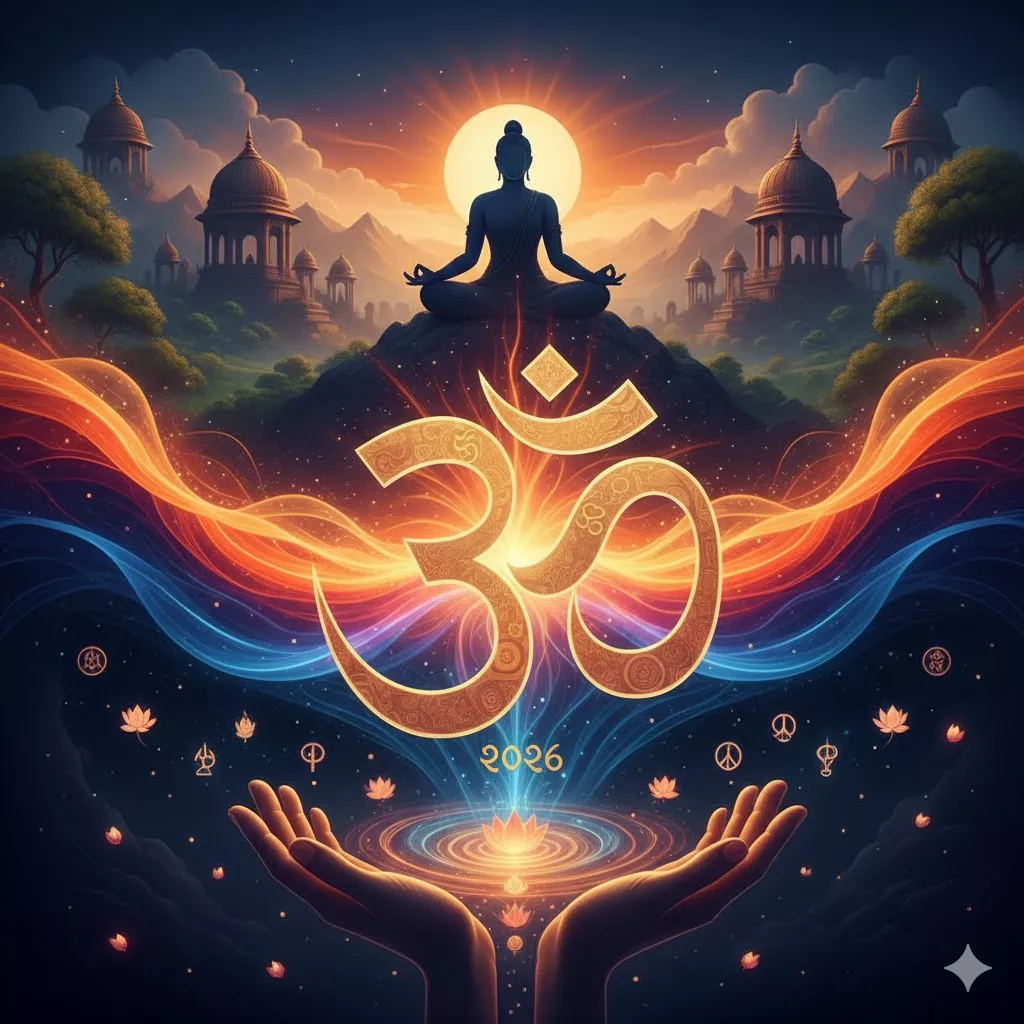


AUM Mantra Power 2026: Benefits & Daily Guide
Discover the eternal cosmic vibration that connects you to universal consciousness
Introduction: The Primordial Sound of Creation
In the vast expanse of Sanatana Dharma’s spiritual wisdom, no sound holds greater significance than AUM (ॐ) – the sacred syllable that represents the very essence of existence. As we progress through 2026, millions of seekers worldwide are rediscovering this ancient mantra’s transformative power, finding solace, strength, and spiritual awakening through its daily practice.
The AUM mantra is not merely a religious chant but a scientific vibration that resonates with the fundamental frequency of the universe itself. Ancient rishis, through deep meditation in the Himalayas and sacred forests, perceived this cosmic sound reverberating through all creation. What they discovered thousands of years ago, modern quantum physics is now beginning to validate – that everything in existence is vibration, and AUM represents the primordial vibration from which all others emerge.
This comprehensive guide will illuminate the profound mysteries of AUM, providing you with authentic scriptural knowledge, practical chanting techniques, and a structured daily practice routine suitable for beginners and advanced practitioners alike. Whether you seek physical healing, mental clarity, emotional balance, or spiritual liberation (moksha), the AUM mantra serves as your divine vehicle.
Understanding AUM: The Foundation of Vedic Knowledge
The Sacred Symbolism of ॐ
The symbol ॐ is composed of three Sanskrit letters: अ (A), उ (U), and म (M), which merge to form AUM. Each component carries deep philosophical and spiritual significance:
A (अ) – Brahma and Creation:
- Represents the waking state (jagrat avastha)
- Symbolizes Lord Brahma, the creator
- Corresponds to the physical realm and material world
- Denotes the beginning of all sounds and existence
U (उ) – Vishnu and Preservation:
- Represents the dream state (swapna avastha)
- Symbolizes Lord Vishnu, the preserver
- Corresponds to the subtle mental realm
- Signifies continuity and sustenance
M (म) – Shiva and Dissolution:
- Represents the deep sleep state (sushupti avastha)
- Symbolizes Lord Shiva, the transformer
- Corresponds to the causal realm of consciousness
- Denotes the conclusion and return to source
The Silent Fourth (Turiya): Beyond these three syllables lies the silent vibration – Turiya – representing pure consciousness, the state of liberation where individual soul (atman) merges with supreme consciousness (Brahman). This silence after chanting AUM is as important as the sound itself.
Scriptural Foundation: What Sacred Texts Reveal
Mandukya Upanishad: This entire Upanishad, comprising just 12 verses, is dedicated exclusively to explaining AUM. It declares: “AUM, this imperishable Word, is the whole of this visible universe. Its explanation is as follows: What has become, what is becoming, what will become – all is AUM. And what transcends these three states of time – that too is AUM.”
Bhagavad Gita (Chapter 8, Verse 13): Lord Krishna instructs Arjuna: “Uttering the single syllable AUM, the eternal Brahman, and remembering Me, he who departs leaving the body attains the Supreme Goal.” This verse establishes AUM as the sonic representation of the Divine itself.
Yoga Sutras of Patanjali (Sutra 1.27-28): Maharishi Patanjali identifies AUM as the Pranava – the sacred word that denotes Ishvara (Supreme Consciousness). Regular repetition of AUM while contemplating its meaning removes all obstacles on the spiritual path.
Taittiriya Upanishad: Describes AUM as the bow, the atman (individual soul) as the arrow, and Brahman (universal consciousness) as the target. Through concentrated chanting, the arrow pierces the target, achieving union.
The Scientific Dimension: Modern Research on AUM
Neurological Effects and Brain Wave Patterns
Recent scientific studies in 2024-2025 have provided remarkable insights into how AUM chanting affects the human brain:
Alpha Wave Enhancement: Research conducted at the All India Institute of Medical Sciences (AIIMS) demonstrated that 10 minutes of AUM chanting significantly increases alpha brain wave production (8-13 Hz). These waves are associated with:
- Deep relaxation without drowsiness
- Enhanced learning capacity
- Improved focus and concentration
- Reduced anxiety and stress
Limbic System Deactivation: Neuroimaging studies reveal that AUM chanting creates a temporary deactivation in the limbic system – the brain’s emotional center. This produces:
- Emotional stability and balance
- Reduced reactivity to stressors
- Enhanced mood regulation
- Greater emotional resilience
Vagus Nerve Stimulation: The specific vibration pattern of AUM stimulates the vagus nerve, which:
- Activates the parasympathetic nervous system
- Lowers heart rate and blood pressure
- Improves digestive function
- Enhances overall physiological balance
The Physics of Sacred Sound
Resonance Frequency: The sustained “mmm” sound in AUM vibrates at approximately 110-120 Hz, which research suggests may be a natural resonance frequency that:
- Harmonizes cellular vibrations
- Creates coherence in biological systems
- Potentially influences DNA expression
- Generates measurable electromagnetic fields around the body
Cymatics and Sacred Geometry: When AUM is chanted near a cymatics plate (which visualizes sound), it creates intricate geometric patterns remarkably similar to ancient yantras and mandalas described in Hindu scriptures – suggesting our ancestors had profound understanding of sound’s creative power.
Comprehensive Benefits of AUM Chanting
Physical Health Benefits
1. Cardiovascular Health:
- Reduces blood pressure naturally
- Lowers heart rate and improves heart rate variability
- Decreases risk of cardiovascular diseases
- Improves circulation throughout the body
2. Respiratory System Enhancement:
- Increases lung capacity through controlled breathing
- Strengthens respiratory muscles
- Improves oxygen utilization efficiency
- Beneficial for asthma and respiratory conditions
3. Immune System Strengthening:
- Reduces cortisol (stress hormone) levels
- Enhances production of beneficial neurotransmitters
- Supports overall immune function
- Promotes cellular health and regeneration
4. Pain Management:
- Natural release of endorphins
- Reduced perception of chronic pain
- Effective for headaches and migraines
- Helps manage fibromyalgia symptoms
5. Digestive Wellness:
- Stimulates digestive organs through vibration
- Reduces digestive stress and discomfort
- Improves metabolic function
- Helps balance gut microbiome
Mental and Emotional Benefits
1. Stress and Anxiety Reduction:
- Immediate calming effect on the nervous system
- Long-term resilience against stress
- Natural anxiety relief without medication
- Enhanced emotional regulation
2. Enhanced Concentration:
- Improved focus and attention span
- Better memory retention and recall
- Enhanced cognitive performance
- Increased mental clarity
3. Sleep Quality Improvement:
- Deeper, more restorative sleep
- Faster sleep onset
- Reduced insomnia symptoms
- More consistent sleep patterns
4. Emotional Balance:
- Greater emotional stability
- Reduced mood swings
- Enhanced positive emotions
- Better relationship dynamics
5. Mental Health Support:
- Complementary support for depression
- Reduced symptoms of PTSD
- Enhanced overall psychological well-being
- Greater life satisfaction
Spiritual Benefits
1. Heightened Awareness:
- Enhanced present-moment consciousness
- Greater self-awareness
- Expanded perception of reality
- Deepened intuitive abilities
2. Meditation Depth:
- Faster entry into meditative states
- Deeper absorption (dhyana)
- Access to higher states of consciousness
- Progress toward samadhi
3. Chakra Activation:
- Balances and energizes all seven chakras
- Particularly activates Ajna (third eye) and Sahasrara (crown)
- Improves pranic flow through nadis
- Awakens dormant spiritual energy
4. Karmic Purification:
- According to scriptures, dissolves negative karmic impressions
- Purifies the subtle body
- Removes obstacles to spiritual progress
- Accelerates soul evolution
5. Divine Connection:
- Strengthens connection to higher consciousness
- Facilitates communion with divine energy
- Opens channels for divine grace
- Supports the ultimate goal of moksha (liberation)
The Perfect AUM Chanting Technique
Correct Pronunciation and Sound Production
The power of AUM lies not just in mental repetition but in proper vocalization. Here is the authentic method:
Step-by-Step Pronunciation Guide:
- A Sound (अ):
- Begin from deep in the abdomen
- Open your mouth wide
- Sound emerges from throat
- Feel vibration in lower abdomen and chest
- Duration: 40% of total chant (approximately 2-3 seconds)
- U Sound (उ):
- Gradually round your lips
- Sound rises to mouth and palate
- Feel vibration moving to chest and throat
- Smooth transition from A
- Duration: 40% of total chant (approximately 2-3 seconds)
- M Sound (म):
- Close lips gently
- Create humming vibration
- Feel vibration in head, particularly skull and brain
- Let sound gradually fade
- Duration: 20% of total chant (approximately 1-2 seconds)
- Silence (Turiya):
- After M fades, remain in absolute silence
- Observe the subtle vibrations continuing
- Experience the gap between thoughts
- This silence is crucial – duration equals the entire AUM chant
Common Mistakes to Avoid:
- Rushing through the syllables
- Breathing from chest instead of diaphragm
- Unequal duration of A and U sounds
- Neglecting the silence after M
- Chanting too loudly or too softly (medium volume is ideal)
- Ignoring the vibrations in different body parts
Optimal Posture and Environment
Sitting Position:
Padmasana (Lotus Pose) – Advanced:
- Cross-legged with feet on opposite thighs
- Spine naturally erect
- Hands in Gyan mudra (thumb-index finger touching)
Sukhasana (Easy Pose) – Beginners:
- Simple cross-legged position
- Use cushion for comfort if needed
- Spine straight but not stiff
Chair Sitting – Accessibility:
- Feet flat on ground
- Spine away from backrest
- Hands on thighs or in mudra
Critical Posture Elements:
- Head balanced (imagine thread pulling crown upward)
- Shoulders relaxed, not hunched
- Chest open, heart center lifted
- Abdomen free for diaphragmatic breathing
- Face muscles relaxed
- Eyes gently closed or half-closed (drishti)
Environment Setup:
Sacred Space Creation:
- Clean, quiet area in your home
- Face East (sunrise direction – new beginnings) or North (spiritual energy)
- Use natural materials – cotton mat, wooden seat
- Keep this space dedicated to spiritual practice
Enhancements (Optional):
- Light a ghee lamp (diya) or candle
- Burn pure incense – sandalwood, camphor, or frankincense
- Place fresh flowers as offering
- Have water nearby for purification
- Display sacred images or yantras that inspire you
Timing Considerations:
- Brahma Muhurta (4:00-6:00 AM): Most spiritually potent time
- Sunrise: Excellent for new practitioners
- Sunset: Transition time, good for reflection
- Before Sleep: Promotes deep, restful sleep
- Consistency: Same time daily creates powerful habit
Daily AUM Practice Routine for 2026
Beginner Level (Weeks 1-4)
Duration: 10-15 minutes daily
Morning Routine:
- Preparation (2 minutes):
- Wash face and hands
- Sit in chosen posture
- Take 5 deep cleansing breaths
- Set intention for practice
- Warm-up (2 minutes):
- Gentle neck rotations
- Shoulder rolls
- 3-5 deep breaths with focus on abdomen expansion
- AUM Chanting (6 minutes):
- Chant AUM 11 times slowly and mindfully
- Focus on pronunciation and vibration
- Maintain awareness of silence between each chant
- Gradually increase to 21 repetitions as comfortable
- Silence and Observation (3 minutes):
- Sit in complete stillness
- Observe residual vibrations
- Notice thoughts without engagement
- Feel energy throughout body
- Closing (2 minutes):
- Gentle deep breaths
- Express gratitude
- Slowly open eyes
- Transition mindfully to daily activities
Weekly Progress Goals:
- Week 1: Establish consistent practice time
- Week 2: Improve pronunciation accuracy
- Week 3: Extend chant duration naturally
- Week 4: Increase to 21 repetitions comfortably
Intermediate Level (Months 2-6)
Duration: 20-30 minutes daily
Enhanced Morning Practice:
- Purification (3 minutes):
- Achamana (sipping water with mantras)
- Pranayama: 5 rounds of Nadi Shodhana (alternate nostril breathing)
- AUM Chanting with Variation (15 minutes):
- First Round: 21 AUM chants at normal volume
- Second Round: 21 AUM chants in whisper (upanshu japa)
- Third Round: 21 AUM chants mentally (manasika japa)
- Chakra Visualization (5 minutes):
- While chanting, visualize AUM’s vibration:
- A: Rising from Muladhara (root) through Manipura (solar plexus)
- U: From Anahata (heart) through Vishuddha (throat)
- M: In Ajna (third eye) and Sahasrara (crown)
- While chanting, visualize AUM’s vibration:
- Extended Meditation (7 minutes):
- Deep silence after chanting
- Witness consciousness state
- No effort, pure being
Integration Practices:
- Chant AUM before meals (3 times)
- Use AUM during stressful moments for instant centering
- Evening practice: 11 AUM chants before sleep
Advanced Level (Months 7-12 and Beyond)
Duration: 45-60 minutes daily
Comprehensive Sadhana:
- Preparation and Pranayama (10 minutes):
- Full yogic breathing
- Bhramari (bee breath) – 7 rounds
- Ujjayi breathing – 5 minutes
- 108 AUM Mala Practice (25 minutes):
- Use rudraksha or tulsi mala (prayer beads)
- One complete mala = 108 AUM chants
- Begin at sumeru bead, don’t cross it
- Maintain steady rhythm and awareness
- Each AUM approximately 12-15 seconds
- Vedic Mantra Integration (10 minutes):
- Gayatri Mantra (24 repetitions)
- Mahamrityunjaya Mantra (11 repetitions)
- Always begin and end these with AUM
- Deep Meditation (15 minutes):
- Transcendental silence
- Witness state awareness
- Turiya experience cultivation
Advanced Techniques:
Ajapa Japa (Spontaneous Repetition):
- Synchronize AUM with natural breath
- Inhale: mentally chant “AAUUUU”
- Exhale: mentally chant “MMMM”
- Becomes effortless, automatic throughout day
Trataka (Concentrated Gazing):
- Gaze at AUM symbol or flame
- Chant while maintaining focus
- Develops concentration to single-pointedness
Special AUM Practices for Specific Intentions
For Physical Healing
Healing AUM Protocol:
- Identify the area needing healing
- Place hand on that area
- Chant AUM 21 times while:
- Visualizing healing golden light
- Feeling vibrations in affected area
- Affirming complete healing
Best practiced: Morning and before sleep for 21 consecutive days
For Mental Clarity and Focus
Clarity Enhancement Practice:
- Sit in Vajrasana (thunderbolt pose)
- Chant AUM 27 times
- Focus on Ajna chakra (between eyebrows)
- Visualize indigo light expanding with each chant
Best practiced: Before important work, study, or decision-making
For Emotional Balance
Heart-Centered AUM:
- Sit with hands in Hridaya mudra (heart gesture)
- Chant AUM 33 times
- Focus on Anahata chakra (heart center)
- Visualize green healing light
- Feel compassion for self and all beings
Best practiced: During emotional challenges or before sleep
For Spiritual Awakening
Kundalini Awakening AUM:
- Advanced practice – requires preparation
- Sit in Siddhasana (perfect pose)
- Perform Mula Bandha (root lock)
- Chant AUM 108 times
- Visualize energy rising from Muladhara to Sahasrara
- Practice under guidance initially
Best practiced: Brahma Muhurta with empty stomach
AUM for Families: Practicing Together in 2026
Children’s AUM Practice
Ages 5-10:
- Simple 5-minute practice
- Make it fun: “Let’s make the universe sound!”
- Chant 7 AUM together
- Use stories: “The sound of creation”
- No pressure, encourage naturally
Ages 11-17:
- 10-15 minute practice
- Explain scientific benefits
- Link to stress relief and better studies
- 11-21 AUM chants
- Respect their autonomy and interest
Benefits for Children:
- Improved concentration for studies
- Better emotional regulation
- Enhanced creativity
- Stronger family bonds
- Cultural and spiritual roots
Family Group Practice
Sunday Morning Tradition:
- Gather entire family
- Create sacred atmosphere together
- Each person leads 11 AUM chants
- Share experiences afterward
- Breakfast together in peaceful mindset
Special Occasions:
- Birthday mornings: 108 AUM for the birthday person
- New Year: 108 AUM at midnight
- Before examinations: Focused group practice
- During festivals: Extended family participation
Integrating AUM with Other Spiritual Practices
AUM and Yoga Asanas
Practice Sequence:
- Begin yoga session with 11 AUM
- Chant AUM during Surya Namaskar (Sun Salutation)
- End each asana sequence with 3 AUM
- Final Shavasana: Mental AUM repetition
- Conclude practice with 21 AUM
Benefits of Integration:
- Deepens yoga practice
- Creates spiritual dimension to physical practice
- Enhanced pranic flow
- Greater mind-body connection
AUM and Meditation Techniques
Vipassana Integration:
- Use AUM to settle mind initially
- Transition to breath observation
- Return to AUM if mind becomes restless
Mantra Meditation:
- AUM as primary mantra
- Or use AUM to begin/end other mantra practices
- AUM + personal deity mantra combination
Transcendental Practices:
- AUM as vehicle to transcendence
- Gradual dissolution into silence
- Gateway to Samadhi states
AUM in Daily Rituals
Morning Rituals:
- Upon waking, mental AUM (3 times)
- After bathing, formal AUM practice
- Before breakfast, gratitude with AUM
Evening Rituals:
- Before dinner, purification with AUM
- Evening prayer/puja with AUM invocation
- Before sleep, relaxing AUM practice
Life Transitions:
- Beginning new projects
- Before important meetings
- During travel (mental AUM for protection)
- During challenges (instant centering)
Common Questions and Guidance
Can Non-Hindus Practice AUM?
Answer: Absolutely. AUM transcends religious boundaries – it is a universal sound representing cosmic consciousness. People of all faiths, or no faith, practice AUM for its scientific and spiritual benefits. What matters is sincere intention and respectful approach.
How Many Times Should I Chant?
Traditional Numbers and Significance:
- 3 times: Quick centering, basic purification
- 7 times: Chakra alignment (seven main chakras)
- 11 times: Beginner’s practice, accessible to all
- 21 times: Standard practice for daily routine
- 27 times: Mental clarity and focus
- 54 times: Half mala, deep practice
- 108 times: Full mala, complete practice, sacred number
Choose based on available time and comfort. Quality always supersedes quantity.
Is It Better to Chant Aloud or Mentally?
Three Levels of Japa:
- Vaikhari (Loud/Normal):
- Beginners benefit most
- Physical vibrations strongest
- Helps develop proper technique
- Upanshu (Whisper):
- Intermediate practice
- More internal focus
- Subtle yet powerful
- Manasika (Mental):
- Most advanced and powerful
- Purely internal vibration
- Can practice anywhere, anytime
Recommendation: Master loud chanting first, then progress naturally to whisper and mental repetition.
What If I Can’t Sit Cross-Legged?
Alternatives:
- Chair with feet flat on ground
- Sitting on knees (Vajrasana) with cushion
- Even lying down if necessary (though sitting is preferable)
The crucial element is spine alignment and comfort – physical pain distracts from practice.
Should I Chant on Empty Stomach?
Ideal Conditions:
- Empty stomach is best for spiritual practices
- At minimum, wait 1-2 hours after meals
- Light stomach allows better energy flow
- However, gentle practice possible anytime
Can Women Practice During Menstruation?
Traditional and Modern Perspective: This varies by tradition and personal belief. Many contemporary teachers encourage women to:
- Honor their body’s needs
- Practice if comfortable
- Reduce intensity if needed
- Mental chanting always appropriate
Listen to your body and intuition.
AUM Practice Calendar for 2026
Monthly Themes and Focus Areas
January 2026: Foundation Building
- Establish daily practice habit
- Master pronunciation
- Morning practice priority
- Goal: 21 consecutive days
February 2026: Deepening Experience
- Increase to 21 AUM daily
- Add evening practice
- Journal observations
- Notice subtle changes
March 2026: Pranayama Integration
- Add Nadi Shodhana before AUM
- Conscious breathing awareness
- Energy body sensitivity
April 2026: Chakra Focus
- Systematic chakra meditation with AUM
- Visualizations during chanting
- Energy body awakening
May 2026: Mala Practice Introduction
- Begin 108 AUM practice
- Sacred beads selection
- Extended morning sessions
June 2026: Family Integration
- Group practice establishment
- Teaching children
- Community building
July 2026: Advanced Techniques
- Ajapa Japa development
- Trataka practice
- Kundalini awareness
August 2026: Retreat and Intensity
- Week-long intensive practice
- Silence periods
- Deep meditation states
September 2026: Integration and Stabilization
- Natural practice flow
- Daily life integration
- Spontaneous AUM awareness
October 2026: Service and Sharing
- Share practice with others
- Community teaching
- Seva (selfless service) with AUM
November 2026: Gratitude and Reflection
- Review year’s journey
- Deepened understanding
- Advanced contemplation
December 2026: Celebration and Commitment
- Annual practice review
- New Year intentions
- Continued dedication
Special Practice Days in 2026
Maha Shivaratri (February 26, 2026):
- Night-long AUM practice
- 108 AUM every hour
- Fasting and meditation
- Spiritual breakthrough opportunity
Ram Navami (April 6, 2026):
- 108 AUM at sunrise
- Devotional practice
- Purification and renewal
Guru Purnima (July 13, 2026):
- Honoring the tradition
- Gratitude to teachers
- 108 AUM dedication
- Spiritual recommitment
Navaratri (October 3-11, 2026):
- Nine days of intensified practice
- Each day: 108 AUM minimum
- Divine feminine energy invocation
- Transformation period
Diwali (October 20, 2026):
- Light and sound festival
- 108 AUM at midnight
- New beginning energies
- Prosperity consciousness
Overcoming Common Challenges
“I Don’t Have Time”
Solution: Quality over quantity
- Even 3 AUM upon waking transforms your day
- 5 minutes is enough to start
- Mental AUM during commute counts
- Consistency matters more than duration
Mini-practices:
- Morning: 3 AUM (1 minute)
- Before lunch: 3 AUM
- Evening: 3 AUM
- Before sleep: 3 AUM Total: 4 minutes daily with profound impact
“My Mind Wanders”
Solution: This is completely normal
- Wandering mind is not failure
- Gently return to AUM without judgment
- Each return strengthens focus
- Progress happens through consistent practice
Techniques:
- Count repetitions on fingers
- Use mala beads for tactile focus
- Visualize AUM symbol
- Focus on physical vibrations
“I Don’t Feel Anything”
Solution: Patience and trust the process
- Benefits are cumulative
- Subtle changes occur first
- Keep practice journal to track progress
- Effects manifest differently for everyone
What to observe:
- Sleep quality improvements
- Stress response changes
- Clarity in decision-making
- Relationship dynamics
- Physical health markers
“I Feel Uncomfortable Sensations”
Solution: Natural purification process
- Emotional releases are normal
- Physical sensations indicate energy movement
- Reduce intensity if too strong
- Seek guidance if persistent
When to seek help:
- Overwhelming emotional releases
- Physical pain during practice
- Persistent discomfort
- Consult experienced teacher or guide
Scientific Studies and Research References
Recent Research (2024-2025)
Neurological Impact Study: All India Institute of Medical Sciences (AIIMS), New Delhi conducted research showing:
- 30% reduction in anxiety scores after 3 months
- Significant increase in alpha brain wave activity
- Improved cognitive function markers
- Enhanced emotional regulation
Cardiovascular Benefits Research: Study published in International Journal of Yoga demonstrated:
- Average 10-15 point reduction in blood pressure
- Improved heart rate variability
- Reduced cardiovascular disease markers
- Better stress resilience
Immune Function Analysis: Research from BHU (Banaras Hindu University) indicated:
- Enhanced immune cell activity
- Reduced inflammatory markers
- Better stress hormone balance
- Overall immune system strengthening
Traditional Validation
Modern science continues to validate what ancient texts proclaimed:
Charaka Samhita (Ayurvedic Text): Describes sound therapy (nada chikitsa) as powerful healing modality, with AUM as supreme therapeutic sound.
Narada Purana: Details AUM’s capacity to purify consciousness and remove karmic obstacles through regular practice.
Yoga Vasistha: Explains how AUM chanting creates neurological pathways to higher consciousness states.
Creating Your Personal AUM Practice Plan
Self-Assessment
Current State Evaluation:
- What is my primary motivation for AUM practice?
- How much time can I realistically dedicate daily?
- What obstacles might I face?
- What support systems do I have?
- What are my spiritual/personal goals?
90-Day Transformation Plan
Days 1-30: Foundation
- Commitment: 10 minutes daily, same time
- Practice: 11 AUM chants, proper technique
- Focus: Consistency and technique mastery
- Journaling: Daily brief notes
Days 31-60: Expansion
- Commitment: 20 minutes daily
- Practice: 21 AUM chants, add pranayama
- Focus: Deepening experience, subtle awareness
- Journaling: Weekly detailed reflection
Days 61-90: Integration
- Commitment: 30 minutes daily
- Practice: 108 AUM (mala practice)
- Focus: Natural incorporation, lifestyle changes
- Journaling: Transformation documentation
Measurement Metrics:
- Energy levels (1-10 scale)
- Sleep quality
- Stress resilience
- Focus and concentration
- Emotional balance
- Physical health improvements
- Spiritual experiences
The Deeper Philosophy: AUM and Ultimate Reality
AUM as Brahman
The Mandukya Upanishad declares “AUM iti ekam aksharam brahma” – AUM, this single syllable, is Brahman (ultimate reality). This profound statement means:
- AUM is not a symbol OF the divine; it IS the divine
- The universe is the embodiment of AUM’s vibration
- By chanting AUM, we align with universal consciousness
- The seeker, the chanting, and the object of meditation become one
The Journey from Sound to Silence
The ultimate purpose of AUM chanting is not the sound itself but the silence it reveals:
Progressive Dissolution:
- Begin with gross sound (physical vibration)
- Progress to subtle sound (mental repetition)
- Merge into causal sound (unstruck sound/anahata nada)
- Transcend to absolute silence (turiya)
- Realize non-dual awareness (advaita)
This journey from sound to silence mirrors the soul’s journey from identification with body-mind to realization of true self (atman) as identical with universal consciousness (Brahman).
Liberation Through AUM
According to Vedantic philosophy, regular AUM practice with understanding leads to:
Viveka (Discrimination): Ability to distinguish eternal from temporary, real from unreal
Vairagya (Dispassion): Natural detachment from temporary pleasures without suppression
Mumukshutvam (Desire for Liberation): Burning aspiration for spiritual freedom
Moksha (Liberation): Ultimate freedom from the cycle of birth and death
Conclusion: Your AUM Journey Begins Now
As we navigate through 2026, the ancient wisdom of AUM offers us an anchor in turbulent times. This sacred syllable, chanted by countless sages, saints, and seekers across millennia, remains as relevant and powerful today as it was when first discovered in deep meditation.
Your practice need not be perfect – it simply needs to be sincere and consistent. Whether you chant AUM once daily or 108 times, whether you practice for five minutes or an hour, you are participating in a timeless tradition that connects you to the very source of existence.
The journey of AUM is ultimately the journey home – home to your true nature, which is pure consciousness, infinite peace, and boundless love. Every time you chant AUM, you are not learning something new but remembering what you have always been.
Begin today. Find a quiet corner, sit comfortably, take a deep breath, and let your voice merge with the cosmic vibration. Notice how the sound begins in your belly, rises through your chest and throat, resonates in your head, and dissolves into silence. In that silence, you may glimpse what the ancient rishis discovered – that you are not separate from the universe but an expression of it, and AUM is your sonic signature.
May your AUM practice illuminate your path, purify your consciousness, heal your body-mind, and guide you to the ultimate realization of your true divine nature.
Final Blessing
Om Purnamadah Purnamidam Purnat Purnamudachyate Purnasya Purnamadaya Purnamevavashishyate
That is whole, this is whole From wholeness emerges wholeness Wholeness coming from wholeness Wholeness still remains
AUM Shanti Shanti Shanti  Peace in body, peace in mind, peace in spirit
Quick Reference Guide
Daily Practice Checklist
Morning:
- Wake up with gratitude
- Wash face and hands
- Sit in chosen posture
- 5 deep breaths
- 11-108 AUM chants (your chosen number)
- 3-5 minutes silence
- Set positive intention for day
Evening:
- 3-5 AUM before dinner
- Reflect on day with gratitude
- 11 AUM before sleep
- Sleep with AUM awareness
Emergency AUM Practice
Stress/Anxiety:
- 3 deep breaths
- 7 AUM chants slowly
- Focus on M vibration in head
- Immediate calming effect
Before Important Event:
- 21 AUM chants
- Visualize success
- Trust universal support
Physical Discomfort:
- Hand on affected area
- 11 AUM chants
- Visualize healing light
- Repeat as needed
Resources for Deeper Study
Recommended Texts:
- Mandukya Upanishad with commentary
- Patanjali’s Yoga Sutras
- Bhagavad Gita, Chapter 8
- “The Yoga of Sound” by Russill Paul
- “Mantra Yoga and Primal Sound” by David Frawley
Online Resources:
- Authentic Sanskrit pronunciation videos
- Guided AUM meditation recordings
- Hindu scriptures in English translation
- Community practice groups
Personal Development:
- Maintain practice journal
- Seek authentic teacher when ready
- Join meditation groups
- Attend spiritual retreats
- Study sacred texts regularly
Author’s Note: This comprehensive guide serves as your companion on the sacred journey of AUM practice. May it inspire daily practice, deepen your understanding, and support your spiritual evolution. The true teacher is your own sincere practice – this guide merely points the way.
Har Har Mahadev! Jai Shri Ram! AUM Namah Shivaya! 
© 2026 HinduTone.com – Preserving and Sharing the Eternal Wisdom of Sanatana Dharma
For More Devotional Journey, Follow
- Temples
https://hindutone.com/temples/ - Tirumala Updates
https://hindutone.com/tirumala/ - Sabarimala Yatra
https://hindutone.com/category/sabarimala-yatra/ - Pooja, Slokas & Mantras
https://hindutone.com/pooja-slokas-and-mantras/ - Hindu Gods
https://hindutone.com/hindu-gods/
Related posts:
 Powerful Mantras and Poojas for Securing USA Student Visas, H1B Visas, and Green Cards
 10 Powerful Hindu Mantras to Attract a Software Job, Maintain Job Security, and Achieve Career Growth
 The Importance of Wednesday (Budhvar) in Hinduism: Poojas, Vratas, Mantras, and Deities to Pray
 Hanuman Chalisa on Tuesday: How to Chant for Success and Protection
 Powerful Monday Mantras: Complete Guide for Hindu Devotees
 Mahamrityunjaya Mantra Meaning, Benefits & Chanting Rules




 ︎
︎

