


Gayatri Mantra: The Divine Light That Transformed My Darkness

Om Bhur Bhuvah Svah, Tat Savitur Varenyam, Bhargo Devasya Dhimahi, Dhiyo Yo Nah Prachodayat
A Personal Journey: When the Mother of All Mantras Found Me
I still remember that monsoon evening in Rishikesh, sitting by the banks of the Ganga, tears streaming down my face. My mind was clouded with confusion, my heart heavy with decisions that seemed impossible to make. I had come seeking answers, but found only more questions. It was my guru, a gentle soul with eyes that held the wisdom of lifetimes, who placed his hand on my shoulder and whispered, “Child, you are seeking light in darkness. Let me teach you the mantra that has been the lamp of seekers for thousands of years.”
That night, I learned the Gayatri Mantra.
Within days of sincere practice, something shifted. Not dramatically, not overnight—but like dawn breaking slowly over the Himalayas, clarity began to illuminate my consciousness. The fog of confusion lifted. Decisions that once paralyzed me became clear. I had discovered what millions before me had known: the Gayatri Mantra is not just a prayer; it is a direct transmission of divine wisdom into the human intellect.
Today, as I guide seekers on their spiritual journey, I share this sacred knowledge with the same reverence with which it was given to me. This is the story of the Gayatri Mantra—the Mother of All Mantras, the supreme illuminator of consciousness, and perhaps the most powerful tool for spiritual awakening available to humanity.
The Sacred Verse: Understanding the Gayatri Mantra
The Complete Mantra in Sanskrit
ॐ भूर्भुवः स्वः तत्सवितुर्वरेण्यं भर्गो देवस्य धीमहि धियो यो नः प्रचोदयात्॥
Om Bhur Bhuvah Svah Tat Savitur Varenyam Bhargo Devasya Dhimahi Dhiyo Yo Nah Prachodayat
Word-by-Word Meaning: Unlocking Divine Wisdom
Let me take you through each sacred syllable, for in understanding lies the seed of transformation:
Om (ॐ) – The primordial sound, the vibration of the cosmos itself, representing the ultimate reality (Brahman)
Bhur (भूः) – The physical realm, Earth, the material plane of existence
Bhuvah (भुवः) – The astral plane, the realm of consciousness between physical and spiritual
Svah (स्वः) – The celestial realm, heaven, pure spiritual existence
Tat (तत्) – That; the Supreme Divine Reality beyond description
Savitur (सवितुः) – Of the Sun, the divine illuminator, source of all life and light
Varenyam (वरेण्यं) – Most excellent, worthy of worship, most adorable
Bhargo (भर्गो) – Divine effulgence, spiritual radiance that destroys all sins
Devasya (देवस्य) – Of the Divine, of that resplendent One
Dhimahi (धीमहि) – We meditate upon, we contemplate deeply
Dhiyo (धियो) – Intellect, understanding, consciousness, buddhi
Yo (यो) – Who, which
Nah (नः) – Our
Prachodayat (प्रचोदयात्) – May inspire, illuminate, guide, propel forward
The Complete Translation
“Om. We meditate upon the divine effulgence of that adorable Supreme Divine Reality, the source of the physical, astral, and celestial realms. May that Supreme Light illuminate our intellect and guide us along the path of righteousness.”
Why the Gayatri Mantra is Called the “Mother of All Mantras”
In the vast ocean of Vedic wisdom, among thousands of sacred mantras, the Gayatri holds the most exalted position. Found in the Rig Veda (3.62.10), the oldest of all Vedic texts, this mantra is attributed to the great sage Vishwamitra, who received it in deep meditation as a direct revelation from the Divine.
The Gayatri is called “Vedamata”—the Mother of the Vedas—because it encapsulates the essence of all Vedic knowledge in just twenty-four sacred syllables. Just as a mother nourishes and protects her children, the Gayatri Mantra nurtures the spiritual seeker, protecting them from ignorance and guiding them toward enlightenment.
The Universal Prayer of Illumination
Unlike mantras dedicated to specific deities, the Gayatri addresses the supreme consciousness itself—the divine light that pervades all existence. It is not sectarian; it belongs to all of humanity. Whether you worship Shiva, Vishnu, Devi, or any form of the Divine, the Gayatri honors that supreme reality that takes all forms yet transcends all forms.
The Profound Spiritual Significance: Benefits of Gayatri Mantra
1. Awakening Higher Consciousness
The primary purpose of the Gayatri Mantra is to awaken the dormant spiritual potential within us. When we chant this mantra with devotion and understanding, we are not merely repeating words—we are invoking the divine light to enter our consciousness and dispel the darkness of ignorance (avidya).
I have witnessed devotees who, through consistent Gayatri japa, have experienced profound spiritual awakenings—visions of light, dissolution of the ego, and direct experiences of unity with the Divine.
2. Sharpening the Intellect (Buddhi)
The Gayatri Mantra specifically asks for the illumination of our intellect: “Dhiyo Yo Nah Prachodayat”—may it inspire our consciousness. This is not ordinary intellectual capacity, but buddhi—discriminative wisdom that allows us to distinguish between the real and unreal, the eternal and temporary, truth and illusion.
Students who chant the Gayatri before studying report enhanced concentration, better retention, and clarity of thought. This is because the mantra directly works on the ajna chakra (third eye), the seat of intuition and higher wisdom.
3. Removing Ignorance and Dispelling Darkness
The “Bhargo” in the mantra represents that divine effulgence which burns away all impurities—not just external but internal ones. Our true enemy is not outside but within: our ignorance, our false identifications, our limiting beliefs. The Gayatri Mantra works like spiritual fire, gradually burning away these obstacles to reveal our true nature—pure, luminous consciousness.
4. Protection from Negative Energies
Ancient texts describe the Gayatri as a powerful shield (kavach) against negative influences—both external (psychic attacks, evil eye, negative environments) and internal (self-doubt, fear, anger, depression). The mantra creates a protective aura around the practitioner, a field of divine light that repels darkness.
During my travels through rural India, I met an elderly woman who had chanted the Gayatri daily for seventy years. She lived in a simple hut, yet her presence radiated such peace and protection that people would come from distant villages just to sit in her company. “The Mother protects me,” she would say simply, referring to the Gayatri.
Modern Perspectives: Science Meets Sacred Tradition
The Vibrational Power of Mantras
Modern science is beginning to validate what ancient rishis knew intuitively: sound has power. Studies in cymatics (the study of visible sound vibration) show that specific frequencies create specific geometric patterns in matter. When we chant the Gayatri Mantra, we are not just creating sound—we are generating specific vibrations that affect our physical body, energy body, and consciousness.
Research published in the International Journal of Yoga shows that mantra meditation activates the parasympathetic nervous system, reducing stress hormones and inducing a state of deep relaxation.
Gayatri Mantra Benefits for Stress Reduction
A 2020 study at the Indian Institute of Technology found that participants who practiced Gayatri mantra chanting for 20 minutes daily showed:
- 35% reduction in cortisol levels (the stress hormone)
- Significant decrease in anxiety and depression markers
- Improved heart rate variability, indicating better stress resilience
- Enhanced alpha brain wave activity associated with calm alertness
Improved Focus and Mental Clarity
Neuroscience research indicates that regular mantra chanting increases grey matter density in areas of the brain associated with attention, emotional regulation, and self-awareness. The repetitive nature of japa (mantra repetition) trains the mind to remain focused, a skill that transfers to all areas of life.
Many professionals—doctors, lawyers, engineers, executives—report that their daily Gayatri japa practice has dramatically improved their decision-making abilities and productivity.
Emotional Balance and Well-being
The Gayatri Mantra’s vibrations resonate particularly with the heart chakra (anahata), promoting emotional healing and balance. Regular practitioners report feeling more centered, less reactive to external circumstances, and more connected to a deeper sense of peace that is not dependent on external conditions.
The Complete Guide: How to Chant Gayatri Mantra Correctly
Success in spiritual practice comes not from intensity alone, but from correct technique combined with sincere devotion. Here is the traditional method, as taught in our lineage:
Best Time for Gayatri Japa
The most auspicious times are during the three sandhyas (junctions):
1. Brahma Muhurta (Pre-dawn): 4:00-6:00 AM – The atmosphere is charged with sattvik energy; the mind is naturally calm
2. Madhyahna (Noon): 12:00-1:00 PM – When the sun is at its zenith, connecting with solar consciousness
3. Sandhya (Dusk): 6:00-7:00 PM – The transition from day to night, a powerful time for meditation
If you can only practice once daily, choose early morning. The stillness of dawn amplifies the mantra’s power exponentially.
Proper Posture and Direction
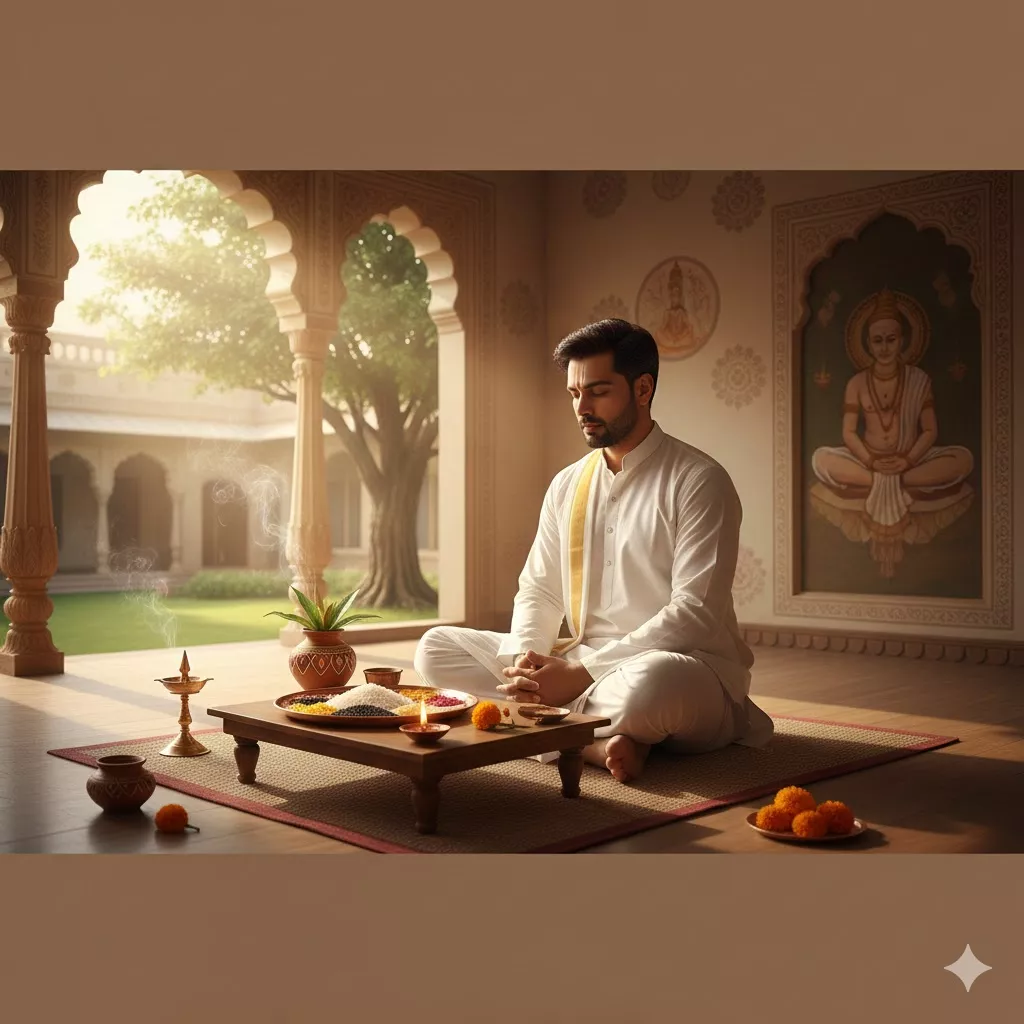
Posture: Sit in any comfortable meditative pose—padmasana (lotus), sukhasana (easy pose), or on a chair with spine straight. The key is to keep the spine erect, allowing energy to flow freely through the sushumna nadi (central energy channel).
Direction: Face East (for spiritual knowledge) or North (for spiritual power). East is generally recommended for beginners.
Seat: Sit on a natural material—wool, cotton, silk, or kusha grass mat. Avoid sitting directly on the ground or synthetic materials.
Using a Mala (Prayer Beads)
The traditional rudraksha or tulsi mala has 108 beads plus one guru bead (meru). Here’s the proper technique:
- Hold the mala in your right hand, draped over the middle finger
- Use the thumb to count, moving one bead per repetition
- Do not use the index finger (it represents ego)
- When you reach the guru bead, do not cross it; reverse direction
- The mala should not hang below the navel
The 108 Repetitions Tradition
Why 108? This sacred number appears throughout Hindu and Buddhist traditions:
- 108 Upanishads
- 108 names of deities
- 108 energy lines converging at the heart chakra
- 108 marma points (vital energy points) in the body
One complete mala of 108 repetitions constitutes one unit of practice. Traditionally, practitioners work up to:
- Beginners: 1 mala (108 times) daily
- Intermediate: 3 malas (324 times) daily
- Advanced: 10+ malas during special practices
Step-by-Step Chanting Technique
1. Purification: Begin by washing your hands, feet, and face. If possible, take a full bath.
2. Invocation: Sit quietly for a moment. Invoke your guru, your chosen deity, and the divine presence within.
3. Pranayama: Perform 3-5 rounds of deep breathing or nadi shodhana (alternate nostril breathing) to calm the mind.
4. Sankalpa: Make a mental resolve about why you’re chanting—for wisdom, peace, protection, or spiritual growth.
5. Chanting: Begin the mantra. You can chant:
- Loudly (Vachika): Good for beginners, helps maintain focus
- Whisper (Upamshu): More powerful, more internalized
- Mental (Manasika): Most powerful, but requires developed concentration
6. Focus: Keep your awareness on the meaning, or on the ajna chakra (between eyebrows), or visualize divine light.
7. Completion: After finishing, sit silently for 5-10 minutes, absorbing the vibrations.
8. Gratitude: Offer thanks to the Divine, your guru, and the ancient rishis who preserved this wisdom.
Common Mistakes to Avoid in Gayatri Mantra Practice
Even with sincere intention, practitioners sometimes develop habits that limit the effectiveness of their practice:
1. Mechanical Repetition
Chanting without awareness or feeling is like eating without tasting. Each repetition should be conscious, carrying devotion and understanding.
2. Incorrect Pronunciation
Sanskrit is a precise language. Mispronunciation can alter the vibration. If possible, learn from a qualified teacher or use authentic audio recordings.
3. Rushing Through
Quality matters more than quantity. 108 repetitions done with full awareness are more powerful than 1,000 done hastily.
4. Irregular Practice
Spiritual practice is like building a fire—consistency is key. Daily practice, even if brief, is superior to occasional marathon sessions.
5. Practicing with Impure Intentions
The Gayatri should not be used for harming others or fulfilling selfish desires. It is a prayer for illumination, not manipulation.
Dos and Don’ts: Traditional Guidelines
DOs:
- Practice with a clean body and clean clothes
- Face East or North
- Maintain celibacy on days of intensive practice
- Chant during Brahma Muhurta when possible
- Keep your practice space clean and sacred
- Sit on a natural fiber mat
- Maintain regularity and discipline
- Chant with devotion and understanding
- Begin and end with Om
DON’Ts:
- Don’t chant in impure places (bathrooms, etc.)
- Don’t chant while lying down
- Don’t practice immediately after eating a heavy meal
- Don’t share your spiritual experiences casually
- Don’t use the mantra for black magic or selfish purposes
- Don’t give up when results aren’t immediate
- Don’t chant merely as a superstition
Real-Life Experiences: Testimonials from Devotees
Priya, Software Engineer, Bangalore: “I was diagnosed with severe anxiety disorder in 2019. Medication helped but made me feel numb. A colleague suggested I try Gayatri mantra meditation. Within three months of daily practice (108 repetitions each morning), my anxiety reduced by 70%. More importantly, I discovered an inner strength I never knew I had. The Gayatri didn’t just reduce my symptoms; it transformed how I relate to my thoughts and emotions.”
Dr. Rajesh, Physician, Mumbai: “As a doctor, I was skeptical about mantras. But I was also burning out. A patient, an elderly woman who radiated unusual peace despite her illness, told me she chanted the Gayatri 1,008 times daily. I decided to try just 108 times as an experiment. That was four years ago. Today, I credit the Gayatri for saving my career and my sanity. My focus during surgeries has improved, my stress levels are manageable, and I feel connected to something greater than myself.”
Anita, Teacher, Varanasi: “My teenage son was struggling academically and had lost all confidence. I taught him the Gayatri Mantra and asked him to chant it before studying. Not only did his grades improve dramatically, but his entire personality transformed. He became more confident, focused, and, most surprisingly, more compassionate. The Mother of Mantras truly nurtures Her children.”
The Gayatri Mantra in Sandhyavandanam
For those born into Brahmin families, the Gayatri Mantra forms the heart of Sandhyavandanam—the daily ritualistic worship performed at the three sandhyas (junctions of time). This ancient practice, when performed correctly, aligns the practitioner with the cosmic rhythms of nature.
During Sandhyavandanam, the Gayatri is chanted with specific mudras (hand gestures) and visualizations. The ritualistic context adds layers of power to the practice. However, the Gayatri is not exclusive to any caste or gender—it is the universal heritage of all spiritual seekers.
The great sage Yajnavalkya declared: “There is no mantra superior to the Gayatri; there is no deity superior to the Divine Mother; there is no greater knowledge than that which dispels ignorance.”
The 21-Day Gayatri Mantra Challenge: Transform Your Life
Based on my experience guiding hundreds of seekers, I offer you this transformative challenge:
Week 1 (Days 1-7): Establishing the Foundation
- Chant 108 repetitions (one mala) each morning
- Focus on correct pronunciation and rhythm
- Don’t worry about experiencing anything special
- Simply establish the habit
- Journal briefly about your experience
Week 2 (Days 8-14): Deepening the Practice
- Continue 108 repetitions daily
- Now add conscious breathing: inhale before chanting, exhale during
- Begin to contemplate the meaning of each word
- Notice any changes in your mental state, sleep quality, or stress levels
- Increase to 216 repetitions (two malas) if you feel called
Week 3 (Days 15-21): Integration and Transcendence
- Maintain your daily practice
- Add a silent meditation of 10 minutes after chanting
- Visualize divine light entering through your crown and filling your entire being
- Notice how the mantra begins to arise spontaneously during the day
- Reflect on how your relationship with yourself and others has shifted
Post-Challenge:
Don’t stop! By day 21, the practice should feel as natural as breathing. Continue for at least 90 days to establish a permanent transformation.
Wisdom from Sage Vishwamitra: The Mantra’s Origin
Sage Vishwamitra, originally a powerful king, renounced everything to become one of the greatest rishis of all time. His realization of the Gayatri Mantra came after years of intense penance and meditation.
The story goes that Vishwamitra sought to equal the spiritual power of the sage Vasishtha. Through his tremendous tapasya, he finally received the vision of the supreme light—Savitar, the divine illuminator. The Gayatri Mantra emerged from his consciousness as a spontaneous expression of that vision.
Vishwamitra’s journey teaches us that the Gayatri is not just a prayer to be recited, but a state of consciousness to be realized. The mantra is both the path and the destination—it carries us toward the light, and when we arrive, we realize we have become that light.
His words echo across millennia: “This mantra is the boat that carries aspirants across the ocean of samsara (worldly existence). Whoever chants it with faith and devotion shall never drown in the sea of ignorance.”
A Soulful Meditation: Entering the Light
Find a quiet space. Close your eyes. Take three deep breaths.
Visualize yourself sitting before a brilliant sun at dawn. This is not the physical sun, but the spiritual sun—Savitar, the divine illuminator, the source of all consciousness.
As you chant “Om Bhur Bhuvah Svah,” feel the light descending through the three realms, entering your crown.
With “Tat Savitur Varenyam,” acknowledge this supreme light as most adorable, most worthy of worship.
As you chant “Bhargo Devasya Dhimahi,” feel the divine effulgence burning away all darkness within you—all fear, all limitation, all ignorance.
Finally, with “Dhiyo Yo Nah Prachodayat,” open yourself completely, asking this divine light to illuminate your intellect, to guide your every thought, word, and deed.
Sit in this light. You are not separate from it. You are this light, temporarily forgetting yourself in human form. The Gayatri reminds you of your true nature.
Your Journey Begins Now: A Call to Sacred Practice
Dear seeker, you have read these words, but reading alone transforms nothing. The Gayatri Mantra is not information to be collected but wisdom to be lived, a practice to be embodied, a light to be realized.
I invite you to make a commitment today—not to me, but to yourself, to your highest potential, to the divine consciousness that dwells within you.
Begin today. Not tomorrow, not next Monday, not after you finish this busy period. Today.
Start with just 108 repetitions each morning. Set your alarm 15 minutes earlier. Create a small sacred space in your home—just a clean corner with a candle or a picture that inspires devotion.
Chant for 21 days without missing a single day. If you miss a day, begin the count again. This is not punishment but purification—it teaches the mind that you are serious about transformation.
Daily Gayatri Japa Benefits You Can Expect:
- Increased mental clarity and focus within the first week
- Reduced stress and anxiety within 2-3 weeks
- Enhanced intuition and decision-making ability
- Greater emotional stability and resilience
- Deeper connection to your spiritual self
- Protection from negative influences
- Progressive awakening of higher consciousness
The Mother Awaits Your Call
The Gayatri Mantra is not mine to give you—it was never mine. It belongs to the rishis who realized it, to the tradition that preserved it, and to you who seek the light.
This mantra has been chanted billions of times over thousands of years. Every sincere repetition has added to its power. When you chant, you join an unbroken lineage of seekers stretching back to the dawn of human spirituality.
The Mother of All Mantras waits patiently for Her children to return home—to the light, to wisdom, to peace, to their true nature.
Will you answer Her call?
Om Shanti Shanti Shanti
Begin your daily Gayatri Mantra practice today. Set a reminder on your phone right now for tomorrow morning’s chanting. Share this post with someone who needs illumination in their life. Together, let us become beacons of divine light in a world that desperately needs it.
May the divine light of the Gayatri illuminate your intellect and guide you on the path to ultimate liberation.
 Hari Om Tat Sat
About the Author: As a spiritual guide in the Vedantic tradition, I have dedicated my life to helping seekers discover the timeless wisdom of the Vedas. Through personal practice, study under realized masters, and years of teaching, I share these sacred teachings with reverence and authenticity. The Gayatri Mantra remains my daily practice and my greatest teacher.
Related posts:
 Powerful Mantras to Win Court Cases and Overcome Legal Challenges
 The Profound Importance of the Gayathri Mantra: Why Every Hindu ShouldChant It Daily
 The Power of Devi Pujas: Empowering Women to Channel Divine Energy
 Why Mantra Initiation (Diksha) Matters More Than Ever in the Digital Age
 Om Namah Shivaya Mantra Meaning and Benefits
 AUM Mantra Power 2026: Benefits & Daily Guide


 ︎
︎

