
Rajgira Paratha for Vrat: Soft Amaranth Parathas with a Singhara Atta Variation
A standard home recipe for rajgira (amaranth flour) paratha for the Navratri fast, bound with boiled potato and cooked in ghee, with a singhara (water chestnut) atta variation, softness tips, substitutions and storage.
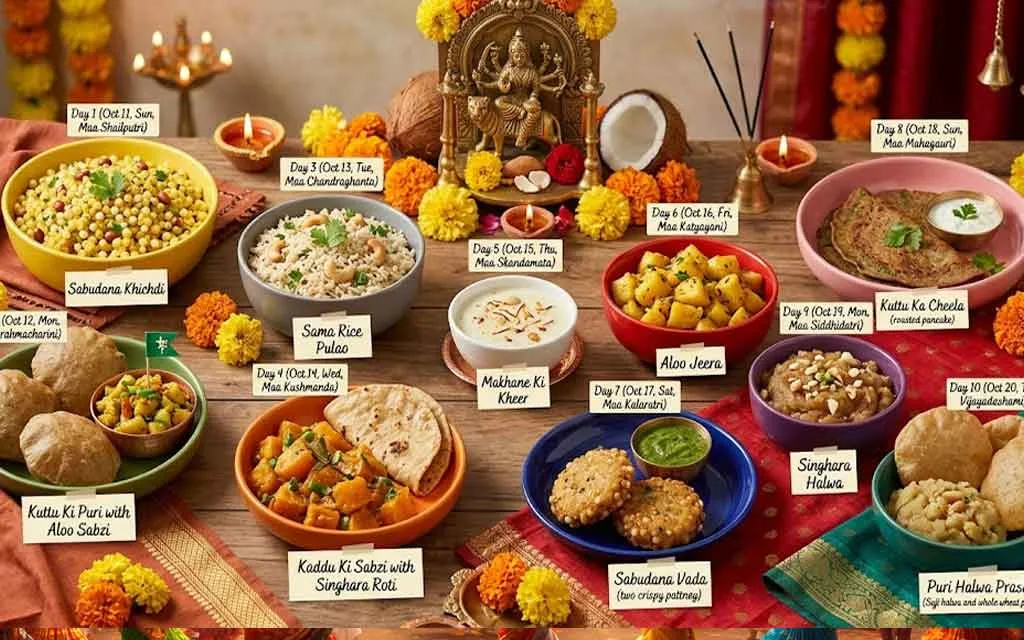
A standard home recipe for rajgira (amaranth flour) paratha for the Navratri fast, bound with boiled potato and cooked in ghee, with a singhara (water chestnut) atta variation, softness tips, substitutions and storage.
Quick answer: Rajgira paratha is made by kneading 1 cup of rajgira (amaranth) flour with two warm mashed boiled potatoes, sendha namak (rock salt) and green chilli into a soft dough, rolling it between two sheets of baking paper and cooking it on a medium-hot tawa with ghee on both sides. For a singhara atta (water chestnut flour) version, use a little more potato and roll the parathas thicker. Both are popular for the Navratri 2026 fast, 11 to 19 October 2026 in India.
This page has standard home recipes for both versions, with approximate quantities and timings, tips for soft parathas, substitutions and storage. For a full nine-day menu, see our Sharad Navratri 2026 day-wise vrat recipes.
Rajgira and singhara in the vrat kitchen
Rajgira (amaranth, sometimes called ramdana) and singhara (water chestnut) are not cereal grains, so many families use their flours on fasting days instead of wheat. Neither has gluten, which is why vrat parathas need potato as a binder and are rolled more gently than wheat parathas. As always, family customs differ, so check the common practice in our Navratri fasting rules 2026 guide.
The recipes
Rajgira Paratha (Amaranth Flour Paratha for Vrat)
Soft flatbreads of rajgira (amaranth) flour bound with mashed boiled potato, seasoned with rock salt and green chilli, and cooked on a tawa with ghee.
Prep: about 15 minutes. Cook: about 20 minutes. Makes: 6 parathas (serves 2 to 3) (approximate).
Ingredients
- 1 cup (about 120 g) rajgira atta (amaranth flour), plus extra for dusting
- 2 medium potatoes (about 250 g), boiled, peeled and finely mashed
- 1/2 teaspoon sendha namak (rock salt), or to taste
- 1 green chilli, finely chopped
- 1/2 teaspoon cumin seeds (optional)
- 1 tablespoon chopped coriander leaves (optional)
- 1 teaspoon ghee for the dough
- About 2 tablespoons ghee for cooking
- Warm water, only if needed
Method
- Mash the boiled potatoes while still warm until smooth, with no lumps.
- In a bowl, combine the rajgira atta, rock salt, green chilli, cumin and coriander. Add the mashed potato and a teaspoon of ghee.
- Knead into a soft, smooth dough. Add warm water a teaspoon at a time only if it is crumbly. Rest it, covered, for 5 minutes.
- Heat a tawa or flat pan over medium heat.
- Divide the dough into 6 balls. Place one between two sheets of baking paper, or dust it well with rajgira atta, and roll gently into a round about 15 cm across and 3 to 4 mm thick.
- Peel off the sheets and lay the paratha on the hot tawa. Cook for about 1 minute until small spots appear underneath, then turn.
- Spread 1/2 teaspoon of ghee on top, turn again and spread ghee on the other side. Press gently with a spatula and cook until both sides have golden-brown spots, about 1 to 2 minutes more.
- Stack the cooked parathas in a cloth-lined box and serve warm with curd or vrat aloo sabzi.
Tips: Do not rest the dough for long; potato-bound vrat doughs turn sticky. If you prefer a stuffed paratha, roll two thin rounds, spread spiced mashed potato between them, seal the edges and cook as above.
Singhara Atta Paratha (Water Chestnut Flour Variation)
The same potato-bound vrat paratha made with singhara (water chestnut) flour, which is denser and needs a little more potato.
Prep: about 15 minutes. Cook: about 20 minutes. Makes: 6 parathas (serves 2 to 3) (approximate).
Ingredients
- 1 cup (about 120 g) singhara atta (water chestnut flour)
- 2 to 3 medium potatoes (about 300 g), boiled, peeled and finely mashed
- 1/2 teaspoon sendha namak (rock salt), or to taste
- 1 green chilli, finely chopped
- 1 tablespoon chopped coriander leaves (optional)
- About 2 tablespoons ghee for cooking
Method
- Mix the singhara atta, rock salt, green chilli and coriander in a bowl.
- Add the warm mashed potatoes and knead into a soft dough without water at first. Add a few drops of water only if needed.
- Divide into 6 balls and press or roll each between two sheets of baking paper into a slightly thicker round, about 12 cm across.
- Cook on a medium-hot tawa as for rajgira paratha, with ghee on both sides, until golden spots appear. Turn carefully, as singhara parathas are more fragile.
Tips: Singhara dough firms up as it sits, so make it just before cooking. If it feels too sticky, add a spoon of rajgira or singhara atta rather than more water.
Tips for soft vrat parathas
- Warm potato: mash the potatoes warm; cold potatoes make a lumpy, crumbly dough.
- Soft dough: it should feel like soft clay, not stiff.
- Medium heat: too low dries the paratha; too high burns the outside before it cooks through.
- Ghee on both sides: it keeps vrat parathas supple.
- Stack and cover: the steam keeps them soft until serving.
Substitutions
| Ingredient | Substitute | Note |
|---|---|---|
| Potato | Boiled arbi (colocasia) or sweet potato | Arbi binds very well |
| Rajgira atta | Kuttu or singhara atta | Adjust potato; kuttu is darker and earthier |
| Ghee | Groundnut oil | Ghee gives the softest, most fragrant result |
| Green chilli | Black pepper | If your family avoids chilli in vrat |
For a deep-fried version with buckwheat flour, see our kuttu puri recipe with vrat aloo sabzi.
Serving ideas through the nine days
Rajgira paratha with plain curd and a dry potato sabzi is an easy weekday meal. Many working families pack it for lunch on the busy weekdays in the middle of Navratri, such as Day 4 on Wednesday 14 October (Maa Kushmanda) and Day 5 on Thursday 15 October (Maa Skandamata). Round off the meal with makhana kheer or switch to sabudana khichdi the next day.
Tips for cooking abroad
- Rajgira atta may be labelled 'amaranth flour' and singhara atta 'water chestnut flour' in Indian grocery stores. Check that the pack is pure flour with no wheat added.
- Some East Asian stores sell water chestnut starch, which is a different, very fine product used for batters; it does not behave like singhara atta.
- Vrat flours keep best in the fridge in warm or humid climates.
Storage
- Cooked parathas: best the same day. Wrap and refrigerate for up to a day; warm on a tawa.
- Dough: make fresh each time.
- Flours: airtight, in a cool place or the fridge.
Frequently asked questions
How do I keep rajgira parathas soft?
Use enough warm mashed potato, knead the dough soft rather than stiff, roll the parathas a little thick, cook them on medium heat rather than low, and stack them in a cloth-lined box straight off the tawa. Low heat for too long dries them out.
Why does my rajgira dough crack while rolling?
Rajgira has no gluten, so the dough relies on potato to hold it. If the edges crack, knead in a little more mashed potato or a few drops of water, and roll between two sheets of baking paper instead of on a dusted board.
What is the difference between rajgira and singhara atta?
Rajgira atta is ground amaranth seed and makes lighter, softer parathas. Singhara atta is ground dried water chestnut; it is denser and starchier, so it needs more potato and gives a slightly thicker paratha. Both are common vrat flours.
Is rajgira allowed during the Navratri fast?
In many families yes. Rajgira and singhara are widely treated as non-grain vrat flours. Customs differ, and some families avoid green chilli, cumin or coriander during the fast. Follow your family's practice.
Can I make the parathas ahead for office lunch?
Yes. Cook them fully, cool, wrap in foil or a cloth and pack. They are best eaten within a few hours; warm them on a tawa if you can. Packed with curd and a dry potato sabzi, they make a practical vrat lunch.
When is Navratri in 2026?
Sharad Navratri runs from Sunday 11 October to Monday 19 October 2026 in India (Drik Panchang), with Durga Ashtami and Maha Navami both on Monday 19 October and Dussehra on Tuesday 20 October.
Editor's note (8 October 2026)
We wrote this recipe page in October 2026 for Sharad Navratri. Dates follow Drik Panchang for India: Navratri from Sunday 11 to Monday 19 October 2026, Durga Ashtami and Maha Navami on Monday 19 October, and Dussehra on Tuesday 20 October. These are standard home recipes; quantities, timings and yields are approximate, and vrat ingredients differ between families and regions.
Related guides
You might also like
Samak Rice Khichdi for Navratri Vrat: Vrat ke Chawal Khichdi, Pulao and Kheer
Sabudana Vada for Vrat: Crisp Fried or Air-Fryer Vadas with Vrat Green Chutney
Sabudana Khichdi for Navratri Vrat: Soaking Ratio, Non-Sticky Method and Variations