The 108 Upanishads: The Complete Muktika Canon of Vedanta
The Upanishads are the concluding wisdom of the Vedas — Vedanta. The Muktika canon, spoken by Lord Rama to Hanuman, enumerates 108 of them. Here is their meaning, their classification by Veda and theme, the principal thirteen, and the four great sayings (Mahavakyas).
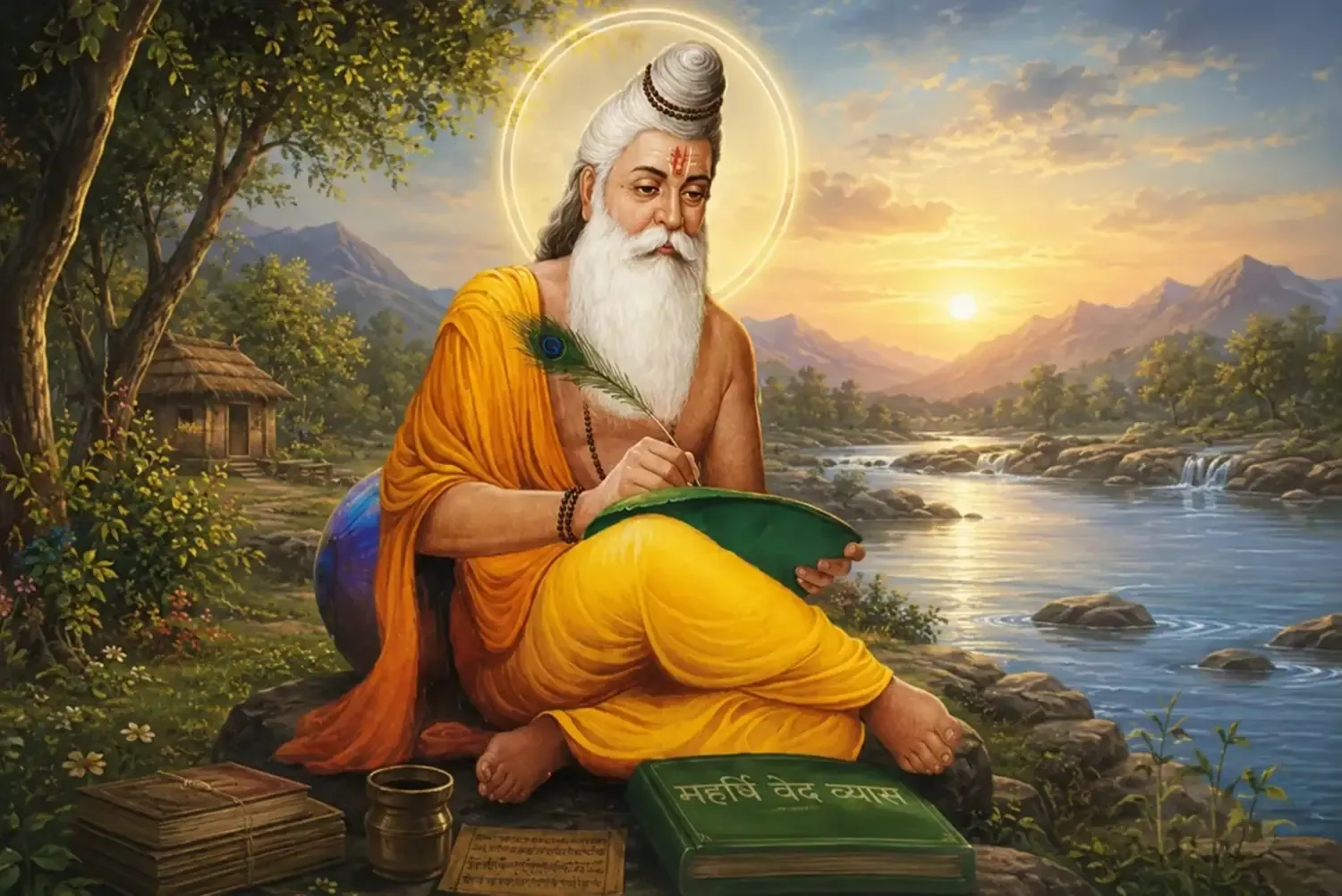
The Upanishads are the concluding wisdom of the Vedas — Vedanta. The Muktika canon, spoken by Lord Rama to Hanuman, enumerates 108 of them.
Quick answer: The 108 Upanishads are the philosophical texts that conclude the Vedas and form the foundation of Vedanta. The count of 108 comes from the Muktika Upanishad, in which Lord Rama tells Hanuman the canonical list. They are distributed across the four Vedas and grouped by theme, with about thirteen recognised as the principal (Mukhya) Upanishads.
The Upanishads are the crown of the Vedas — the texts where ritual gives way to reflection, and where the seeker turns from outward offering to the inward question of who they truly are. They are called Vedanta, meaning both the concluding portion of the Vedas and the culmination of Vedic knowledge. Traditionally the number of Upanishads is given as 108, a count preserved in the Muktika canon.
What is an Upanishad?
The word upanishad is usually explained as upa (near), ni (down), and shad (to sit) — the act of sitting down near a teacher to receive secret, liberating knowledge. The Upanishads were transmitted in this intimate setting, from realised teacher to sincere student, and they carry the tone of dialogue, wonder, and direct inquiry rather than commandment.
The Upanishads belong to sruti — that which is heard, the revealed and eternal scripture, as opposed to smriti, which is remembered and composed by human authors. As sruti they are regarded as the highest authority in Hindu philosophy. Their central concern is the nature of Brahman (the ultimate reality), Atman (the innermost self), and the relationship between them.
Because they form the final layer of the Vedic corpus — after the Samhitas (hymns), Brahmanas (ritual manuals), and Aranyakas (forest treatises) — the Upanishads are the source and reference point for the entire tradition of Vedanta, including the schools of Advaita, Vishishtadvaita, and Dvaita.
Why 108? The Muktika Canon
There is no single fixed ancient list of Upanishads, and many more than 108 texts bear the name. The specific number 108 comes from the Muktika Upanishad, a late Upanishad framed as a dialogue in which Lord Rama instructs his devotee Hanuman on the path to liberation (mukti, from which the text takes its name).
In this dialogue, Rama tells Hanuman that liberation is attained through the study and realisation of the Upanishads, and he enumerates a canonical list of 108. This Muktika list of 108 became the widely accepted standard, and it is why devotees speak of the 108 Upanishads. The number 108 is itself deeply auspicious in Hindu tradition, echoed in the mala of 108 beads.
The Muktika canon assigns each of the 108 Upanishads to one of the four Vedas. Below is the standard Muktika distribution.
The 108 Upanishads by Veda
| Veda | Number of Upanishads |
|---|---|
| Rigveda | 10 |
| Shukla Yajurveda (White) | 19 |
| Krishna Yajurveda (Black) | 32 |
| Samaveda | 16 |
| Atharvaveda | 31 |
| Total | 108 |
This distribution reflects how each Veda gave rise to its own schools (shakhas) and its own contemplative literature. The Yajurveda, split into its Shukla and Krishna recensions, together accounts for the largest share, while the Atharvaveda — the youngest Veda — hosts many of the later sectarian and yogic Upanishads.
The 108 Upanishads by Theme
Scholars also group the 108 by subject matter. These thematic categories are not part of the Muktika text itself but are a useful traditional and academic classification.
- Mukhya (Principal) — the oldest and most authoritative, roughly thirteen, commented upon by the great acharyas.
- Samanya Vedanta — general Upanishads teaching non-dual and Vedantic philosophy.
- Sannyasa — Upanishads on renunciation and the life of the monk.
- Yoga — Upanishads describing meditation, pranayama, kundalini, and the subtle body.
- Shakta — Upanishads devoted to the Goddess (Shakti / Devi).
- Vaishnava — Upanishads devoted to Vishnu and his avatars.
- Shaiva — Upanishads devoted to Shiva.
The Principal (Mukhya) Upanishads
About thirteen Upanishads are regarded as principal. They are the oldest, are quoted in the foundational Brahma Sutras, and were given commentaries by Adi Shankaracharya and other teachers. These are the Upanishads a student is traditionally advised to study first.
| Upanishad | Veda | Core Theme |
|---|---|---|
| Isha | Shukla Yajurveda | The divine pervading all; renunciation amid action. |
| Kena | Samaveda | That by which the mind and senses function — the power behind them. |
| Katha | Krishna Yajurveda | Nachiketas and Yama; the immortal Self and the path beyond death. |
| Prashna | Atharvaveda | Six great questions answered on prana, creation, and Om. |
| Mundaka | Atharvaveda | Higher and lower knowledge; the two birds on one tree. |
| Mandukya | Atharvaveda | The syllable Om and the four states of consciousness. |
| Taittiriya | Krishna Yajurveda | The five sheaths (koshas) and the bliss of Brahman. |
| Aitareya | Rigveda | Creation from the Self; consciousness as Brahman. |
| Chandogya | Samaveda | Tat Tvam Asi; meditation, Om, and the Self within the heart. |
| Brihadaranyaka | Shukla Yajurveda | The largest Upanishad; the Self as the ground of all, neti neti. |
| Svetasvatara | Krishna Yajurveda | Theistic Vedanta; devotion to the one God, Rudra/Shiva. |
| Kaushitaki | Rigveda | Prana, rebirth, and the journey of the soul. |
| Maitrayaniya (Maitri) | Krishna Yajurveda | The Self, the mind, and liberation through meditation on Om. |
Of these, the first ten (Isha through Brihadaranyaka) are the most universally cited; Svetasvatara, Kaushitaki, and Maitrayaniya are counted among the principal group by most traditions, giving the familiar total of thirteen.
The Four Mahavakyas (Great Sayings)
From the principal Upanishads the tradition distils four Mahavakyas — the great sayings — one drawn from each of the four Vedas. Each condenses the entire teaching of Vedanta into a single declaration of the identity of the individual Self with the ultimate reality.
| Mahavakya (Devanagari) | IAST | Meaning | Source (Upanishad, Veda) |
|---|---|---|---|
| प्रज्ञानं ब्रह्म | Prajnanam Brahma | Consciousness is Brahman. | Aitareya, Rigveda |
| अहं ब्रह्मास्मि | Aham Brahmasmi | I am Brahman. | Brihadaranyaka, Yajurveda |
| तत् त्वम् असि | Tat Tvam Asi | That thou art. | Chandogya, Samaveda |
| अयम् आत्मा ब्रह्म | Ayam Atma Brahma | This Self is Brahman. | Mandukya, Atharvaveda |
The Mahavakyas are not slogans but instructions for contemplation. In the Advaita tradition, the aspirant hears them from a teacher (sravana), reflects on them until doubt is resolved (manana), and meditates on them until the truth is directly realised (nididhyasana).
How to Study the Upanishads
The Upanishads are terse and often paradoxical, and the tradition holds that they are best approached with a qualified guide and a settled mind. A few time-honoured guidelines can help the sincere seeker.
- Begin with the principal Upanishads — Isha, Kena, and Katha are gentle and beloved starting points.
- Study with a teacher or a trustworthy commentary; the terse verses open up through explanation.
- Read the text aloud or listen to it chanted; the Upanishads were meant to be heard, and the sound carries meaning.
- Cultivate the fourfold qualification (sadhana chatushtaya): discrimination, dispassion, the six virtues, and a longing for liberation.
- Progress from hearing (sravana) to reflection (manana) to sustained meditation (nididhyasana).
- Return to the same Upanishad many times; its meaning deepens as the mind matures.
The remaining Upanishads — the Sannyasa, Yoga, Shakta, Vaishnava, and Shaiva groups — are studied later, often according to one's chosen path of devotion or practice. The complete 108 are enumerated in the Muktika canon, and a lifetime of study rarely exhausts even the principal few.
A Devotional Closing
The Upanishads end not in argument but in benediction. Many open and close with the shanti mantra — Om, peace, peace, peace — a threefold prayer for peace in the body, in the surroundings, and in the unseen forces of the world.
One of the most cherished of these prayers, from the Brihadaranyaka, asks: lead me from the unreal to the real, from darkness to light, from death to immortality — asato ma sad gamaya, tamaso ma jyotir gamaya, mrityor ma amritam gamaya. This is the heart of the 108 Upanishads: not information to be collected, but a light to be walked toward.
May the study of these sacred texts bring the seeker from restlessness to peace, and from the many to the One. Om Shanti Shanti Shanti.
Frequently Asked Questions
Why are there said to be 108 Upanishads?
The number 108 comes from the Muktika Upanishad, in which Lord Rama tells Hanuman the canonical list of Upanishads needed for liberation. Many more texts bear the name Upanishad, but the Muktika list of 108 became the accepted standard, and 108 is itself an auspicious number in Hindu tradition.
What does the word Upanishad mean?
It is generally explained as upa (near), ni (down), and shad (to sit) — sitting down near a teacher to receive secret, liberating knowledge. The name reflects the intimate teacher-to-student setting in which the wisdom was transmitted.
What is the difference between the Vedas and the Upanishads?
The Upanishads are the concluding portion of the Vedas, called Vedanta. Where the earlier layers of the Vedas focus on hymns and rituals, the Upanishads turn to philosophy — the nature of Brahman, the Self, and liberation.
How many principal Upanishads are there?
About thirteen are regarded as principal (Mukhya): Isha, Kena, Katha, Prashna, Mundaka, Mandukya, Taittiriya, Aitareya, Chandogya, Brihadaranyaka, Svetasvatara, Kaushitaki, and Maitrayaniya. They are the oldest and were commented upon by Adi Shankaracharya and other acharyas.
What are the four Mahavakyas?
The four great sayings are Prajnanam Brahma (Aitareya, Rigveda), Aham Brahmasmi (Brihadaranyaka, Yajurveda), Tat Tvam Asi (Chandogya, Samaveda), and Ayam Atma Brahma (Mandukya, Atharvaveda). Each declares the identity of the individual Self with the ultimate reality.
How are the 108 Upanishads distributed among the Vedas?
In the Muktika canon: Rigveda has 10, Shukla Yajurveda 19, Krishna Yajurveda 32, Samaveda 16, and Atharvaveda 31, totalling 108.
Which Upanishad should a beginner read first?
The principal Upanishads are the best starting point, and Isha, Kena, and Katha are especially loved as gentle introductions. Studying with a teacher or a reliable commentary is strongly recommended.
Are the Upanishads sruti or smriti?
The Upanishads are sruti — revealed, eternal scripture that is heard rather than composed. As sruti they hold the highest authority in Hindu philosophy, above the remembered texts (smriti) such as the epics and Puranas.
You might also like
Bilvashtakam: Full Text with Meaning — The Eight Verses of Bilva Offering to Lord Shiva
Swaraj in the Bhagavad Gita: Inner Freedom and Self-Mastery
Best Eco-Friendly Puja Items for USA NRIs: Sustainable Choices for Hindu Worship