Before the Nectar, the Poison: Samudra Manthan & the 2026 AI Energy Crisis
Samudra Manthan teaches that poison precedes nectar. In 2026, AI’s explosive growth brings huge benefits alongside surging data-center energy demand — the infrastructure challenge and a sustainable path forward, seen through Sanatana Dharma.
“Before the nectar came the poison.” This timeless lesson from Samudra Manthan — the churning of the Ocean of Milk — speaks directly to our AI-driven age. Around World Environment Day 2026, the breakneck rise of artificial intelligence asks us to face a hard truth: transformative innovation often carries heavy costs before it yields its full reward.
We celebrate AI’s gifts — breakthroughs in healthcare, science and productivity — yet rarely discuss what powers them: the vast energy infrastructure behind data centers. This reflection draws on the wisdom of Sanatana Dharma while looking honestly at the real-world infrastructure of the AI boom.
The Myth: Churning, Poison and Nectar
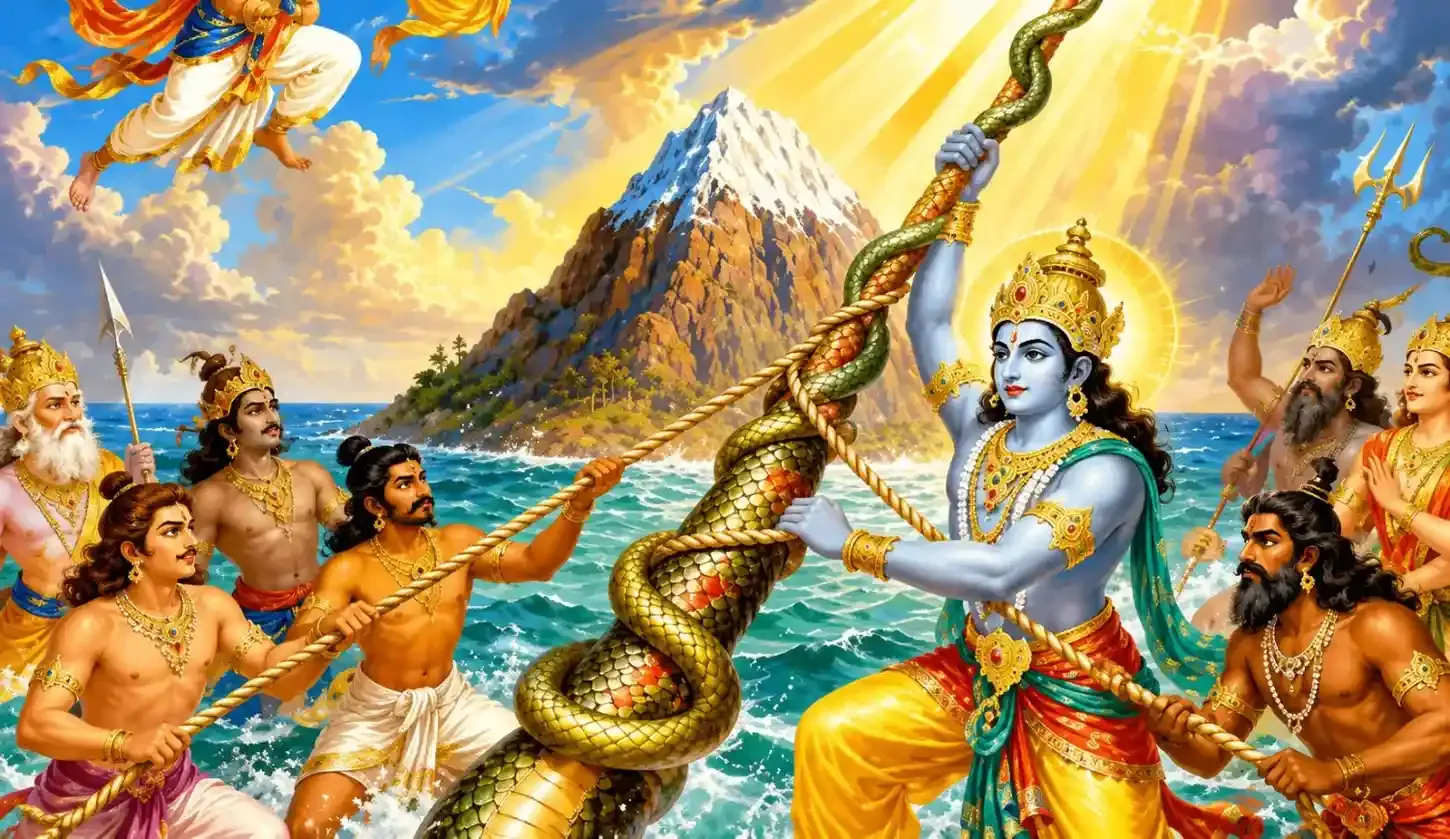
In the Puranas, the Devas and Asuras together churned the Kshira Sagara (Ocean of Milk) using Mount Mandara as the churn and Vasuki, the serpent king, as the rope, seeking Amrita, the nectar of immortality. Before the nectar, a deadly poison — Halahala — arose, threatening all creation. Lord Shiva, in supreme compassion, drank the poison and held it in his throat, which turned blue, earning him the name Neelakantha. Only after that sacrifice did the nectar and other treasures appear.
It is a profound metaphor for progress: great rewards demand confronting challenges, collective effort and wise stewardship. In 2026, AI is our modern Samudra Manthan — a churning of data, algorithms and compute that promises the “nectar” of human advancement, but first surfaces the “poison” of environmental and energy strain.
The Poison: AI’s Surging Energy Footprint
- 2024 baseline: global data-center electricity reached ~415 TWh (~1.5% of world electricity), rising sharply through 2025 on AI workloads.
- 2030 projection (IEA): data-center use could roughly double to ~945 TWh — about Japan’s total consumption, ~3% of global electricity.
- AI servers: growing fastest, on the order of ~30% a year in base-case scenarios.
- Goldman Sachs Research: forecasts a potential ~165% rise in data-center power demand by decade-end versus 2023.
These are projections from bodies such as the IEA and Goldman Sachs, not certainties — but the direction is clear. The pressure is real: on power grids, on water for cooling, and on land. And everyday AI inference (routine queries), not just training, drives most of it.
India’s Data-Center Boom
- Capacity: projected to grow from ~1.4–1.5 GW to ~8–10 GW by 2030 — roughly a six-fold increase.
- Share of electricity: could rise from under 1% to about 3% of India’s consumption by 2030.
- Hubs: Mumbai, Hyderabad, Delhi-NCR, Bengaluru and Chennai — a single large facility can use as much power as ~100,000 homes.
This supports India’s AI and Digital India ambitions, but raises real questions about sustainable power sourcing alongside existing demand from industry, agriculture and households.
Broader Implications
- Water: cooling systems consume large volumes of water.
- Carbon: reliance on fossil fuels in some regions strains climate goals.
- Grid & cost: concentrated demand can affect prices and reliability.
- Land & resources: new facilities need substantial physical footprints.
Yet this is not a call to halt progress. Like the Devas and Asuras who persisted through the churning, we must navigate these challenges together.
The Path to Nectar: Sustainable AI
- Efficiency: more efficient chips, liquid cooling and optimised algorithms cut energy per computation.
- Renewables + storage: solar, wind and batteries to power facilities cleanly — strong potential in India.
- AI for sustainability: AI can optimise grids, forecast renewable output and accelerate climate modelling.
- Policy & collaboration: carbon-aware computing, edge architectures and sensible regulation.
- Clean baseload: small modular reactors (SMRs) and next-gen power for always-on needs.
Harnessing AI Responsibly
AI’s benefits — drug discovery, climate solutions, personalised education, productivity — are real and potentially world-changing. The key is aligning the infrastructure that supports it with environmental stewardship. On World Environment Day, this meeting of ancient wisdom and modern technology invites reflection: true progress means addressing the full cost, not only celebrating the gain.
Frequently Asked Questions
What does Samudra Manthan teach about progress?
That great rewards (the nectar, Amrita) come only after facing difficulty (the Halahala poison) through collective effort and wise, compassionate stewardship — Lord Shiva holding the poison in his throat as Neelakantha.
How much energy does AI really use?
Reported figures: global data-center electricity was ~415 TWh in 2024 (~1.5% of world use); the IEA projects it could roughly double to ~945 TWh by 2030, with AI servers growing fastest. Treat exact numbers as projections from bodies like the IEA and Goldman Sachs.
What is India’s data-center outlook?
India’s capacity is projected to grow from ~1.4–1.5 GW to ~8–10 GW by 2030, potentially lifting data centers from under 1% to about 3% of national electricity, concentrated in Mumbai, Hyderabad, Delhi-NCR, Bengaluru and Chennai.
Can AI be made sustainable?
Yes — through efficiency gains (better chips, liquid cooling, optimised algorithms), renewable + storage integration, carbon-aware computing, and clean baseload options; AI can also help optimise grids and climate models.
Conclusion
The lesson of Samudra Manthan — that poison precedes nectar, and that responsibility and collective will are needed to reach the reward — is timeless guidance for our AI moment. As data centers churn through enormous energy in 2026 and beyond, may we emulate Lord Shiva’s example: face the challenge directly, innovate sustainably, and ensure the Amrita of AI benefits all of humanity and the Earth. This World Environment Day, let us choose a balanced path — fuelling advancement while protecting our shared natural heritage.
For more reflections where Sanatana Dharma meets modern life, explore HinduTone’s spirituality section.
Share this with family and friends
Send it on WhatsApp, post it, or copy the link.
More from Spirituality
- Sri Medha Dakshinamurthy Swami Dhyanam | Meditation Sloka for Intelligence, Eloquence & Self-Realization
- What Is True Poverty? | Dharma Is the Greatest Wealth | Sanatana Dharma
- Correct Yourself First! | The Power of Constructive Criticism for Personal Growth
- Trees: Abodes of the Divine | Spiritual and Environmental Significance of Trees
- Dashaphala Rahasyalu Part 3: When Do Planetary Dashas Give Full Results?
You might also like

Daiva Sankalpam (Divine Will): The Story of the Sadhu on the Sinking Boat

Chilkur Balaji 'Visa Balaji' Temple: The 11 and 108 Pradakshina Custom Explained for NRIs

Ekagrata (One-Pointedness): Yoga Concentration and Samyama Glossary