The Radiant Covenant: Surya Dev's Divine Encounter with Arjun
A Tale of Faith and Celestial Grace In the heart of ancient Bharat, where the earth pulsed with devotion and the skies shimmered with celestial secrets, lived…
A Tale of Faith and Celestial Grace
In the heart of ancient Bharat, where the earth pulsed with devotion and the skies shimmered with celestial secrets, lived a humble farmer named Arjun. His days were woven with the rhythm of the sun—rising before its golden rays kissed the horizon, he offered water to Surya Dev with hands trembling in reverence. Each dawn, his voice rose in the sacred Surya Mantra, a melody of faith that echoed through the sleepy village. Though his fields were modest and his life simple, Arjun harbored a burning desire—to witness the divine glory of Surya Dev, the Sun God, whose light sustained all life.
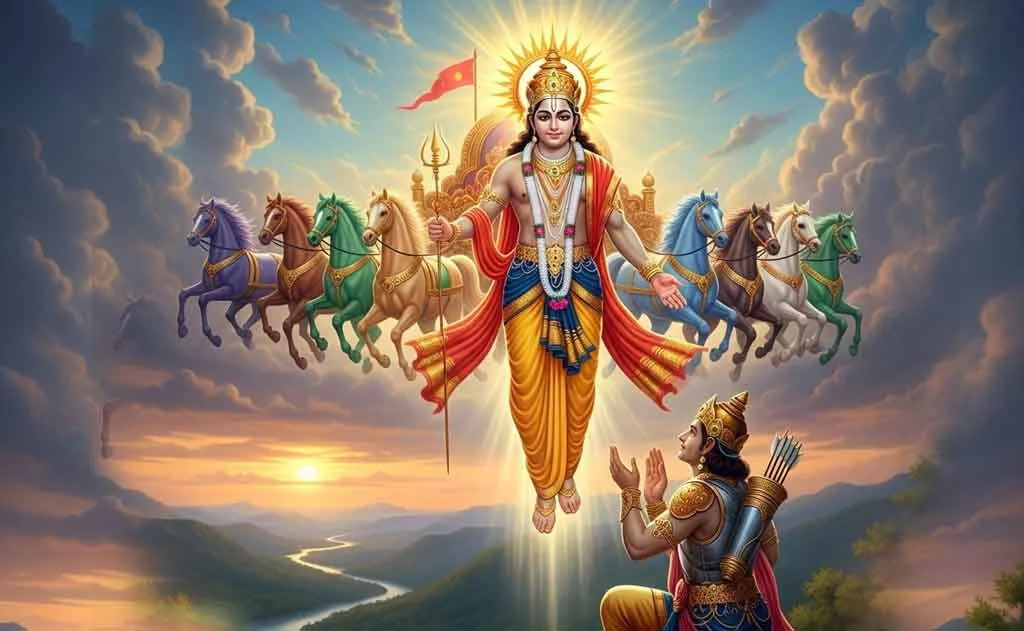
One extraordinary morning, as the first rays pierced the mist, a mystical glow enveloped Arjun’s parched fields. His heart raced as he approached, and there, before his wide eyes, stood a vision of splendor: a golden chariot blazing with unearthly brilliance, pulled by seven majestic horses whose manes danced like flames. At the chariot’s helm sat Surya Dev, his form radiant and regal, adorned with a crown of light, a lotus blooming in one hand, and a conch gleaming in the other. Beside him, Aruna, the divine charioteer, guided the steeds with ethereal grace, their hooves leaving trails of stardust.
Arjun dropped to his knees, his breath caught in awe. “O Surya Dev, Lord of the Skies,” he stammered, “why does your divine presence bless this unworthy soul?”
Surya Dev’s eyes, warm as the midday sun, softened with compassion. “Arjun,” his voice boomed like a gentle thunder, “your devotion has pierced the veils of the heavens. I have descended to test the purity of your heart. Name your boon, and it shall be yours.”
Tears streamed down Arjun’s weathered face as he lifted his gaze. “Great Lord, I crave neither riches nor dominion. Grant me the strength to serve you and my people. Let my fields flourish to feed the hungry, and fill me with your light to guide others.”
A divine silence hung in the air as Surya Dev’s face glowed with approval. With a majestic sweep of his hand, the barren fields erupted into a sea of golden crops, swaying as if blessed by the gods. A surge of warmth flooded Arjun’s soul, igniting a fire of purpose within him. “From this day forth,” Surya Dev proclaimed, “your village shall thrive in abundance, and your name shall be etched in the annals of devotion. Teach the world to rise with me, for I am the eternal source of life.”
As the chariot ascended, its wheels spinning arcs of light across the heavens, Arjun felt a divine calling awaken. He dedicated his life to teaching the villagers the Surya Namaskar, a sacred dance of poses to honor the Sun God, their movements mirroring the sun’s journey. The village flourished, its people prospering under Surya Dev’s blessings, and tales of Arjun’s encounter spread like wildfire, inspiring generations.
To this day, devotees at www.hindutone.com retell this captivating saga, a testament to the unbreakable bond between faith and the radiant grace of Surya Dev, urging all to greet each sunrise with a heart full of devotion.
Who is Surya Dev? The Vedic Identity of the Sun God
Surya Dev holds one of the most ancient and exalted positions in the Vedic pantheon. The Rigveda dedicates numerous hymns — known as Surya Suktas — to his glory, describing him as Aditya, son of the cosmic mother Aditi, and as the very eye of the universe (sūryo cakṣuḥ). He is simultaneously the source of physical light and the illuminator of spiritual consciousness, qualities that make his worship foundational rather than merely devotional.
In the Puranic tradition, particularly the Brahma Vaivarta Purana and the Surya Purana, Surya is counted among the Navagrahas — the nine celestial bodies that govern human destiny — and is regarded as a direct manifestation of Brahman in visible form. His twelve monthly forms, called the Dvādaśādityas, each carry a unique name and function, governing seasons, rain, and the renewal of life across the year. The farmer Arjun's daily worship thus aligned him with this cosmic governance, making his fields an extension of divine order itself.
The Significance of Aruna: Why the Charioteer Precedes the Sun
The presence of Aruna in the story carries deep scriptural meaning. According to the Mahabharata and the Vishnu Purana, Aruna is the elder brother of Garuda, born from the cosmic egg of the sage Kashyapa and Vinata. His very body radiates the reddish glow of dawn — the word 'aruna' in Sanskrit literally means 'reddish' or 'dawn-coloured' — and he rides ahead of Surya's chariot to soften the sun's otherwise unbearable brilliance before it reaches the mortal world.
This mythological detail carries a profound philosophical teaching: divine grace rarely arrives at its full intensity without a preparatory messenger. Just as Aruna tempers the sun's light to make it life-giving rather than scorching, true spiritual experience is typically preceded by practices — mantra, devotion, ethical living — that prepare the aspirant's inner constitution. Arjun's years of predawn worship were, symbolically, his own 'Aruna phase,' readying his heart to bear the full presence of Surya Dev.
The Seven Horses of Surya's Chariot: A Map of Cosmic Time
The seven horses that draw Surya's golden chariot are not ornamental details — they represent the seven days of the week (saptavāra) and, in deeper cosmological readings, the seven rays of visible light that together constitute the spectrum of creation. The Aitareya Brahmana and later texts such as the Vishnu Purana name these horses collectively as Harit (golden-green), a term that underlines their living, luminous nature rather than treating them as mere animals.
Each horse is also linked to one of the seven meters of Vedic chanting — Gāyatrī, Uṣṇik, Anuṣṭubh, Bṛhatī, Paṅkti, Triṣṭubh, and Jagatī — suggesting that Surya's movement across the sky is itself a form of cosmic sound, a perpetual recitation that sustains the rhythm of existence. When Arjun chanted the Surya Mantra at dawn, he was, in this sense, joining his human voice to the chariot's eternal hymn, making his devotion an act of participatory cosmology rather than mere petition.
The Surya Mantra: What Arjun Recited and Why It Holds Power
The most celebrated solar mantra in Hindu tradition is the Gayatri Mantra (Rigveda 3.62.10), which specifically invokes the solar principle — 'dhiyo yo naḥ pracodayāt' meaning 'may that [divine sun] illuminate our intellect.' Alongside this, the Aditya Hridayam, preserved in the Yuddha Kanda of Valmiki's Ramayana, is recited by the sage Agastya to Sri Rama before battle, describing Surya as the root of all vitality and the destroyer of all darkness, both literal and metaphorical.
Predawn worship — the practice Arjun maintained — corresponds to the Brahma Muhurta, the period roughly ninety minutes before sunrise considered most conducive to spiritual practice across both Ayurvedic and Yogic traditions. Offering arghya (water) to the rising sun during this window, while chanting the twelve names of Surya known as the Dwadasha Namavalī, is considered an act of gratitude that aligns the worshipper's prāṇa with the solar life-force that animates all living beings.
Arjun's Boon and the Dharma of Selfless Asking
The boon Arjun requests — strength to serve, fertile fields to feed others, inner light to guide his community — mirrors a recurring ethical archetype in Hindu scripture. When King Ambarisha was blessed by Vishnu, when Sabari served Ram for decades without asking reward, or when the sage Dadhichi surrendered his very bones to enable the gods' victory, the unifying thread is nishkama bhakti: devotion stripped of personal craving. Arjun's response to a divine offer places him firmly within this lineage of exemplary devotees.
The Bhagavata Purana (Canto 4) explicitly teaches that a true devotee, when offered any boon by the Lord, asks only for continued devotion and the welfare of all beings — sarve bhavantu sukhinaḥ. Arjun's request for his fields to feed the hungry is therefore not rural modesty; it is the highest theological response, one that transforms a personal encounter with the divine into an act of communal and cosmic responsibility.
Temples and Living Traditions: Where Surya Worship Endures Today
The tradition of Surya worship that Arjun embodies in the story remains vibrantly alive in several major pilgrimage sites across India. The Konark Sun Temple in Odisha, built in the 13th century CE, is architecturally designed as Surya's divine chariot with twelve pairs of carved stone wheels and seven stone horses — a three-dimensional rendering of the very vision Arjun witnessed. Similarly, the Modhera Sun Temple in Gujarat, constructed during the Solanki dynasty, is oriented so that sunlight falls directly on the central deity during the equinoxes.
The festival of Chhath Puja, observed primarily in Bihar, Jharkhand, and eastern Uttar Pradesh, preserves the spirit of Arjun's practice with remarkable fidelity: devotees fast rigorously, stand in bodies of water at dawn, and offer arghya to the rising sun with cupped hands. The Makar Sankranti festival, celebrated across the entire subcontinent, marks the sun's northward journey (Uttarāyaṇa) and remains one of the most universally observed solar festivals, reminding every Hindu household that the covenant between human devotion and solar grace is not a story from the past — it is renewed each morning.
Frequently Asked Questions
Who is Arjun in the story of Surya Dev's divine encounter?
He is a humble farmer in ancient Bharat who offered water to Surya Dev and chanted the Surya Mantra every dawn. As commonly told, his devotion earned him a vision of the Sun God.
What boon did Arjun ask from Surya Dev?
He asked for no riches or dominion, only strength to serve Surya Dev and his people, fields that feed the hungry, and divine light to guide others. This selfless asking reflects nishkama bhakti, devotion without personal craving.
Why does Surya Dev's chariot have seven horses?
The seven horses represent the seven days of the week and, in deeper readings, the seven rays of visible light. Each is also linked to a Vedic meter such as Gayatri, Anushtubh or Jagati.
Who is Aruna, the charioteer of Surya Dev?
Aruna is the elder brother of Garuda, whose body has the reddish glow of dawn. He rides ahead of the chariot to soften the sun's brilliance before it reaches the mortal world.
Which mantras and practices are linked to Surya worship?
The Gayatri Mantra invokes the solar principle, and the Aditya Hridayam from Valmiki's Ramayana praises Surya. Devotees offer arghya (water) to the rising sun during Brahma Muhurta, and Surya Namaskar honors the Sun God.
Where can Surya worship be seen at temples today?
The Konark Sun Temple in Odisha, built in the 13th century CE, is designed as Surya's chariot with twelve pairs of wheels and seven stone horses. The Modhera Sun Temple in Gujarat is oriented so sunlight falls on the central deity during the equinoxes.
Share this with family and friends
Send it on WhatsApp, post it, or copy the link.
More from Stories
- Nirjala Ekadashi Mahatmyam | Bhima–Vyasa Dialogue | Pandava Nirjala Ekadashi Story
- Nirjala Ekadashi Significance | Sage Vyasa's Teaching to Bhimasena | Ekadashi Vrat Story
- Phalashruti of Listening to the Ganga Avatarana | The Sacred Benefits of Hearing the Descent of the Ganga
- Prepaid Death: A Story Every Busy Son and Daughter Must Read
- Did Eklavya Participate in the Kurukshetra War? The Real Story
You might also like
Diwali Stories for Kids: One Story Every Night for the 5 Days of Diwali (2026)
Navratri Stories for Kids: One Story Every Night for the 9 Forms of Durga (2026)
Ten Heads of Ravana: Meaning, Stories and Interpretations Explained