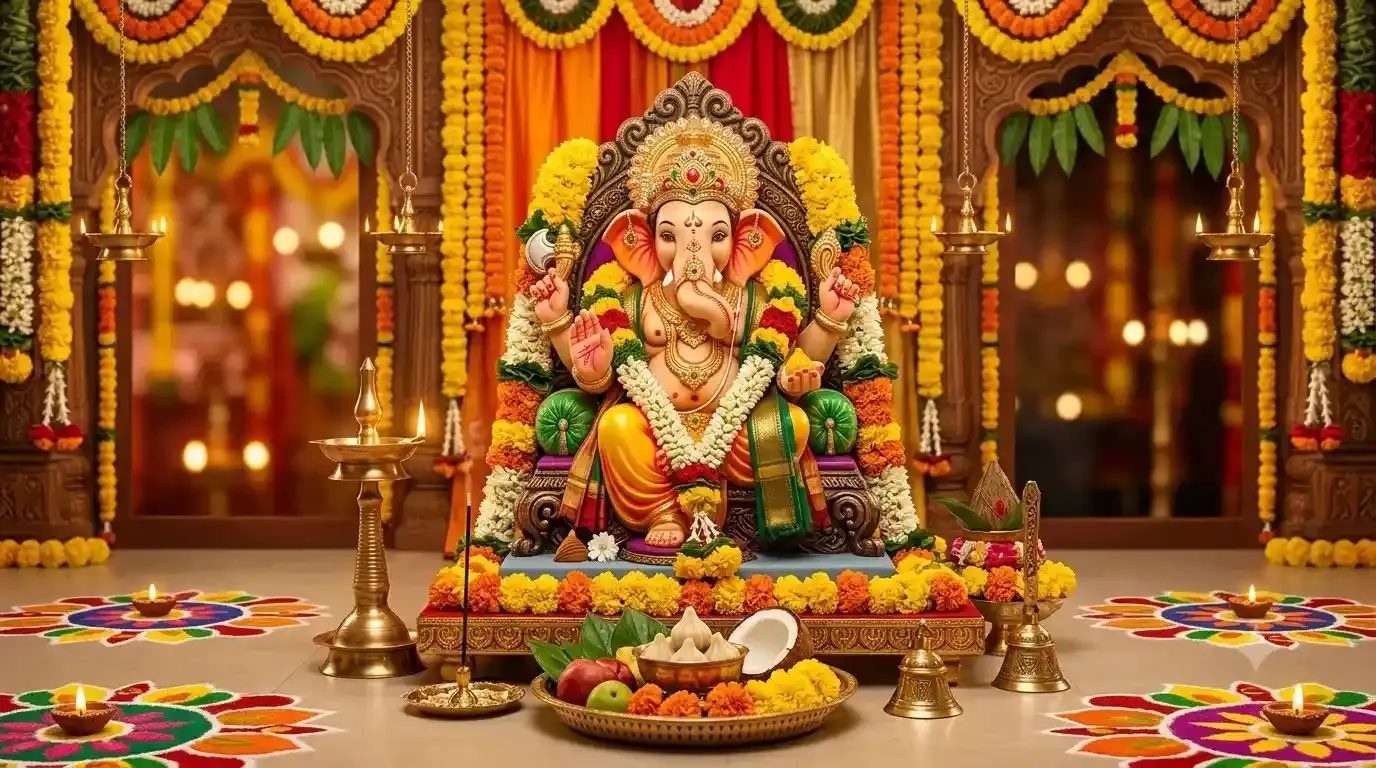
108 Shakti Peethas: The Sacred Abodes of the Divine Mother
Wherever a part of Goddess Sati's body fell to earth, a Shakti Peetha arose. Discover the origin legend, the four Adi Shakti Peethas, and the major temples of the Divine Mother across the subcontinent.
Wherever a part of Goddess Sati's body fell to earth, a Shakti Peetha arose. Discover the origin legend, the four Adi Shakti Peethas, and the major temples of the Divine Mother across the subcontinent.
Quick answer: The Shakti Peethas are sacred shrines that arose wherever a part of Goddess Sati's body or an ornament fell to earth after Vishnu's Sudarshana Chakra divided it. Their number varies by tradition — most commonly counted as 51, sometimes 52, 64, or 108 in wider enumerations. Each Peetha is worshipped as a living seat of the Divine Mother (Shakti), with an associated form of Devi and her guardian Bhairava. Together they form one of the holiest pilgrimage networks in the Hindu world.
Across the Indian subcontinent, from the misty hills of Assam to the deserts of Balochistan, from the Himalayan foothills to the southern tip at Kanyakumari, stand the Shakti Peethas — sacred seats of the Divine Mother. Each is believed to mark the very spot where a part of Goddess Sati's body, or one of her ornaments, fell to the earth. To the devotee, these are not merely temples but living presences of Adi Shakti, the primordial energy that sustains the cosmos.
This is the story of how the Mother's grief became the earth's grace, of a pilgrimage that binds a continent together, and of the many names by which the one Devi is adored.
The Origin Legend: Sati, Daksha, and the Grief of Shiva
Long ago, Sati — the daughter of Prajapati Daksha — married Lord Shiva against her father's wishes. Daksha never accepted the ascetic Shiva, lord of the cremation grounds, as a worthy son-in-law. In time he arranged a great yajna (fire sacrifice) and pointedly did not invite Shiva or Sati.
Sati, longing to attend and to reason with her father, went to the sacrifice uninvited. There Daksha heaped insults upon Shiva before the assembled gods and sages. Unable to bear the humiliation of her beloved lord, Sati gave up her body — some say by yogic fire kindled from within, some say by walking into the sacrificial flames — an act remembered as her self-immolation.
When news reached Shiva, his grief turned to a terrible fury. His attendants disrupted Daksha's sacrifice, and Shiva himself, lifting the lifeless body of Sati upon his shoulder, began the tandava — a wild, world-shaking dance of sorrow. So fierce was his grief that the very order of creation trembled.
To restore balance and to release Shiva from his anguish, Lord Vishnu followed and, with his Sudarshana Chakra, gently severed Sati's body piece by piece. Wherever a part of her body — or an ornament she wore — touched the earth, that ground became sanctified forever as a Shakti Peetha, a seat of the Goddess. At each such place Shakti abides in a distinct form, guarded by a fierce aspect of Shiva known as the Bhairava.
How Many Shakti Peethas Are There?
One of the most honest things a devotee can learn is that the tradition does not fix a single number. Different scriptures, regional traditions, and later enumerations count the Peethas differently:
- 51 Peethas — the most widely accepted count, corresponding to the letters of the Sanskrit alphabet.
- 52 Peethas — a closely related enumeration found in several traditions.
- 64 Peethas — mentioned in some Tantric and Puranic sources.
- 108 Peethas — an expansive count in certain later lists, echoing the sacred number 108.
The title '108 Shakti Peethas' honours the largest of these enumerations and the sacred completeness the number 108 represents in Hindu thought. Yet the essential truth is the same across every count: the one Divine Mother is present, whole and undivided, at each seat. She is never truly divided — only revealed in many forms for the sake of her devotees.
The Four Adi Shakti Peethas
Among all the Peethas, tradition holds a small number as the Adi (original or foremost) Shakti Peethas — considered the most sacred and spiritually potent. The most widely cited list of four Adi Peethas is:
- Bimala at Puri, Odisha — within the great Jagannath temple complex.
- Tara Tarini near Berhampur, Odisha — atop the Kumari hills by the Rushikulya river.
- Kamakhya (Kamarupa) at Nilachal Hill, Guwahati, Assam — where the yoni of the Goddess is worshipped.
- Dakshina Kalika at Kalighat, Kolkata, West Bengal — the presiding Goddess of the city.
It should be said plainly that traditions differ here too. Some lists substitute or add other Peethas as 'Adi', and various sampradayas venerate their own foremost seats. What unites them is the reverence in which the whole community holds these primal centres of Shakti.
Major Shakti Peethas: A Devotee's Reference
The following table lists some of the most well-established and widely revered Shakti Peethas. Where the associated body part or relic is confidently attested in tradition, it is given; where accounts vary, only the Peetha and its location are listed. The names of the presiding Shakti and her Bhairava are noted where they are well known.
| Peetha / Location | Body Part or Relic | Shakti (and Bhairava) |
|---|---|---|
| Kamakhya (Kamarupa), Guwahati, Assam | Yoni (womb / genitals) | Kamakhya; Bhairava Umananda |
| Kalighat / Dakshina Kali, Kolkata | Toes of the right foot | Kalika; Bhairava Nakuleshwar |
| Bimala, Puri, Odisha | Feet (navel in some accounts) | Bimala; Bhairava Jagannath |
| Tara Tarini, Berhampur, Odisha | Breasts | Tara Tarini |
| Jwalamukhi, Kangra, Himachal Pradesh | Tongue (worshipped as eternal flames) | Siddhida (Ambika); Bhairava Unmatta |
| Vishalakshi, Varanasi (Kashi), Uttar Pradesh | Earring / ornament (Manikarnika) | Vishalakshi; Bhairava Kaal Bhairav |
| Hinglaj, Balochistan, Pakistan | Brahmarandhra (top of the head) | Kottari (Hingula); Bhairava Bhimalochana |
| Bhramaramba, Srisailam, Andhra Pradesh | Neck | Bhramaramba; Bhairava Mallikarjuna |
| Kanyakumari, Tamil Nadu | Back / spine (traditions vary) | Bhagavathy / Kanyakumari |
| Jayanti, Jaintia Hills / Nartiang, Meghalaya | Left thigh | Jayanti; Bhairava Kramadishwara |
| Tripura Sundari, Udaipur, Tripura | Right foot | Tripura Sundari; Bhairava Tripuresh |
| Manikarnika / Chandi, region of Kashi | Ornament | See Vishalakshi (Kashi) |
| Naina Devi, Bilaspur, Himachal Pradesh | Eyes | Mahishapeeth Mardini |
| Chintpurni (Chhinnamastika), Una, Himachal Pradesh | Forehead / feet (accounts vary) | Chhinnamastika |
| Mahalakshmi (Kolhapur), Maharashtra | Eyes (traditions vary) | Mahalakshmi |
| Attahas, Birbhum, West Bengal | Lips | Phullara; Bhairava Vishvesh |
This is only a partial listing of the most prominent Peethas. Where a devotee finds a body part omitted above, it is a mark of honesty rather than gap — the traditions genuinely differ, and it is better to worship in reverent uncertainty than to fix what the scriptures leave open.
Vaishno Devi and the Living Tradition
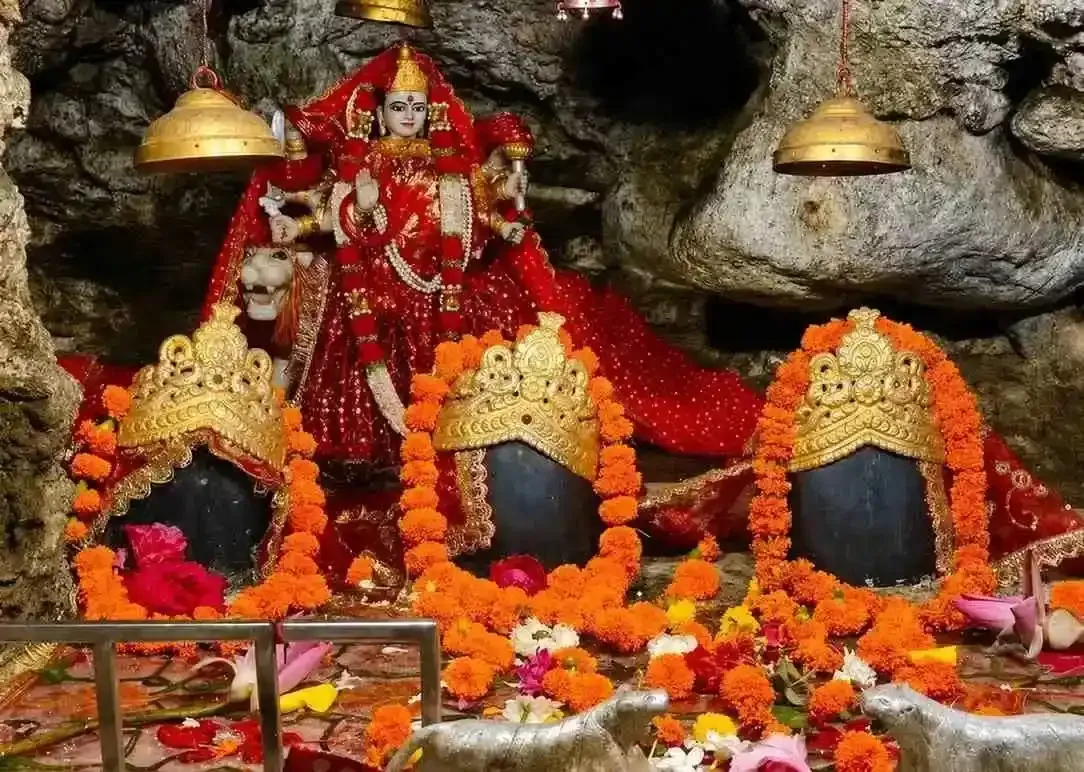
Beyond the classical enumerations, several beloved shrines are worshipped within the wider Shakti tradition. The cave temple of Vaishno Devi in the Trikuta hills of Jammu, where the Mother is adored in the form of three pindis (Maha Kali, Maha Lakshmi, and Maha Saraswati), draws millions of pilgrims each year. While its place among the formal 51 or 108 lists is discussed differently across traditions, its devotional stature as a seat of the Mother is beyond question.
Why the Shakti Peethas Matter to Devotees
For the devotee, the Shakti Peethas are proof that the Divine Mother is not distant. Her body became this very earth; her presence is woven into the soil of the land. To stand at a Peetha is to stand where the Mother herself descended.
- Each Peetha grants a distinct grace, from the fertility and life-force of Kamakhya to the fierce protection of Kali at Kalighat.
- The Bhairava at each seat guards the Goddess and the pilgrim alike, a reminder that Shiva and Shakti are never separated.
- Worship at a Peetha is believed to dissolve deep karma, grant fearlessness, and awaken devotion (bhakti) in the heart.
- The network of Peethas binds the subcontinent into a single sacred geography — one Mother, many thrones.
The Shakti Peetha Yatra: Undertaking the Pilgrimage
A Shakti Peetha yatra is a pilgrimage of the heart as much as of the road. Some devotees vow to visit all four Adi Peethas; others undertake the immense journey to as many of the 51 or 108 seats as a lifetime allows. There is no single prescribed route — the yatra is shaped by devotion, means, and the Mother's own call.
- Begin with sankalpa (sacred resolve), offering your intention at the feet of Devi before setting out.
- Many pilgrims start with the Adi Peethas — Kamakhya, Kalighat, Bimala, and Tara Tarini — as the spiritual foundation of the yatra.
- At each shrine, offer flowers, red cloth, sindoor, and — where custom permits — the traditional offerings of that Peetha.
- Honour the local Bhairava along with the Goddess, for the Peetha is complete only with both.
- Maintain simplicity, cleanliness, and inner silence; the yatra is a discipline of surrender, not merely travel.
Distances are great and some Peethas lie in remote or foreign lands, such as Hinglaj in Pakistan. Devotees often complete the yatra over many years, or hold the Mother's name in the heart when the road cannot be walked — for she measures the pilgrimage by love, not by miles.
The Navaratri Connection
The Shakti Peethas shine most brightly during Navaratri, the nine nights sacred to the Divine Mother. In this festival the Goddess is worshipped in her nine forms (Navadurga), and the Peethas — as her living seats — become the great centres of that worship.
At Kamakhya, the Ambubachi Mela marks the Mother's annual cycle and draws vast throngs of devotees and tantrics. At Kalighat and across Bengal, the autumn Navaratri flows into Durga Puja, when the Mother is invoked with unmatched fervour. To visit a Peetha during Navaratri is considered especially auspicious, for the Goddess is believed to be most present and most gracious in those nine luminous nights.
One Mother, Many Thrones
Whether we count fifty-one seats or one hundred and eight, the teaching of the Shakti Peethas is one and the same: the Divine Mother could not be divided by grief or by the chakra of Vishnu. What fell to earth was her boundless compassion, scattering itself so that her children everywhere might find a place to lay their sorrows at her feet.
May the Mother who dwells in every Peetha, who is the strength within all beings, guard and bless all who seek her.
Sarva Mangala Mangalye, Shive Sarvartha Sadhike — O Auspicious One who fulfils every purpose, refuge of all, three-eyed Gauri, Narayani, we bow to you again and again.
Frequently Asked Questions
How many Shakti Peethas are there?
The number varies by tradition. The most commonly accepted count is 51, corresponding to the letters of the Sanskrit alphabet, while some traditions count 52, 64, or 108. The title '108 Shakti Peethas' reflects the largest enumeration and the sacred completeness of the number 108. Across every count, the same Divine Mother is understood to be wholly present at each seat.
What is the origin legend of the Shakti Peethas?
When Goddess Sati gave up her body at her father Daksha's sacrifice, a grief-stricken Shiva carried her corpse in his cosmic tandava dance. To calm him and restore order, Vishnu used his Sudarshana Chakra to divide Sati's body. Wherever a part of her body or an ornament fell, that spot became a Shakti Peetha, a sacred seat of the Goddess.
What are the four Adi Shakti Peethas?
The four Adi (foremost) Shakti Peethas most commonly named are Bimala at Puri (Odisha), Tara Tarini near Berhampur (Odisha), Kamakhya at Guwahati (Assam), and Dakshina Kalika at Kalighat (Kolkata). Traditions differ, and some lists include other seats, but these four are widely revered as the most sacred.
What is worshipped at Kamakhya Shakti Peetha?
Kamakhya in Assam is where the yoni (womb) of the Goddess is said to have fallen, and it is worshipped as the seat of divine feminine creative power. It is one of the four Adi Shakti Peethas and a major centre of Tantric worship, famous for the annual Ambubachi Mela.
Who is the Bhairava at a Shakti Peetha?
At each Shakti Peetha, the Goddess is accompanied by a fierce guardian form of Shiva known as the Bhairava. The Bhairava protects both the shrine and the pilgrim, and worship of a Peetha is considered complete only when both the Goddess and her Bhairava are honoured, reflecting the inseparable union of Shiva and Shakti.
Is Vaishno Devi a Shakti Peetha?
Vaishno Devi in Jammu is one of the most beloved shrines of the Divine Mother, where she is worshipped as three pindis representing Maha Kali, Maha Lakshmi, and Maha Saraswati. Its place among the formal 51 or 108 lists is described differently across traditions, but its devotional stature as a seat of the Mother is beyond question.
How is the Shakti Peetha pilgrimage undertaken?
The Shakti Peetha yatra has no single fixed route; it is shaped by the devotee's devotion and means. Many begin with a sacred resolve (sankalpa) and the four Adi Peethas, then visit as many seats as a lifetime allows, offering flowers, red cloth, and sindoor while honouring both the Goddess and her Bhairava. Because some Peethas lie far away or abroad, the yatra is often completed over many years.
Why are the Shakti Peethas important during Navaratri?
During Navaratri, the nine nights sacred to the Divine Mother, the Shakti Peethas become the great centres of her worship. As living seats of the Goddess, they are believed to be especially charged with her presence and grace during this festival, when she is adored in her nine forms (Navadurga).