Konark Sun Temple: Spiritual Significance & Hidden Symbolism — The Complete Sacred Story
[image: 🌅] Konark Sun Temple — Where Stone Speaks the Language of Eternity There are buildings that shelter human beings from the elements.
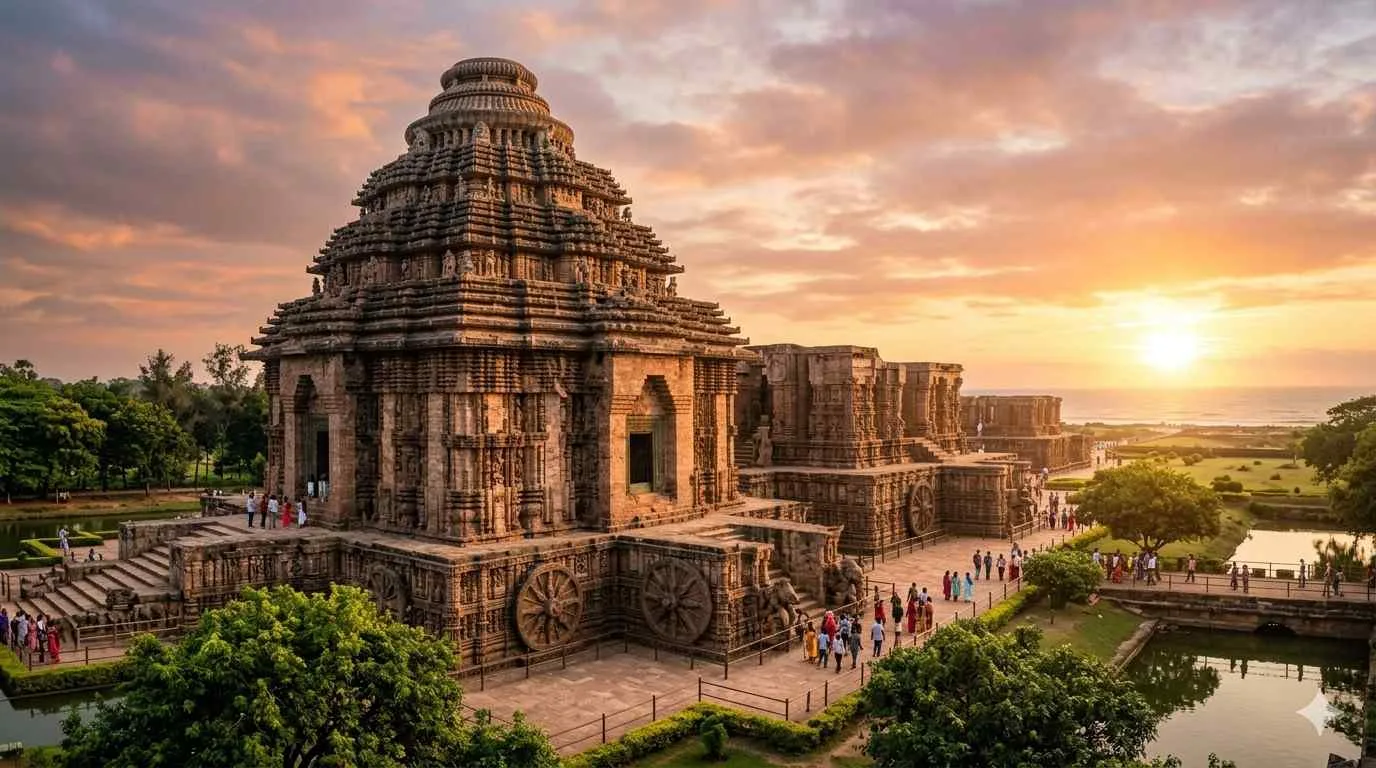
[image: 🌅] Konark Sun Temple — Where Stone Speaks the Language of Eternity There are buildings that shelter human beings from the elements.
[image: 🌅] Konark Sun Temple — Where Stone Speaks the Language of Eternity
There are buildings that shelter human beings from the elements.
There are monuments that commemorate human achievement.
And then — rising very rarely across the span of human civilization — there are sacred structures that are themselves scriptures. Stone and geometry arranged not merely to impress the eye but to transmit, across centuries and millennia, the deepest truths that a civilization has discovered about the cosmos, about time, about the divine, and about the human soul's journey through both.
The Konark Sun Temple of Odisha is such a structure.
Standing on the northeastern coast of India at the edge of the Bay of Bengal, in the ancient sacred region of Odisha — the land of Lord Jagannath — the Konark Sun Temple rises from the earth as a colossal stone chariot of the Sun God (Surya). It is simultaneously an astronomical instrument of breathtaking precision, an encyclopedia of Vedic philosophy rendered in stone, a monument to the devotion of an entire civilization, and a mystery so deep that more than seven centuries after its construction, scholars, architects, and spiritual seekers continue to find new layers of meaning within its carved surfaces.
UNESCO recognized it as a World Heritage Site in 1984. Ancient Arab and European sailors called it the "Black Pagoda" — using its towering dark stone spire as a navigational landmark from the sea. Indian tradition calls it Arka Kshetra — the sacred land of the Sun. And the local Odia people, generation after generation, have called it simply by its ancient name:
Konark — from Kona (corner/angle) and Arka (the Sun) — "The Sun at the Corner of the World."
At HinduTone, we offer you the most complete, spiritually rich account of the Konark Sun Temple — its mythological origins, its extraordinary architecture, every layer of its hidden symbolism, the tragic and triumphant story of its construction, the mystery of the magnetic loadstone, the sacred science encoded in its 24 wheels, and the timeless spiritual wisdom it continues to transmit to every seeker who stands before it.
[image: 📅] Konark Sun Temple — Sacred Facts at a Glance
[image: 🌞] The Mythology of Konark — Why the Sun Temple Was Built Here
The Sacred Story of Samba — Lord Krishna's Son and the Curse
The mythological origin story of the Konark Sun Temple begins not with King Narasimhadeva in the 13th century but in the divine age — with Samba, the beloved son of Lord Krishna and his wife Jambavati.
Samba was extraordinarily handsome — renowned throughout the three worlds for his physical beauty, which was said to rival even that of Lord Kamadeva (the god of love) himself. This beauty became the source of his terrible downfall.
One day, Samba entered a pond where a group of sage-wives (rishi-patnis) were bathing. The sages, returning from their meditations, discovered Samba's inappropriate presence among their wives. Infuriated by this transgression of the most sacred codes of conduct, the sages uttered a devastating curse upon Samba:
"You who are so proud of your beauty — let that beauty be destroyed. May your entire body be afflicted with the most terrible disease — may leprosy consume you completely."
The curse took immediate effect. Within days, Samba's glorious body was ravaged by leprosy — patches of white, scaly skin spreading across his face, his arms, his entire form. The beautiful prince who had caused the offense through his pride in physical perfection was now hideous even to look upon.
Samba, in despair and shame, retreated from Dwaraka to the forests. He wandered in grief until he reached the sacred land of Mitravana on the banks of the Chandrabhaga River — the very spot where modern Konark stands. There, guided by divine inspiration, he performed an extraordinary tapasya (austerity) in honor of Lord Surya (the Sun God) — the lord of health, radiance, and the destroyer of all disease and darkness.
Twelve Years of Tapasya — The Sun God's Grace
For twelve years, Samba stood in the Chandrabhaga River every day at the precise moment of sunrise — facing the rising sun with his arms raised in prayer, standing waist-deep in the flowing sacred water, chanting the Surya Namaskara mantras and the Aditya Hridayam (the Heart of the Sun) without break.
Twelve years of daily, unbroken devotion in the cold river at the edge of the Bay of Bengal.
At the end of twelve years, Lord Surya himself descended from his solar chariot in a blaze of divine light so intense that the entire sky turned golden. He stood before the emaciated but spiritually transformed Samba and spoke:
"O Samba, son of Krishna — you have pleased me beyond measure with your twelve years of unbroken devotion. Ask for any boon."
Samba asked only for the restoration of his health — and in that instant, every trace of leprosy vanished from his body. His beauty was restored — more radiant than before, illuminated now from within by the light of genuine devotion.
But Surya then gave Samba an additional gift — a sacred Surya idol (some traditions say carved from the wood of a sacred tree, some say made from the Shankhachurna stone retrieved from the Chandrabhaga River). Surya instructed Samba:
"Build a temple to me here — on this sacred ground where you have worshipped for twelve years. This place shall be known as Arka Kshetra forever. All those who are afflicted with disease, suffering, or the darkness of ignorance — who come here and worship me with devotion — shall be healed and illuminated, just as you have been."
Samba returned to Dwaraka, received his father Lord Krishna's blessing, and built the first Surya temple at Mitravana (Konark) — the Sambapanchami Temple, considered the founding shrine of what would eventually become, a thousand years later, the great Konark Sun Temple built by King Narasimhadeva.
This foundational myth encodes a profound spiritual teaching: The Sun, in Hindu cosmology, is not merely a star. He is the supreme healer, the lord of consciousness, the destroyer of the darkness of ignorance and disease. Just as sunlight kills bacteria and dispels the literal darkness of night — Surya's grace dissolves the karmic "diseases" of the soul.
The Sacred Geography — Why This Exact Spot?
The choice of Konark's location is not accidental — it reflects the ancient Hindu science of sacred geography (Vastu Purusha Mandala):
- The Chandrabhaga River — where Samba performed his tapasya — meets the Bay of Bengal exactly here. The confluence of river and ocean is always considered supremely sacred in Hindu tradition.
- Konark sits on the same sacred axis as Puri — 35 km to the southwest. Puri is the abode of Lord Jagannath (Vishnu). Konark is the abode of Surya. The two temples together form one component of a sacred triad completed by the Bhubaneswar Lingaraja (Shiva). Together — Surya, Vishnu, and Shiva — they represent the Trimurti (divine trinity) mapped onto the landscape of Odisha.
- The northeastern direction — where Konark stands relative to Puri — is the Ishanya corner in Vastu Shastra, the direction of divine knowledge and cosmic intelligence. The placement of a Sun Temple — the giver of knowledge and illumination — precisely in this corner of the sacred triad is a deliberate act of cosmic architecture.
- The precise latitude of Konark (19.9°N) means that on the equinoxes (March 21 and September 21), the rising sun shines directly through the eastern entrance of the temple onto the main deity — a feat of astronomical alignment comparable to Egypt's Abu Simbel or England's Stonehenge.
[image: 👑] King Narasimhadeva I — The Builder Who Moved Mountains
The Historical Context
The 13th century was one of the most turbulent periods in Indian history. The subcontinent was being reshaped by waves of conquest — the Delhi Sultanate under successive rulers was pushing deeper into the heart of India. The Eastern Ganga dynasty of Odisha — guardians of the great Jagannath tradition at Puri — was one of the few Hindu kingdoms successfully resisting these incursions.
King Narasimhadeva I (ruled 1238–1264 CE) was the greatest monarch of this dynasty — a warrior of extraordinary courage and a devotee of the Sun God. After his decisive victory over the Bengal Sultanate — repelling a major Muslim invasion of Odisha — he decided to build the greatest Sun Temple the world had ever seen, in gratitude to Lord Surya for his protection in battle, and as an eternal monument to the glory of Odia civilization.
He commissioned the finest architects, sculptors, and craftsmen from across India. The project would take 12,000 workers (some accounts say 1,200 master craftsmen with thousands of assistants) and twelve years to complete — the same sacred number as Samba's tapasya. The chief architect chosen for this impossible task was the legendary Bishu Maharana — whose brilliance and whose personal tragedy are inseparable from the story of the temple itself.
The Legend of Bishu Maharana and Dharmapada — The Boy Who Saved Everything
This is the most heartbreaking and most beloved story associated with the Konark Sun Temple — the story of a father's fear and a son's sacrifice.
Bishu Maharana was the supreme master architect (Sthapati) appointed by King Narasimhadeva to oversee the entire construction. He was a genius — versed in the Vastu Shastra texts, in astronomy, in stone-working — a man who had spent his entire life studying the sacred science of temple architecture.
Under his direction, 12,000 workers labored for twelve years, shaping the extraordinary chariot-temple stone by stone. Every worker, every supervisor, every sub-architect lived on-site — completely devoted to this singular purpose.
But as the temple neared completion — when all the carvings were done, all the walls raised, all the sculptures in place — one problem remained unsolved: the massive capstone (kalasha) at the very top of the main shikhara could not be placed. Every time workers attempted to position it, the entire structure would become unbalanced — threatening to collapse. Multiple attempts failed. The magnetic properties of certain stones in the construction, combined with the extraordinary weight distribution of the massive structure, created an engineering problem that none of the 12,000 workers or their master Bishu Maharana could solve.
The king grew impatient. Days became weeks. Weeks stretched toward months. The deadline for the temple's consecration — which had to occur on a specific astronomically auspicious date — was approaching. If the capstone was not placed by that date, years of work might be lost. The king threatened severe punishment for failure.
Bishu Maharana — the greatest architect of his age — sat in despair. He knew the mathematics. He understood the stone. But the solution eluded him.
Dharmapada — The Twelve-Year-Old Who Knew
Bishu Maharana had a twelve-year-old son named Dharmapada — a boy of extraordinary intelligence who had grown up listening to his father discuss every architectural problem of the temple from his earliest childhood. Dharmapada had never been to the construction site — children were not permitted in the sacred work zone — but he had absorbed, from his father's nightly conversations, a complete understanding of every aspect of the temple's structure.
One night, as Bishu Maharana sat in silence unable to sleep, Dharmapada approached him.
"Father — I know the solution to the capstone problem," the boy said quietly.
Bishu Maharana looked at his son with exhausted eyes. But something in the boy's calmness made him listen.
Dharmapada described the precise angle, the exact weight distribution, the specific placement that would allow the capstone to be seated correctly — solving in a few sentences the problem that had defeated 12,000 workers and their master for weeks.
Bishu Maharana wept. He embraced his son. And then the terrible thought came to him.
If a twelve-year-old boy could solve what 12,000 workers could not — the king would question why it had taken so long. Worse — the king would want to know who had solved it. And if it became known that a child had solved what the master architect could not, Bishu Maharana feared that the king, in his displeasure, might demolish the temple and rebuild it — or worse, punish all the workers for the delay.
He was frozen by fear — afraid for the temple, afraid for the thousands of workers who had given twelve years of their lives to this project, afraid for his own reputation.
Dharmapada understood his father's unspoken fear.
The next morning, before the workers arrived, Dharmapada climbed alone to the top of the temple — carrying the capstone solution in his hands and in his heart. He positioned the capstone himself, with the precision of his father's genius inherited in full.
And then — Dharmapada jumped from the top of the temple into the sea.
He gave his life so that no one would ever know how the capstone was placed. His sacrifice removed every question, every suspicion, every possibility of the king's wrath falling on the workers or his father.
The workers arrived to find the capstone perfectly in place — and no sign of who had placed it. The temple was complete.
The story of Dharmapada is told and retold in Odisha — in songs, in plays, in schools, in temples. There is no monument to him at Konark. There is no inscription bearing his name. But among the Odia people, his story lives as powerfully as the temple itself.
The temple that took 12,000 hands twelve years to build — was completed by the invisible hands of a twelve-year-old boy who loved it enough to die for it.
Spiritual Teaching: The Konark Sun Temple was built by collective human aspiration — the dreams of a king, the genius of an architect, the labor of thousands. But it was completed by something none of these could provide alone: selfless sacrifice. The greatest sacred monuments of humanity are always finished by love.
[image: 🏛️] The Architecture — A Cosmic Chariot in Stone
The Concept: The Chariot of the Sun God
The entire Konark Sun Temple is conceived and executed as the divine chariot of Lord Surya — the vehicle in which the Sun God traverses the sky every day from dawn to dusk, carrying light and life to every corner of the universe.
In the Vedic texts, Surya's chariot is described in precise detail:
- Drawn by 7 horses (representing the 7 colors of visible light / 7 days of the week)
- Rolling on 12 pairs of wheels (the 12 months of the year) — 24 wheels total
- The chariot moves at the speed of light, carrying the god across the sky from east to west
The Konark temple translates this cosmic description into stone architecture with breathtaking literalism and astronomical precision.
The Three Structures of the Original Temple
The original Konark Sun Temple consisted of three interconnected structures:
1. The Deul (Main Sanctum Tower / Shikhara)
- Original height: approximately 68 meters (225 feet)
- Shaped like a mountain rising from the earth — the cosmic Mount Meru at the center of the universe
- The main sanctum where the primary idol of Lord Surya stood
- Now collapsed — only the base remains
- The collapse is attributed to various causes: the removal of the magnetic loadstone (see below), the salt air of the Bay of Bengal over centuries, and possible deliberate vandalism
2. The Jagamohana (Audience Hall / Porch)
- Current height: approximately 38 meters (128 feet) — the tallest surviving structure
- Where devotees gathered to witness the deity's worship
- Its pyramidal roof creates a distinctive silhouette against the Odia sky
- Now sealed with sand from the inside (filled by British engineers in 1903 to stabilize the structure) — visitors see only its exterior magnificence
3. The Natya Mandapa (Dance Hall)
- A separate structure to the east of the main temple
- Where temple dancers (Devadasis trained in Odissi) performed their sacred dances for the deity
- Now a partially standing ruin — but enough remains to understand its extraordinary scale
The 24 Wheels — A Calendar of Sacred Time
The most celebrated feature of the Konark Sun Temple — and the image that appears on the Indian national currency (the 10-rupee note) and the Odisha state emblem — is its 24 carved stone wheels, each approximately 3 meters in diameter, arranged in pairs along the base of the temple plinth.
These wheels are not decorative. They are a complete sacred timepiece — a stone calendar encoding the ancient Hindu understanding of cosmic time.
The 24 Wheels as 24 Hours
The most immediate interpretation: the 24 wheels represent the 24 hours of a single day — the complete cycle of the Sun from midnight to midnight. This is the chariot of the Sun, and its 24 wheels carry it through 24 hours.
The 24 Wheels as 24 Fortnights (Paksha)
The Hindu calendar divides each month into two fortnights — Shukla Paksha (waxing fortnight) and Krishna Paksha (waning fortnight). A year has 24 such fortnights. The 24 wheels thus represent the complete annual cycle — the Sun chariot completing one journey around the year.
The 8 Spokes of Each Wheel as Praharas
Each of the 24 wheels has 8 spokes. In the traditional Hindu division of the day, a day and night is divided into 8 praharas (periods of approximately 3 hours each). The 8 spokes of each wheel therefore mark the 8 divisions of the day — creating a complete sundial.
And indeed — the wheels function as actual sundials. The shadow of each spoke on the circular rim of the wheel indicates the time of day with remarkable precision. On a clear day at Konark, you can tell the time to within approximately 15 minutes by reading the shadow pattern of the spokes.
The Intricate Carvings of Each Wheel
Every single spoke and rim section of each wheel is covered with extraordinarily detailed carvings depicting every aspect of human life:
- Figures of men and women in daily activity — farming, cooking, hunting, music
- Romantic couples (mithuna figures) — celebrating the joy of human love
- Animals and nature — elephants, horses, serpents, birds
- Celestial beings — apsaras (divine dancers), gandharvas (divine musicians), yakshas, kinnaras
- Battle scenes and royal processions
- Geometric patterns encoding mathematical relationships
This encyclopedic depiction of all aspects of life on the wheel of the Sun chariot encodes one of the deepest teachings of Hindu philosophy:
All of life — every joy and sorrow, every birth and death, every moment of love and loss — is contained within the revolution of the Sun's wheel. The cosmos does not stand apart from life. Life IS the cosmos spinning.
The 7 Horses — The Spectrum of Light and Time
Seven massive stone horses — in full gallop, straining forward with extraordinary energy and realism — are carved pulling the Sun chariot. Of the original seven, two remain in relatively good condition at the eastern entrance; the others have been damaged or lost.
The seven horses carry multiple layers of symbolic meaning:
1. The Seven Colors of Visible Light (VIBGYOR) Surya's chariot is pulled by seven horses representing the seven colors of the rainbow — the spectrum of visible light that the Sun contains and distributes. The splitting of light into seven colors through a prism — known to modern science — was encoded in Hindu cosmology thousands of years ago as the seven horses of Surya's chariot.
2. The Seven Days of the Week Each horse governs one day of the week — Sunday (Surya), Monday (Soma), Tuesday (Mangal), Wednesday (Budha), Thursday (Guru), Friday (Shukra), Saturday (Shani). The Sun's chariot drawn by all seven horses carries the entire week in a single journey.
3. The Seven Sacred Meters of Vedic Poetry (Chandas) Gayatri, Ushnik, Anushtup, Brihati, Pankti, Trishtup, and Jagati — the seven primary poetic meters of the Rigveda — are associated with the seven horses, encoding the idea that the Sun's movement through the sky is itself a form of sacred poetry, a cosmic mantra spoken continuously.
4. The Seven Planes of Consciousness The Vedic understanding of consciousness as existing in seven planes — from gross physical awareness to the deepest samadhi — is mapped onto the seven horses, each representing one ascending level of awareness.
The Three Surya Idols — The Sun at Three Times of Day
One of the most remarkable features of the original Konark Temple was the arrangement of three large stone idols of Lord Surya at three specific positions on the temple walls — oriented to receive the direct light of the sun at three different times of day:
The eastern idol shows Surya with a serene, youthful expression — the dawn of life.
The southern idol shows Surya in full divine authority — the noon of life.
The western idol shows Surya with a slightly meditative expression — the evening of life.
Together, the three Surya idols map the three great phases of human life — youth, maturity, and old age — onto the three positions of the Sun in the sky. Standing before these three idols at Konark is not merely a religious act but a philosophical meditation on the nature of time and existence.
Each human life is a single revolution of the Sun's chariot — from the rising of birth to the setting of death, with the full glory of the noon-sun in between. Worship Surya and you worship the cosmic pattern within which every human life is lived.
[image: 🔮] The Hidden Symbolism — Layers Within Layers
The genius of the Konark Sun Temple lies in its multi-layered symbolism — each feature of the temple carries meaning simultaneously at multiple levels, from the immediately visible to the deeply esoteric.
The Temple as the Human Body (Vastu Purusha)
In the Vedic architectural tradition, every temple is conceived as the Vastu Purusha — the "cosmic person" lying within the sacred ground. The temple is the body of the Divine Being mapped onto stone.
At Konark:
- The main shikhara (tower) = the head of the cosmic person — reaching toward the heavens
- The Jagamohana = the chest — where the gathered devotees (the breath of the temple) reside
- The Natya Mandapa = the feet — where dance (life force, movement) originates
- The 24 wheels = the organs of perception — the senses by which the cosmic being experiences the world of time
The 1200 Elephants at the Base — Stability on the Foundation of Strength
The lowest plinth (base platform) of the Konark temple is decorated with a continuous frieze of elephants — over 1,200 in number, each slightly different, arranged in a continuous procession around the entire base.
The elephant represents stability, strength, and groundedness in Hindu iconography. The Lord Ganesha connection is also present — Ganesha (the elephant-headed god, remover of obstacles) is always honored at the base of sacred structures.
The 1,200 elephants at the base of the Konark temple encode this teaching: the cosmos is sustained by strength and stability. The Sun's chariot does not float in an empty void — it is grounded in the reality of the earth, stable and powerful like the elephant's tread.
The Erotic Sculptures (Mithuna) — The Sacred Meaning of Desire
One of the most discussed — and most misunderstood — features of the Konark Sun Temple is the presence of extraordinarily explicit erotic carvings (Mithuna figures) on the outer walls, particularly at the upper levels.
These sculptures — depicting couples in various stages of romantic embrace and lovemaking with extraordinary artistic beauty and anatomical detail — have puzzled, scandalized, and fascinated visitors for centuries. Multiple interpretations exist:
Interpretation 1: The Progression of the Temple Experience
The erotic carvings are placed on the outer walls — the exterior of the sacred space. As a devotee moves from the outer walls inward toward the sanctum, the carvings change progressively:
- Outermost layers: scenes of desire, sensual life, worldly experience
- Middle layers: scenes of devotion, music, celestial beings
- Innermost sanctum: the pure presence of the deity — beyond all form and desire
The journey from the outer erotic carvings to the inner sanctum maps the spiritual journey itself: from the pull of sensory desire (the outer world) to the silence of pure consciousness (the inner sanctum). You physically walk through the stages of spiritual evolution as you enter the temple.
Interpretation 2: Kama as a Sacred Force
Hindu philosophy recognizes Kama (desire/love) as one of the four Purusharthas — four legitimate goals of human life — alongside Dharma (righteousness), Artha (prosperity), and Moksha (liberation). The Mithuna carvings celebrate Kama not as something shameful to be hidden but as a sacred dimension of existence — a divine force to be expressed with beauty, artistry, and reverence.
The Sun God is the source of all life — and all life propagates through the force of desire. The erotic carvings at a Sun Temple are thus cosmologically appropriate — Surya's warmth is itself what makes reproduction, growth, and the continuation of life possible.
Interpretation 3: Protection Against Lightning
Some scholars of Vastu Shastra and temple architecture suggest that the Mithuna figures had a protective function — the erotic energy they represent was believed to attract and dissipate destructive lightning strikes, protecting the sacred structure from nature's violence.
Interpretation 4: Tantric Philosophy
From a Tantric philosophical perspective, the Mithuna carvings represent the union of Shiva and Shakti — the masculine and feminine principles of the cosmos — whose eternal embrace IS the universe. The Tantric tradition sees the divine as fundamentally an act of cosmic love-union — and these carvings are its most explicit expression in stone.
The Magnetic Loadstone — The Greatest Mystery of Konark
Perhaps the most extraordinary and most debated feature of the original Konark Sun Temple is the legendary magnetic loadstone (Adamant/Lodestone) — a massive magnetized stone said to have been placed at the very apex of the main shikhara.
According to historical accounts — from medieval Arab traders, Portuguese sailors, and Indian chronicles — the original temple had a powerful magnet at its peak. This magnet was so strong that it:
- Kept the main Surya idol suspended in mid-air — floating within the sanctum without any visible support — through magnetic levitation
- Drew iron ships from the sea toward the coast, causing them to run aground — which is one reason ancient sailors feared this coastline and kept their distance
- Created a permanent alignment of the temple's entire iron-and-stone structure
The Portuguese are said to have removed this magnet in the 16th century — either to help their ships navigate safely or to destabilize the temple. The removal of the magnet, according to some accounts, disrupted the carefully calibrated magnetic balance of the entire structure — triggering the eventual collapse of the main shikhara.
Whether the floating idol was literal levitation or a more subtle form of alignment — the story of the magnetic loadstone speaks to an extraordinary ancient knowledge of magnetic forces that still awaits complete understanding.
Seven centuries later, we are still asking: how did the ancient builders of Konark know what they knew? What science, what spiritual understanding, encoded in the language of sacred architecture, allowed them to create something so technically precise, so astronomically aligned, so magnetically sophisticated — with the tools of the 13th century?
[image: 🌅] The Astronomical Precision of Konark
The Konark Sun Temple is one of the world's most precise ancient astronomical instruments.
Solar Alignments
Equinox Alignment (March 21 & September 21): On the spring and autumn equinoxes, the rising sun shines in a perfect straight line through the eastern entrance, through the Jagamohana, directly onto the face of the main Surya idol in the sanctum — a feat of astronomical alignment requiring extraordinary precision in the placement of every wall and doorway.
Solstice Alignments (June 21 & December 21): On the summer and winter solstices, the sunlight enters through specifically positioned windows at precise angles — casting patterns of light and shadow on the interior walls that function as seasonal markers.
Daily Sundial Function: The 24 carved wheels function as precision sundials throughout the day. The shadow cast by each wheel's spokes on the wheel's rim indicates the time of day to within approximately 15 minutes.
The Orientation of the Temple
The temple faces east — directly toward the rising sun — with the main entrance aligned to the first light of dawn. This is standard for Surya temples, but Konark's alignment is exceptional in its precision:
The temple is oriented at exactly 90 degrees to the equinoctial sunrise — meaning that on the equinoxes, the sunrise light travels perfectly straight along the temple's central axis, from the entrance through the hall to the sanctum.
Constellations and Nakshatras in Stone
The sculptural program of the Konark temple includes detailed depictions of all 27 Nakshatras (lunar mansions) and 12 Rashis (zodiacal signs) — carved in specific positions that correspond to their actual astronomical relationships.
The entire outer wall of the temple, when read as a single unified text, functions as a stone Panchangam — an annual almanac encoding the complete astronomical knowledge of 13th-century India.
[image: 🛕] The Three Suryas — Complete Iconography of the Sun God
The Surya idols at Konark are among the finest examples of Surya iconography in all of India. Understanding their iconography deepens the experience of the temple enormously.
Standard Surya Iconography
Lord Surya is always depicted with specific features that encode his divine nature:
The Three Konark Suryas in Detail
Udaya Surya (Dawn):
- Right foot forward, weight forward — moving, energetic, arriving
- Expression: serene, hopeful, full of the freshness of new beginning
- Receives direct light at the moment of sunrise — the idol literally glows in the first light of day
Madhyana Surya (Noon):
- Standing in perfect balance — both feet equally planted
- Expression: commanding, powerful, fully present
- Receives the vertical noon sun — at the peak of illumination
Asta Surya (Evening):
- Slightly weight shifted back — the posture of one preparing to rest
- Expression: reflective, deep, carrying the accumulated wisdom of the day
- Receives the golden evening light — at the most beautiful moment of illumination
[image: 🎭] The Natya Mandapa — Where Dance Was a Sacred Science
The Natya Mandapa (dance hall) of the Konark Sun Temple was not a performance space in the modern sense. It was a sacred ritual space where the ancient science of Odissi dance was performed as an act of direct worship — where trained temple dancers (Maharis) offered their art as the highest possible human gift to Lord Surya.
Why Dance is a Form of Worship at Konark
The Vedic texts state that Lord Surya takes particular delight in sacred dance — because dance, like the movement of the Sun itself, is time made visible. The dancer's body moving through space is a microcosmic reflection of the Sun's chariot moving through the sky.
The 24 wheels of Konark are the cosmic clock.
The Odissi dancer moving within the Natya Mandapa is the human clock — the mortal mirror of the Sun's eternal dance.
The Natya Mandapa's outer walls are covered with carvings of dancers in every possible pose — all 108 karanas (movement positions) from the Natyashastra (the ancient Indian treatise on performing arts) are represented. This makes the Natya Mandapa walls the most complete visual textbook of classical Indian dance in existence.
[image: 🌊] The Collapse — Why the Main Tower Fell
The main Deul (shikhara) of the Konark Sun Temple collapsed sometime between the 16th and 18th centuries. The exact cause remains debated — but multiple factors contributed:
1. Removal of the Magnetic Loadstone: The magnetic stone at the apex, which may have regulated the structural balance of the entire iron-and-stone construction through magnetic forces, was reportedly removed by Portuguese sailors in the 16th century. This destabilized the delicate equilibrium of the upper structure.
2. Salt Air from the Bay of Bengal: The temple stands barely a kilometer from the sea. Centuries of salt-laden air weakened the stone and mortar gradually, particularly affecting the upper portions most exposed to the elements.
3. Possible Deliberate Vandalism: Some historical accounts suggest deliberate destruction — either by Mughal forces or by Muslim governors of the Deccan — though this remains disputed.
4. The Removal of the Sanctum Deity: The main Surya idol was reportedly removed from the sanctum and taken to Puri for safekeeping — some traditions say it is now worshipped within the Jagannath Temple complex at Puri. The removal of the deity from the sanctum, in the Vastu tradition, is believed to cause the slow spiritual "dimming" of a temple's structural energy.
5. The Temple's Own Magnetic Architecture: Some modern engineers suggest that the extraordinary iron beams used in the temple's construction (which have resisted corrosion for 700+ years through an ancient metallurgical technique still not fully understood) may have contributed to eventual structural stress as the magnetic equilibrium was disturbed.
[image: 🌺] The Konark Dance Festival — Living Tradition of Sacred Art
Every year in December, the Konark Dance Festival transforms the ancient temple into a living stage — with the great stone chariot as the backdrop and the finest classical dancers of India performing under the open sky and stars.
Classical dance forms performed at the festival:
- Odissi — the sacred dance form born in the Jagannath and Konark temple traditions
- Bharatanatyam — the ancient temple dance of South India
- Kathak, Manipuri, Kuchipudi, Mohiniattam, Sattriya — all eight classical forms of India
When Odissi dancers perform before the Konark temple at night — their movements mirroring the carvings on the walls above them — the experience is nothing short of mystical. The stone dancers of the 13th century and the living dancers of the 21st century breathe together in the same sacred rhythm.
[image: 🙏] The Spiritual Teachings of Konark — What the Temple Tells Every Seeker
Teaching 1: Time is Sacred
The entire Konark temple is a meditation on time — the 24 hours encoded in 24 wheels, the 12 months in 12 pairs, the 7 days in 7 horses, the 3 phases of life in 3 Surya idols. The Sun Temple does not teach that time is an enemy to be escaped. It teaches that time is the divine chariot itself — the vehicle in which the cosmic drama of existence unfolds.
Every moment of every day is Surya's wheel turning. To be conscious within time — not lost in regret about the past or anxiety about the future, but fully present in the turning wheel of now — is the Sun God's deepest teaching.
Teaching 2: All of Life is Equally Sacred
From the erotic Mithuna carvings to the ascetic meditating figures, from the battle scenes to the musicians, from the elephants to the celestial dancers — every dimension of life is carved with equal care, equal artistry, equal sanctity on the walls of the Konark Sun Temple.
This is the Vedic philosophy made visible in stone: there is no part of life that is not the Sun's domain, not Surya's gift, not worthy of celebration. The sacred and the secular are not opposites at Konark — they are the same cloth woven into endlessly varied patterns by the same divine hand.
Teaching 3: Beauty is a Form of Truth
The extraordinary artistic beauty of Konark — the perfection of its proportions, the exquisite detail of its carvings, the grace of its stone figures — is not decoration. It is a philosophical statement:
Truth is beautiful. Beauty is truth. The highest philosophy, when fully realized, expresses itself as beauty — as art, as dance, as sacred architecture — because the Divine, in all its expressions, is fundamentally beautiful.
This is why Hindu temples are not spare, austere, minimalist structures. They are overflowing with beauty — because the divine reality they celebrate is itself overflowing with beauty.
Teaching 4: Light Conquers All Darkness
The Sun is the eternal enemy of darkness — not through violence but through simple presence. The moment the Sun rises, darkness does not flee — it simply ceases to be, because light and darkness cannot coexist in the same space.
This is the Vedic understanding of spiritual practice: the solution to the darkness of ignorance is not to fight ignorance but to bring the light of knowledge. Not to battle desire with repression but to illuminate it with understanding. Not to overcome fear with courage alone but to see through fear with wisdom.
Lord Surya does not conquer the night. He simply arrives — and the night dissolves.
Stand in the light of Konark, let the Sun warm your face, and feel what every pilgrim has felt for seven centuries: the warmth of the cosmos itself, welcoming you home.
[image: 🌞] Surya Worship at Konark — Rituals and Mantras
The Surya Namaskara — Sun Salutation
The ancient practice of Surya Namaskara (Sun Salutation) — now widely known through modern yoga — originated as a spiritual practice of offering the body itself as a tribute to the Sun God. The 12 positions of the Surya Namaskara correspond to the 12 zodiacal positions of the Sun through the year.
Each position has its own Surya mantra:
The Gayatri Mantra — The Supreme Prayer to the Sun
The Gayatri Mantra — the most sacred mantra of the Vedic tradition, chanted billions of times across thousands of years — is addressed directly to Lord Surya in his aspect as the divine light of consciousness:
ॐ भूर्भुवः स्वः।
तत्सवितुर्वरेण्यम्।
भर्गो देवस्य धीमहि।
धियो यो नः प्रचोदयात् ॥
Om Bhur Bhuvah Svah
Tat Savitur Varenyam
Bhargo Devasya Dhimahi
Dhiyo Yo Nah Prachodayat
Complete Meaning: Om — the primordial sound. We meditate upon the divine light (bharga) of that adorable (varenyam) Sun (Savitur) who illumines (prachodayat) the three worlds (bhur, bhuvah, svah). May that divine light illuminate our intellect (dhiyo).
This is not simply a prayer for the physical Sun. The Savitur addressed in the Gayatri is the inner Sun of consciousness — the light of awareness itself — that illumines the mind from within just as the physical Sun illumines the world from without.
Chanting the Gayatri Mantra at Konark at sunrise — as the first rays of the Sun strike the temple's eastern face — is one of the most powerful spiritual experiences available to a human being.
Aditya Hridayam — The Heart of the Sun
The Aditya Hridayam — the 31-verse hymn from the Valmiki Ramayana — was taught to Lord Rama by the sage Agastya on the battlefield of Lanka when Rama was exhausted and despairing before his battle with Ravana. Agastya appeared and taught Rama this hymn to Surya, promising that chanting it would give Rama the strength and divine blessing to defeat Ravana.
This is the same hymn that Samba chanted for twelve years in the Chandrabhaga River at Konark.
Opening verses:
ततो युद्धपरिश्रान्तं समरे चिन्तया स्थितम्।
रावणं चाग्रतो दृष्ट्वा युद्धाय समुपस्थितम् ॥
दैवतैश्च समागम्य द्रष्टुमभ्यागतो रणम्।
उपागम्याब्रवीद्रामं अगस्त्यो भगवानृषिः ॥
Tato yuddhaparishrantam samare chintaya sthitam
Ravanam chagrato drishtva yuddhaya samupasthitam
[image: 🗺️] Visiting Konark Sun Temple — Complete Practical Guide
How to Reach Konark
From Puri (35 km):
- Regular bus service from Puri Bus Stand (1 hour)
- Auto-rickshaw or taxi (45 minutes)
- The Puri–Konark Marine Drive is one of the most scenic coastal roads in India
From Bhubaneswar (65 km):
- Direct bus from Bhubaneswar Bus Terminal (2 hours)
- Taxi or cab (1.5 hours via NH316)
- Part of the Golden Triangle of Odisha tourism circuit
From Kolkata (500 km):
- Train to Puri (6 hours), then bus/taxi to Konark
- Flight to Bhubaneswar, then road to Konark
Best Time to Visit
Temple Timings and Practical Information
The Sound and Light Show
Every evening, the Konark Sun Temple becomes the backdrop for a stunning Sound and Light Show — narrating the temple's history, mythology, and symbolism through projected light and a dramatic narrative. Watching the story of Dharmapada unfold against the ancient stone walls under the stars is an experience of extraordinary power.
[image: 🌟] The Konark Sacred Triangle — Three Temples, One Universe
The Konark Sun Temple does not stand alone in sacred isolation. It is part of a sacred triad — the Puri-Bhubaneswar-Konark Triangle — three temples representing the Hindu Trimurti mapped onto the landscape of Odisha:
Pilgrims who visit all three temples complete a sacred circuit that honors all three aspects of the divine — the sustainer (Vishnu), the transformer (Shiva), and the illuminator (Surya). Together, the three temples represent the complete cosmology of existence: creation, preservation, dissolution — and the light of consciousness that witnesses all three.
[image: ✨] Standing Before Konark — The Experience That Changes You
There are places in the world that do something to you that is difficult to explain rationally.
You arrive at Konark — perhaps having seen photographs, having read the descriptions, having prepared yourself with historical and philosophical knowledge. You think you know what to expect.
And then you stand before it.
The scale hits you first — the immensity of the stone chariot rising from the flat Odia plain against the blue sky, the 24 wheels glowing in the morning light, the stone horses straining forward in permanent, frozen gallop. You feel suddenly very small — not in an uncomfortable way, but in the way that mountains make you feel small, or the ocean, or a clear night sky full of stars.
Then the details begin to emerge — the thousands of carvings covering every inch of stone, the impossible perfection of each individual figure, the mathematical precision of the wheel spokes, the energy radiating from the stone dancers who have been dancing in stone for seven hundred years.
And then — if you come at sunrise, if you sit quietly in the early morning light before the crowds arrive — something shifts. The stories you have read begin to feel less like history and more like truth. The stone begins to breathe. The wheels begin to turn — not physically, but in your awareness. The entire structure becomes what its builders always intended it to be: a teaching, a transmission, a direct pointing toward the light of consciousness itself.
Lord Surya does not need a temple to exist. The Sun rises every morning with equal indifference to whether anyone has built temples to honor him or not. But the temple exists for us — for the human heart that needs a physical anchor for the infinite, a visible metaphor for the invisible, a stone hymn to the light that is both outside in the sky and inside in the soul.
The Konark Sun Temple is that hymn. Seven hundred years old. Still singing.
Om Suryaya Namah | Om Adityaya Namah | Om Bhaskaraya Namah
[image: 📖] Frequently Asked Questions
Q1. Who built the Konark Sun Temple and when?
A: The Konark Sun Temple was built by King Narasimhadeva I of the Eastern Ganga Dynasty of Odisha between approximately 1238–1264 CE. Construction reportedly took 12 years and involved 12,000 workers. The chief architect was Bishu Maharana, whose son Dharmapada's sacrifice is inseparably woven into the temple's legendary history.
Q2. Why did the main tower of the Konark Sun Temple collapse?
A: The main shikhara (tower) collapsed sometime between the 16th and 18th centuries. Contributing factors include the removal of the magnetic loadstone at the apex (attributed to Portuguese sailors), centuries of salt air from the nearby Bay of Bengal, possible deliberate vandalism, and the structural consequences of removing the main deity from the sanctum. The surviving Jagamohana (audience hall) is filled with sand internally for structural stabilization.
Q3. What is the significance of the 24 wheels at Konark?
A: The 24 wheels represent multiple layers of meaning simultaneously: the 24 hours of a day, the 24 fortnights of a year, and function as actual precision sundials — the shadow of each wheel's 8 spokes on its rim indicates the time of day to within approximately 15 minutes. Each wheel is also an encyclopedic carving of all aspects of human life.
Q4. What was the magnetic loadstone at Konark?
A: According to historical accounts from Arab traders, Portuguese sailors, and Indian chronicles, the original temple had a massive magnetized stone (loadstone) at its apex. This magnet was so powerful it reportedly kept the main Surya idol suspended in mid-air through magnetic levitation and drew iron-hulled ships toward the coast. Its removal by the Portuguese in the 16th century is believed to have disrupted the structural balance of the temple.
Q5. Why are there erotic sculptures on a Hindu temple?
A: The Mithuna (erotic) carvings on the outer walls of Konark carry multiple layers of meaning. They represent Kama (desire/love) as one of the four legitimate goals of human life in Hindu philosophy. They map the spiritual journey — from outer sensory desire to inner divine silence — as a devotee moves from the outer walls into the sanctum. From a Tantric perspective, they represent the cosmic union of Shiva and Shakti. They are placed on the exterior, not the interior, of the sacred space — symbolizing the world of desire that the devotee is moving through and beyond.
Q6. What is the Samba legend connected to Konark?
A: According to the Samba Purana, Samba — the son of Lord Krishna — was cursed with leprosy by sages whose wives he had disrespected. He performed twelve years of tapasya in the Chandrabhaga River at Konark, worshipping Lord Surya. Surya appeared, healed his leprosy, and instructed him to build a temple at the spot. The first Surya temple at Konark was thus built by Samba — making the site sacred long before King Narasimhadeva's 13th-century construction.
Q7. What is the best time to visit Konark for a spiritual experience?
A: Sunrise is the most spiritually powerful time — arriving before 6 AM to watch the first light of the sun strike the eastern face of the temple. The equinoxes (March 21 and September 21) are especially significant — on these days, sunrise light travels directly along the temple's central axis, illuminating the interior in the way the original builders intended. December also offers the Konark Dance Festival — a unique combination of ancient sacred architecture and living classical dance.
© 2026 HinduTone.com | All Rights Reserved
www.hindutone.com — Your Trusted Guide to Hindu Spirituality, Temples, and Sacred Traditions
Related Posts You May Like:
- Utkala Dibasa 2026: The Complete Spiritual Story of Odisha and Lord Jagannath
- Puri Jagannath Temple: Mysteries, Miracles & Complete Spiritual Guide
- Char Dham Yatra 2026: The Complete Pilgrimage Guide
- Surya Jayanti 2026: The Festival of the Sun God — Significance & Rituals
- Odissi Dance: The Sacred Art Form Born in the Temples of Odisha
- Adi Shankaracharya: The Saint Who Walked All of India for Dharma
How to Reach — Travel Guide — Konark Sun Temple
✈️ By Flight
Biju Patnaik International Airport, Bhubaneswar (BBI, ~65 km) is the nearest. From the airport, taxis via Marine Drive take ~1.5 hours. Most travellers fly into Bhubaneswar and combine Konark with Puri.
🚂 By Train
Puri Railway Station (35 km, 45 min by taxi) and Bhubaneswar (65 km) are the nearest. There's no railway station at Konark itself. Trains to Puri/Bhubaneswar connect from Delhi, Mumbai, Chennai, Bengaluru, Kolkata.
🚌 By Bus
Konark Bus Stand is 1 km from the temple. OSRTC runs hourly Puri–Konark and Bhubaneswar–Konark services. Marine Drive buses (Puri–Konark) are scenic.
🚗 By Road / Car
On NH-316A. From Puri (35 km via the spectacular Marine Drive), Bhubaneswar (65 km), Cuttack (90 km). The Marine Drive is one of India's most beautiful coastal roads.
Best Places to Visit Near Konark Sun Temple
Combine your darshan at Konark Sun Temple with these well-known nearby attractions for a complete pilgrimage and travel experience:
Chandrabhaga Beach (3 km) — quiet golden beach where the Magha Saptami fair is held; sunrise is exceptional.
Puri Jagannath Temple (35 km) — the Char Dham; combine with Konark in a single circuit.
Bhubaneswar Lingaraj Temple (65 km) — the city of 1,000 temples; the Old Town shrines are essential.
Pipili (35 km en route to Bhubaneswar) — appliqué craft village; bright umbrellas and wall hangings.
Astaranga Beach (15 km) — sunset over the Bay of Bengal.
Ramachandi Temple (10 km) — ancient sea-facing Devi shrine on the Marine Drive.
All distances are approximate; please verify on Google Maps and check current road, weather and local conditions before travelling. For latest darshan timings and special pilgrim arrangements, refer to the temple's official authority website.
You might also like
Top 20 Sivalayam in USA: A Devotee's Guide to America's Most Sacred Shiva Temples (2026)
Shani Deva Temples Worldwide & Must-Performed Rituals — Complete Devotee's Guide

Head Priest — Hindu Society of Calgary, Alberta Canada | 2026 Cycle