Ranganathaswamy Srirangam: Divine Mysteries & Soul-Stirring Miracles of the Largest Functioning Hindu Temple
The largest functioning Hindu temple in the world by area — 156 acres, 21 gopurams, the cosmic body of Lord Vishnu reclining on Adi Shesha. Discover Sri Ranganathaswamy at Srirangam: origin, the Ramanuja connection, Vaikuntha Ekadasi, daily rituals, and the miracles of the sleeping god.
The largest functioning Hindu temple in the world by area — 156 acres, 21 gopurams, the cosmic body of Lord Vishnu reclining on Adi Shesha. Discover Sri Ranganathaswamy at Srirangam: origin, the Ramanuja connection, Vaikuntha Ekadasi, daily rituals, and the miracles of the sleeping god.
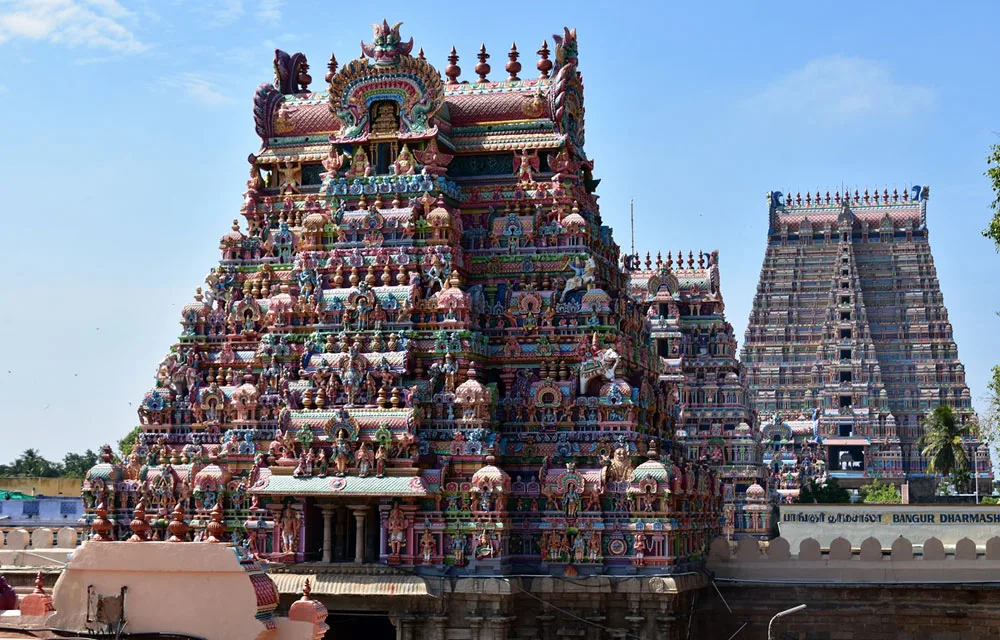
Between two arms of the Kaveri river, on an island the local people call Srirangam, stands the largest functioning Hindu temple in the world. One hundred and fifty-six acres of sanctified ground. Seven concentric walled enclosures — seven prakaras — within which an entire town lives, worships, and serves. Twenty-one towering gopurams piercing the sky, the tallest at 236 feet. And in the innermost sanctum, lying on the thousand-headed serpent Adi Shesha as he has for millennia, Lord Vishnu rests in cosmic sleep as Sri Ranganatha — the Lord of the Stage.
This HinduTone guide opens the temple-city of Srirangam: the cosmic story of how Vishnu came to recline here, the Ramanuja connection that made Srirangam the centre of Vaishnava theology, the Vaikuntha Ekadasi when the gates of heaven open for one day, the seven prakaras and their meaning, the daily rituals, and the soul-stirring miracles of the sleeping god who, the chronicles say, listens even when he appears to dream.
The Cosmic Story: How Lord Vishnu Came to Sleep on the Kaveri
The Sthala Purana of Srirangam describes the origin. The original Ranganatha murti — Lord Vishnu reclining on Adi Shesha — was worshipped in the celestial realm of Brahma. Lord Rama, after defeating Ravana, presented the murti to his ally Vibhishana, who wished to take it back to Lanka as the family deity of his rakshasa kingdom. Rama agreed, with one condition: once Vibhishana set the murti down on earth, it could never be moved.
Vibhishana began his journey south. When he reached the Kaveri river, he wished to perform his sandhya rituals and set the murti down — believing the condition only applied at the final destination. The moment the murti touched the earth, it became immovable. Vibhishana pleaded, prayed, threatened — the murti would not move. But Vishnu, taking pity on the rakshasa king's devotion, agreed to face south so he could perpetually look toward Lanka and bless Vibhishana's kingdom. The Ranganatha murti has faced south ever since — the only major Vishnu murti in India to do so.
The Kaveri river, witness to this cosmic decree, formed the natural island of Srirangam around the temple. The water never floods the sanctum, despite the temple lying within the river's active channel. Geologists explain the phenomenon as a fortunate alignment of channel and bedrock; devotees see it as the river's eternal honour to the Lord she protects.
The Living Sanctum: Seven Prakaras and the Reclining God
Srirangam is built as a seven-walled mandala. The pilgrim enters through the outermost gopuram and walks inward through six more enclosures before reaching the garbhagriha. Each prakara represents a level of cosmic ascent — from the everyday world of commerce and homes (outer prakaras) to the inner sanctum where the Lord lies on the cosmic serpent.
- Seven prakaras: total area 156 acres. The first three are open to all and contain shops, homes of priestly families, lesser shrines. The inner four are restricted to Hindus.
- 21 gopurams: the Raja Gopuram (south, 236 feet) is the tallest temple tower in the world. Completed in 1987 after centuries of construction.
- The main shrine: Lord Ranganatha reclines on the seven-hooded Adi Shesha, head pointed south, feet north — a 13-foot-long murti carved from a single block of stone.
- Goddess Ranganayaki has her own large shrine in a separate enclosure — She accepts darshan requests separately, an unusually independent positioning for a consort goddess.
- The Garuda Mandapam holds a 8-foot Garuda murti, facing Ranganatha, perpetually serving the sleeping Lord.
- The Hall of 1000 Pillars (actually 953 pillars) is one of the most architecturally significant in India — the central pillars are carved with rearing horses, riders, and mythological scenes that move when viewed from different angles.
The Ramanuja Connection: The Centre of Sri Vaishnava Theology
Of all the Vaishnava temples in India, Srirangam holds a unique theological position: it was here, in the 11th–12th century, that Sri Ramanuja codified the Vishishtadvaita Vedanta — qualified non-dualism — that became the foundation of the Sri Vaishnava sampradaya. Ramanuja came to Srirangam, organized the temple's administration into the system still used today, established the worship-protocol that the Archakas follow even now, and is preserved as a mummified body within the temple itself.
His samadhi in the fifth prakara contains his actual physical body, preserved through a process of saffron paste and herbal application for over 900 years. Devotees can take darshan of the seated Ramanuja exactly as he was at the moment of his samadhi — eyes open, hands in a teaching mudra, expression serene. The preservation is one of the most extraordinary in the world. The temple priests apply fresh saffron and herbs every six months.
Ramanuja's legacy permeates the temple: the daily rituals he prescribed, the sevas he organized, the prakara system he formalized, the role-divisions among the priestly families — all continue exactly as he set them. Srirangam is not just a temple but a living archive of one of Hinduism's deepest theological systems.
Daily Rituals: Worshipping the Sleeping God
Srirangam follows the Pancharatra Agama tradition — six full pujas a day, each one elaborate and lengthy. The temple opens at 6:00 am and closes at 9:00 pm, with full ceremonies at fixed hours.
- Viswarupa Darshan (6:00 am): the Lord is "woken" with veda chanting. The first darshan of the day.
- Pongal Naivedyam (8:00 am): rice and dal cooked at the temple offered to the Lord, then distributed.
- Madhyana Naivedyam (12:00 noon): the noon offering — a full meal, served in silver vessels.
- Sayanam (5:30 pm): the evening puja, with deepa-aaradhana.
- Ardhajama (8:30 pm): the night puja, the most secret rite. The Lord is prepared for the night.
- Ekantha Seva (9:00 pm): the closing seva. The Lord is placed in cosmic sleep until dawn.
On Saturdays, special abhishekam is performed. On Vaikuntha Ekadasi (December–January), the temple's Heaven Gate (Vaikuntha Vasal) opens for one day only — the most extraordinary annual event at Srirangam.
Vaikuntha Ekadasi: The Day the Gates of Heaven Open
On Margazhi Shukla Ekadasi — typically late December — the Paramapada Vasal (Gate to Vaikuntha) inside the temple is opened for exactly one day. According to scripture, devotees who pass through this gate on this single day attain Vaikuntha — the eternal abode of Vishnu — at the moment of their death, regardless of any other karmic burden.
Over a million pilgrims arrive at Srirangam for Vaikuntha Ekadasi. The queue forms two days in advance. Through the night before, the Lord is decorated in special form, taken in procession around all seven prakaras, and at the appointed moment the Vaikuntha gate opens. The procession through it lasts the entire day; the gate closes only at sunset, and is sealed again until the next Margazhi.
There is no other temple in India where the door to heaven, theologically speaking, opens for one calendar day a year. The temple's claim is unique. Devotees report transformations after the darshan that defy any naturalistic explanation.
Soul-Stirring Miracles: When the Sleeping God Acts
The River That Bows: The Kaveri river, in active monsoon flood, has reached the temple walls of Srirangam at least a dozen times in recorded history (the 19th and 20th centuries are particularly well-documented). On every occasion, the water has stopped at the second prakara — never crossed into the inner shrine. Modern flood-control engineering has nothing to do with this; the phenomenon predates all of it.
Sultanate Survival: When Malik Kafur sacked Srirangam in 1311, the Ranganatha murti was hidden by priests for over forty years — moved through 12 different locations across South India before being safely restored to Srirangam. The murti is the original — never replaced, never re-carved. The pilgrim who takes darshan today sees the same stone Vibhishana set down millennia ago.
The Preserved Saint: Ramanuja's body has remained preserved in his samadhi shrine for over 900 years. Modern conservators who have examined the preservation describe the saffron-and-herb method as unique in world history. The body remains intact, the features clear, with only minor accommodations needed every 250 years (the last major refresh was in the 18th century).
Vaikuntha Ekadasi Transformations: Devotees who have taken darshan through the Heaven Gate consistently describe profound experiential shifts — sometimes immediate, sometimes unfolding over months or years. The temple keeps a register of testimonies dating back centuries; the patterns repeat.
The Path of Devotion: Walking the Temple-City
A Srirangam yatra requires patience. The 156-acre complex cannot be hurried; the seven prakaras are designed to slow the pilgrim down. Most devotees stay for at least two days — one to walk the outer prakaras and inner shrines, one for the main darshan, sevas, and Ramanuja samadhi.
- Enter through the south Raja Gopuram and walk slowly inward. The architecture is the prayer.
- Visit Goddess Ranganayaki's shrine separately — She accepts independent darshan and is not just an appendage to the main shrine.
- Take darshan of Ramanuja's preserved body in the fifth prakara. Spend at least 15 minutes — most pilgrims rush past, missing the moment.
- Eat the temple prasad if you can — the rice-pongal and the curd-rice are among the most authentic temple foods anywhere in India.
- If your visit aligns with Vaikuntha Ekadasi (late December), make it the centre of your pilgrimage. Arrive a day early; queue overnight if necessary.
- Combine with the nearby Jambukeshwarar Temple (the Water Element among the Pancha Bhuta Sthalas, just 2 km away) and Uchi Pillayar Rock Fort in Trichy — Vaishnava and Shaiva traditions side by side.
Why Srirangam is the Heart of Vaishnavism
There are larger ruined temples (Angkor Wat). There are taller gopurams (the 236-foot Srirangam Raja Gopuram itself). There are richer treasuries (Padmanabhaswamy). But Srirangam is the largest functioning Hindu temple in the world — and that word, functioning, is the key. It is not a monument. It is a living temple-city where the rituals Ramanuja prescribed in the 12th century are performed by his descendants every morning, where the gates of heaven open once a year, where the cosmic sleep of Lord Vishnu has been the central concern of human attention for over a thousand years without interruption.
To enter Srirangam is to enter a continuity. The murti, the river, the prakaras, the Ramanuja samadhi, the Vaikuntha Vasal — none of these have moved or changed. The world rearranges itself around them, century after century.
Om Namo Narayanaya. Sri Ranga Mangalam.
Frequently asked questions
Why does the Ranganatha murti at Srirangam face south?
As commonly told, Vibhishana set the murti down by the Kaveri on his way to Lanka, and it became immovable. Vishnu then agreed to face south so he could look toward Lanka and bless Vibhishana's kingdom.
What are the daily puja timings at Srirangam?
The temple opens at 6:00 am and closes at 9:00 pm. Viswarupa Darshan is at 6:00 am, Pongal Naivedyam at 8:00 am, Madhyana Naivedyam at 12:00 noon, Sayanam at 5:30 pm, Ardhajama at 8:30 pm and Ekantha Seva at 9:00 pm.
When is Vaikuntha Ekadasi at Srirangam?
It falls on Margazhi Shukla Ekadasi, typically late December. The Paramapada Vasal (Vaikuntha Vasal) opens for one day only and closes at sunset.
How big is Srirangam temple and how many prakaras does it have?
It covers 156 acres with seven concentric prakaras and 21 gopurams. The Raja Gopuram on the south is 236 feet tall.
What is Ramanuja's connection to Srirangam?
In the 11th–12th century Ramanuja codified Vishishtadvaita Vedanta here and organized the temple's administration and worship protocol. His preserved body is in his samadhi shrine in the fifth prakara.
How long should pilgrims plan for a Srirangam visit?
Most devotees stay at least two days. One day is for walking the outer prakaras and inner shrines, and one for the main darshan, sevas and the Ramanuja samadhi.
You might also like

Guruvayur: Divine Mysteries & Soul-Stirring Miracles of the Dwarka of the South
Lingaraja: Divine Mysteries & Soul-Stirring Miracles of the Eleventh-Century Shiva-Vishnu Temple at Bhubaneswar
Banke Bihari: Divine Mysteries & Soul-Stirring Miracles of the Krishna Who Hides from His Devotees